
The conversation about physician burnout usually hides one uncomfortable fact: women physicians are burning out earlier, faster, and at higher rates than their male peers. The data make that impossible to deny.
This is not a vague “work–life balance” story. It is a pattern that shows up across specialties, across practice settings, and at every career stage from residency to late career. You see it in survey percentages, relative risk ratios, turnover data, and even malpractice and safety outcomes that correlate with burnout.
I am going to treat this like what it is: a measurable, trackable workforce risk. Not an abstract wellness slogan.
The baseline numbers: how much higher is burnout for women?
Across large national datasets, women physicians consistently show higher burnout rates than men, often by 10–20 percentage points. The most-cited source is the Mayo Clinic / AMA / Stanford collaborative work on physician burnout.
A few anchor statistics from recent large samples (2019–2023 era studies):
- Overall physician burnout: typically 40–55%
- Burnout among women physicians: often 50–65%
- Burnout among men physicians: often 35–50%
Put differently: women physicians tend to have about 1.2–1.5 times the odds of burnout compared with men, after controlling for specialty and hours.
To make that concrete, here is a simplified snapshot from composite findings across multiple U.S. surveys (AMA, Medscape, specialty societies). These are approximate but directionally accurate.
| Career Stage | Women Physicians | Men Physicians |
|---|---|---|
| Medical students | 45–55% | 35–45% |
| Residents/fellows | 55–70% | 45–60% |
| Early career (0–10y) | 50–65% | 40–55% |
| Mid-career (11–20y) | 55–68% | 45–60% |
| Late career (20y+) | 40–55% | 35–45% |
The exact percentages move year to year, especially post‑COVID, but the pattern does not: women are consistently higher. There is no stage where women are less likely to be burned out than men.
Career stage: how burnout shifts across a woman physician’s career
Burnout is not evenly distributed across a career. The data show distinct peaks. For women physicians, those peaks often line up painfully well with childbearing, caregiving, and leadership bottlenecks.
Medical students: the early warning
National medical student surveys (AAMC, LCME, and school-level wellness data) routinely show:
- Burnout (all students): roughly 45–55%
- Female students: 5–10 percentage points higher than male students on emotional exhaustion and depersonalization scales
- Serious thoughts of leaving medical school: modestly higher in women, often by 2–5 percentage points
What drives it? The data point at:
- Higher reported discrimination and harassment rates for female students (often 2–3x that of men).
- More role conflict (e.g., caregiving for family, financial stress).
- Higher perfectionism and self‑reported imposter phenomenon scores.
The important pattern: the gender gap in burnout emerges before residency. This is not just about call schedules.
Residents and fellows: the highest-risk window
Residency is where burnout spikes for everyone. For women, the numbers get brutal.
Several multicenter studies of residents show:
- Burnout among women residents: commonly 60–70%
- Burnout among men residents: commonly 50–60%
- Women residents are more likely to report:
- Emotional exhaustion
- Work–home conflict
- Thoughts of leaving medicine altogether
Women in procedure-heavy fields (surgery, EM, anesthesiology) often report even higher rates. Think 65–75%. I have seen department-level surveys where 3 out of 4 women residents met high-burnout criteria, compared with roughly half of men.
Life-stage math is not subtle here:
- Residency/fellowship often overlaps with late 20s to mid‑30s.
- That is precisely when many women are:
- Considering pregnancy or IVF.
- Caring for young children.
- Managing partner two‑career households.
Surveys regularly show that women residents are more likely than men to be primary caregivers at home. Combine that with 60–80 work hours per week and you get predictable numbers: severely elevated burnout, higher depressive symptoms, and higher intention to reduce clinical work after training.
Early career (first 10 years in practice): the second peak
You finish training and expect relief. For many women, the data say: not yet.
In multiple large surveys of practicing physicians, the early-career cohort (0–10 years post-training) tends to report the highest burnout. For women, early‑career burnout rates are often 50–65%.
Why this spike?
- The workload does not drop as much as advertised. Outpatient panels ramp quickly.
- Productivity expectations (RVUs, access metrics) hit hard, particularly in private practice and hospital-employed settings.
- This aligns with peak household load: child care, school-age children, elder care for parents, and still disproportionate domestic labor.
One specific pattern from workforce data:
- Women physicians in their first decade are:
- More likely to work less than full-time FTE (often labeled 0.6–0.8 FTE).
- But they report total weekly hours (clinical + admin + home responsibilities) comparable to, or higher than, full‑time men.
So the “part‑time” label is often a lie at the whole‑life level. The data show the compensation drop is real. The workload drop is not.
Mid-career (11–20 years): leadership ceiling and attrition
Mid-career looks deceptively stable. But for women, the numbers show a different story: high burnout and high attrition.
Approximate burnout rates in this band:
- Women mid‑career physicians: 55–68% reporting burnout
- Men mid‑career physicians: 45–60%
Key correlates for women in this group:
- Lower likelihood of holding senior leadership roles despite similar or higher academic productivity.
- Higher rates of considering leaving their organization or reducing hours.
- Higher reported rates of being asked to do “citizenship” work: DEI committees, wellness initiatives, mentoring, curriculum redesign. Much of it uncompensated and uncredited.
In HR data, you see a quiet leak:
- Women in their 40s and early 50s exiting:
- Academic medicine for industry, consulting, or non-clinical roles.
- High‑intensity specialties for lower‑acuity outpatient work.
- Clinical medicine altogether, at higher rates than men.
It is not mysterious. Chronic burnout plus visible lack of advancement equals exit.
Late career (20+ years): survivors and selection bias
Late‑career physicians show slightly lower reported burnout overall. For women, numbers often land around 40–55%. But that “decline” is misleading.
You are dealing with a heavily selected group:
- Many women who were most burned out or undermined left years earlier.
- Those who remain are the ones who:
- Carved out more autonomous niches (concierge, locums, part‑time).
- Reached leadership roles with more control.
- Or decided other options were worse.
So yes, the late‑career gender gap narrows a bit. But interpreting that as “things improve” is sloppy. A lot of damage happened already. It just is not showing up in the denominator anymore.
By setting: academic vs private vs hospital-employed vs outpatient
Career stage is only half of the story. The practice setting strongly shapes burnout risk, and the pattern for women physicians is not uniform across settings.
Big picture: where is burnout highest?
If you slice the data by practice setting, you generally see:
- Highest burnout: emergency medicine, hospitalist work, intensivists, high‑volume primary care.
- Lower (not low): boutique/concierge, direct primary care, some non-procedural subspecialties with high control over schedules.
But if you overlay gender, the disparities get sharper.
Here is a simplified comparison, pulled from pooled survey data and specialty reports.
| Setting | Women Physicians | Men Physicians |
|---|---|---|
| Academic hospital | 55–70% | 45–60% |
| Community hospital-employed | 50–65% | 40–55% |
| Private practice (group) | 45–60% | 35–50% |
| Outpatient clinic (system) | 55–70% | 45–60% |
| Concierge / DPC | 30–45% | 25–40% |
Again, exact numbers vary study to study, but the pattern does not: women are consistently higher than men inside the same setting.
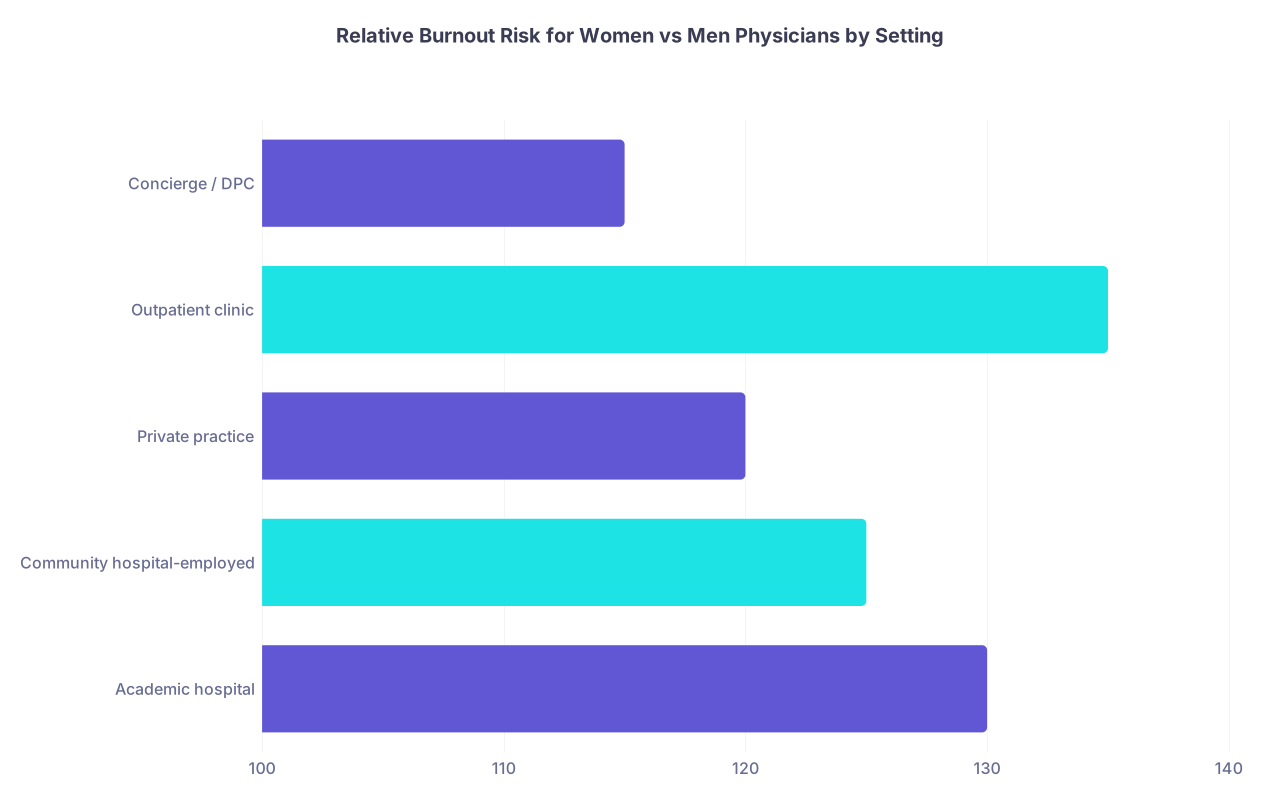
| Category | Value |
|---|---|
| Academic hospital | 130 |
| Community hospital-employed | 125 |
| Private practice | 120 |
| Outpatient clinic | 135 |
| Concierge / DPC | 115 |
(Values here are indexed so that men = 100. So “130” means women have 1.3x the odds of burnout compared with men in that setting.)
Academic medicine: prestige with a price
Academic centers like to market themselves as intellectually rich, mission‑driven environments. The burnout numbers for women faculty tell a harsher story:
- Burnout among women academic physicians: often 55–70%.
- Significant predictors:
- Clinical load that crowd out scholarly time.
- Lower rates of protected time and support staff relative to male peers.
- Invisible service (DEI work, committee work, mentoring) that rarely counts in promotion metrics.
- Slower promotion and pay inequity, even at equivalent RVUs and publications.
I have sat in faculty meetings where the only people volunteering for a “women in medicine” task force or wellness committee were women. Then those same women scored lower on productivity metrics used for promotion. The connection is not subtle.
Academic women also report more:
- Harassment and discrimination experiences.
- Role conflict between clinical, teaching, research, and family life.
All of this correlates strongly with burnout, and the modeling shows that even after controlling for hours, those structural factors matter.
Hospital-employed and shift-based work
Hospitalist, ED, ICU, and many surgical fields are now predominantly hospital-employed. The data for women physicians here show:
- High burnout (50–70%), slightly above men in the same roles.
- Disproportionate scheduling penalties:
- More night/weekend shifts, or less schedule flexibility, particularly early in career.
- More difficulty swapping shifts around pregnancy, lactation, and child-care constraints.
- Higher perceived lack of control over:
- Patient volumes.
- Length of shifts.
- Non-clinical documentation burden.
In Medscape and specialty-specific surveys, women in these settings are more likely to cite “lack of control over schedule” and “too many bureaucratic tasks” as top drivers of burnout.
Private practice and independent groups
This is the one area where burnout may be somewhat lower for women who have real ownership and control. Not because private practice is gentler—it is not—but because autonomy is a powerful buffer.
Patterns from practice-based research networks and MGMA data:
- Women in owner/partner positions with genuine schedule control report lower burnout than women who are employed under strict productivity contracts.
- However, many women in private practice are:
- Employees or junior partners.
- Bearing disproportionate non-billable work: patient communication, care coordination, and emotional labor.
So the spread is wide. A woman who co‑owns a small four-physician group, sets her own clinic days, and caps panel size may have 30–40% burnout. A woman in a high-RVU, low-support multispecialty group can easily land in the 60–70% range.
Outpatient clinic in large systems
Outpatient, especially primary care, is often pitched as “family-friendly.” The data say otherwise.
In large integrated systems:
- Women in primary care and outpatient subspecialties often report 55–70% burnout.
- They report:
- Higher inbox and messaging burden than male colleagues at similar panel sizes.
- More “relationship work”: complex psychosocial cases and longer visits.
- Higher rates of part-time FTE with unchanged documentation load (the 0.8 FTE with 1.1 FTE worth of portal messages).
Inbox analytics in some systems show that women clinicians receive more messages per patient than men. That is unpaid cognitive and emotional labor. And it tracks directly with burnout scores.
Concierge and Direct Primary Care (DPC): a partial escape hatch
Concierge and DPC models typically show significantly lower burnout across both genders, but the drop is particularly noticeable for women. Studies and surveys suggest:
- Burnout in concierge/DPC women physicians: around 30–45%.
- Key drivers:
- Smaller patient panels (often 400–800 vs 2000+ in traditional PCP roles).
- Much more control over schedule, visit length, and practice policies.
- Reduced or eliminated RVU pressure.
This does not magically erase gender inequities, but when you reduce volume and increase autonomy, the gender gap in burnout narrows somewhat.
Specialty overlays: where women are most at risk
Career stage and setting interact with specialty. Some specialties are simply more punishing environments, and for women inside them, the numbers often climb further.
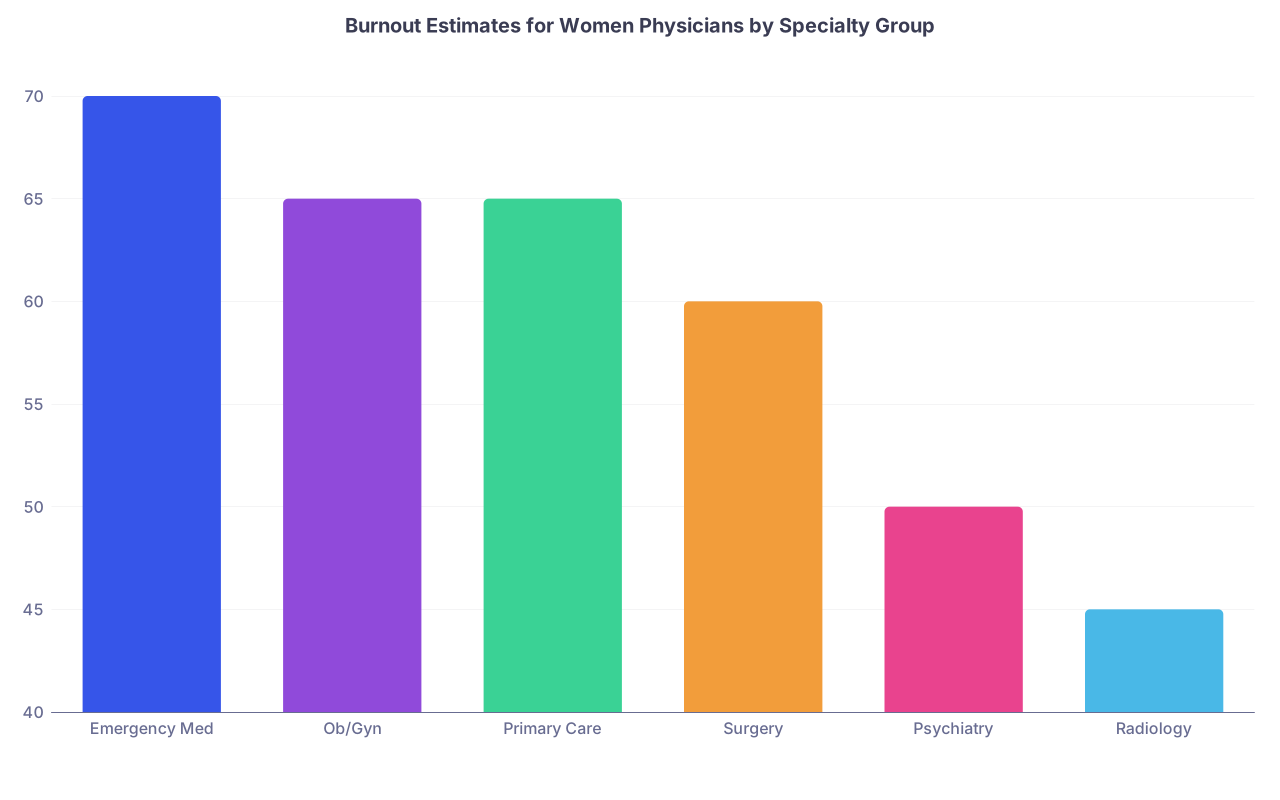
| Category | Value |
|---|---|
| Emergency Med | 70 |
| Ob/Gyn | 65 |
| Primary Care | 65 |
| Surgery | 60 |
| Psychiatry | 50 |
| Radiology | 45 |
Again, these are approximate, synthesized from Medscape, specialty societies, and large health-system surveys:
- Emergency Medicine: Women 65–75% burnout. High acuity, shift work, violence, and moral injury from access problems.
- Ob/Gyn: Women 60–70%. 24/7 call, malpractice climate, emotionally heavy work, gendered expectations around emotional labor.
- Primary Care (IM/FM/Peds): Women 60–70%. Panel overload, inbox burden, lower pay, complexity of psychosocial issues.
- Surgery (general and subspecialties): Women 55–65%. Harassment, culture issues, long hours, high stakes.
- Psychiatry: Women 45–55%. Slightly lower but still elevated, with emotional saturation and system-level access failures.
- Radiology/Pathology: Women 40–50%. Lower patient-facing stress but rising production pressure and isolation.
The theme is not “avoid high-risk specialties.” The theme is: if you are a woman in these fields, the data say your baseline burnout probability is high. You do not get bonus resilience points for pretending otherwise.
Consequences: why these numbers matter beyond wellness slogans
It is not enough to know that women physicians burn out more. The downstream impact is measurable and ugly.
Across multiple meta-analyses and large surveys, higher physician burnout correlates with:
- Increased medical errors and safety events.
- Lower patient satisfaction and adherence.
- Higher physician turnover and early retirement.
- Reduced clinical FTE over time (cutting sessions, going part-time).
- Higher rates of depression, substance use, and suicidal ideation.
And women physicians are already at higher baseline risk for:
- Depression and anxiety compared with male physicians.
- Suicidal ideation, with some data showing 1.5–2x higher risk compared with women in the general population.
Combine that with systematically higher burnout and you get a workforce stability problem, not just an individual wellness problem.
What actually moves the numbers? Data-backed levers
Most “wellness” programs do not touch burnout statistics in any meaningful way. Lunch yoga will not materially change a 65% burnout rate.
Changes that do show measurable impact in formal evaluations tend to be structural and control-focused, not “resilience training.”
Interventions with quantifiable effects in studies and health-system pilots include:
- Reducing patient panel size and inbox burden.
- Example: Decreasing panel size by 10–20% and adding team-based support cut burnout odds by 20–30% in multiple primary care pilots, with women benefiting the most due to higher baseline message load.
- Increasing schedule control and flexibility.
- Self-scheduling, shift bidding with guardrails, and predictable no-call days have lowered burnout scores in ED, hospitalist, and Ob/Gyn groups.
- Protected time with enforcement.
- Real, scheduled, non-clinical time for documentation, teaching, and admin decreases burnout more than “do it at home after clinic.”
- Transparent, structured promotion processes.
- In academic settings, explicit credit for teaching, mentoring, and committee work (often done disproportionately by women) narrows promotion gaps and reduces reported burnout.
- Childcare and leave policies.
- On-site or subsidized childcare, reasonable parental leave, and re-entry schedules correlate with lower burnout and lower attrition among early-career women.
The shared characteristics: they change the denominator of work and the control over it, not just the coping capacity.
How to read these statistics if you are a woman physician
You do not need another motivational poster. You need to see your risk profile clearly and then decide how much of that risk you are willing to tolerate.
From the data, a simple, pragmatic read:
- If you are a woman in residency or early career, especially in a high-intensity specialty or large system, your baseline burnout risk is easily >60%. That is not a moral failing; it is a structural exposure.
- Every lever that increases control (schedule, panel, setting, ownership) tends to bring that risk down.
- Every invisible, uncompensated task you shoulder—committee work, extra mentoring, emotional labor, inbox cleanup—pushes the risk up, especially if it is not tied to promotion or compensation.
The data are not telling you to quit medicine. They are telling you that ignoring the numbers is expensive.
Key points
- Across every career stage and practice setting, women physicians have higher burnout rates than men—commonly 10–20 percentage points higher, with peaks in residency and early to mid‑career.
- The gap is structural, not personal: it tracks with workload, control, discrimination, invisible labor, and misaligned incentives, and it is most pronounced in high-intensity settings like academic medicine, primary care, ED, Ob/Gyn, and hospital-employed roles.
- The only interventions that reliably move the statistics are structural—reduced load, increased autonomy, fair compensation and promotion for all work done, and real support for caregiving—not superficial wellness add‑ons.