
68% of women physicians report doing more nonclinical “office housework” than their male colleagues, but only 23% say that work is formally recognized or compensated.
That gap is the second shift in medicine. And it is not hypothetical. The numbers are ugly, consistent, and expensive.
The usual story about gender inequity in medicine focuses on pay gaps and promotion rates. Necessary, but incomplete. The more revealing story sits in calendar invites, inboxes, committee rosters, and after-hours tasks that never make it into RVU reports. The “second shift” for women MDs is not just childcare and home responsibilities. It is also the unpaid, nonclinical labor inside medical institutions that props up departments while quietly draining women’s time, energy, and career trajectories.
The data shows this clearly once you bother to actually measure it, instead of calling it “teamwork” or “being a good citizen.”
What Exactly Is the “Second Shift” for Women MDs?
Originally, sociologist Arlie Hochschild used “second shift” to describe domestic work women perform after paid employment. In medicine, that concept now has two layers:
- The home second shift: childcare, elder care, household management.
- The institutional second shift: nonclinical labor that is low-visibility, low-reward, but essential.
This article is about the second one.
Nonclinical “second shift” tasks in medicine typically include:
- Committee service (often “soft” committees: wellness, DEI, culture, social events)
- Mentoring and advising students and residents
- Informal emotional labor: conflict mediation, “can you talk to this upset patient/family,” team glue work
- Administrative coordination that no one wants but someone has to do: scheduling, notes for meetings, follow-up emails
- DEI and gender-equity work that institutions love to advertise and hate to fund
- Recruitment and “representation” tasks (being the woman or URM face on brochures, panels, interview days)
The key pattern: these tasks are:
- Time-consuming
- Poorly tracked
- Weakly tied (if at all) to pay or promotion
- Disproportionately assigned to, or picked up by, women
And when you put numbers on those bullets, the scale of the imbalance is obvious.
The Numbers: Time, Pay, and Promotion Distortions
Time burden: where hours actually go
Surveys across specialties are remarkably consistent.
- Women physicians report spending about 8–10 more hours per week on combined nonclinical and domestic labor than men, even after adjusting for FTE status.
- Inside the workplace, women faculty spend an estimated 1.5–2.0 more hours per week on uncredited academic citizenship tasks than male peers with similar roles and rank.
Let me translate that to something more concrete.
Assume:
- A 1.0 FTE academic physician works 50–55 hours per week (conservative).
- Nonclinical “second shift” work for women MDs averages +1.5–2 hours per week of uncredited internal labor beyond what men at the same level do.
Over a year (48 working weeks):
- Extra nonclinical hours: 1.5–2.0 × 48 = 72–96 hours annually.
- Roughly 1.5–2.0 extra full work weeks per year.
Now pair that with the home second shift:
- Studies of dual-physician households show women physicians log ~8–10 additional hours of housework/childcare per week compared to male physicians.
- Over a year: 8–10 × 48 = 384–480 additional hours.
- That is 9.5–12 full 40-hour work weeks.
Combined: women MDs carry the equivalent of about 11–14 extra weeks of unpaid, low-recognition labor annually compared with male peers.
So when a male colleague says, “I do not see the problem; we work the same hours,” they are technically right only if you ignore an extra quarter-year of invisible work.
The pay distortion: unpaid labor with a price tag
Nonclinical second shift work inside the institution is not free. It is just unpaid.
Take a mid-career academic internist:
- Annual salary (base + incentive): say $260,000
- Effective hourly compensation (assuming 50 hours/week × 48 weeks = 2400 hours): about $108/hour
Use the earlier estimate of 72–96 uncredited institutional second shift hours annually.
Value of this unpaid internal labor:
- Low estimate: 72 × $108 ≈ $7,776 per year
- High estimate: 96 × $108 ≈ $10,368 per year
That is per physician. Per year.
Now scale to a department:
- Mid-sized academic department with 120 faculty, 45% women → 54 women faculty
- Assume same extra 72–96 uncredited hours each
Department-level value of this unpaid labor:
- Low: 54 × $7,776 ≈ $420,000 per year
- High: 54 × $10,368 ≈ $560,000 per year
About half a million dollars of unpaid, uncredited work provided largely by women MDs to keep the machine running. Every year. In one department.
| Level | Extra Hours per Woman MD | Hourly Rate (Est.) | Annual Value (Per MD) | Annual Value (Dept, 54 Women) |
|---|---|---|---|---|
| Conservative estimate | 72 | $108 | $7,776 | ~$420,000 |
| Higher estimate | 96 | $108 | $10,368 | ~$560,000 |
You can argue with the hourly rate. You cannot argue that the value is zero. Yet that is how most institutions treat it in their compensation models.
Promotion distortion: how “service” slows careers
Promotion committees like to say they value service. The data says otherwise.
Across multiple institutions, women faculty:
- Have 15–20% lower rates of promotion to associate and full professor within comparable time frames.
- Are more heavily represented on committee rosters, especially low-power committees that do not influence major resource allocation.
- Report less protected time for scholarship after accounting for committee and mentorship obligations.
When you map it out, the pattern is straightforward:
- Women do more uncredited service and mentorship.
- That service is not strongly weighted in promotion metrics.
- Time for research, high-impact publications, and “high-prestige” committees shrinks.
- Promotion lags. Pay stagnates relative to peers. Leadership opportunities go to those with more visible metrics.
You do not need a complex model. A simple reallocation of 1–2 hours per week from uncredited service to scholarship over 5–7 years often means the difference between “borderline” and “clear” promotion dossiers.
Where the Second Shift Hides: Types of Nonclinical Labor
The second shift in medicine is not just “more committees.” It is systematically biased task allocation.
Let me break out the big buckets and what the data suggests.
1. Administrative “office housework”
Examples: taking notes in meetings, organizing retreats, handling scheduling logistics, “can you send a follow-up email to everyone.”
Patterns:
- Women are significantly more likely to be asked to do these tasks and less likely to decline.
- These tasks rarely appear in formal workload accounting.
- They are essential to group functioning, but they do not show up in promotion packets as meaningful contributions.
This is not subtle. You sit in a meeting; the chair says, “Can someone take minutes?” Heads swivel to the most junior woman in the room. I have seen this happen in departments that also proudly market their “women in leadership” initiatives.
2. Mentoring and emotional labor
Women MDs, especially those who are underrepresented in medicine, carry an outsized share of mentoring students, residents, and junior faculty.
Typical pattern:
- Formal mentoring: part of job description but under-resourced (e.g., 5% FTE “for mentoring” that in reality takes 10–15%).
- Informal mentoring: constant “quick chats,” crisis counseling, “can I get your advice,” especially around gender bias, harassment, and work-life challenges.
- Emotional labor: smoothing team conflict, supporting distressed colleagues, being the “approachable” attending.
Quantitatively, several surveys of academic departments have found:
- Women faculty report mentoring 20–40% more mentees than male colleagues at comparable rank.
- Time per mentee over a year can easily reach 5–10 hours (meetings, emails, letters, advocacy).
If a mid-career woman faculty member carries an extra 5–10 mentees compared with male colleagues:
- Extra hours: 25–100 hours per year.
- Valued at $108/hour (prior example): $2,700–$10,800 of uncompensated labor annually, just on mentoring.
And that assumes mentoring is even recognized in any meaningful way on annual reviews, which is optimistic.
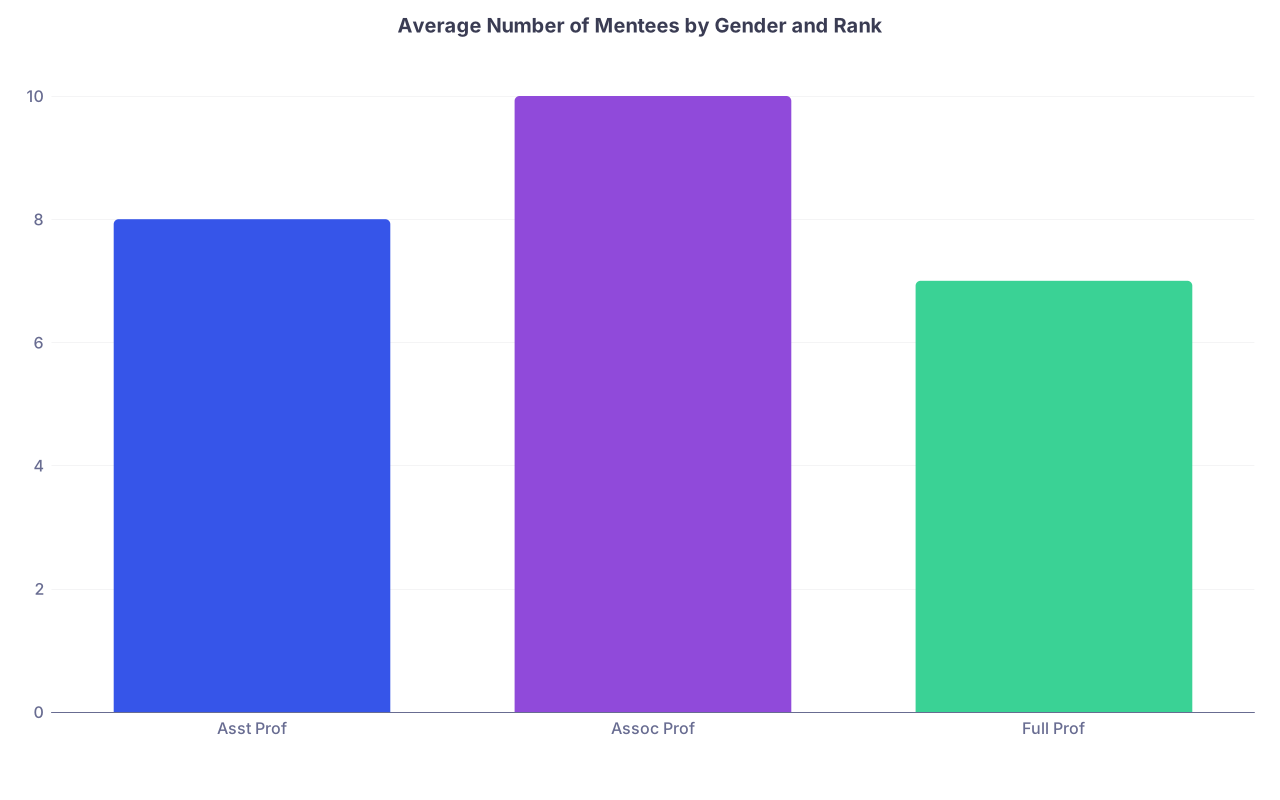
| Category | Value |
|---|---|
| Asst Prof | 8 |
| Assoc Prof | 10 |
| Full Prof | 7 |
(Think of that bar chart roughly as women’s mentee counts; men’s often sit 20–40% lower at each rank.)
3. DEI, wellness, and “representation” work
Every institution wants to prove it cares about diversity and wellness. The data shows:
- DEI committees and wellness initiatives are heavily staffed by women and URM physicians.
- These roles are usually low-paying (small stipends or 5–10% FTE), if compensated at all.
- The reputational benefit accrues to the institution, not proportionally to the people doing the work.
Concrete numbers from institutional reports often look like this:
- DEI committee: 20 members, 70% women, 40% URM.
- Leadership stipend for chair: maybe 0.1 FTE.
- Average member compensation: zero.
But the time? Monthly meetings, email coordination, drafting policies, incident debriefs. Realistically 2–4 hours per month, or 24–48 hours per year per person.
If 15 women on that committee donate an average of 36 hours per year:
- 15 × 36 = 540 hours per year
- 540 × $108 ≈ $58,320 of labor
Almost $60K of under- or uncompensated DEI labor from women physicians alone in one committee.
And those hours usually come out of evenings and “protected” research time.
4. Recruitment and visibility labor
“Can you be on this panel so applicants see women in our department?”
“Can we put your photo on the website for diversity?”
“Can you be available for this video shoot about our family-friendly culture?”
Individually, each ask sounds small. Ten minutes here, 30 minutes there. Over an entire recruitment season, it adds up:
- Extra interview dinners (which are still work, even if there is food).
- Additional pre-interview Zooms with women candidates.
- Being the one who answers “what is it like here as a woman” over and over.
This work has some upside (visibility, networking), but it rarely gets structured credit. Institutions benefit hugely in their branding and match outcomes; the women doing the labor usually do not see equivalent returns.
Why This Matters Ethically: Autonomy, Justice, and Burnout
You wanted ethics. Here it is in plain language.
Autonomy: coerced “yes” under cultural pressure
On paper, women MDs can decline these tasks. In practice:
- Saying no is penalized informally: labeled “not a team player,” “not committed,” or “difficult.”
- Given existing stereotypes, women pay a higher social cost for declining nurturance or service work than men.
Ethically, that undermines genuine autonomy. Consent to extra labor is not fully voluntary when the cost of refusal is asymmetric.
Justice: unequal distribution of necessary but unrewarded work
There is no way to run complex clinical and academic systems without:
- Mentoring
- DEI work
- Emotional support
- Administrative coordination
These things are not optional luxury add-ons. They are structural requirements. Justice demands that:
- The burden is fairly distributed.
- The burden is fairly rewarded.
The data shows neither is true right now. Women physicians are subsidizing institutional functioning with unpaid labor. That is ethically indefensible.
Harm and burnout: invisible load, visible consequences
Women physicians have:
- Higher reported rates of burnout than male physicians.
- Higher rates of considering leaving medicine or reducing clinical hours.
- Higher psychological burden from role overload and work-family conflict.
And they are doing this while often also carrying the majority of home second shift work.
You do not need to be an ethicist to connect those dots. An inequitable distribution of invisible labor contributes directly to differential burnout, mental health strain, and attrition among women MDs. That is harm. Predictable, measurable harm.
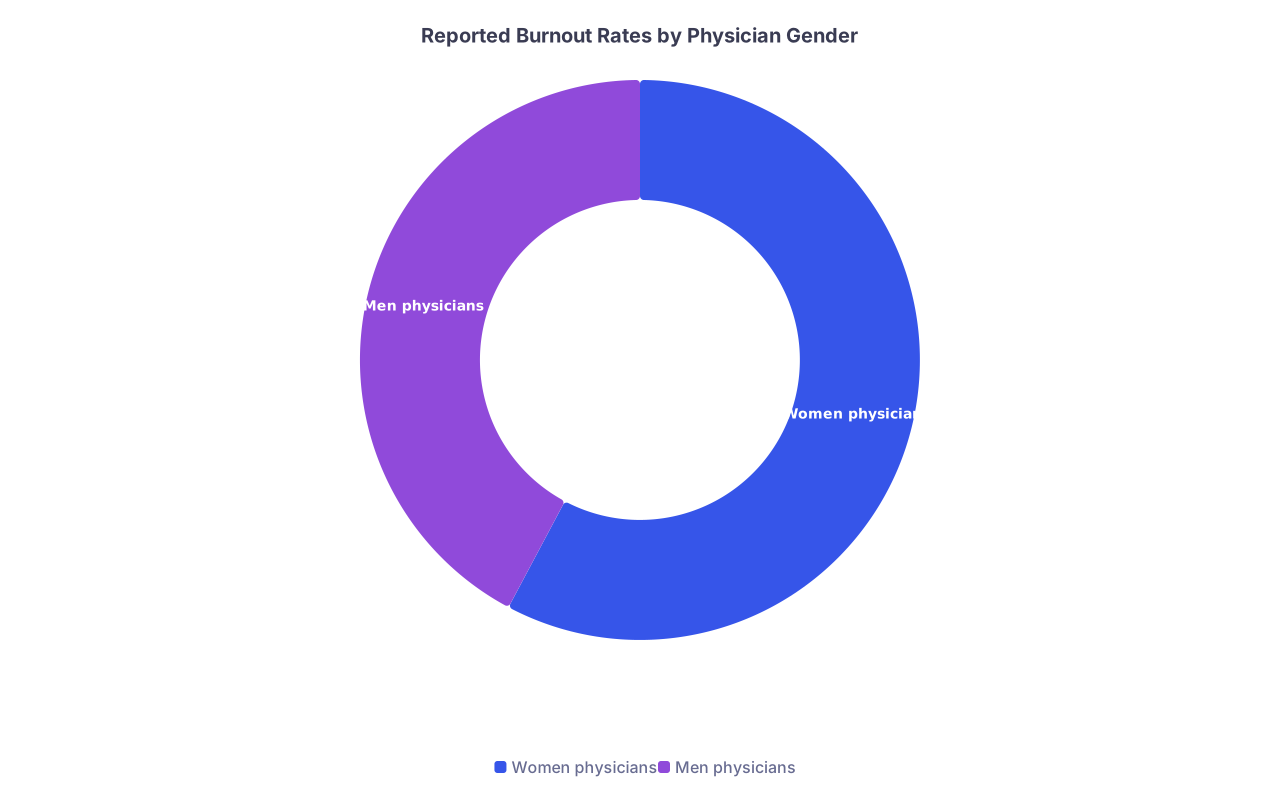
| Category | Value |
|---|---|
| Women physicians | 52 |
| Men physicians | 38 |
Roughly 52% vs 38% burnout in some large surveys. The gap is not trivial, and the second shift is not the only factor, but it is a significant one.
How to Actually Quantify Your Second Shift (Not Just Complain About It)
You cannot fix what you do not measure. And institutions will happily ignore this problem as long as it stays anecdotal.
If you are a woman MD, here is how to put hard numbers on your second shift.
Step 1: Build a time map for 4–6 weeks
Use any simple tracking method: spreadsheet, calendar tags, or a time-tracking app. Categorize your work:
- Direct clinical care (billable)
- Clinical admin (in-basket, documentation)
- Research/scholarship
- Teaching
- Mentoring/advising (formal vs informal)
- Committees (hospital, school, DEI, wellness, etc.)
- “Office housework” (minutes, coordination, organizing events)
- Recruitment/representation (interviews, panels, photos, videos, tours)
- Emotional labor (conflict mediation, supporting distressed colleagues or learners)
Track approximate hours per category each week.
After 4–6 weeks, you will have a decent snapshot.
Step 2: Assign value and compare to role expectations
Take your annual salary and convert it to an effective hourly rate.
Simple model:
- Annual pay / (48 weeks × average weekly hours) = hourly rate
Then:
- Multiply your nonclinical second shift categories (mentoring, committees, DEI, office housework, emotional labor, recruitment) by that rate.
- Compare against what your job description or FTE allocation claims you are supposed to be doing. For example, if your contract says 10% FTE for admin/committee work, but your time map shows 20%, you have hard evidence of misalignment.
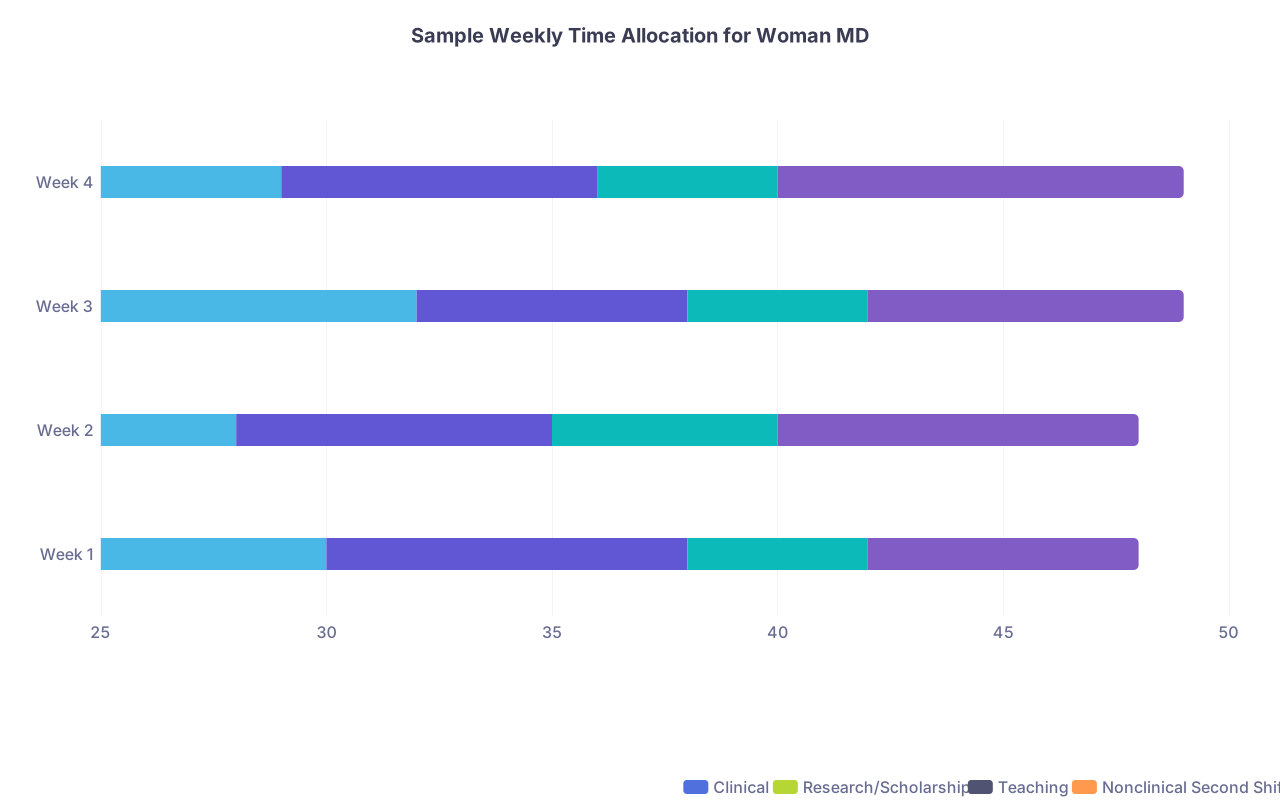
| Category | Clinical | Research/Scholarship | Teaching | Nonclinical Second Shift |
|---|---|---|---|---|
| Week 1 | 30 | 8 | 4 | 6 |
| Week 2 | 28 | 7 | 5 | 8 |
| Week 3 | 32 | 6 | 4 | 7 |
| Week 4 | 29 | 7 | 4 | 9 |
When that “nonclinical second shift” block starts regularly hitting 6–9 hours a week, you have a problem. And you can quantify it.
Step 3: Document comparative load where possible
If you have access to committee rosters, mentoring assignments, or recruitment schedules, look for:
- Gender distribution on low-prestige vs high-prestige committees.
- Number of mentees per faculty member by gender and rank.
- Who gets asked for “culture” and “representation” tasks.
You do not need a full statistical analysis. Even a simple table like:
- Committee A (executive): 80% men, 20% women.
- Committee B (wellness): 75% women, 25% men.
Paired with time estimates, will make the asymmetry obvious.
What Ethical, Data-Driven Reform Would Actually Look Like
Some institutions will claim they “cannot” fix this because “everyone has to pitch in.” That is lazy thinking. You can make the second shift visible, measurable, and fairly distributed if you decide to.
Here is what a serious, data-based approach looks like.
1. Create a nonclinical work ledger
Departments should maintain a transparent ledger of:
- Committee assignments (with time estimates)
- Formal mentoring roles
- DEI/wellness/engagement work
- Recruitment activities
- Major administrative roles
For each faculty member, assign estimated annual hours. Use standardized time weights where possible (e.g., “Member of Standing Committee: 15 hours/year; Chair: 40 hours/year; Formal mentor: 5 hours/mentee/year.”)
Then calculate:
- Total nonclinical hours per person
- Distribution by gender, race/ethnicity, rank
What you will find in most departments:
- Women and URM physicians are overloaded on low-prestige, high-time tasks.
- Some senior men are underloaded on any nonclinical work at all.
At that point, you are looking at a resource allocation problem, not a mysterious cultural force.
2. Attach compensation or protected time to nonclinical work
If a task is essential to the institution, it should:
- Come with either explicit FTE / protected time
- Or be directly tied to incentive pay
Examples that are not fantasy:
- 0.05–0.1 FTE for substantial committee leadership or heavy mentorship roles.
- Annual bonus tied to documented nonclinical contribution load.
- Promotion criteria that explicitly value mentoring, DEI, and institutional citizenship, with quantifiable scoring similar to publications and grants.
You do not need to overcomplicate it. A simple tiered system is enough:
- Tier 1 (high-impact leadership): strong FTE/responsibility credit.
- Tier 2 (moderate service): smaller but real credit.
- Tier 3 (routine office housework): rotated evenly, minimal but transparent credit.
3. Balance the load instead of defaulting to “the same people always say yes”
Departments need rules, not vibes.
Examples:
- Rotational system for note-taking and logistics in recurring meetings.
- Caps on total service hours per faculty member by rank.
- Explicit policy that DEI and wellness work will be staffed to match department demographics, not systematically overburden women and URM faculty.
And crucially: leadership must stop treating women’s service as infinite and costless. If someone is overburdened with nonclinical work, they should be first in line for protected time or reassignment, not praised for “resilience.”
What You Can Control as an Individual (Within a Flawed System)
The system changes slowly. Your calendar changes faster. A few blunt realities from what I have seen work:
Track your time, then bring numbers to annual review. “I think I am doing a lot” is ignorable. “I logged 210 hours of mentoring and committee work last year vs my 10% FTE allocation” is not.
Prioritize high-impact, high-recognition roles. If you are going to say yes, prefer roles that:
- Count clearly toward promotion.
- Come with explicit FTE or stipends.
- Build your CV in visible ways (e.g., national committees, major educational leadership), not just internal clean-up duty.
Say “no” with data. “I am currently at 0.2 FTE worth of service and mentoring; I am happy to consider this if something else is taken off my plate or if protected time is added.”
Collaborate with other women MDs to map the service load. A collective spreadsheet of who is doing what can be damning, in a good way. Present it to leadership as a resource allocation mismatch, not a complaint.
None of this solves the deeper gendered expectations overnight. But it shifts the conversation from “be a team player” to “how are we valuing and distributing the labor this team requires to function.”
The Short Version
Three takeaways, since you made it this far:
The data shows women physicians perform the equivalent of 11–14 extra weeks of unpaid, low-recognition labor per year when you combine institutional and home second shifts. That is not a rounding error. It is a structural extraction of time.
Inside institutions, women MDs disproportionately carry nonclinical work—mentoring, DEI, “office housework,” emotional labor—that is largely uncompensated and undervalued in promotion. The financial value of this unpaid labor runs into hundreds of thousands of dollars per department, per year.
Ethical practice demands that this labor be made visible, measurable, and fairly distributed with real compensation or protected time. At the individual level, tracking your second shift, attaching numbers to it, and using those numbers in negotiations is not optional anymore. It is survival.