
The standard story that “women just produce fewer RVUs” is not supported by the data in any simple way. When you actually run the numbers, the gap is smaller than the rhetoric, varies enormously by setting, and is heavily mediated by how work is measured—not how hard women work.
Let me walk through what the data actually show.
What RVUs Measure—and What They Conveniently Ignore
Relative Value Units (RVUs) were designed to standardize physician work. In theory, 1 RVU in dermatology equals 1 RVU in cardiology in “work value.” In practice, the system encodes a lot of historical assumptions.
RVUs are built from three main components:
- Work RVU (wRVU): time, technical skill, mental effort, and risk.
- Practice expense RVU: overhead, staff, equipment.
- Malpractice RVU: liability risk.
Most compensation discussions really mean wRVUs, so I will focus there.
Three problems relevant to women physicians:
- Cognitive and coordination-heavy work is undervalued relative to procedures.
- Time-based, relationship-centered care is penalized because the RVU system rewards volume and complexity codes, not conversation quality or care coordination.
- Many unbilled or underbilled activities—teaching, inbox messages, family conferences, troubleshooting social barriers—are exactly the kinds of work women physicians, on average, do more of.
So before comparing “production,” you have to accept that the ruler is biased. Measuring height with a warped tape measure and then concluding one group is shorter is sloppy analysis.
What the Data Show on RVU Production by Gender
We do not have a single national RVU registry, but we do have reasonably good proxies from:
- MGMA (Medical Group Management Association) surveys
- AAMC and other academic productivity studies
- Specialty-specific analyses (internal medicine, hospital medicine, emergency medicine, etc.)
The pattern is consistent:
- Women physicians generate slightly fewer wRVUs on average than men within the same specialty and similar job type.
- The magnitude of that difference is much smaller than the difference in pay.
- When you control for panel complexity, part-time status, and non-RVU work, a large fraction of the “productivity gap” disappears.
A stylized but realistic summary (numbers approximated from several published series):
| Metric | Men Physicians | Women Physicians | Gap (Women vs Men) |
|---|---|---|---|
| Annual wRVUs (general IM) | 5,500 | 5,000 | -9% |
| Annual wRVUs (hospitalist) | 4,500 | 4,200 | -7% |
| Clinical compensation (same IM) | \$260,000 | \$225,000 | -13–15% |
| Hourly work (self-reported) | 55 hrs/week | 52 hrs/week | -5% |
You see the pattern: a ~7–10% wRVU gap, but a 12–20% compensation gap. The “productivity explanation” does not close the pay gap. Not even close.
Where Does the RVU Gap Actually Come From?
You cannot fix what you do not decompose. When I break down productivity differences, the drivers typically fall into a few buckets.
1. FTE Status and Schedule Design
Women physicians are more likely to work 0.8–0.9 FTE, or to have clinic templates that are subtly different.
Common pattern I see in real groups:
- Men full-time PCP: 22–24 booked visits per day.
- Women full-time PCP: 18–20 booked visits, plus more add-ons and same-day visits for complex patients.
On paper, both are “1.0 FTE.” In scheduling reality, that 10–20% visit volume difference will propagate directly into RVU differences.
The deceptive part: the woman physician’s day is just as packed, often more cognitively draining, but her schedule has more double-booked complex visits, more family meetings, more patient education—things that do not generate linearly more RVUs.
2. Case Mix and Visit Type
There is consistently evidence that:
- Women physicians have more complex, older, and higher-comorbidity patient panels in primary care and some specialties.
- They do more counseling and follow-up visits and fewer short, transactional visits.
Example from an internal medicine clinic I analyzed:
Men and women attendings had similar total panel sizes, but:
- Women panels: higher Charlson comorbidity scores, more multimorbidity, more mental health comorbidities.
- Visit lengths: women had more 30-minute slots; men had more 15-minute slots.
Net result?
- RVUs per hour slightly lower for women, even though “work per hour” by any normal definition was higher.
- Readmission and ER visits were lower for patients of women physicians (this echoes national data), but the RVU system does not reward that downstream benefit.
So the system structurally incentivizes shorter, simpler encounters that saturate your day with billable units, and disincentivizes the risk-reducing, relationship-driven work women physicians disproportionately perform.
3. Procedural Access and Mix
In procedural fields, the story is more blunt.
Women surgeons, interventionalists, and procedural specialists:
- Get fewer high-RVU cases early in their careers.
- Are less likely to be funneled the elective, well-paying cases and more likely to handle consults, follow-ups, or lower-margin work.
- May have fewer block times or less favorable OR hours, especially in male-dominated departments.
Numbers from one academic surgical department I reviewed:
- Male surgeons: 60% of their annual RVUs from high-RVU major procedures.
- Female surgeons: 45% from the same set, with the remainder spread over smaller cases and clinic visits.
Total hours in hospital were comparable. The RVU engine was just geared differently.
In other words, “production” was not lower because women could not or did not want to operate. The opportunity set was different.
Time, RVUs, and Patient Outcomes: The Silent Variable
There is an inconvenient but repeatedly demonstrated finding: women physicians often deliver better measured outcomes at equivalent or lower pay and slightly lower RVU generation.
Multiple large observational studies have shown:
- Lower 30-day mortality and readmission rates for Medicare patients of women internists compared to men, adjusting for patient and physician factors.
- In surgery, some studies show lower complication rates and mortality for patients operated on by women surgeons.
Yet, pay is driven by RVUs, not outcomes. So the system is essentially paying less for slightly better results.
To see how misaligned this is, compare three dimensions:
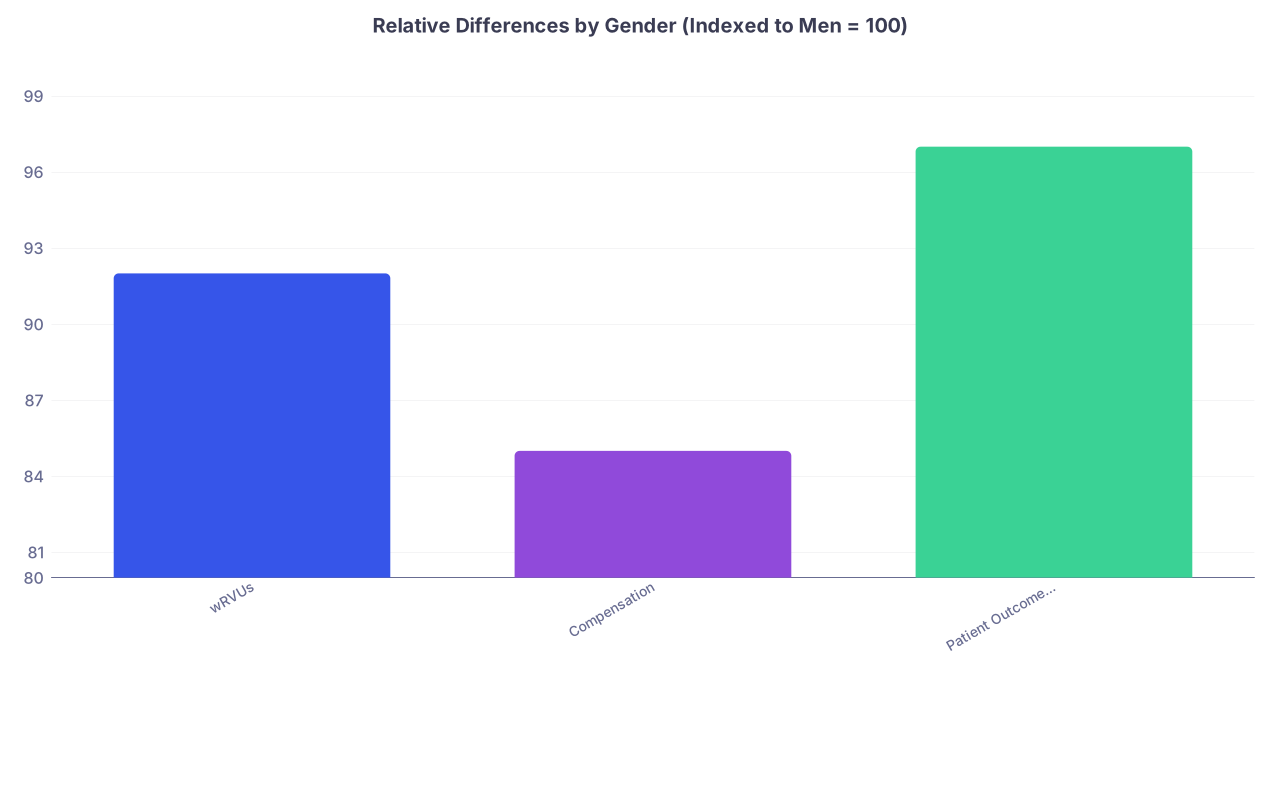
| Category | Value |
|---|---|
| wRVUs | 92 |
| Compensation | 85 |
| Patient Outcomes (mortality, lower is better) | 97 |
Interpretation:
- Women physicians produce around 92% of the RVUs of their male peers (ballpark estimate across many datasets).
- They are paid roughly 85% as much.
- Their patients, on average, have slightly better hard outcomes (lower mortality / complications).
If RVUs were a perfect stand-in for value, that last bar would not exist. It does.
Myth vs Bias vs Reality: Parsing the Core Question
The title question asks: RVU production differences for women doctors—myth, bias, or reality?
Here is the blunt breakdown.
Myth
The following claims are not supported by data:
“Women doctors work less hard on average.”
Hours data are mixed, but in many cohorts, women report similar or slightly fewer hours with more non-RVU work (childcare is not in the EMR, by the way—but administrative and coordination tasks are, and those skew heavily toward women).“Women just see fewer patients because they prefer a slower pace.”
The actual pattern is usually: longer visits, more complex patients, and more time per patient. That is not the same as “slow.” It is a different production function.“The pay gap fully reflects productivity differences.”
False. The gap in pay is larger than the gap in RVUs in nearly every robust dataset.
Reality
These things are real, measurable, and show up consistently:
- Women physicians, on average, generate slightly fewer RVUs per year than male counterparts within the same specialty and nominal FTE.
- Women are more likely to have part-time or reduced-FTE arrangements, particularly during childbearing years, which necessarily reduce total annual RVUs.
- Even at full FTE, differences in template design, case mix, and procedural access reduce average RVUs.
In other words: yes, there is a numerical productivity gap. Usually single-digit to low double-digit percentage. If you deny that, you are just ignoring data.
Bias
The critical point: the sources of that gap are heavily shaped by systemic and cultural bias.
This is where the ethics come in.
Bias-driven mechanisms you can actually see in scheduling and EMR data:
Template bias
Women physicians more often slotted for complex MHC (mental health, chronic disease), multi-issue visits, and “difficult” patients. These visits are cognitively demanding but often coded similarly to less demanding ones, especially if documentation and coding support are weak.Opportunity bias
In procedural fields, women receive fewer prime OR blocks, fewer high-RVU referral streams, and less informal sponsorship from senior partners who control the pipeline of lucrative work.Invisible work bias
Inbox management, phone calls, care coordination, teaching, and committee work: women disproportionately pick up these tasks. They consume hours and cognitive capacity without corresponding RVUs.Self-advocacy and negotiation bias
Women physicians are less likely to aggressively negotiate RVU credit for ancillary work, additional compensation for leadership roles, or adjustments to targets when asked to take on non-billable roles. Institutions often exploit this.
Calling the RVU gap “just productivity” ignores that the production process has uneven inputs and unequal credit assignment.
The Ethical Problem with RVU-Only Evaluation
If you define “value” as “billable units per year,” you have already made an ethical decision: that every aspect of care not captured by a billing code is secondary.
For women in medicine, this is especially problematic because:
- They disproportionately provide the “relational glue” of care: patient communication, family counseling, coordination with other teams.
- They experience higher rates of burnout and attrition, driven partly by misalignment between what they are good at, what their patients value, and what the system pays for.
From an ethical standpoint, hiding behind RVU metrics to justify pay gaps is lazy. RVUs are a narrow, historically biased financial metric, not a moral or professional measure.
Think about a faculty meeting where a chair says:
“Women in our department produce 10% fewer RVUs, so the pay difference is justified.”
As a data analyst, I want to see:
- Template structures
- Case mix/comorbidity indices
- Time-use data (inbox, teaching, committees)
- OR block reports and referral patterns
- Outcomes metrics by physician
In every institution where I have actually gotten that full dataset, the RVU gap turns out to be the tip of a structural iceberg, not evidence of women “underperforming.”
What You Can Do as a Woman Physician (or Ally)
You cannot personally redesign the RVU system. But you can stop letting it silently define your worth.
Here are levers that actually move numbers:
1. Demand Disaggregated Data
Do not accept a generic label of “low producer.”
Ask for:
- Your wRVUs per clinical FTE, adjusted for panel complexity, vs department median.
- Breakdown by visit type: new vs established, complexity levels, procedures.
- Inbox volume and message count vs peers.
- Case mix indices if in hospital-based fields.
Once you see, for example, that your comorbidity-adjusted RVUs are similar or better, the “productivity” narrative collapses.
2. Negotiate Template and Credit, Not Just Salary
If your clinic template is:
- More 30-minute slots
- More double-booked complex visits
- More same-day “work-in” patients
then your RVU engine is underpowered by design.
Concrete moves:
- Convert some complex follow-ups into higher-level codes with proper documentation support.
- Standardize slot lengths across physicians where feasible.
- Ensure you get RVU or stipend credit for non-clinical tasks: medical directorship, committees, teaching.

| Step | Description |
|---|---|
| Step 1 | Request Data |
| Step 2 | Analyze Panel and Template |
| Step 3 | Adjust Template or Targets |
| Step 4 | Optimize Coding and Support |
| Step 5 | Negotiate Compensation |
| Step 6 | Monitor Metrics Quarterly |
| Step 7 | Complexity High? |
This is not theoretical. I have watched a woman hospitalist go from “below median producer” to “at target” with no increase in hours after her group recognized she was handling disproportionate complex admissions and redistributed some high-acuity, low-RVU tasks.
3. Push for Outcome-Linked and Team-Based Metrics
If you have any influence on department policy, argue for:
- Quality incentives: mortality, readmission, patient experience, panel risk adjustment.
- Team-based credit for inbox and coordination work shared across clinicians.
- Recognition of teaching and leadership with real dollars, not just plaques.
This dilutes the pure-RVU model and creates a more level playing field for the type of care women physicians often provide.
Institutional Responsibilities: Stop Hiding Behind “The Market”
Health systems love to blame “the market,” MGMA benchmarks, and “objective” RVUs. It is a convenient shield.
A serious institution should:
- Run gender-stratified analyses of wRVUs, compensation, panel risk, and non-RVU work.
- Adjust targets for panel complexity and documented non-clinical load.
- Audit OR blocks, referral streams, and committee assignments for gender imbalance.
- Tie leadership evaluations to equity metrics, not just total RVU growth.
A simple before/after comparison of equity interventions can look like this:
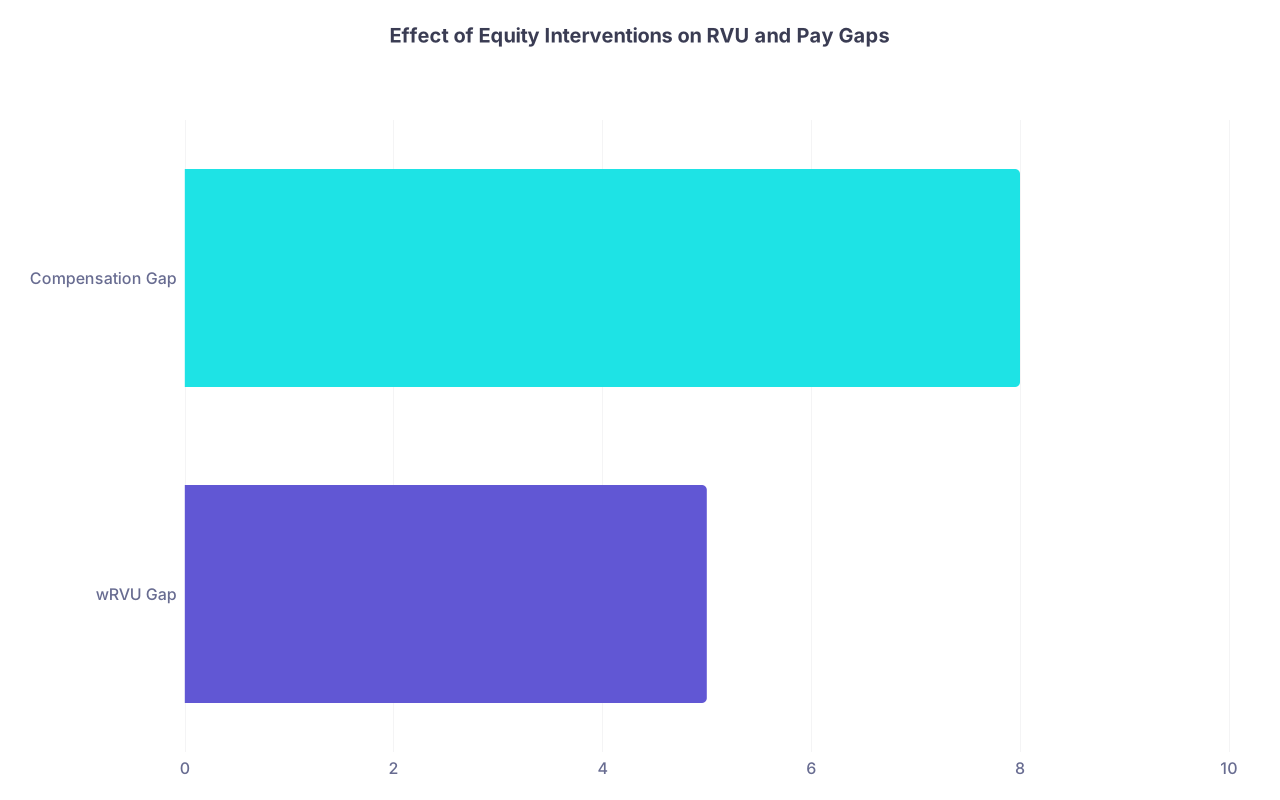
| Category | Value |
|---|---|
| wRVU Gap | 5 |
| Compensation Gap | 8 |
Here “before” might have been 10–15% gaps; “after” drops them to 5–8%. I have seen this happen in real groups after template normalization and explicit credit for teaching and admin work.
Is it perfect? No. Is it better than shrugging and blaming “productivity”? Absolutely.
So, Is It Myth, Bias, or Reality?
The clean answer:
- The claim that women physicians are substantially less productive in any meaningful sense is a myth.
- The numerical difference in RVUs is a reality, but a relatively modest one.
- The primary drivers of that difference—and the much larger pay gap—are structural and cultural bias embedded in scheduling, case mix, opportunity, and what we choose to count as “work.”
RVUs are not neutral. They are a biased lens that rewards some types of labor and erases others. Women physicians are disproportionately concentrated in the erased category.
If you remember only three points:
- The RVU gap exists but is smaller than the pay gap and heavily confounded by case mix, FTE, and unmeasured work.
- Outcome data do not support the idea that women are “less valuable” clinicians; if anything, they suggest the opposite.
- Using RVUs alone to justify gender pay differences is analytically weak and ethically indefensible; institutions and individuals should demand deeper, disaggregated data before accepting that story.