
The dirty secret is this: female attendings are evaluated on “likeability” more than almost anything else—far more than their male colleagues—and almost no one will admit it out loud.
You feel it every day, but you probably think it’s “just you.” It’s not. It’s structural, it’s cultural, and it’s absolutely baked into how your department talks about you behind closed doors.
Let me tell you what actually happens in those rooms you’re not in.
What “Likeability” Really Means For Female Attendings
Here’s the first thing to understand: when faculty, chiefs, or residents say a male attending is “great,” they usually mean competent, protective, and effective.
When they say a female attending is “great,” they usually mean easy to be around, not too demanding, and emotionally convenient.
Same word. Different criteria.
In promotions meetings, residency eval committees, and those “informal” hallway huddles that actually drive decisions, this is how it sounds:
- “Residents love working with him, he’s so chill.”
- “She’s very smart, but she’s… intense.”
- “He can be a little abrupt, but he gets the job done.”
- “She’s abrasive. People are scared to approach her.”
Exact same behaviors. Very different interpretations.
A male attending who’s direct = decisive.
A female attending who’s direct = difficult.
I have literally heard: “He’s earned the right to be tough.” And in the same breath about a woman: “She doesn’t have the emotional intelligence for leadership.”
That’s the game you’re actually playing.
The Double Bind: Competent vs. Likeable
At most academic centers, senior leadership will stand up in grand rounds and say all the right things about diversity, equity, inclusion. Then they walk back to the conference room where the promotions and leadership decisions are actually made… and fall right back into old patterns.
There’s a well-known double bind for women in leadership:
If you’re warm, you’re seen as likeable but less competent.
If you’re assertive, you’re seen as competent but less likeable.
Male attendings are allowed to occupy “leader” without penalty. Female attendings are constantly asked, consciously or not, “Does she make us feel good while doing it?”
Here’s how it shows up in real scenarios:
In an M&M where you hold a resident accountable:
A male attending: “He’s setting high standards. Residents need that.”
A female attending: “She humiliated him. That’s not supportive.”In the OR when you stop a case to correct a safety issue:
A male attending: “He doesn’t tolerate sloppiness. Good.”
A female attending: “She overreacted. The vibe completely changed.”In feedback to residents:
A male attending writing: “Needs improvement in time management” is seen as honest and fair.
A female attending writing the exact same thing is flagged as “too harsh” and “not resident friendly.”
Same language. Different narrative around who’s “likeable.”
And remember—most evaluation systems are still heavily narrative-based. Those little adjectives and “vibes” inside comments? They shape your entire professional reputation.
How This Shows Up in Evaluations and Promotions
You want to know where this really bites? Faculty evaluations and promotions committees.
Let me give you some actual patterns I’ve seen when reviewing faculty portfolios and sitting in those rooms at big-name places—think UCSF, Northwestern, Emory, community programs too. The bias is not unique to any one institution.
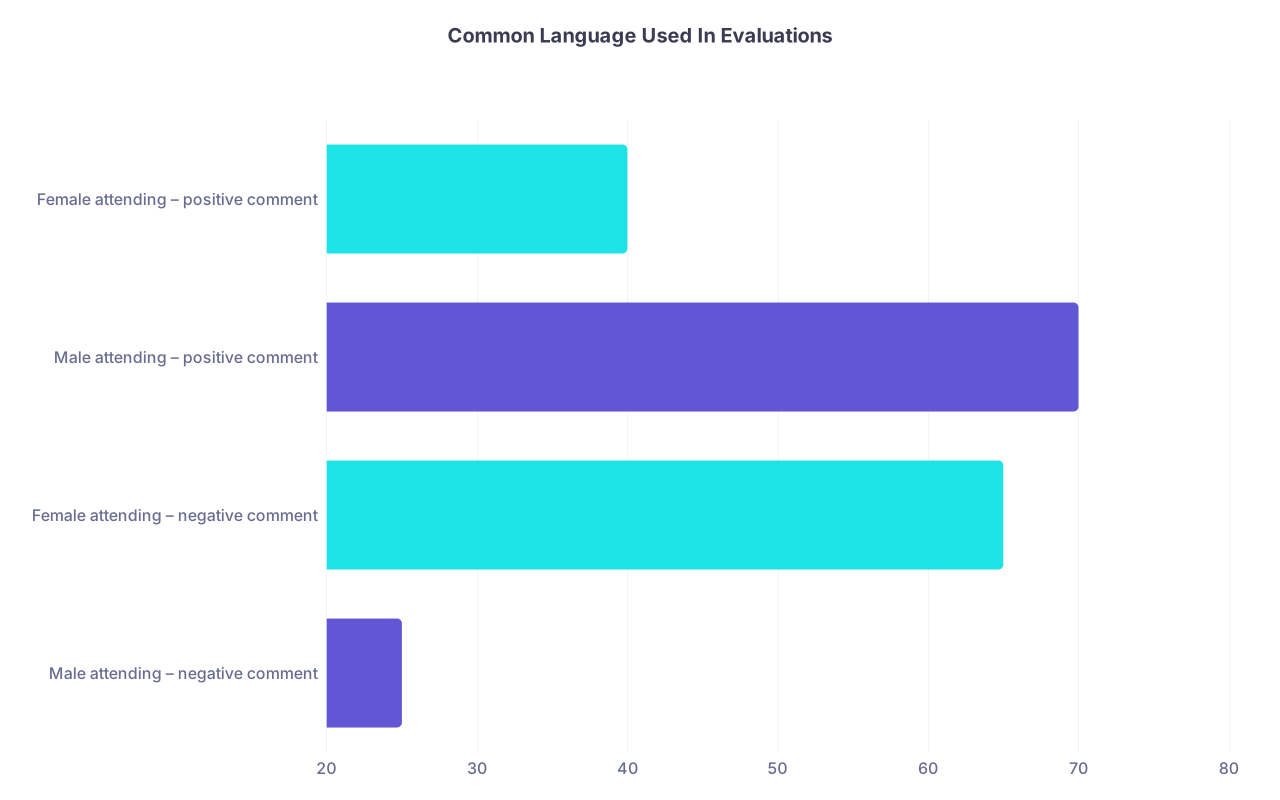
| Category | Value |
|---|---|
| Male attending – negative comment | 25 |
| Female attending – negative comment | 65 |
| Male attending – positive comment | 70 |
| Female attending – positive comment | 40 |
What this kind of distribution usually looks like in real life:
For men, negative comments focus on skills or specific incidents:
“Occasionally late with documentation.”
“Could improve clarity of instructions in the OR.”
For women, negative comments center on personality and interpersonal tone:
“Hard to approach when busy.”
“Can come off as frustrated.”
“Sometimes makes the team feel uncomfortable with her expectations.”
And promotions? The conversation shifts from “What has he accomplished?” to “How do people feel about her?”
I’ve heard lines like:
- “Residents say they’re afraid to disappoint her.”
- “She’s very driven. I’m not sure she’ll be supported in a bigger leadership role.”
- “We’ve received ‘some feedback’ about her tone in high-stress situations.”
“Some feedback” almost always means one or two emotionally loaded complaints that carry way more weight than the countless times she quietly did the right thing under pressure.
Male attendings get promoted for outputs and CV lines. Female attendings are filtered through this invisible “likeability tax”—they must have the CV, the teaching scores, the patient satisfaction, and they must maintain the right emotional climate while doing it.
You are not imagining the moving goalposts. They are real.
Residents, Students, and the “Vibe Economy”
The hidden drivers are residents and students, but not in the way you think.
Their formal evaluations have power, yes. But what really sticks is their informal chatter. Group texts. Late-night venting after call. Those hallway “Who are your favorite attendings?” conversations that seem harmless.
They’re not harmless. They’re political.
Walk into any resident workroom and you’ll hear some version of:
- “She’s good but so intense. I’m nervous when I’m on with her.”
- “He pushes us hard, but he’s hilarious, so it’s fine.”
- “She’s scary.”
- “He’s a shark, but he’s on our side.”
The emotional bandwidth residents expect from female attendings is absurd. You’re supposed to be:
- Warm but not “soft”
- Clear but not “sharp”
- High standards but low tension
- Confident but perpetually open to feedback
- Supportive but never visibly tired, annoyed, or human
Male attendings can have a “bad day” and everyone shrugs: “He’s just like that sometimes.”
Female attendings have one tense encounter, and suddenly: “There’s a pattern.”
The “vibe economy” of residency—who’s “chill,” who’s “scary,” who’s “safe”—feeds directly into how you’re talked about in leadership meetings.
I’ve literally watched a chief resident’s one-line comment—“Residents are sometimes anxious working with her”—reshape how an entire committee thinks about a female attending they barely know.
That same anxiousness with a male attending gets twisted into: “He commands respect.”
The Tightrope of Teaching and Feedback
Here’s where it becomes an ethical landmine: teaching and patient safety.
To teach well, you have to give honest, sometimes uncomfortable feedback. You have to stop someone mid-procedure. You have to say, “That’s not acceptable,” or “You’re not ready to do that yet.”
Male attendings get to do this with far fewer consequences. Their corrections are framed as “mentorship.”
Female attendings’ corrections are often framed as “attacks” or “humiliating.”
So what happens? Many women pull their punches. Not because they don’t care about standards, but because they’re sick of the fallout. The complaints. The whispered “She’s so mean.”
You see this in subtle, damaging shifts:
- A female attending who used to correct technique at the bedside now “waits for a better moment” and lets small errors slide.
- She writes more vaguely positive evals than she believes, to avoid being tagged as “unsupportive.”
- She stops volunteering for remediation plans because those learners are the ones most likely to complain when held to basic expectations.
There’s a moral tension you can feel in your bones: you know what excellent patient care demands, and you know what your environment punishes.
That is the ethical cost of the likeability standard.
The Politics of “Leadership Potential”
When people talk about “leadership potential” in meetings, they rarely mean what they say.
For men, “leadership potential” usually means: he’s ambitious, visible, maybe rough around the edges, but we see ourselves in him.
For women, “leadership potential” morphs into: will she make everyone comfortable while doing more work than she’s credited for?
I’ve watched search committees do this dance in real time:
A male candidate for division chief:
- “He’s tough, but this division needs a shakeup.”
- “He’ll step on some toes, but change is hard.”
- “We can coach him on communication.”
A female candidate with the same profile:
- “She’s rubbed some people the wrong way in the past.”
- “We don’t want to lose good people if she pushes too hard.”
- “I’m not sure she has the soft skills for this role.”
Exact same behaviors. His rough edges become a leadership asset. Her rough edges are a risk.
You’re not just being judged on what you do. You’re being judged on whether your strength makes others slightly uncomfortable.
And that’s what “likeability” really comes down to for female attendings: the degree to which your leadership does not disturb anyone’s emotional comfort—even when that comfort protects dysfunction.
Strategies That Actually Work (Without Selling Your Soul)
I’m not going to tell you to “smile more” or “phrase everything as a suggestion.” That’s how you burn out and start resenting everyone.
You’re not going to out-people-please a rigged system.
But there are ways smart women manage this landscape without becoming a caricature of “nice.”
1. Separate warmth from softness
You can be warm without lowering your standards.
What this looks like in practice:
- Start interactions with clear, neutral connection: “Okay, walk me through your plan.”
- Use calm, descriptive language rather than value-laden language: “This dose is too high for this patient” instead of “This is wrong.”
- Pair correction with a path forward: “Right now, I’m not comfortable with you doing this unsupervised. Here’s what I want to see over the next two weeks.”
You’re not cushioning the truth. You’re packaging it in a way that’s hard to spin as “cruel.”
2. Control the written record
Do not underestimate how much narrative comments shape your reputation.
You can’t control what others write about you, but you can:
- Use consistent, professional language in your own evals. When the resident who’s furious with you writes a scathing narrative, the GME office will see your measured, specific, behavior-focused feedback next to it and clock the difference.
- Document difficult encounters in real time in email to yourself or a neutral party. Not drama—facts. Dates, times, what was said, what you did. When that “she’s mean” complaint shows up six months later, you’re not scrambling.
Over time, patterns matter. You want your pattern to be: calm, specific, fair, and relentlessly patient-focused.
3. Build quiet alliances early
The programs where female attendings survive and thrive have one common feature: they’re not alone.
That doesn’t mean you need a sisterhood of ten senior women. Sometimes you just need two or three people who see clearly.
This is what actually helps:
- A program director who will say in a room: “We are not punishing her for enforcing standards.”
- A male ally who features your work publicly and counters lazy narratives. “Actually, residents who work with her come out much stronger clinically.”
- A senior nurse or APP who treats your expectations as normal and isn’t afraid to say, “She expects a lot, but she’s consistent.”
Those aren’t touchy-feely supports. They’re political armor.
4. Decide consciously what you’re willing to trade
This part is uncomfortable, but it’s real: you will have to choose where to bend and where not to.
Some women decide: I will never modulate my tone to spare fragile egos. Then they accept being labeled “difficult” and build careers on excellence, publications, and external recognition.
Others decide: I’m going for internal leadership, so I’ll strategically smooth certain edges, pick my battles, and stay in the room long enough to change it from the inside.
Neither is morally superior. But drifting unconsciously—trying to please everyone while holding your own standards—is how you end up chronically exhausted and still misjudged.
Pick your line. On purpose.
What Institutions Pretend Not To Know
Here’s the part no one puts in the wellness newsletters: the system benefits when you doubt yourself.
If you’re constantly second-guessing:
- “Was I too harsh?”
- “Did I overreact?”
- “Should I have let that go?”
…you’re easier to control, easier to overload, easier to sideline.
Departments quietly rely on women to do the emotional labor: mentoring the struggling resident, smoothing over conflicts, absorbing patient frustration. Then they penalize those same women when they occasionally show the strain.
I’ve seen female attendings pushed into “resident support” roles with no title and no FTE. They’re praised as “beloved,” then passed over for division chief because “we’re not sure how she’ll handle the more political aspects.”
Translation: you carried the feelings so others could carry the power.
Once you see that pattern, it’s hard to un-see it.
A Quick Reality Check: You’re Not Imagining This
If you want a sanity check, watch how the same behavior is handled across genders.

Use this simple mental experiment for the next month:
When you hear criticism of a female attending’s style—“She’s harsh,” “She’s scary,” “She’s not supportive”—ask yourself silently:
“If a man did the exact same thing, how would people describe it?”
You’ll start to see the pattern immediately. Words magically change:
- Harsh → Holds people accountable
- Scary → Commands respect
- Not supportive → Not here to be your friend
Once you recognize that gap, you stop automatically internalizing every piece of “feedback” as a moral indictment.
Some of it is just people’s discomfort that you’re not playing the role they wrote for you.
Where This Goes Next
The likeability trap isn’t going away tomorrow. Culture is slow. Power is sticky. People cling to the leaders who feel familiar, and “familiar” in medicine still looks male, white, and emotionally non-demanding to the people already in charge.
But here’s what is shifting:
Younger residents—especially women and underrepresented minorities—are increasingly savvy. They can tell the difference between “tough but fair” and “toxic.” Many of them want attendings who don’t sugarcoat reality.
Institutional metrics are becoming more transparent. When patient outcomes, teaching awards, and scholarly output are all in black and white, it becomes harder (not impossible, but harder) to justify sidelining a clearly high-performing woman because “some people don’t like her tone.”
And faculty are getting bolder about calling the pattern by its name. I’ve seen women in promotions meetings straight-up say: “We’re holding her to a likeability standard we do not apply to him.” Once that’s on the table, the room shifts. Not always enough. But it shifts.
You’re not crazy. You’re not too sensitive. You’re not “bad at people.”
You’re working in a system that quietly judges your worth by how comfortable you make others feel—while demanding you be clinically flawless, endlessly available, and perpetually calm.
Understanding that isn’t cynicism. It’s strategy.
Learn the pattern. Decide what you’re willing to do—and not do—to play in it. Build the alliances that make you harder to mischaracterize. Protect your standards and your energy like they’re both non-renewable.
With that foundation, you can start shaping not just your reputation, but the culture your juniors step into after you. And changing that culture? That’s the next chapter.
But that’s a story for another day.
FAQs
1. How do I handle being called “intimidating” by residents or colleagues?
First, do not reflexively apologize for being “intimidating.” That word is often a projection of someone’s insecurity. Instead, you can say something like, “I expect a lot because patients deserve our best, but I want you to feel able to ask questions. If there’s something specific I did that shut you down, tell me.”
You’re signaling openness to specific, behavior-based feedback without accepting a vague personality label as truth. Then you adjust only where it aligns with your values and patient care—not just to make people more comfortable.
2. Should I soften my feedback style to avoid complaints?
You should refine your feedback style to be clearer and more effective, not to water it down. Focus on being specific, behavior-focused, and forward-looking: what happened, why it matters, what needs to change. Avoid character labels (“lazy,” “careless”) and stick to observable actions.
If someone still complains, you have a clean, professional record of what you said. Over time, leadership notices who gives consistent, solid feedback, even if a subset of residents finds it “tough.”
3. What do I do if I’m getting unfair evaluations because of “likeability” issues?
Document patterns. Save comments, dates, and concrete examples. Request a meeting with your division chief, PD, or chair and frame it calmly: “I’m seeing a discrepancy between my objective outcomes and some of the narrative feedback. I’d like your help interpreting this.” Then ask directly, “Are there specific behaviors you’re concerned about, or do you think some of this reflects gendered expectations?”
You’re inviting them to either name concrete issues (which you can address) or tacitly acknowledge bias. Either way, you’ve put the pattern on their radar—professionally and clearly.
4. How can I support other female attendings stuck in this likeability trap?
Start small and specific. Publicly back them when you can: “She’s an excellent teacher and sets exactly the standards we say we value.” In meetings, challenge vague criticisms: “When you say ‘hard to work with,’ can you give a specific example?” Share your own experiences privately so they know they’re not alone.
And when you’re in any room where evaluations or promotions are discussed, be the person who names the double standard: “We’re describing him as ‘strong’ for the same behavior we’re calling ‘harsh’ in her.” That one sentence, said calmly, changes the entire conversation more than any policy memo ever will.