
If Your Co-Resident Takes Credit for Your Work in Front of Faculty
What do you do in the exact moment your co-resident just presented your plan, your workup, your QI project to faculty like it was theirs—and everyone smiles and praises them?
Not in theory. In the actual noon conference, sign-out, or M&M that just happened five minutes ago. When your face is hot, your stomach is in your shoes, and you’re trying to decide: do I speak up and risk looking petty, or stay quiet and let them steal months of work?
Let’s walk through this situation like we’re on your team. Because I’ve watched this play out: on rounds, in research meetings, in grand rounds prep. It’s ugly, it’s political, and it hits women—and especially women of color—harder and more often.
Here’s what to do, step by step.
Step 1: What To Do In The Moment (When It Just Happened)
I’m not going to pretend you’ll always have the perfect comeback. You won’t. You’re busy thinking about your patients, not rehearsing clapbacks. So you need a few simple scripts in your back pocket.
Scenario A: On rounds or in a small group
You’re on rounds. You did the overnight workup. You wrote the note. You built the plan. Your co-resident presents it as if it’s theirs.
You let them finish (usually smart—not always, but usually). Then you say, clearly and calmly:
“Just to add—this was actually the plan I put together overnight. I’m happy to walk through the reasoning, especially around starting X and holding Y.”
Short. Factual. No accusations.
Or:
“I worked up this patient last night and built the plan you’re hearing. One thing I’d emphasize is…”
You’re not asking for permission. You’re just correcting the record. Out loud. In front of the people who matter.
If the attending moves on quickly, you can still get your line in:
“Before we move on, I do want to clarify that I was the one who did the initial workup and created the plan. I’d appreciate feedback on my reasoning.”
You are tying your name to the cognitive work. That’s what promotions and letters are based on.
Scenario B: Conference / QI / research meeting
This is where the credit-stealing hurts the most. Projects get tied to names. Names go on CVs.
Your co-resident is presenting the project you essentially built. They say “my project” or talk only about “what I did.”
When they pause, you jump in with something like:
“I’m really glad we’re presenting this—this has been a big team effort over the last few months. I led the data collection and primary analysis and would be happy to walk through the methodology or limitations.”
Or:
“I’ve been working on this since [month], especially on the [X] arm of the project—so if anyone has questions about that component, I can speak to it.”
No drama. Just a factual statement that anchors you to the work.
If they outright erase you—using “I” language for something you did solo—you can be a bit more direct:
“Just to clarify roles: I was the primary person on the chart review and data analysis, and [co-resident] has been helping with the presentation and dissemination.”
Again—factual, not emotional. Let everyone else feel awkward. That’s not your problem.
Step 2: Decide If You Need a Same-Day Private Conversation
If this was a one-off “oops” or a clear pattern. Very different situations.
You ask yourself 3 questions:
- Has this person done this before?
- Did they have any way of not knowing this was my work?
- Did they correct themselves at all when I spoke up?
If you answer “yes, they’ve done this before” or “no, they clearly knew it was mine” and “no, they didn’t correct it,” you do not ignore it. You address it.
Same day if possible. Short, controlled, private.
You:
“Hey, can we talk for two minutes about what happened on rounds / in conference earlier?”
Them: “Uh, sure.”
You:
“When you presented [X], you spoke about it like it was your work, even though I did the initial workup and plan. That put me in a position where I had to correct it in front of faculty. I need that not to happen again.”
Pause. Do not over-explain. Do not apologize for bringing it up.
If they say, “Oh, I didn’t realize,” you can respond:
“I hear you, but it’s happened [today / before in Y context]. Going forward, if you’re presenting work that’s mine, I need you to acknowledge that upfront.”
You’re training them how to behave with you. You’re not asking.
If they get defensive:
“I’m not saying you did it on purpose. I am saying the impact is that I lose visible credit for my work. That’s not acceptable to me.”
That’s it. You don’t need to argue beyond that.
Step 3: Protect Your Reputation with Faculty—Without Looking Petty
Here’s the part women in medicine get stuck on: “If I say anything, I’ll look petty or difficult.”
You’re not pulling them into your roommate drama. You’re dealing with professional credit, which directly affects your letters, your fellowship chances, and your job prospects.
The trick is to frame it as clarity, not complaint.
How to talk to faculty after a credit-steal
Pick the right person: someone who knows your work, potentially writes your letter, or runs the project.
Then say:
“I wanted to follow up briefly on the [project/plan/presentation] from earlier today. I’ve been leading the [X] part of that—data collection, analysis, and drafting. I realized in the presentation that my role might not have been clear, and I want to make sure you know the work I’ve been doing, especially as we think about letters / future projects.”
You’re not leading with “they stole my work.” You’re leading with “here’s what I’ve done.” If the faculty member is not clueless, they’ll read between the lines.
If the situation was blatant, you can be a bit more explicit, but still calm:
“There was some role confusion in how it was presented today, and I want to correct that so you have an accurate picture of who did what.”
For QI / research, you follow up in writing. Always.
Step 4: Fix the Paper Trail (Email, Authorship, Documentation)
If work is not written down with your name on it, it is at risk. That’s the reality.
You want a clear, time-stamped record that ties you to the work.
For a clinical initiative or QI project
You send an email to the project lead and key stakeholders:
“Thank you all for the opportunity to present our [project name] today.
Just to summarize roles for clarity: – I led: [chart review, data collection, data analysis, initial intervention design] – [Co-resident] contributed to: [slides, literature review, presenting at conference] – [Others] did: [IRB support, statistical review, etc.]
Next steps I’m planning to work on: – [Drafting abstract] – [Preparing poster/manuscript] – [Implementing next PDSA cycle]”
You’ve now created an official record. If your co-resident tries to push you aside later (on authorship, for example), you have a paper trail.
For research and authorship
Non-negotiable: send a roles-and-responsibilities email early. But if you didn’t, you start now.
Subject: “Roles on [Project Name]”
“Dr. [PI], I wanted to clarify my role so far on our [project name] and confirm authorship expectations.
To date, I have: – Designed [X aspect] – Collected [Y data] – Performed [Z analyses] – Drafted [sections A, B]
My understanding is that this would place me as [first author / co-first / second author], assuming continued contribution through manuscript completion. Please let me know if that aligns with your understanding.”
If your co-resident has been misrepresenting their role, this forces reality back onto the table.
Step 5: Recognize the Gender Dynamics (Because They’re Real)
Women—especially women of color—get their ideas and labor invisibilized more. This is not your imagination.
You know the pattern:
You suggest a plan in pre-rounds. No reaction.
Ten minutes later, male co-resident says the same thing. “Great idea.”
Or:
You did the overnight deep dive. Morning rounds credit goes to whoever has the louder voice or more social capital.
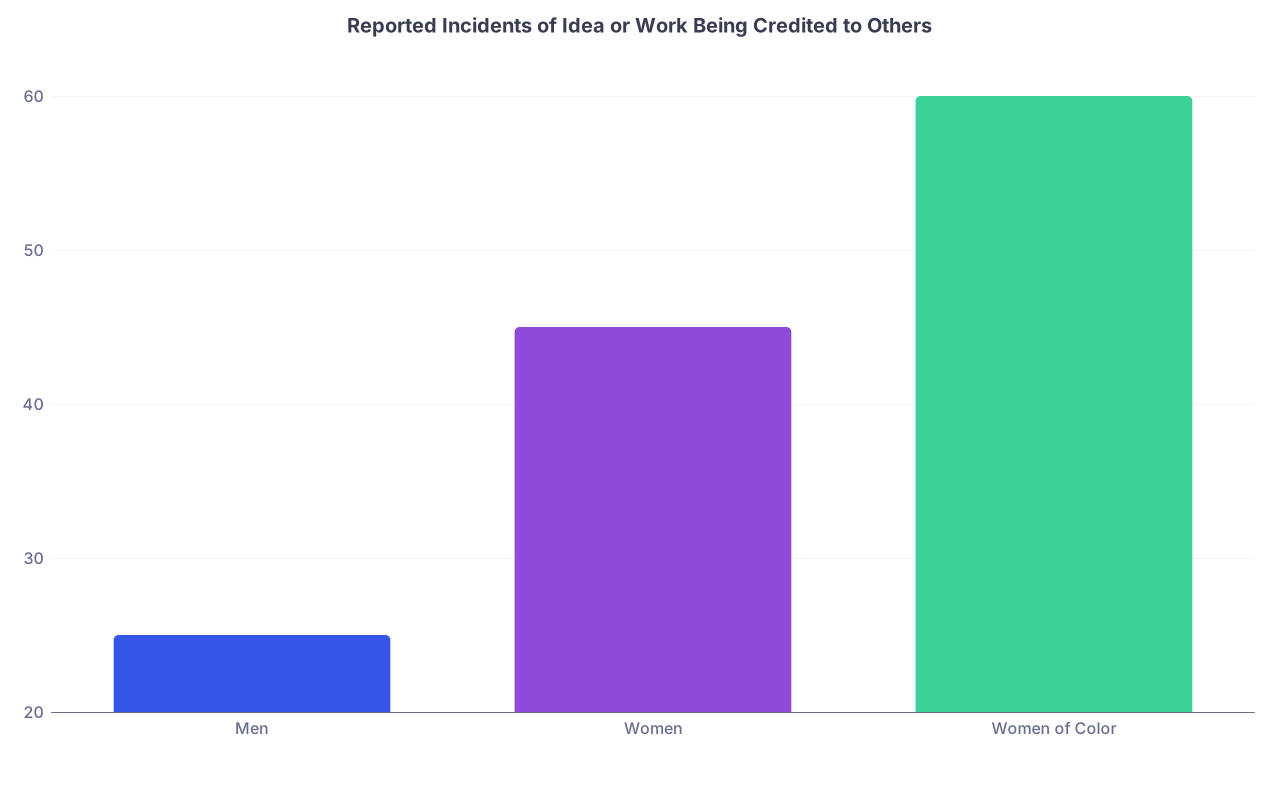
| Category | Value |
|---|---|
| Men | 25 |
| Women | 45 |
| Women of Color | 60 |
Numbers like these show up in survey after survey. The exact percentages vary, but the pattern does not.
So no, you’re not “too sensitive.” You’re noticing something real.
What does that mean practically?
You can’t rely on “they’ll notice my hard work.” You have to attach your name to your cognitive work regularly and out loud. That’s not arrogance. That’s survival in academic medicine.
It also means: if you’re a woman watching another woman get erased, you speak up.
“Actually, that was Dr. Patel’s idea during sign-out last night.”
“Just to add—Dr. Lopez did the deep dive on this overnight and came up with this plan.”
You normalize visible credit for women. That’s culture change, one sentence at a time.
Step 6: When the Co-Resident Keeps Doing It (Pattern, Not One-Off)
If this was a one-time slip and they genuinely correct themselves, fine. People mess up.
If it’s a pattern, you’re now in a different situation. You’re dealing with someone who sees you as a resource, not a peer. They will keep doing it as long as it works.
You now go from “one-off correction” to “structured boundary.”
You:
Stop feeding them uncredited work. If they ask you to “look over” something and then present it as theirs, you change your response.
“Happy to review, but I’d want to be listed as co-presenter / co-author if I’m doing substantial work on it.”
Name the behavior very explicitly in a second conversation.
“We talked about this before, but it’s still happening. When you present work that I’ve done as if you did it, that’s taking credit for my work. It has consequences for my evaluations and my career. That’s not acceptable.”
Start looping in allies.
This is where “I don’t want to be dramatic” gets you into trouble. You are not gossiping; you are documenting a pattern.
To a trusted chief or faculty mentor:
“I’m running into a repeated issue where a co-resident is taking visible credit for work I’ve done—on rounds and in project presentations—despite me bringing it up directly with them. I’m concerned about the impact on my evaluations and letters. I’d appreciate your advice and, if needed, help addressing it.”
You’re signaling: this is not a personality conflict. This is a professionalism and equity problem.
Step 7: When (and How) to Escalate Formally
You do not run to GME every time someone paraphrases your suggestion. That dilutes your own credibility.
You do escalate when three boxes are checked:
- There is a repeated pattern.
- You have already addressed it directly with the person clearly.
- It’s affecting—or could realistically affect—your evaluations, letters, authorship, or leadership opportunities.
At that point, you move to chief resident, program director, or both.
You go in prepared:
– Dates and brief descriptions of specific incidents
– What your contribution actually was
– What was said publicly that misrepresented it
– How you already addressed it with the co-resident
– The impact you’re worried about (evaluations, reputation, authorship)
You say:
“I’m not asking for drama or punishment. I’m asking for protection of my professional contributions and help setting clear boundaries about credit and professionalism.”
If your PD is decent, they’ll take it seriously. If they brush it off with “well, that’s just personalities,” you formally protect yourself another way—through emails clarifying your work, through mentorship relationships, through choosing future collaborators more carefully.
Step 8: Preventive Moves So This Happens Less Often
You can’t completely prevent people from being opportunistic. But you can make it harder for them.
1. Label your work early and often
When you present or update:
“I’ve been working on this patient overnight and my plan is…”
“I’ve been leading this QI project for the last 3 months, focusing on…”
“In my chart review of 80 patients, I found…”
You’re tying the noun (plan, project, review) to you.
2. Own the mic when possible
If it’s your project, you should be the one presenting it. If you’re constantly doing the backend work while someone else talks, you’re setting yourself up to be erased.
When a faculty member asks, “Who wants to present this?” you volunteer. Immediately. Don’t wait for democracy; medicine is not built that way.
3. Clarify roles before big events
Before a big presentation:
“Just so we’re on the same page: I’ll handle intro and methods since I led that work, and you can take results and discussion.”
Or for rounds:
“I did the full overnight workup and plan on this patient, so I’ll present them.”
Say it once, confidently. If your co-resident tries to override you, that’s your first red flag.
Step 9: Take Care of the Emotional Fallout (You’re Not Overreacting)
Let me be blunt: having your work stolen feels violating. Your brain did the heavy lift. Someone else got the dopamine hit and the career points.
What makes it worse is that we train women to immediately second-guess themselves:
“Maybe I’m making this up.”
“Maybe they didn’t mean it.”
“Maybe I should just work harder and they’ll notice.”
No. You are allowed to:
– Be angry.
– Feel hurt.
– Decide you will not work with that person again if you can help it.
What you do not do is let that anger leak sideways into your professional behavior—snapping on rounds, passive-aggressive comments in front of patients. You channel it.
Where?
Into tightening your boundaries. Choosing better collaborators. Building a network of faculty who know exactly what you’re capable of. Maybe into a resident wellness or women-in-medicine group where you name this behavior and strategize around it.
You use the experience. You don’t let it define your sense of your own competence.
A Quick Reality Check: Not Every Overlap is Theft
Sometimes two people really did work on the same thing, and both feel ownership.
You and your co-resident both saw the patient, both wrote parts of the note, both refined the plan. Or you co-developed the QI intervention, but you did more of the grunt work.
In those cases, be precise about what’s actually bothering you.
Is it that they talk only in “I” language and never “we”?
Is it that your extra work is invisible?
Is it that they’re getting solo credit for something you built together?
You handle it the same way—clarify roles, speak up—but you hold the nuance. Not every overlap equals theft. That makes your complaints stronger when it is theft.
Your Next Step Today
Do one concrete thing: open your email and draft a 4–5 sentence message to a faculty member or mentor that clearly outlines a project or patient care initiative you’ve led in the last month and what your role was.
You don’t have to send it yet. But write it.
Then read it and ask: “Does this make my contribution unmistakable to someone outside the room?”
If the answer is no, fix it. Then send it to one person.
That’s how you start shifting from “I hope they notice” to “I make my work visible.”