
The biggest lie you will hear is: “We treat everyone the same here.”
If you are the only woman of color in your residency class, you already know that is not true. Your experience is not “the same.” It is heavier. Lonelier. And it can be quietly brutal if you do not have a strategy.
This is not about “being grateful for the opportunity.” You earned your seat. Now you need to survive—and actually build power—inside a system that was not designed with you in mind.
Here is what to do, step by step, if you are that only woman of color in your program.
1. Name What Is Actually Happening (You Are Not Imagining It)
First: stop gaslighting yourself.
You are not “too sensitive” because:
- Attendings remember your white co-resident’s name after one rotation and still call you “hey, doctor.”
- Nurses default to your male co-resident for “real questions,” even when you are the senior.
- Patients assume you are the nurse, tech, or interpreter—repeatedly.
- You say something in rounds, no response. Your co-resident repeats it 30 seconds later, and the room suddenly thinks it’s brilliant.
That pattern is not random. It’s a mix of racism, sexism, and bias that you are absorbing daily.
Here’s the move: you need language and a framework so it doesn’t eat you alive.
Write this down somewhere private—phone notes is fine:
- “I am not an accident here. My acceptance is data that I meet or exceed the bar.”
- “What I am experiencing has a name: bias, stereotype threat, tokenism. It is not my personal failure.”
- “I will not spend my entire residency trying to prove I belong. I will spend it getting excellent and building leverage.”
That last line is the pivot. You are not in a courtroom defending your existence. You are in training acquiring skills and receipts.
2. Build a Quiet, Strategic Support Map
You need a support system. But not just vibes and “girl, that’s crazy” texts. You need specific people for specific roles.
Think of it as your residency support map:
| Role | Who to Look For |
|---|---|
| Safety Vent | Trusted peer, friend, therapist |
| Internal Ally | Co-resident or faculty in your program |
| External Mentor | WOC physician outside your hospital |
| Formal Power Ally | PD, APD, chief, DEI leader |
You do not need all four on day one. Start with two:
Safety Vent – someone you can message “You will not believe what just happened on rounds” and they get it. Could be:
- A med school friend now at another program
- A sibling or partner who actually listens
- A therapist (highly recommended, especially one familiar with medical culture or racialized stress)
External Mentor – ideally a woman of color attending in your specialty or adjacent. She does not have to be at your institution. Honestly, better if she is not. You need someone who can say:
- “That’s not normal. At my program, this is how we’d handle it.”
- “Document this.”
- “This is how you phrase that email to your PD.”
Action: set a goal to send two emails or LinkedIn messages this month to women of color physicians you admire. Keep it simple:
“I’m a PGY-1 in internal medicine at [Hospital]. I’m the only woman of color in my class and would really value a 20-minute call to get your advice on how you navigated residency. Totally understand if your schedule is packed.”
Most people will ignore it. You do not need most people. You need one.
3. Decide Your Disclosure Strategy (What You Share, With Whom)
Not everyone gets to hear your truth. That’s not cynicism. That’s survival.
You need a disclosure strategy:
Inner circle (full context):
You tell them everything. The awful attending comment. The nurse that repeatedly undermines you. The doubt. The anger. This is usually:- Your safety vent person
- Maybe one co-resident who has proven themselves
Middle circle (filtered context):
Here you give partial stories with professional framing:- “I’ve noticed some dynamics on the team about communication and hierarchy that feel off—I’m trying to approach it constructively.”
This might be: - A chief you cautiously trust
- A faculty mentor who seems aware but not fully “in it”
- “I’ve noticed some dynamics on the team about communication and hierarchy that feel off—I’m trying to approach it constructively.”
Outer circle (no context, just behaviors):
Here’s where you stay tight:- “I’m noticing X pattern that affects patient care and team functioning.”
No race/gender language unless: - You trust their response
- Or you’re escalating a pattern through formal channels
- “I’m noticing X pattern that affects patient care and team functioning.”
Why so careful? Because once you are labeled “angry,” “overly sensitive,” or “difficult,” it sticks. And people weaponize it during evaluation season.
This does not mean you stay silent. It means you choose when speaking up moves the needle and when it just empties your tank.
4. Create a Script Bank for Racist/Sexist Moments
You’re going to face garbage. Patients. Staff. Sometimes faculty. If you try to invent a response in the moment every time, you will either freeze or blow up. You need scripts.
Pick your level each time: deflect, assert, or escalate. Have options ready.
Patient assumes you are not the doctor
Patient: “When is the doctor coming?”
You: “I am the doctor taking care of you today. My name is Dr. [Last Name]. What questions can I answer for you?”
If they double down:
Patient: “No, I mean the real doctor. The man doctor.”
You: “I am the physician responsible for your care. If you’d like a second opinion, I can discuss that with my attending, but I will still be part of your care team.”
You are allowed to be calm and firm without apologizing for existing.
Staff undermines you in front of a patient
Nurse (to patient): “Let me check this with the senior doctor,” and goes to your male junior.
Later, privately:
You: “Hey, I noticed you went to [Name] for decisions about our patient in 312, even though I’m the senior on service. For patient safety and clarity, I need you to bring medical questions to me first.”
If they say, “Oh, I didn’t mean anything by it,” you do not need to debate intent. Just repeat:
You: “Sure. Going forward, I just want to be clear on the team structure so nothing gets missed.”
Attending makes a biased “joke”
Attending during rounds: “Well, you probably have a solid background in this, given your culture, right?”
Options, depending on your read of safety and power:
Soft but clear:
You (light but firm): “I’d rather we stick to my training than assumptions about my culture.”
More direct (if they’re someone who can handle it or you have backup):
You: “Comments like that make it hard to show up fully as a trainee. I’d appreciate if we kept it professional.”
If you cannot safely respond in the moment, document it. Time, date, witnesses, exact phrasing. This is not paranoia. It’s evidence.

5. Treat Documentation Like a Second Chart
If problematic behavior becomes a pattern, stop relying on memory. Residency is a blur. You will forget details. You need a personal log.
Use a private, non-work device or an encrypted note app. For each incident, jot:
- Date and time
- Location/rotation
- Who was present
- Exact words or behaviors (as close as you can get)
- Immediate impact (e.g., “I avoided speaking the rest of rounds,” “Patient refused my care,” “Nurse refused to carry out an order until cosigned by male co-resident”)
This is not for you to read every night and spiral. This is for:
- Pattern recognition: “Wow, this attending repeatedly targets me and the other minoritized residents.”
- Protected reporting: when/if you go to your PD, GME office, or DEI officer, this turns “I feel like” into “Here are eight concrete examples over four months.”
Programs, frankly, respond more when they see liability and risk. Clear documentation does that.
6. Play the Evaluation Game Without Losing Yourself
Here’s the harsh truth: as the only woman of color, your mistakes will be remembered more sharply and attributed to your “personality” or “fit,” not just your learning curve.
So you need to be a bit surgical about evaluations.
Get clarity early
Within the first month of a new rotation, ask your attending:
“How do you like to structure feedback? And what does a strong evaluation look like from your perspective on this rotation?”
You’re not sucking up. You’re gathering the grading rubric they won’t write down.
Ask mid-rotation, not just at the end
Two weeks in:
“Could we take 5 minutes for feedback? I want to make sure there are no blind spots that might show up in my final evaluation.”
If they say something vague like, “You’re doing fine,” press gently:
“Anything specific that would take me from ‘fine’ to ‘strong’ on this rotation?”
You are nudging them to articulate expectations clearly, on the record, while there is still time to adjust.
Counter stereotyped feedback
Common coded language for women of color: “not confident enough,” “comes across as defensive,” “not a team player,” “communication style can be improved.”
If you get this and it feels off, ask for receipts:
“Could you give me a couple of concrete examples so I can understand the situations you’re referring to?”
If they cannot, that tells you a lot. You now have material to bring to a mentor, chief, or PD:
“I’m concerned about a pattern of vague, personality-focused feedback without specific examples. I want to make sure I’m being evaluated fairly and based on clinical performance.”
You are not begging. You are protecting your record.
7. Find Power Outside Their Approval
If your entire self-worth is tied to what your program thinks of you, you’re in danger. They are not the final judges of your career.
You need parallel tracks of validation and power:
- Patient impact. Keep a small file (again, private) of thank-you notes, kind emails, or even just moments you remember where you showed up well for a patient or family. That is real data about your competence.
- Scholarship or side projects. Research, QI, advocacy, community work—even on a small scale—gives you identity and leverage beyond “resident number 7 in this program.”
- External recognition. Present at a conference. Apply for a small grant. Join a national group like SNMA alumni, AMWA (American Medical Women’s Association), or specialty-specific WOC groups. Someone outside your hospital should know your name.
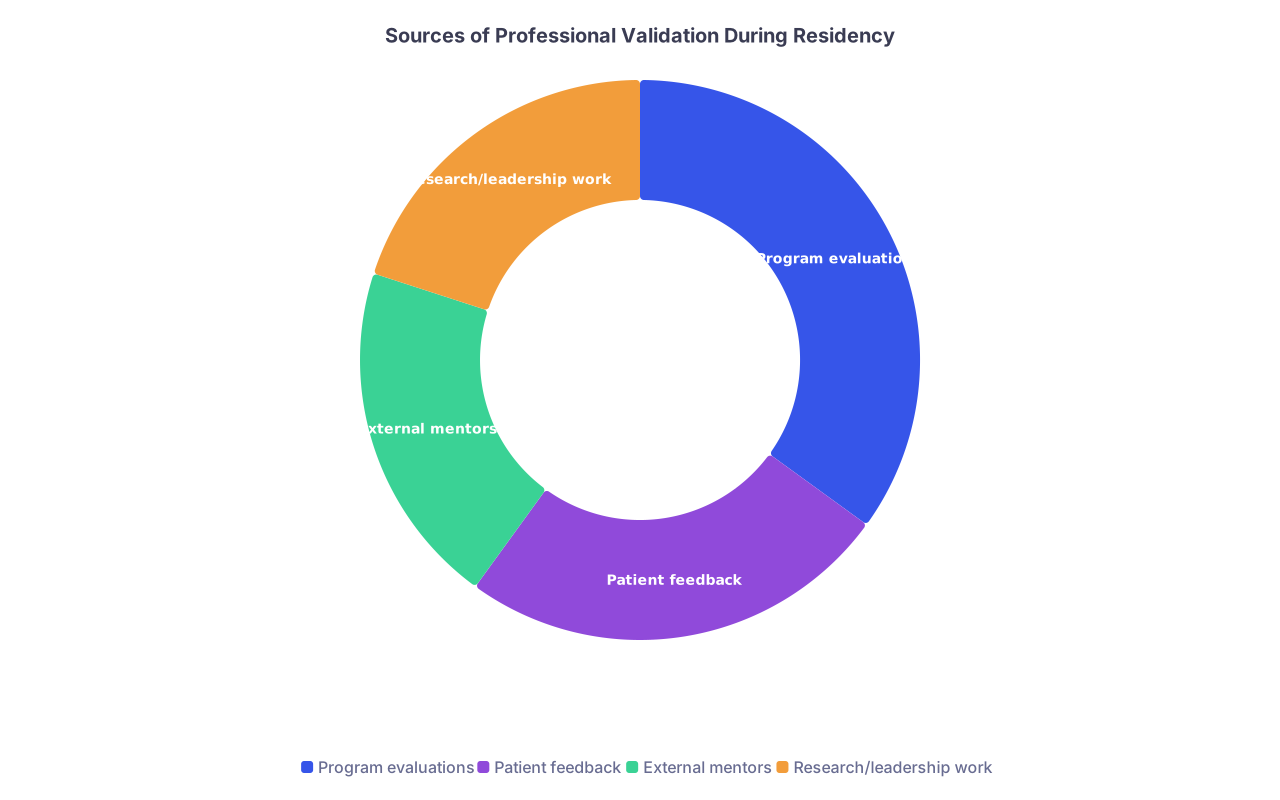
| Category | Value |
|---|---|
| Program evaluations | 35 |
| Patient feedback | 25 |
| External mentors | 20 |
| Research/leadership work | 20 |
The point is simple: don’t let your program be the only mirror you look into.
8. Protect Your Energy Like It’s a Clinical Resource
You are going to be asked—implicitly or explicitly—to be:
- The DEI representative
- The unofficial translator of “what Black/Latina/Asian communities think”
- The student whisperer for minoritized med students
- The face in every diversity photo on the website
Here’s how you keep that from swallowing you.
Decide your “yes” categories
Maybe you deeply care about mentoring minoritized med students. Great. That’s a yes category.
Maybe you are done sitting on “diversity committees” that generate glossy PDFs and no actual policy. That’s a no.
Use this script:
“I care a lot about equity work. Right now, with my clinical load, I can commit to one focused project that has clear goals and support. Can you share specifically what the time expectation is and how this will be supported or recognized in my evaluations or promotion?”
If they cannot answer that, you’re being asked to volunteer invisible labor. You’re allowed to say:
“Given my current rotation intensity and lack of protected time, I’m not able to do this well. I’d prefer to step back than do it halfway.”
You do not need to fix your institution by yourself during residency. You’re allowed to survive first.

9. Use the System When You Need It (Without Burning Bridges By Accident)
Sometimes things cross a line that requires formal engagement: harassment, discriminatory assignments, retaliation, or repeated undermining that affects patient safety.
Your escalation ladder might look like this:
- Informal check-in with a trusted chief or faculty mentor. “Here’s what happened. Am I overreacting? How would you approach this?”
- Meeting with PD or APD. Bring your documented examples. Focus on patterns and impact on patient care and education, not just personal offense.
- GME office / ombudsperson / DEI office. These exist to address exactly this, even if they are imperfect.
When you talk to leadership, frame it like this:
- “I am committed to my training and want to be here.”
- “Here are concrete things that are undermining my ability to learn and care for patients.”
- “Here is what I’m asking for.” (Examples: “Not to be paired with X attending on every rotation,” “Facilitated mediation,” “Formal review of evaluation patterns,” “Clear guidance on escalation for future incidents.”)
Direct. Specific. Professional. No apology for bringing it up.
And then—follow up by email after meetings, summarizing what was discussed. That paper trail matters.
10. Plan for Your Exit While You’re Still Inside
Being the only woman of color in your class is often temporary. Not because they suddenly fix diversity, but because you graduate.
I’ve watched residents white-knuckle their way through toxic environments and then realize, in their last six months, that they have no plan for life after this. Don’t do that to yourself.
Start early (PGY-2 at the latest):
- Think about your specialty niche. Hospitalist? Outpatient? Fellowship? Policy?
- Cultivate mentors and sponsors outside your program who can write letters, nominate you for positions, or pull you into networks.
- Be honest about what you don’t want to repeat. If your current hospital is a boys’ club with performative diversity, don’t sign on as faculty hoping it’ll magically improve because you stay.
Your goal is not just to “make it through.” It’s to land in a place where you are not the only one forever—or if you are, you at least have rank, pay, and institutional power.

| Step | Description |
|---|---|
| Step 1 | Bias or harmful incident |
| Step 2 | Document and debrief with safety vent |
| Step 3 | Log details in incident file |
| Step 4 | Discuss with trusted mentor or chief |
| Step 5 | Monitor and continue support |
| Step 6 | Meet with PD or APD |
| Step 7 | Contact GME or DEI office |
| Step 8 | Formal complaint or mediation |
| Step 9 | One time or pattern? |
| Step 10 | Resolved with informal steps? |
| Step 11 | Adequate response? |
11. Remember: Their Limited Imagination Is Not Your Ceiling
One last thing. Maybe the most important.
Some people in your program have never seen a woman of color as:
- Division chief
- Department chair
- National PI on a major trial
- Medical school dean
Their mental image of “leader” does not look like you. That’s not your problem to fix during 28-hour calls.
What you can do:
- Get so clinically solid they have to respect your work, even if they don’t fully “get” you.
- Build a network of people who do see you clearly.
- Decide, consciously, which parts of yourself you will protect and refuse to shrink—even if it makes some colleagues slightly uncomfortable.
You don’t owe anyone a smaller version of yourself to make their worldview less fragile.
Today, do one concrete thing: open your phone and list three names—people you trust or want to reach out to. Text or email one of them before you sleep: tell them where you are, what you’re facing, and that you’re looking for real support, not platitudes. Start building your map now, before the next incident hits.