
You’re sitting in a call room, or your car, or a bathroom stall because you wanted privacy. You’re scrolling or flipping through your evaluation and you see it:
“She can be a bit too emotional.” “Sometimes comes across as soft.” “Needs to be more thick-skinned / tougher with patients and staff.” “Great with patients, but may be overly sensitive in team interactions.”
Your chest gets hot. Part of you wants to cry. Part of you wants to punch a wall. And the ugly little thought creeps in: If I were a guy, would they have written ‘empathetic,’ ‘approachable,’ or ‘good team player’ instead?
You’re not imagining the gendered subtext. I’ve seen this movie too many times. Same behavior, different labels:
- Man: passionate, strong advocate, decisive
- Woman: emotional, difficult, soft
So let’s not waste time pretending this is a neutral data point. Here’s what to do when an evaluation labels you “too emotional” or “soft” – step by step, starting right now.
Step 1: Translate the Vague Insult into Specific, Usable Data
The words “too emotional” or “soft” are garbage feedback as written. They’re subjective, biased, and not behaviorally anchored. But buried inside, there might be actual information that can help you.
First job: separate signal from sexist noise.
Ask yourself, very specifically:
Did they mention a particular situation?
“Got visibly upset when a plan was changed.”
“Seemed flustered when criticized in front of the team.”
“Yielded too easily to demanding families.”Is there any concrete behavior described?
Crying on rounds? Raising your voice? Shutting down? Avoiding conflict? Apologizing excessively? Yielding on medically unsafe requests?
If your written evaluation is all vibes and no details, you treat it as incomplete data, not as a verdict on your personality.
Now write your own translation of what they might be trying to say in behavioral terms. For example:
- “Too emotional” → “On two occasions, I showed my frustration visibly in front of the team when I disagreed with a decision.”
- “Soft” → “I defer frequently to others’ preferences and occasionally avoid direct confrontation, even when I disagree.”
Those are things you can actually work with. The words “too emotional” and “soft” are not.
If you honestly cannot identify any specific behavior behind the comment, mentally file this evaluation as “biased / low-quality feedback” and downgrade its importance. You still need to decide what to do politically. But you do not need to internalize it.
Step 2: Reality-Check with People You Trust (Quietly, Not in a Group Vent)
Before you decide your attendings are all sexist dinosaurs or that you’re secretly unfit for medicine, get data from people who know you and have watched you work.
Pick 1–3 people max. Not a whole group chat, not Twitter.
Good options:
- A female senior resident who’s respected by attendings
- A faculty mentor (especially a woman or someone explicitly supportive of women in medicine)
- A chief resident who has seen your performance across rotations
Use language that invites honest critique, not just comfort:
“Someone described me as ‘too emotional’ and ‘soft’ in my evaluation this block. I’m trying to figure out if there are specific behaviors I should adjust versus just biased wording. You’ve seen me in high-stress moments – are there times where my reactions could be read that way? I want the real answer, not just reassurance.”
Then shut up and listen.
What you might hear:
- “Honestly, no. You’re appropriately assertive. I think that comment says more about them than you.”
- “You do tear up when you’re really frustrated. It’s understandable, but others might be reading that as you being overwhelmed.”
- “You’re very accommodating with nursing and families, which is great, but I have seen you back down when you’re actually right about the plan.”
This step matters because it keeps you from overcorrecting. I’ve watched women swing from “too soft” to unnecessarily aggressive, and then they get new labels: “abrasive,” “difficult,” “not a team player.” Perfect.
Your goal is not to erase emotion. It’s to get control of how it shows up publicly in ways that affect patient care and team dynamics.
Step 3: Identify Which Part is Their Bias vs. Your Growth Edge
You need to hold two truths at once:
- Gender bias is real and absolutely colors these labels.
- You are still responsible for your professional behavior under stress.
So break it down into a simple grid for yourself:
| Category | Example Thought You Might Have |
|---|---|
| Clear bias | “Male co-resident did the same thing and got praised.” |
| Genuine strength | “Patients open up to me because I show feeling.” |
| Real growth area | “I sometimes cry in front of the team when frustrated.” |
| Politically risky | “I visibly shut down or get sharp when challenged.” |
You protect your strengths. You address your growth areas. You stay aware of what’s politically risky in your particular culture, because medicine is not a meritocracy – it’s a people system with power dynamics.
Bias does not mean you ignore feedback. It means you selectively respond, on your terms.
Step 4: Decide on Your Strategy: Adapt, Push Back, or Document (Usually Some Mix)
You’ve got three levers:
- Adapt your behavior for strategic reasons.
- Push back on bad feedback.
- Document bias and patterns.
You do not have to choose just one.
4A. Strategic Adaptation (Without Erasing Yourself)
This is the unglamorous truth: you’re playing a long game in a small world. You need letters. You need advocates. You need a reputation that gets you where you want to go. That sometimes means adjusting the expression of your emotion while keeping the core of your empathy.
Common scenarios and concrete fixes:
Scenario: You tear up when intensely frustrated or when criticized harshly.
What to do:
- Recognize your early warning signs: throat tight, chest hot, short sentences.
- Have a stock phrase ready: “I’m really invested in this case; I’d like to step out for a minute and come back to this conversation.”
- Physically leave if you need to. Cry in the bathroom, stairwell, car. Then come back calm and focused.
- Later, if appropriate, briefly circle back: “On rounds earlier, I felt strongly about that plan and let it show more than I meant to. I’ve thought about it, and here’s how I’m approaching it now…”
Scenario: You get labeled “soft” because you’re accommodating and conflict-avoidant.
What to do:
- Script one firm line you can use when you disagree: “I hear your point, but I’m concerned about X. My recommendation is Y.”
- Practice holding eye contact and not immediately softening with “sorry” or “maybe I’m wrong, but…”
- On the wards, pick one low-stakes scenario each day where you intentionally voice your opinion clearly instead of deferring. Build the muscle.
Scenario: Families/nurses love you, attendings think you’re too pliable.
What to do:
- Keep your warmth. You need it.
- Pair it with clear boundaries: “I really understand why you’re asking for that. For safety reasons, here’s what I can do instead…”
- When you say no, stop overexplaining. One clear sentence, then silence.
You’re not killing your emotional range. You’re controlling its timing and audience.
4B. Pushing Back on Biased or Useless Feedback
You are allowed to challenge vague, gendered nonsense. The trick is to sound like a professional seeking clarity, not a wounded ego seeking validation.
If it’s a resident:
“On my evaluation you mentioned I can be ‘too emotional’ / ‘soft.’ I’m working on my professionalism and want to improve. Could you give me 1–2 specific situations where you saw that, and what behavior you would’ve preferred in that moment?”
If it’s an attending:
“In my written feedback, there was a comment that I’m ‘too emotional.’ I take professional behavior seriously. Could you help me understand what specific behaviors you’re referring to, so I can target them directly?”
If they:
- Can’t give you anything concrete → you’ve just exposed low-quality feedback. Document the conversation (date, content).
- Reveal something real (e.g., “you raised your voice,” “you left the room abruptly,” “you seemed visibly upset on rounds”) → now you have something to work with.
If the wording is blatantly gendered, you can go one level further, especially if you have some political capital with the person:
“I also want to flag that terms like ‘emotional’ and ‘soft’ tend to get used more with women, even when behaviors are similar across residents. I’m happy to adjust any unprofessional behaviors, but I want to make sure we’re anchoring feedback to specific actions rather than personality labels.”
Some people will get defensive. Some will think about it later. Either way, you’ve planted a seed and signaled you’re not a doormat.
4C. Document Patterns – This Is About Protection, Not Paranoia
If you’re seeing a pattern of gendered language, double standards, or one particular faculty member targeting women with this style of feedback, you quietly build your file.
Keep a simple running log:
- Date
- Evaluator
- Exact phrases (copy-paste or quote)
- Context (e.g., “Male co-resident did X, he was praised for being assertive; I did Y, called ‘emotional.’”)
This isn’t for daily rage-reading. It’s insurance. If you ever:
- Go to the program director with concerns about biased evaluations
- Need to explain a specific bad eval to fellowship programs
- End up in a formal remediation process or, worst case, legal scenario
…you aren’t relying on vague memories. You have specifics.
Step 5: Protect Your Core: Your Empathy is Not the Problem
Let me be blunt: medicine needs “soft.” It just refuses to admit it when it’s done by women.
Patients do better when their doctors:
- Show appropriate emotion at bad news
- Sit down and listen longer than the bare minimum
- Remember details about their lives
- Notice when the team is burning out and say something
That “softness” is part of what makes you a good physician. You do not amputate that to satisfy some attending who wants everyone to be a stoic robot.
The work is to differentiate:
Healthy, professional emotional presence
You look concerned. Your voice softens with bad news. You say, “I’m really sorry this is happening.” You care, visibly.Uncontained emotional spillover that affects care or teamwork
You cry frequently in front of the team about frustration with colleagues. You snap when challenged. You shut down and stop participating after criticism. You vent about staff in front of patients.
You want to preserve the first and tighten up the second.
If you start to feel yourself hardening into someone you don’t recognize, that’s a sign you’re overcorrecting to survive a toxic culture. That’s not “professionalism.” That’s damage.
Step 6: Use Program Structures to Your Advantage
Most training programs say they care about fair evaluation, bias education, and professionalism. Use their own language.
A few specific moves:
In a meeting with your program director:
“I’m seeing language in my feedback like ‘too emotional’ or ‘soft.’ I’d like some help understanding how the program defines professional emotional behavior, and how to distinguish between constructive empathy and what’s considered unprofessional. I also want to ensure my evaluations are behavior-based and not personality labels.”In a CCC (Clinical Competency Committee) or milestone conversation:
“For the professionalism and communication milestones, could we anchor the discussion to specific actions and incidents rather than general descriptors, so I can build a clear action plan?”If your institution has a bias reporting system or ombudsperson, and you’re seeing a pattern:
Bring 2–3 concrete examples, not your entire life story. “Here’s the behavior. Here’s the language. Here’s the gender pattern I’m noticing.”
You’re not asking for special treatment. You’re asking them to live up to their own policies.
Step 7: Decide What “Professional Emotional Expression” Looks Like for You
You can’t control what every attending thinks. But you can decide on your personal code for how you’ll handle emotion at work.
Make it specific, not vague ideas like “be more professional.”
Examples:
- “I will never have my first cry about a clinical conflict in front of the team. If I feel tears coming, I’ll step out, reset, and come back.”
- “I will disagree at least once a day in rounds when I think something’s suboptimal, even if my instinct is to stay quiet.”
- “I will stop apologizing for having an opinion. I’ll reserve apologies for actual mistakes or harm, not existence.”
- “I will allow patients to see my humanity when appropriate – a quiet ‘this is hard’ is okay. Full emotional decompensation is for my support system, not the bedside.”
You set your own bar. Then you train toward it.
Step 8: Build a Counter-Narrative in Your File
If your record has a couple of “too emotional” or “soft” comments, you want other lines that clearly describe your strengths in this exact domain.
You can actively cultivate that.
When an attending comments positively on your communication or empathy, ask them to include that language in formal evaluations or letters:
“I’m really glad my approach with that family was helpful. If you’re comfortable, I’d appreciate if you could highlight that style of communication in my written evaluation – I’ve been working intentionally on balancing empathy with clarity.”
Gather phrases like:
- “Outstanding at handling difficult family meetings.”
- “Provides exceptional emotional support without losing clinical objectivity.”
- “Shows poise under stress and maintains compassionate presence.”
These become the counterweight to “too emotional / soft” when someone later reads your file in aggregate.
Step 9: Find Women (and Allies) Who’ve Been Through This and Survived Intact
You’re not the first woman in medicine to have her humanity labeled as a problem. Do not try to reinvent everything in isolation.
Ask explicitly:
“Did you ever get labeled as ‘too emotional’ or ‘soft’ in training? What did you actually do about it?”
You’ll hear versions of:
- “Yes, from Dr. X. I made small visible changes around them, documented the bias, and then made sure other attendings really saw my strengths.”
- “I used to cry in the bathroom on call. Over time I learned to feel everything, just not in front of the wrong people.”
- “I never tried to become one of the bros. I just got sharper about when and how I showed vulnerability.”
You’re collecting tactics and reassurance, not permission.
Step 10: Your Next Move – Today, Not “Someday”
Do this today. Not next week.
- Pull up the evaluation with “too emotional” or “soft.”
- Underneath those words, write in your own translation:
- What specific behaviors might they be pointing at?
- Which ones do you actually agree are worth tightening up?
- Pick one person (mentor, senior resident, chief) and send a short message:
“I got some feedback about being ‘too emotional / soft’ on my recent eval. I’m trying to sort out what’s real versus biased wording and figure out a concrete plan. Could we talk for 15–20 minutes this week?”
That’s it. One translation. One person. One conversation.
From there, you’re not the “too emotional” resident. You’re the physician actively shaping how your emotional intelligence shows up in a system that doesn’t always know what to do with it.
And that’s a hell of a lot stronger than “soft.”
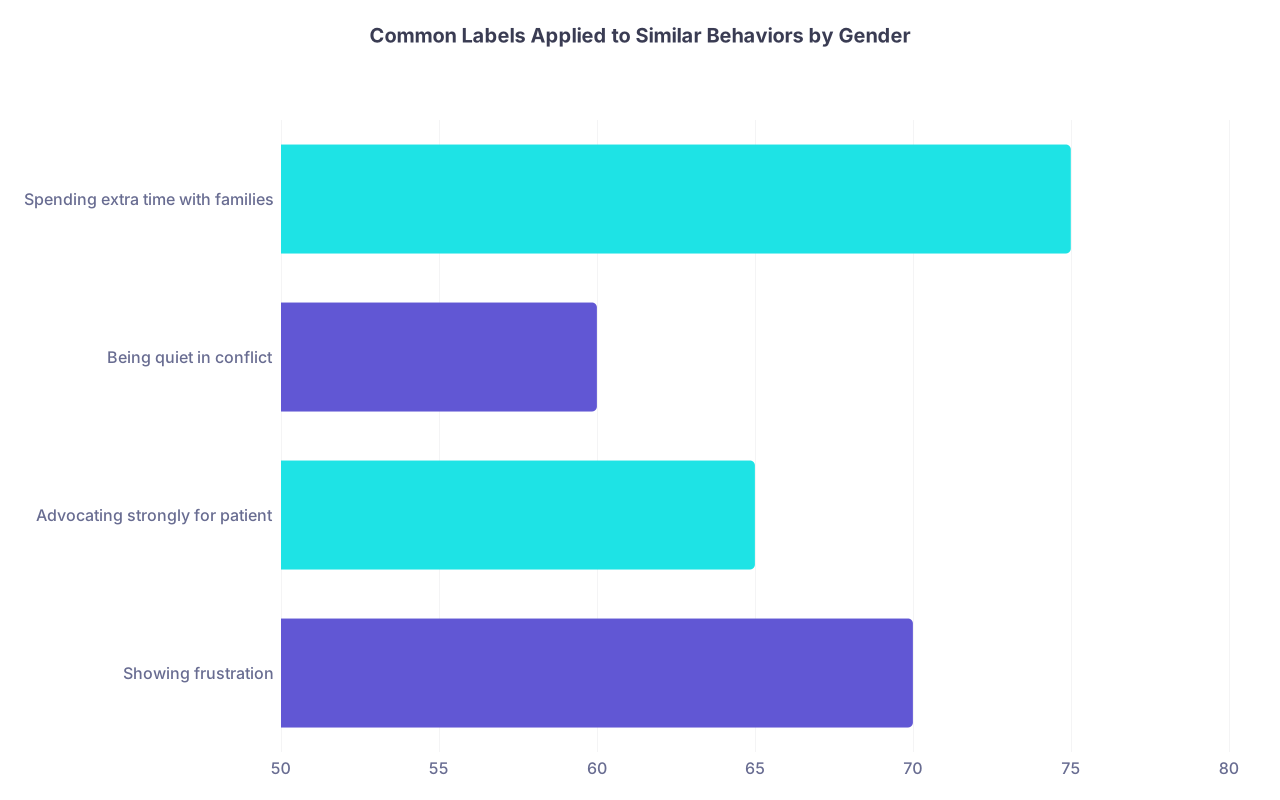
| Category | Value |
|---|---|
| Showing frustration | 70 |
| Advocating strongly for patient | 65 |
| Being quiet in conflict | 60 |
| Spending extra time with families | 75 |

| Step | Description |
|---|---|
| Step 1 | Read evaluation |
| Step 2 | Treat as low quality feedback |
| Step 3 | Document wording and evaluator |
| Step 4 | Seek mentor perspective |
| Step 5 | List concrete behaviors |
| Step 6 | Reality check with trusted mentor |
| Step 7 | Create behavior change plan |
| Step 8 | Note as bias |
| Step 9 | Consider discussing wording with evaluator |
| Step 10 | Any specific behaviors? |
| Step 11 | Real growth area? |