
The unspoken rule in many medical workplaces is simple: women are expected to say yes.
When you don’t—especially to extra, unpaid tasks—you often get punished. Not formally. Socially. Subtly. And that can hurt your evaluations, your reputation, and your mental health.
I’m going to lay out exactly what’s happening, how to tell if you’re being socially punished for saying no, and what to do about it in real-world hospital and clinic settings. Not theory. Actual phrases, strategies, and scripts you can use tomorrow.
What This Actually Looks Like On The Ground
You already know the pattern, but let’s name it so you can stop gaslighting yourself.
You say no to things like:
- “Can you organize the resident wellness event?”
- “Can you update this quality dashboard on your own time?”
- “Can you mentor these three students—just informal, no protected time?”
- “We need someone to take notes for this committee meeting.”
You decline, or you set a boundary. And then:
- You’re “forgotten” from group invites.
- Your name gets left off emails about projects.
- Someone casually calls you “not a team player.”
- A male colleague who never volunteers is still “great to work with.”
- You get a subtle tone change in feedback: “could be more engaged,” “not as visible,” “needs to show more initiative.”
Here’s the key: you didn’t do anything wrong. You just violated an unwritten gendered rule—women are supposed to be agreeable, helpful, and self-sacrificing. Especially in medicine, where the culture already rewards martyrdom.
You’re not imagining the backlash. I’ve watched attendings rave about a female resident’s work ethic… right up until she declined one committee “opportunity” that had zero academic value. Overnight she became “difficult to schedule with.”
So let’s deal with the situation you’re actually in, not the fantasy world where everyone respects a polite no.
Step 1: Diagnose What’s Really Going On
Before you respond, you need a clear read on the dynamics. Otherwise you’ll either overreact or underreact.
Ask yourself three questions:
Is this pattern gendered?
Compare yourself to male peers with similar seniority. Who gets asked to do:- Notes for meetings
- Planning social events
- “Just quick” educational tasks
- Welcome lunches for new staff If men are spared or praised while you’re judged, that’s a gendered pattern, not a personality issue.
Is the social punishment targeted or general?
- If everyone who says no to that person gets iced out, you’re dealing with a difficult personality or dysfunctional culture.
- If you and other women catch more heat for the same boundary, you’re facing gendered expectations.
Is this affecting your career capital?
Look for concrete hits:- Fewer invitations to academic projects or talks
- Cooler tone in evaluations after a specific “no”
- Being left off group emails or meetings where decisions get made
Once it starts affecting evaluations or opportunities, this isn’t just unpleasant. It’s strategic.
Document specific examples. Date, people present, what was said, what changed afterward. You may never need the notes. But if you do, you’ll be glad they exist.
Step 2: Build a Personal Rulebook for Saying No
You can’t stop the requests. You can control your framework for responding so you aren’t reinventing the wheel every time.
Create 3 buckets:
Hell Yes Tasks
You say yes because they directly serve your goals:- Count toward promotion (authorship, leadership roles with clear criteria)
- Build skills you actually want
- Give you visibility with people who matter for your career These can still be unpaid. But they’re not free.
Conditional Yes Tasks
You’ll do them if certain things are true:- There’s protected time
- The workload is clearly defined and finite
- Someone senior will publicly recognize your contribution These require negotiation, not blind acceptance.
Default No Tasks
These are structurally exploitative for women:- Taking minutes
- “Can you just coordinate this?” with no credit
- Emotional labor (conflict smoothing, birthday planning, staff appreciation tasks)
- Anything labeled “great exposure” with no concrete benefit
Write this out for yourself. Literally. On paper or in your notes app. Because under stress, you’ll be tempted to cave. Your rulebook gives you something stable to fall back on.
Step 3: Use “Structured No” Instead of Just “No”
Plain “no” is technically enough. Socially, in medical culture, it can be expensive—especially for women. I’m not saying this is fair. I’m saying it’s reality.
So you use a structured no. It does three things:
- Affirms your commitment to the team/mission.
- States a clear boundary or constraint.
- Redirects or defines what you can offer.
Example scenarios:
Scenario 1: Unpaid Committee Work You Don’t Want
They say: “We’d love for you to be on this wellness committee. It’d be great exposure.”
You say: “I care a lot about wellness, but I’m currently at capacity with [X projects that count]. I wouldn’t be able to give this committee the energy it deserves, so I’m going to decline. If it becomes a formal role with protected time later, I’d be happy to revisit.”
See what you did: team-oriented language, clear capacity limit, and you named the missing piece—protected time.
Scenario 2: Admin-Like Tasks Aimed at You as the Only Woman
They say in a meeting: “Can someone take minutes? Maybe you could, Dr. Patel?”
You say: “I’d like to participate fully in the discussion. I recommend we either rotate note-taking each meeting or ask admin to support with minutes so everyone can contribute equally.”
If they push:
“I’m not able to take that on today.” Then stay quiet. Do not over-explain.
You’ve named a fair solution and refused the gendered default. That’s not “not a team player.” That’s equity.
Scenario 3: “Quick” Mentoring That’s Actually Time-Intensive
They say: “Can you meet with this student every week? You’re so relatable.”
You say: “I’m glad they feel comfortable with me, and I’m happy to meet once to get them oriented. For ongoing mentoring, it would be better to identify a formal mentor with protected time or distribute between several faculty.”
You’re not abandoning the student. You’re resisting the informal, endless, uncredited dump of emotional labor on you.
Step 4: Handle the Social Backlash Deliberately
The punishment usually comes as:
- Subtle cold shoulder
- Passive-aggressive comments
- Back-channel criticism (“she’s checked out”)
- Performance feedback with vague language about “engagement”
Here’s how to respond without burning your career down.
A. Name the Behavior Neutrally (When Needed)
If a colleague starts icing you out or making comments, you address it privately, calmly, early.
“Hey, I’ve noticed a shift after I declined joining that project—less communication and some comments about my engagement. My understanding is we can set boundaries around unpaid work. Is there something specific you’re concerned about with my performance?”
You’re doing three things:
- Tying the shift to the boundary explicitly
- Forcing them to name a performance-related concern (usually they can’t)
- Signaling you’re not a soft target
Do not get dragged into apologizing for your no. You can regret the impact without retracting the boundary: “I’m sorry if my no caught you off guard; I should have communicated my bandwidth earlier. The boundary still stands, but I’m open to other ways to contribute that align with my role.”
B. Separate Relationship Repair From Boundary Collapse
Sometimes you do want to smooth the relationship. That doesn’t mean you sacrifice your no.
Example:
- Grab coffee with the attending/program director.
- Acknowledge the tension: “I’ve had to pull back on some extra work to stay sustainable this year, and I get that it may have looked abrupt.”
- Then re-anchor: “My clinical work and [X] project remain my priorities. I want to be sure that’s what I’m evaluated on.”
You’re inviting them to recalibrate without re-opening the unpaid labor door.
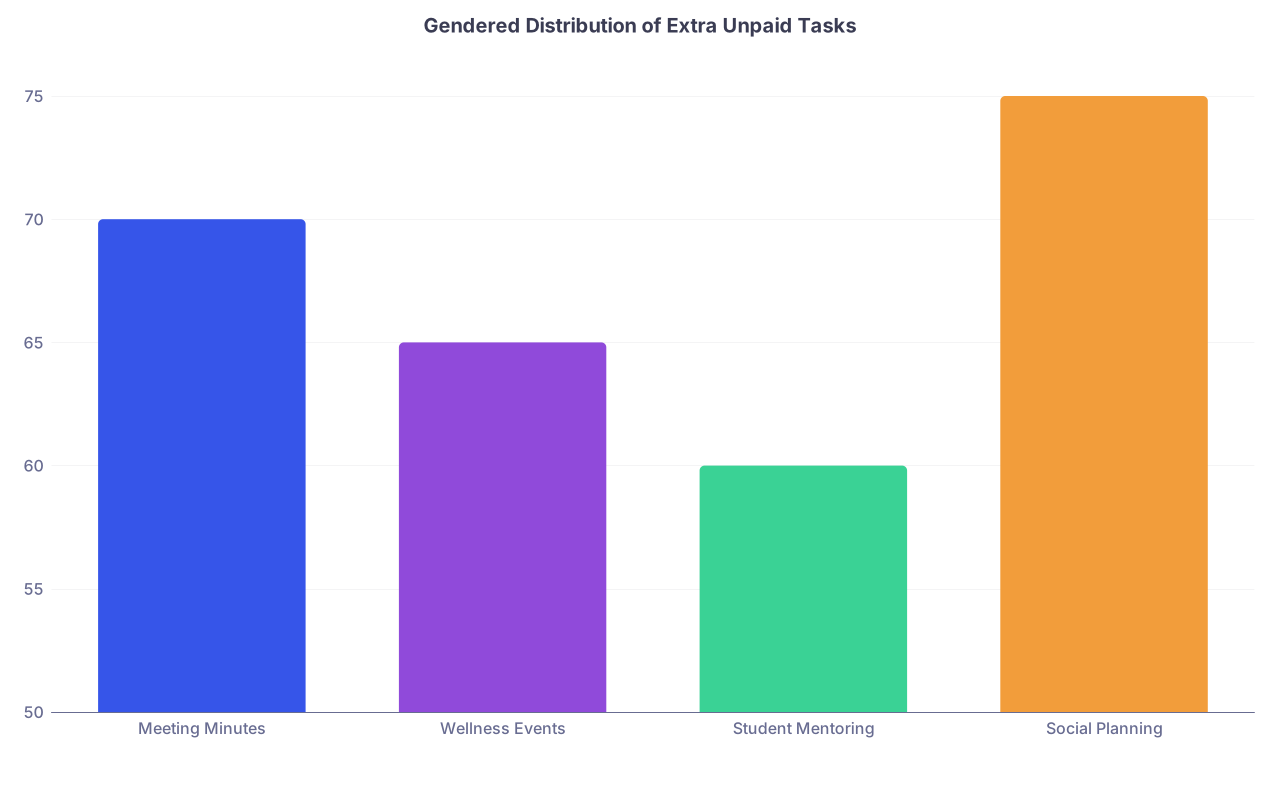
| Category | Value |
|---|---|
| Meeting Minutes | 70 |
| Wellness Events | 65 |
| Student Mentoring | 60 |
| Social Planning | 75 |
Step 5: Protect Your Evaluations and Reputation Strategically
You can’t just rely on “people will see the truth.” They won’t. You need evidence and proactive framing.
1. Make Your Actual Work Visible
Women get dinged for “not engaged” because their heavy work is invisible while the visible fluff goes to the “yes” people.
You fix that by:
- Sending short, factual update emails to supervisors:
“Quick update—this month I completed [X clinic metrics / Y teaching sessions / Z project milestones]. Planning next to [next concrete step].” - Logging teaching, mentorship, committee contributions in whatever system your institution uses, even if it feels obnoxious.
- When appropriate, stating your priorities out loud in meetings:
“Given my current commitments to the QI project and resident education sessions, I won’t be able to take on additional tasks this quarter.”
You’re drawing a line between “engaged in my core responsibilities” and “available for unpaid extras.”
2. Pre-Empt Vague Criticism in Feedback Meetings
Before an evaluation, you send a one-page summary of your contributions. Bulleted, not a novel.
In the meeting, if they say “some people have perceived you as less engaged,” you answer:
“I’d like to understand if there are specific concerns about my clinical work, teaching, or project performance. I’ve intentionally limited unpaid committee work to focus on these areas, so if there are gaps in my core responsibilities, I want to address those directly.”
You force them to distinguish between:
- You not doing your job (fixable, fair feedback)
- You not being endlessly available for unpaid side work (not legitimate performance criticism)
If they keep it vague:
“I’m very open to concrete feedback. Without specific examples tied to my role, it’s hard for me to improve meaningfully.”
Say it calmly. Then shut up.
Step 6: Build Allies Quietly, Not Performatively
You don’t need a public crusade. You do need a small network.
Aim for three types of allies:
Senior Woman (or man who actually gets it)
Someone who has made it through the system and will be blunt with you. Ask directly: “I’ve started saying no to some unpaid tasks, and I’m seeing social fallout. What’s the politically smartest way to protect myself here?”Peer Witnesses
Colleagues who can say, when needed, “Actually, she’s been doing X, Y, Z.” You build this by:- Collaborating on real projects
- Sharing credit generously
- Being transparent about what you are doing, not just what you refuse
Formal Support Structures
- GME office
- Faculty development or women-in-medicine group
- Ombuds, if your institution has one
You’re not running to them for every slight. You’re keeping them in the loop if:
- Evaluations start to show vague, personality-based negativity after you set boundaries
- Opportunities are clearly withheld in retaliation for saying no
Short, factual: “I’ve noticed a pattern where declining unpaid tasks seems to correlate with more negative, non-specific feedback about my engagement. I’d like guidance on addressing this while maintaining appropriate limits on my workload.”

Step 7: Decide When To Play The Long Game vs. Cut Your Losses
Some environments will never stop punishing women for saying no. You can be brilliant, kind, and boundary-respecting, and still be permanently labeled “not helpful enough.”
You have three options, and all of them are valid:
Play Minimal Game, Maximize Extraction
- Do the minimum extra visible stuff needed to stay off the radar (one low-effort committee, one token social thing).
- Pour the rest of your energy into skills, publications, or experience that move you out of that environment in 1–3 years. This is the “quiet exit strategy.”
Stay and Shape Culture (Slowly)
You:- Model structured nos
- Back other women up when they set limits (“Actually, we’ve all been stretched thin; rotating that job makes sense.”)
- Push for structural fixes: rotating minutes, formal roles with protected time, acknowledgment in promotion criteria
This is emotional labor. Only do it if you’ve decided consciously that it’s worth it to you.
Leave
If the social punishment escalates to:- Unfair evaluations despite strong performance
- Overt gendered comments
- Systematic blocking of opportunities
Start planning your move. Another hospital, another division, telemedicine, private practice, a different academic center.
Staying in a system that feeds on your free labor and punishes your boundaries is not noble. It’s just costly.

| Step | Description |
|---|---|
| Step 1 | Task Request |
| Step 2 | Structured No |
| Step 3 | Say Yes |
| Step 4 | Negotiate Conditions |
| Step 5 | Does it align with my goals |
| Step 6 | Has protected time or clear credit |
| Step 7 | Conditions met |
| Request Type | Default Bucket | Sample Structured Response |
|---|---|---|
| Meeting minutes | Default No | Suggest rotation/admin support; decline taking minutes yourself |
| Wellness committee | Conditional | Ask about protected time/credit; decline if none |
| Student mentoring | Conditional | One-time meeting, then shared/assigned mentor |
| Social event planning | Default No | Recommend rotating responsibility or admin support |
FAQs
1. Won’t saying no hurt my chances for leadership roles later?
If the only path to leadership in your setting is through unpaid, gendered labor, that’s a rigged game. The roles that actually matter for promotion and leadership—project leads, PI roles, formal committee chair positions—come with defined responsibilities and measurable outcomes. Focus on those. A few strategic yeses to meaningful, visible work beat a thousand invisible “she’s so helpful” tasks that never show up on your CV.
2. How do I respond when someone calls me “not a team player” after I say no?
Stay calm and pull it back to specifics: “I’d like to understand what aspect of my teamwork you’re concerned about—clinical coverage, communication, or project follow-through? I’ve limited unpaid extra tasks to keep my core responsibilities strong, but I’m very open to feedback on my actual team performance.” If they can’t cite specifics, you’ve exposed that the issue is your boundary, not your behavior.
3. What if another woman says yes to everything and makes me look bad?
Do not compete in the martyrdom Olympics. That colleague is feeding a broken system, often at tremendous cost to herself. You stay in your lane: high-quality core work, strategic yeses, clear boundaries. If leadership compares you, redirect: “We have different bandwidth and goals this year. I’m focusing on X and Y, which align with my promotion plan.” You’re not responsible for other people’s over-functioning.
4. When should I formally document or report social retaliation?
Start documenting the moment you see a pattern: timestamps, what you declined, what shifted afterward, specific comments or evaluation language. Consider reporting or seeking formal advice if:
- Your evaluations drop suddenly after you set boundaries.
- You get repeatedly described with vague negative terms (“difficult,” “not engaged”) without examples.
- Opportunities are clearly pulled in retaliation.
Bring documentation, stick to facts, and frame it as concern about fairness and professionalism, not personal drama.
Key points: You’re not wrong for saying no. You will sometimes be punished for it. Your job is not to fix the entire culture—it’s to protect your time, your career, and your sanity while choosing, deliberately, when to push back, when to play the game, and when to walk away.