
The worst part is not always the sexist comment. It is when your program shrugs and tells you—directly or indirectly—that this is just how things are.
If that just happened to you, you are not overreacting. You are in an ethics problem, a career problem, and a safety problem all at once. Let’s treat it like that.
This is the playbook for when you report a serious gender-based incident—harassment, discrimination, assault, retaliation—and your program yawns, minimizes, or quietly buries it.
Step 1: Name What Just Happened (To You, Not Just On Paper)
Before you decide what to do, you need to be brutally clear with yourself about what actually happened. Not the sanitized, “I’m sure they didn’t mean it” version your brain is already trying to write.
Ask yourself a few direct questions:
- Was the conduct about your gender, gender identity, or expression?
- Did it affect your safety, ability to work, evaluation, or opportunities?
- Did someone in power know about it and choose to do nothing or very little?
Examples I have seen or heard about (and yes, these are real):
- An attending tells a woman intern on rounds, “You’re too pretty to be in surgery, our patients will get distracted. Smile more and maybe we’ll keep you.”
- A patient repeatedly calls a woman med student “sweetheart” and grabs her wrist. The senior resident laughs: “He’s old school, just let it go.”
- A program director tells a pregnant resident, “We really prefer residents who are fully committed to training. The timing of your pregnancy is…unfortunate.”
- A co-resident circulates a sexually explicit meme about a woman fellow in a group chat. Chief residents “handle it” by telling her she’s “too sensitive for this specialty.”
If anything in your gut says: This is wrong and they’re blowing it off—you listen to that. Your instinct is usually more honest than the institutional response.
Write down right now:
- Exactly what was said or done.
- Who was there.
- When and where it happened.
- How your program responded (or failed to respond).
Not for drama. For accuracy. Your memory will blur under stress and fatigue. Get it out of your head and into somewhere safe.
Step 2: Separate Three Questions: Ethics, Safety, and Strategy
You’re not just asking “Is this wrong?” You’re asking three different questions:
- Is this ethically unacceptable?
- Am I safe if nothing changes?
- What strategy actually protects my career and my sanity?
Ethically: Your program has an obligation—not a suggestion—to take gender-based harassment and discrimination seriously. That’s not just “professionalism.” It’s Title IX territory (for med students and many trainees) and often Title VII (for employees). Shrugging off serious complaints is not “neutral”; it’s complicity.
Safety: If the person who made the comment/incident:
- Controls your evaluations
- Has a history of similar behavior
- Has ever retaliated against others
…then your physical, psychological, and career safety are active issues. When your program shrugs, they are telling you they will not protect you. You need to hear that.
Strategy: You do not have to choose between “burn it all down” and “stay silent.” There are multiple paths. Some are loud. Some are surgical. Some are quiet but very deliberate.
We’ll walk through them.
Step 3: Build a Private, Detailed Record (Starting Today)
If your program has already minimized or ignored a serious incident, stop relying on their documentation to protect you. You need your own.
Create a private log (not on hospital email, not on hospital devices):
- Date, time, location of the original incident.
- Exact words or behaviors as best you remember them.
- Who witnessed it.
- Every person you told about it, when, and how (email, in-person, text).
- Their responses—in as much detail and direct quotes as you can recall.
Do this in a simple document or encrypted notes app under a boring name. Back it up.
Then, start keeping running notes for any new interactions involving:
- The person who made the comment/incident.
- Anyone you reported it to.
- Any changes in your schedule, evaluations, or treatment that feel off.
You’re not being paranoid. You’re preparing for the possibility that you will need to show a pattern.
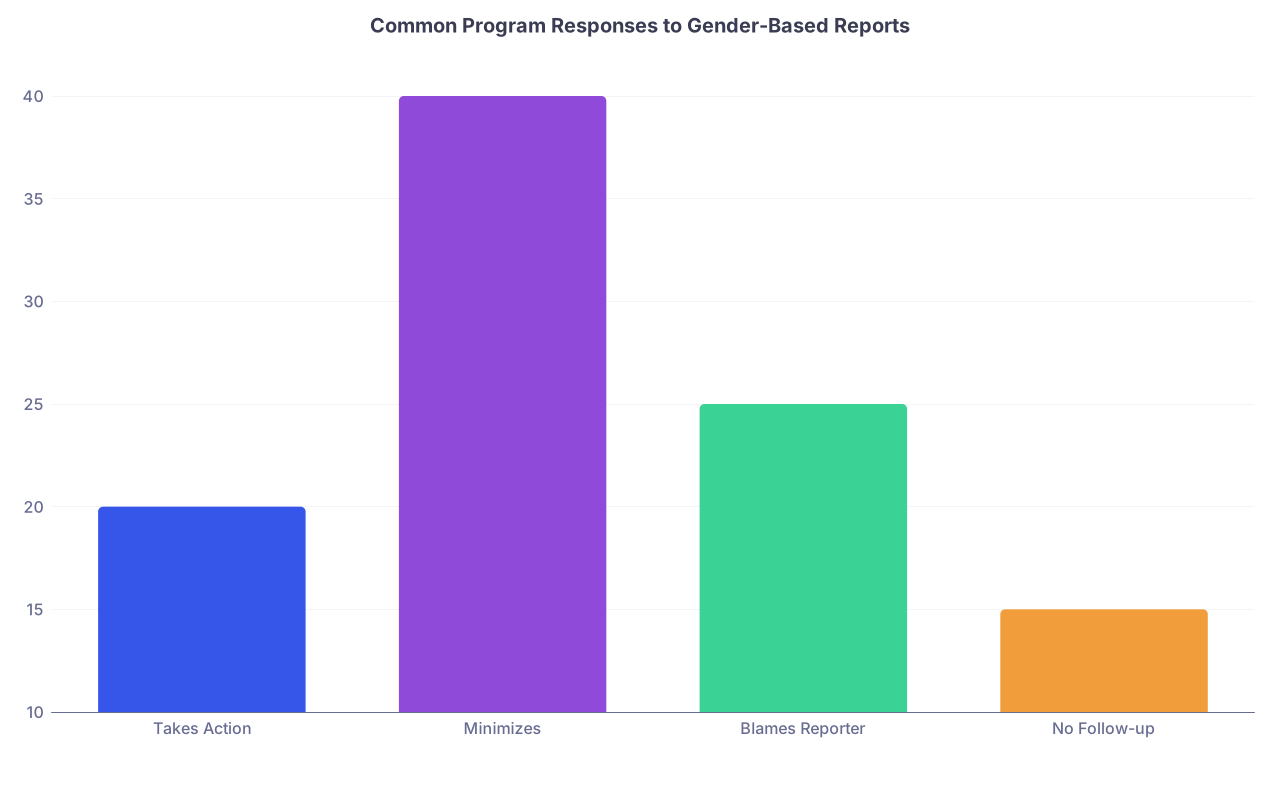
| Category | Value |
|---|---|
| Takes Action | 20 |
| Minimizes | 40 |
| Blames Reporter | 25 |
| No Follow-up | 15 |
Step 4: Clarify Exactly How Your Program “Shrugged It Off”
“Shrugged off” can look subtle. It’s not always someone saying, “We don’t care.”
Common patterns:
The “he didn’t mean it” minimization
“He’s from a different generation.”
“That’s just how she jokes.”
“He treats everyone like that.”The fake action
“We’re going to have him watch a professionalism video, so it’s handled.”
You never see any change. No documentation. No escalation.The delay tactic
“We’re still looking into it.”
“The committee hasn’t met yet.”
Months go by. Nothing.The shoulder tap
You hear from a chief or associate PD: “We just don’t want this to affect the team culture or your reputation. Maybe let it go?”
Label it clearly: Was it minimization, dismissal, retaliation-tinged, or performative?
That label matters, because it determines your next move.
Step 5: Identify Your Real Allies (Spoiler: They’re Often Outside Your Program)
If your program response is weak, do not keep bouncing your concerns around the same people who have already shown you their ceiling. Widen the circle strategically.
Potential allies and why they matter:
Title IX office (for med students and often residents in university-based programs)
They exist specifically for discrimination and harassment based on sex/gender. They are separate from your program leadership. They can force processes the PD does not control.GME office / Designated Institutional Official (for residents/fellows)
They care about ACGME accreditation and institutional liability. A pattern of ignored serious incidents is their problem.Ombudsperson (if your institution has one)
Confidential, off-the-record discussion. They cannot fix everything, but they can help map out options and risks.Employee relations / HR
Mixed bag. They work for the institution, not you. But they do care about legal exposure. A documented gender-based complaint with no response is liability. Use that.Wellness/mental health services
Not for reporting. For survival. A good therapist who understands academic medicine can help you think clearly when you’re gaslit and exhausted.
| Role/Office | Best For |
|---|---|
| Title IX | Harassment, discrimination, assault |
| GME/DIO | Residency/fellowship oversight issues |
| Ombudsperson | Confidential strategy discussion |
| HR/Employee Relations | Policy violations, hostile work environment |
| Confidential Therapist | Coping, planning, reality-checking |
Notice what’s not on that list: “Trust the same program leader who already dismissed you.” You can loop them back in later if needed. For now, you’re building leverage and options.
Step 6: Decide Your Goal Before You Speak Again
You have more than one possible goal. Do not mix them up in the same breath.
Possible goals:
- Protect yourself from further harm.
- Protect others (especially more junior women or trainees).
- Create documentation that the institution cannot ignore later.
- Get the specific person disciplined, removed from teaching, or formally warned.
- Prepare to transfer programs or change rotations.
- Prepare for a formal complaint or legal route.
You cannot maximize all of these at once without cost. For example:
- Going nuclear to remove an attending might be absolutely justified—but it may close doors to future letters from that department.
- Staying quiet to protect your evaluation might mean another student gets hurt later.
You get to choose your priority. There is no morally pure choice that magically avoids risk. Anyone telling you there is has not been in this position.
Be honest with yourself:
“If I had to pick two goals only, what would they be?”
Write them down. Use them to filter your decisions.
Step 7: Upgrade Your Communication: From “Concerned” to Precise and Documented
If your program shrugged once, the next communication needs to be sharp, factual, and written. You are no longer in the “casual mention in the hallway” phase.
Email format you can adapt (from your personal, but professional, voice):
Subject: Follow-up on [date] report of gender-based incident
Dear Dr. [Name],
On [date], I reported to you that [brief description of incident: who, what, where]. I expressed concern that this conduct was gender-based and affected my ability to feel safe and supported in the learning environment.
Since then, I have observed [describe any response, or “no response”]. I remain concerned that the issue has not been adequately addressed and that similar behavior could continue, toward myself or other trainees.
I would like to understand:
- What steps have been taken in response to my report.
- How the program plans to ensure a safe and non-discriminatory environment moving forward.
I appreciate your attention to this and would welcome a meeting this week to discuss concrete next steps.
Sincerely,
[Your Name], [Your Role, PGY level or MS year]
That email does a few critical things:
- Uses the words “gender-based” and “non-discriminatory environment.” That’s legal language, not vague “vibes.”
- Asks specific questions about action, not “how can we all get along.”
- Creates a timestamped record of their (in)action.
If they stonewall or send a fluff response, that becomes useful documentation for Title IX, GME, or HR.

| Step | Description |
|---|---|
| Step 1 | Serious gender-based incident |
| Step 2 | Report to program leadership |
| Step 3 | Monitor and document |
| Step 4 | Document in detail |
| Step 5 | Contact Title IX or GME |
| Step 6 | Consider HR/legal/transfer |
| Step 7 | Maintain records and support |
| Step 8 | Program response appropriate |
| Step 9 | Need further action |
Step 8: Use the System’s Own Rules Against Its Shrug
Most institutions have written policies that sound great on paper. Use them.
Find (on your institution’s website):
- The Title IX policy.
- Anti-discrimination and anti-harassment policy.
- GME policies on resident/fellow mistreatment.
- Your med school’s or hospital’s “Code of Conduct.”
You’re looking for phrases like:
- “Zero tolerance for harassment.”
- “Prompt and thorough investigation.”
- “Retaliation is prohibited.”
- “Safe learning environment.”
When you escalate—to Title IX, GME, HR, ombud—you quote their own policy back:
“Your policy states that all reports of gender-based harassment will be promptly and thoroughly investigated. I reported X on [date] to [person]. To date, the only action has been Y. I am concerned this does not meet the standard in your written policy.”
That sentence lands differently than “I feel like no one cares.” Institutions understand “you are not following your own rules” as a serious red flag.
Step 9: Manage the Retaliation Risk Without Gaslighting Yourself
Here’s the uncomfortable truth: retaliation happens. Programs will swear up and down that they never do this. Then somehow:
- Your schedule changes to all the worst rotations.
- You suddenly “need to work on professionalism” in evaluations.
- You’re excluded from research or teaching opportunities.
- People start calling you “difficult,” “not a good fit,” “too emotional.”
If your program shrugged at a serious incident, you should assume they’re also at risk of retaliating, even if unintentionally.
What to do:
- Document every change after your report. Dates, people, content.
- Keep copies of your prior evaluations. You need “before” and “after” data.
- Forward key emails to a personal email account (no PHI, no patient info).
- Tell at least one trusted person outside your program what you’re seeing.
If things start shifting and you suspect retaliation, you use the actual word:
“I am concerned that these changes may constitute retaliation for my prior report of gender-based harassment/discrimination.”
Title IX, HR, and GME all take that word seriously when it is backed by specifics.
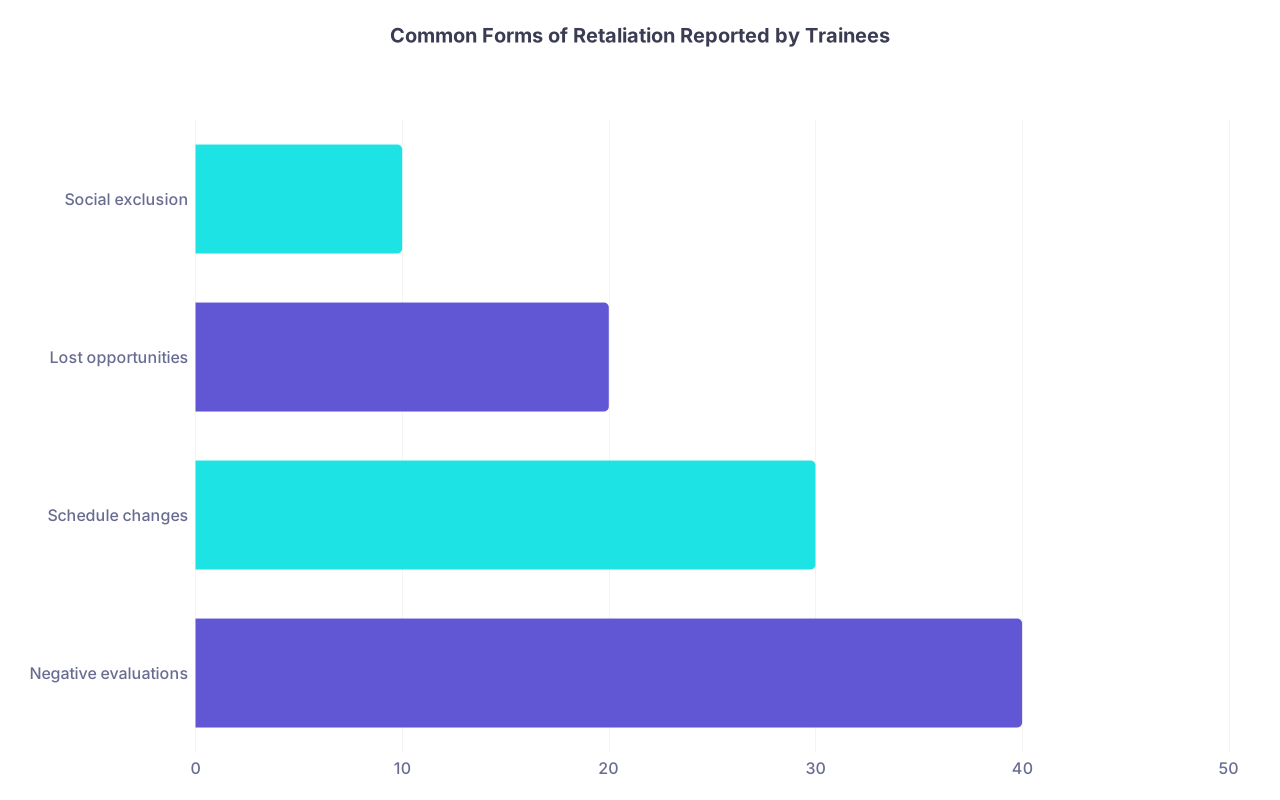
| Category | Value |
|---|---|
| Negative evaluations | 40 |
| Schedule changes | 30 |
| Lost opportunities | 20 |
| Social exclusion | 10 |
Step 10: Consider the Nuclear Options Early, Not After You Break
There are three “big moves” people often delay until they’re completely burnt out:
- Requesting a change in rotation site, team, or supervisor.
- Requesting a transfer to another program or campus.
- Filing a formal Title IX/HR complaint or consulting an attorney.
I’m not telling you to do all or any of these. I am telling you to think about them now, while you can still think, not when you’re in full crisis.
Questions to ask yourself:
- Could I do my required training while minimizing contact with this person/department?
- If I had to leave this program, what would I need—letters, case logs, evaluations?
- If my worst-case scenario is staying here for 2–4 more years with no change, is that survivable for me?
Call this the “escape hatch inventory.” You might not pull it. But you’ll know where it is.
If you decide to explore legal advice:
You quietly consult an employment or civil rights attorney with experience in academic medicine or higher education. You bring your documentation. You ask: Given this pattern, what are my options, my risks, and my leverage?
Good lawyers will often tell you not to file a lawsuit today. They might help you write a letter that gets the institution’s attention. Or they might advise you to keep documenting until you have a stronger case.
Step 11: Protect Your Sense of Reality (They Will Try to Distort It)
When a gender-based incident is shrugged off, the secondary trauma is the gaslighting.
You’ll hear:
- “Are you sure you’re not misinterpreting?”
- “I’m sure he didn’t mean it like that.”
- “We all went through stuff like this; you just have to be tough.”
- “You don’t want to be known for this.”
If you hear this enough, you start rewriting the story:
Maybe I am too sensitive. Maybe I did overreact. Maybe this is just medicine.
Stop. Check against these anchors:
- If this exact incident happened to your best friend or sister, and leadership shrugged, would you tell her she’s overreacting?
- Would this be acceptable in any other professional setting—law firm, tech company, bank?
- Does the behavior clearly violate the institution’s own policies?
When the answers line up as “this is wrong,” trust that. Then surround yourself with at least a couple of people who see it too—a co-resident, mentor at another institution, therapist, women-in-medicine group, alumni network.

Step 12: Decide Who You Want to Be in This Story
This sounds lofty, but it’s actually very practical.
You’re in a values conflict. Your internal questions:
- Do I want to be the person who tried to protect others, even if no one gave me a medal?
- Do I want to be the person who prioritized survival and finished training intact, even if I let some things go?
- Do I want to be the person who used the system’s own rules to force change, even if it made me unpopular?
All three are valid. What you cannot be is all three to the maximum at the same time.
So you decide:
“For the next 6–12 months, my priority is [X]. I will act in ways that align with that, and I will not torture myself for not also being [Y and Z].”
That clarity makes the miserable parts at least coherent. You’re not flailing. You’re choosing.
A Quick Example Scenario: What It Looks Like in Practice
Let’s make this concrete.
You’re a PGY-2 in internal medicine. On night float, an attending tells you, in front of the team, “We like our women residents to be nurturing, not bossy. Let the male interns take the lead on codes.” You feel gutted and furious.
You tell your chief next day. Chief says, “Yeah, he’s problematic. I’ll talk to him.” Week later, nothing. Same attending now barely speaks to you. Your next eval from him says you “struggle with team dynamics.”
What you do, stepwise:
- You write down exact words from the comment and the timing of the eval.
- You email the chief: “Following up on the gender-based comment I reported on [date]…”
- Their response is vague. You forward your log and emails to your personal account.
- You schedule a meeting with GME or the program director, and in that meeting you use the words: “gender-based comment,” “impact on my clinical role,” “concern about retaliation.”
- You follow that meeting with a short summary email: “As we discussed today, I reported… I understand that next steps are…”
- If that goes nowhere, you contact the institutional GME office or Title IX, referencing their own policies and your timeline.
- Meanwhile, you identify a different attending who values your work and ask them proactively for a concurrent evaluation or letter to counterbalance the bad one.
- You talk to a therapist or trusted mentor outside your program to keep your reality intact.
This is not about being dramatic. It is about refusing to quietly absorb other people’s ethical failures as your “professional development.”

Final Thoughts
Three things to carry out of this:
- A serious gender-based incident with a shrug response is not a “misunderstanding.” It is an institutional failure you are allowed to treat as such.
- Your power comes from precise documentation, using the system’s own policies and language, and widening your circle beyond the people who already dismissed you.
- You get to choose your priority—protection, change, or survival—and align your actions with that choice without apologizing for not doing everything at once.
You are not the problem here. But you do have to decide how you’re going to respond to it.