
The worst thing you can do when a male resident keeps undermining your orders is to quietly “be the bigger person” and hope it stops. It will not. It will escalate, damage patient care, and brand you as someone who can be overridden.
Here’s how you handle it like a professional who intends to keep her authority — and her sanity.
First, Get Clear: What “Undermining” Actually Looks Like
You are not crazy or “too sensitive” for noticing patterns. Undermining has a very recognizable flavor.
Think concrete behaviors, not vague vibes. For example:
- You write for IV Lasix 40 mg. Ten minutes later he tells the nurse, “Let’s just do 20 mg, she’s probably fine,” without paging you.
- In rounds, you lay out a plan. He immediately contradicts you, loudly, with eye-roll energy: “Well actually, I already talked to nephrology and they said…” (he didn’t) — in front of the whole team.
- A nurse says, “Dr. X told me to do Y.” He responds, “No, do this instead, I’m the resident,” again, without clarifying with you.
- He “clarifies” your orders by saying things like, “Don’t worry about what she wrote, we’ll do it my way,” or “Attendings write a lot of ‘just in case’ stuff, we’ll see what’s really needed.”
If you recognize this, that’s not “different styles.” That’s someone eroding your authority and confusing the care hierarchy.
You’re in the WOMEN IN MEDICINE zone here, yes, but do not fall into the trap of thinking this is just a “feelings” issue. This is about:
- Patient safety
- Chain of command
- Professionalism
- Gender dynamics, often — but handled through concrete, policy-based steps
You’ll anchor your response in patient care and hospital policy, not “He hurt my feelings.”
Step 1: Stop the Immediate Harm — Clean, Calm Redirects
Your first priority: protect patients and re-establish clear lines in the moment.
You are not going to give big speeches during a code or mid-ED chaos. You use short, crisp, public corrections that reset the chain of command and then save the deeper conversation for later.
Here are ready-made lines. Use them almost verbatim.
Scenario: He changes your order with the nurse in front of you or the team.
You say:
- “No, we’re going to keep the original order. The plan is X. If you disagree, talk with me first before changing it.”
- “For clarity: I’m responsible for this patient’s plan. The order stands as written. Let’s discuss any concerns after we stabilize things.”
- “Please do not change my orders without discussing it with me. That creates confusion and is unsafe.”
There will be a beat of awkward silence. Good. That silence is where the team learns who’s in charge.
Scenario: He contradicts you on rounds in a performative way.
You say:
- “Let’s pause. I’m the attending on this patient. The plan is A, B, C. If you think something else is better, bring it to me directly, not as a side conversation with the team.”
- “I appreciate input, but the final plan comes from me. Right now the plan is X. We can talk offline about your concerns.”
You’re not arguing about medicine in that moment. You’re asserting structure. He may be right or wrong on the content; the process is the problem.
Scenario: Nurse is caught between you and him.
You say (so the nurse hears your authority clearly):
- “If you ever receive a change to my orders, please check with me directly before acting on it. I’m responsible for this patient’s care.”
- “If there’s confusion between what I wrote and what Dr. Y says, default to my written orders and page me.”
You want nurses to know you support them following the correct hierarchy. They hate being in the middle. Give them cover.
Step 2: Have the Private Conversation — Early, Direct, Documented
Do not wait until you’re ready to scream. The longer you let this go, the more he’ll believe it’s acceptable.
You pull him aside. Not in the hallway where everyone can hear. A call room, conference room, an empty workroom. Door mostly closed.
You keep it short and professional, not emotional.
Base script:
“Let me be clear about something. I’m seeing a pattern where you’re changing or contradicting my orders with the team and with nursing without speaking to me first. That’s not acceptable. It undermines patient safety and the chain of command.
If you disagree with a plan:
- You bring it to me directly
- We discuss it
- Then we present a unified plan to the team
If you continue to override my orders without discussing, I will have to formally address it with the program and service leadership. I want you to learn and advocate for patients. But not by disregarding the attending in charge.
Any questions about that?”
Then stop talking. Silence forces him to respond to the actual point.
You’re not asking permission. You’re setting a boundary.
You’re also doing something critical here: you’re creating a clear moment you can later reference in writing (“I spoke with Dr. X on [date] and clearly instructed him not to change my orders without discussing them with me”).
If he gets defensive and says things like, “I’m just advocating for patients” or “I thought you’d want to do it this way,” you respond:
“I welcome input. What I do not accept is you changing what I’ve ordered without talking to me. Going forward, you need to page me or speak to me directly before altering any plan I’ve made. That’s the expectation.”
Step 3: Start a Quiet, Factual Paper Trail
You are not being dramatic. You are protecting yourself and your patients.
You need documentation, especially as a woman dealing with a male resident. Because when this escalates (and it often does), stories shift. You want facts.
What to document:
- Date and time of each incident
- Patient initials / MRN (do NOT store this in personal email or phone; use secure, hospital-sanctioned notes or locked notebook you treat as potential medico-legal documentation)
- Exactly what happened
- Who was present (nurse name, other residents, etc.)
- Exact language if egregious (“He told the nurse ‘Ignore that attending order, I know what she meant’”)
- Any patient impact (delay, confusion, near-miss, actual harm)
You do not editorialize in your notes. No, “He was such a jerk.” You write like you’re charting:
“On 11/15, 09:30, patient AB (MRN ending 1234) – I ordered IV Lasix 40 mg for acute pulmonary edema. At 09:45, RN Smith informed me resident Dr. John Doe instructed her to give 20 mg instead, without contacting me. I confirmed with RN that this was his direct verbal order. I clarified with RN that my original order stands and instructed RN to follow attending orders unless directly changed by me.”
Why this matters:
- If you need to go to the PD, DIO, HR, or legal, you have specifics.
- It protects you if something goes wrong ("Why was Lasix changed?")
- It shows a pattern, not “one bad day.”
Step 4: Loop in Allies Early — Not as a Last Resort
This is where a lot of women mess up: they wait until they’re desperate, then reach out. By then, damage is done and it looks like a personal conflict.
You want calm, early, professional escalation.
Who you can talk to:
- Your service chief or section head
- The residency program director (PD)
- An associate PD you trust
- A senior female colleague who actually has clout (not just “nice,” but respected and willing to back you)
- GME office if it crosses into harassment territory
You do not go in with, “He’s sexist.” You go in with, “Here are three specific episodes where he changed or undermined my orders without discussing them with me, creating risk to patients and confusion for staff.”
Example email to PD (short, to the point):
“Dr. [PD],
I’d like a brief meeting regarding a professionalism and supervision concern with one of your residents, Dr. [Name]. I’m seeing a pattern of him changing or contradicting my patient care orders without discussing them with me, which is creating confusion among nursing staff and could compromise patient safety.
I’ve already spoken with him directly and clearly about this expectation, but the behavior has continued. I have specific examples with dates/times and am happy to share them.
Can we find 15 minutes this week to discuss?
Best,
[Your Name], [Your Title/Division]”
Notice two things:
- You’ve already addressed it directly with the resident.
- You frame it as supervision, safety, and professionalism — the holy trinity PDs actually care about.
Step 5: Use Structure and Policy As Your Backbone
You are not going to win this by having the best personality. You win by leaning on structure.
Know your hospital’s:
- Supervision policy (often spells out attending vs resident authority)
- Professionalism policy
- Harassment or discrimination policy
If you’re attending-level, you can say to the resident:
“Supervision policy is clear: attending is responsible for the care plan. Your role is to raise concerns to me, not to override me with nursing. We’re going to follow that.”
If you’re a senior resident and the underminer is a male co-resident or junior:
Same pattern, slightly different framing:
“I’m the senior on this service. You need to run changes in plan by me so we present one unified plan to the attending and to the team. Telling the nurse to do something different than what I’ve ordered without talking to me is not acceptable.”
If he tries to use “but the attending told me X,” then:
“Great, then the attending should update the orders or we can both talk with them. Until then, we follow the existing orders. This is about keeping a clear and safe chain of command, not about who’s right.”
Step 6: Handle the Gender Piece Without Letting Them Dismiss You
Let’s not pretend this isn’t gendered most of the time.
The male resident who “just had a concern” with your order will somehow manage to follow the male attending’s orders without “clarifying” them with the nurse. He argues with you. He says “Yes, sir” to them.
You have two options here, depending on your environment:
Option A: Quietly ensure senior men back you in public
This is tactical and often effective:
- Ask a supportive male attending or senior to explicitly back your authority in front of the resident: “Dr. [You] is running this service. Her orders are the plan. If you disagree, bring it to her, not to staff.”
- During rounds, if he mouths off, you look to the senior faculty: “Dr. [Senior], can you clarify for the team how you’d like disagreements about plans to be handled?”
You know what the answer should be. Now it’s on the record.
Option B: Explicitly name the pattern to leadership
With PDs or chiefs you trust, you can say what’s actually happening:
“I’ve noticed Dr. X does not do this with male attendings. He repeatedly questions or overrides my orders in front of staff, but not theirs. From my perspective, there’s a clear gender dynamic here.”
Reason? Discrimination patterns matter. GME is (slowly) waking up. They can’t fix what they don’t see.
Don’t expect miracles. But getting “This is partly gendered behavior” into the official discussion forces the program to at least pretend to care.
Step 7: Protect Your Reputation While You Stand Your Ground
Here’s the trap: as a woman, you will get labeled. Either you’re “too soft and get walked on” or you’re “difficult.”
You’re going to pick “firm, professional, and very hard to gaslight.”
Action points:
- Stay calm in public. You can be direct, even sharp, but not unhinged. No raised-voice hallway fights.
- Keep your tone low and steady when you correct him: “No, the order stands. Talk to me after rounds if you have any concerns.”
- Avoid snark in the chart. No passive-aggressive “per resident’s curious change…” in notes. Chart facts only.
- Make sure nurses know you support them following proper channels, not playing sides. They talk. A lot. You want them saying, “She’s clear, she protects us, she doesn’t throw people under the bus.”
If someone later calls you “intense,” you can live with that. Better than “easy to ignore.”
Step 8: Know When to Escalate Hard
There’s a threshold where this stops being “training issue” and becomes “serious risk and misconduct.”
You escalate aggressively if you see:
- A pattern of him ignoring your orders leading to near misses or actual harm
- Retaliation when you set limits (e.g., bad-mouthing you to other residents, whisper campaigns with nurses, eye-rolling, refusal to speak directly to you)
- Sexist comments (“She’s overreacting,” “You know how some female attendings are,” “She’s just emotional about it”)
- Sabotage (deliberate delay in carrying out orders, “forgetting” pages, altering documentation)
At that point, you’re not just talking to the PD. You may need:
- Service chief / department chair
- GME office
- Hospital professionalism or physician conduct committee
- HR if it crosses into harassment / hostile work environment
You go in with your documentation and a very simple line:
“This isn’t a personality conflict. I’ve documented repeated episodes where Dr. X changed my medical orders without my knowledge or consent, in ways that could compromise patient safety. I’ve spoken to him directly. The pattern has continued. This needs a formal response.”
A Quick Tool: Distinguish Constructive Pushback From Undermining
You do not want to train residents to be silent. You want them to think critically and speak up. So draw a clean line in your head.
| Behavior Type | Constructive Pushback | Undermining |
|---|---|---|
| Where it happens | Directly to you, in private or respectful team discussion | Behind your back to nurses or other residents |
| Tone | Curious, focused on patient care | Dismissive, eye-rolling, undercutting |
| Action | Raises concern, then follows final plan | Changes orders or directions without approval |
| Result | Better shared plan, clear hierarchy | Confusion, mixed messages, potential safety risk |
If it’s in the right column, it’s your job to shut it down.
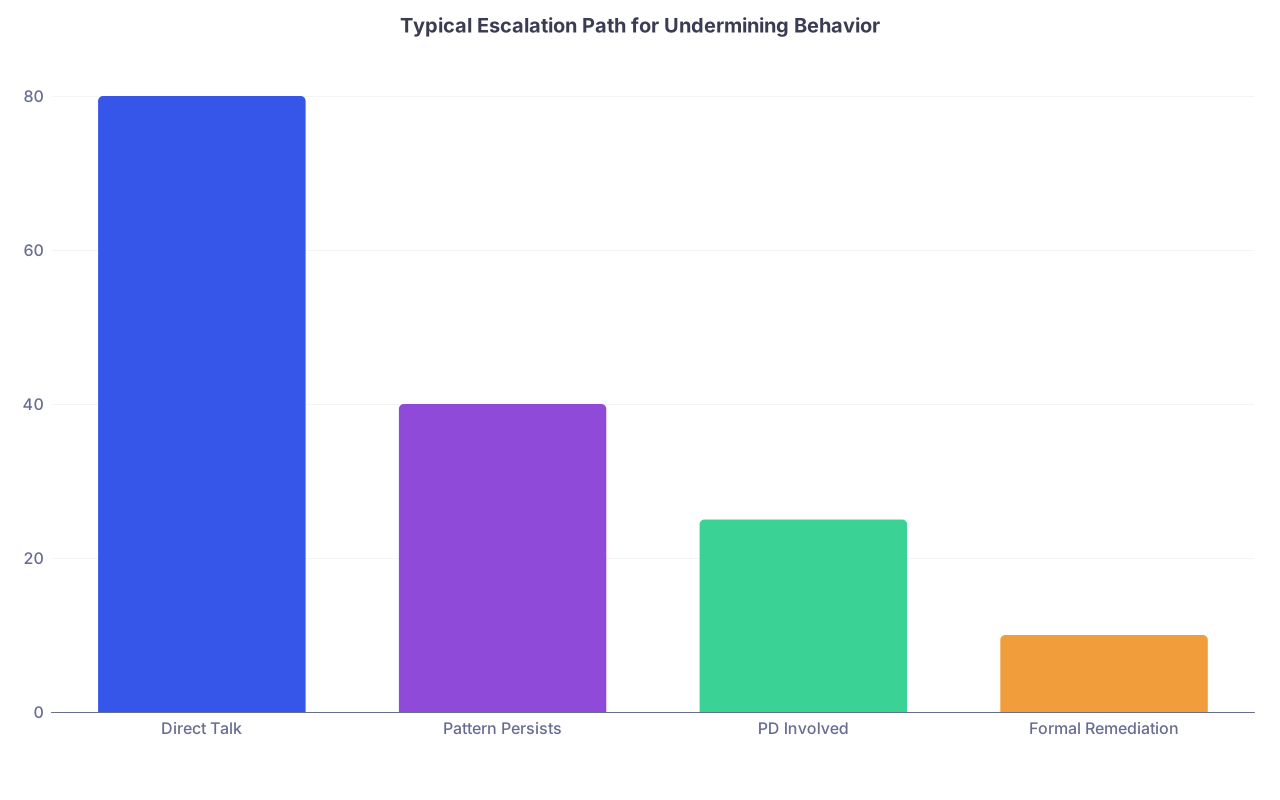
| Category | Value |
|---|---|
| Direct Talk | 80 |
| Pattern Persists | 40 |
| PD Involved | 25 |
| Formal Remediation | 10 |
How to Train Yourself to Respond in Real Time
You will not magically come up with the perfect line when your adrenaline spikes. You need a few go-to phrases you can almost say on autopilot.
Write them on a sticky note. I’m serious. Stick it in your white coat.
Examples:
- “No. The plan is as I ordered. If you disagree, we can talk privately after this.”
- “For safety, please do not change my orders without discussing it with me.”
- “I’m the attending on this case. The team will follow my orders. Bring concerns to me directly.”
Practice saying them out loud once or twice. It’ll feel awkward. Then when you need them, your mouth won’t freeze.

| Step | Description |
|---|---|
| Step 1 | Incident occurs |
| Step 2 | Correct in moment |
| Step 3 | Document facts |
| Step 4 | Private conversation |
| Step 5 | Monitor quietly |
| Step 6 | Escalate to PD/chief |
| Step 7 | Formal institutional process |
| Step 8 | Close loop and debrief |
| Step 9 | Behavior stops? |
| Step 10 | Still persists or retaliation? |

Protecting Your Future While You Fix the Present
Long term, this is about more than surviving one problematic resident. It’s about building a reputation where people think twice before trying this with you.
A few strategic moves:
- Be very clear and organized with your plans. A messy, constantly changing plan is easier to challenge.
- Over-communicate with nursing: “For this patient, if you hear anything different from what I ordered, page me before changing anything.”
- After a major dust-up, send a short, neutral summarizing email:
“Dr. X, as we discussed today, any changes to my orders for patients under my care should be discussed with me first, to maintain clarity and safety. Thank you for your cooperation.”
Now it’s written down. - Build a reputation as someone who backs up good residents hard. When you champion them, they will champion you. And word spreads: “She’s tough but fair. Do not play games with her.”
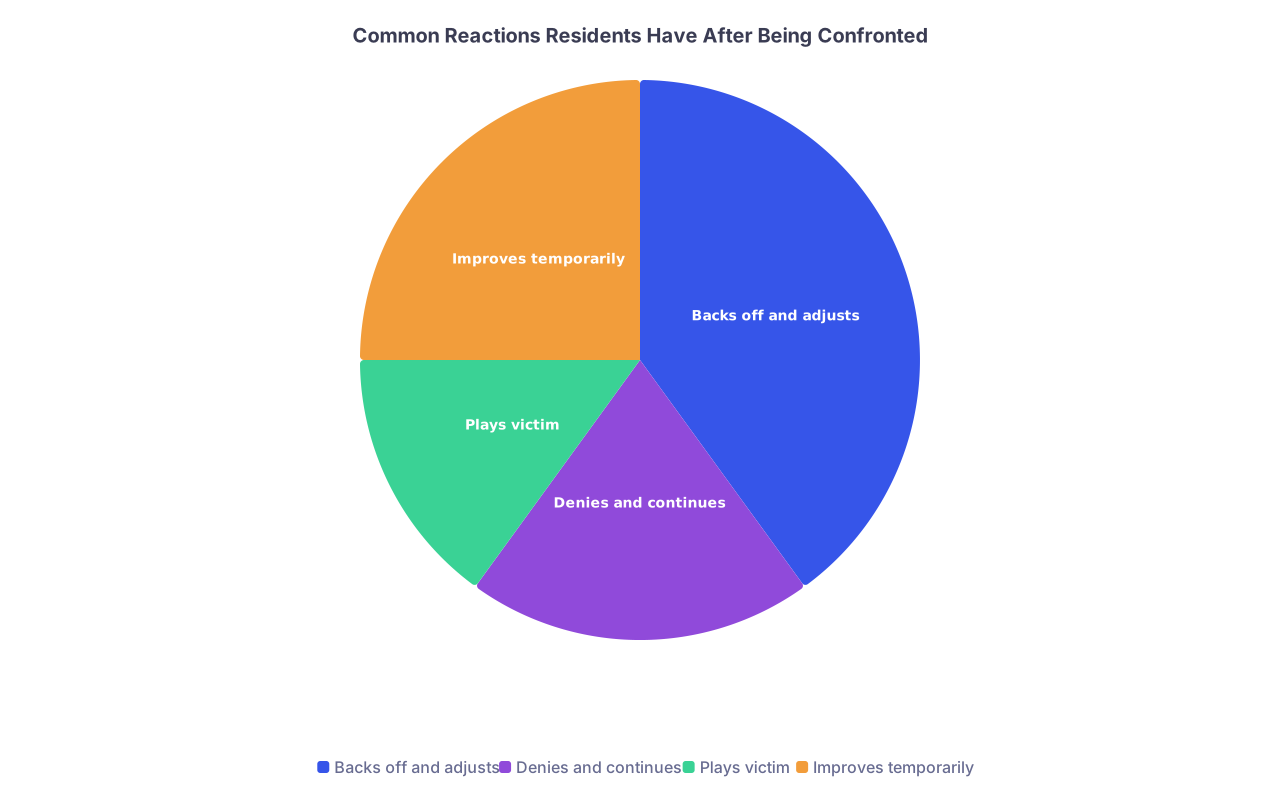
| Category | Value |
|---|---|
| Backs off and adjusts | 40 |
| Denies and continues | 20 |
| Plays victim | 15 |
| Improves temporarily | 25 |

When You’re the Trainee, Not the Attending
If you’re a female intern or junior resident dealing with a male senior who undermines your orders (or your attending’s orders through you), you tweak the approach but keep the backbone.
You say:
“Dr. X, I’m the primary resident on this patient and I’m carrying out Dr. [Attending]’s plan. If you think something should be different, let’s both discuss it with them. I’m not comfortable giving nurses instructions that contradict the attending’s orders unless we’ve cleared it.”
If he keeps doing it, you go to your attending and say:
“I’m having trouble with Dr. X repeatedly changing or contradicting your plan through the nurses without involving me or you, and it’s making it hard to care for the patient safely. Can you help set expectations with him?”
Good attendings will step in hard. If they do not, that tells you a lot about your environment — and reinforces the need for your own documentation and future allies.

The Bottom Line
Three things to keep front and center:
- You’re not “overreacting.” A male resident repeatedly undermining your orders is a safety, professionalism, and hierarchy problem — often with a gender edge — and it must be addressed.
- Handle it in layers: correct in the moment, have a direct private conversation, document each episode, and escalate calmly but firmly if it continues.
- Anchor everything in patient care and policy, not personality. You’re not asking to be liked. You’re insisting on a clear, safe chain of command — and training everyone around you to take your authority seriously.