
Last week on rounds, a third-year resident started presenting an admission she’d stayed late to work up. Two sentences in, an outspoken male co-resident cut in, “Yeah, so basically he’s in florid heart failure,” and took over. The attending turned to him, started asking questions, and within 15 seconds, she was invisible in a case she owned.
If that feels uncomfortably familiar, you’re not imagining it and you’re not oversensitive. It happens to women in medicine constantly—on rounds, in case conferences, in family meetings. Let’s talk about what to do in the moment, and how to change the pattern over time without burning yourself out.
1. First: Read the Situation Fast
You do not have time for a full social analysis in front of the whole team. You have about three seconds to decide what you’re dealing with.
Ask yourself, very quickly:
- Who interrupted me?
- Is this a one-time thing or a pattern?
- Is the attending engaged and watching, or distracted and halfway down the hall?
You’re mainly sorting into three buckets:
- The enthusiastic blurter (no malice, low awareness).
- The chronic interrupter (pattern, usually a power move).
- The attending-driven redirect (you were cut off because the attending moved on).
You’ll handle each a little differently, but the first step is the same: do not disappear. If you fold and go silent, you teach everyone that you’re safe to talk over.
That does not mean you need to be aggressive. It means you need a default, calm, practiced response ready. So you don’t freeze.
2. Your Immediate, In-the-Moment Toolkit
Picture this: You’re the sub-I on medicine. You start: “Mr. Smith is a 65-year-old male with a history of—” and your male co-student jumps in with, “He came in with shortness of breath and chest pain since—”
Here’s how to handle this in real time.
A. The Calm Verbal Reclaim
You’re aiming for neutral, firm, and brief. Not apologetic. Not a TED talk.
Lines that work:
- “I’ll finish the summary and then we can add details.”
- “Let me complete the HPI and then we can discuss.”
- “I’m almost done with the HPI—then I’d like to go through the assessment.”
You look at the attending when you say it, not the interrupter. You’re signaling: I’m still the one presenting this case.
Example:
You: “Mr. Jones is a 72-year-old—”
Co-resident: “Yeah, he came in super hypoxic, sats in the 80s—”
You (turn slightly toward attending): “I’ll finish the HPI and then we can go over the ED course.”
Then keep going as if that’s normal. Because it should be.

B. The Nonverbal Anchor
Sometimes you do not need words. You just need to keep control of the floor.
Tactics:
- Physically position yourself next to or slightly in front of the attending at the start of rounds. If you’re presenting, do not stand three people back behind a tall co-resident.
- Use your notes or tablet as a “talking object” in your hands. When you keep looking at it and talking, people are less likely to bulldoze.
- If someone cuts in briefly, you can pause half a beat, look at them, neutral face, then resume exactly where you left off.
The key is: do not laugh it off, do not shrink back, do not literally step behind someone. Your body teaches people how to treat you.
C. When the Attending Is the One Redirecting
This is where it gets tricky. Attending interrupts, points a question at someone else, or walks away while you’re mid-sentence.
Two possible causes:
- They’re rushing and not thinking about the dynamics at all.
- They don’t see you as the primary owner of the case.
You can still quietly stake some ground:
Attending: “Ok, so he’s in heart failure. [Turns to senior.] What’s your plan?”
You: “I have an initial plan I worked out last night—after that, I’d like your input.”
Then give your plan succinctly. No monologue. But you’ve now said: I came prepared. I have thoughts. I’m not a scribe.
If they literally walk off mid-presentation (yes, happens), finish one meaningful sentence to the team: “So, his troponins were flat and EKG unchanged from baseline—no current evidence of acute ischemia.” That’s for the record and for yourself. Then move on.
3. Handling Repeat Offenders on the Team
Now we’re moving from “that was annoying” to “this is a pattern.” The co-resident who constantly answers questions directed at you. The fellow who hijacks your assessment every. single. time.
This is where women in medicine get stuck: you do not want to be labeled “difficult,” but you also cannot silently accept being sidelined.
Here’s how to handle it like a professional, not a doormat.
A. Name It Briefly In The Moment
You do not need a TED Talk on patriarchy on rounds. You need one sentence.
Examples:
- “I hadn’t finished the assessment yet—I’ll continue and then I’m happy to hear your thoughts.”
- “I was about to address that—let me complete my reasoning first.”
- “I’d like to answer since I admitted her last night.”
Again, look at the attending, not the offender. You’re talking to the authority in the room.
B. One-on-One, Off-Stage Conversation
This is where real behavior change tends to happen. Not on rounds. Not in front of the attending. In a quiet hallway or workroom.
Script this before you go in; you’re not improvising.
Format that works:
- Describe the pattern (specific, neutral).
- State the effect.
- Say what you want going forward.
Example:
“Hey, can I grab you for a second? I’ve noticed on rounds that when I’m presenting, you often jump in and answer questions that were directed to me or finish my HPI. When that happens, it makes it harder for me to demonstrate my reasoning and get feedback. I’d appreciate it if, when I’m presenting, you could give me a chance to finish before adding your thoughts.”
You’ll see one of three reactions:
- Genuine surprise + apology → great, problem probably improves.
- Defensive minimization (“Oh, I do that to everyone”) → stay calm: “Maybe—but I’m telling you it affects my ability to learn. I’m asking you to adjust.”
- Eye-roll, non-response → log it mentally. You may need back-up.
C. Looping in Allies
If you’ve tried direct feedback and the behavior continues, you involve someone higher.
You are not going to march in shouting “sexism.” You’re going to describe behaviors and impact.
To chief resident or program director:
“I want to run something by you. On rounds this month, there’s been a repeated pattern where when I present, [name] frequently talks over me or answers questions directed to me. I’ve spoken with him directly and asked him to let me complete my presentations, but it’s still happening. It’s affecting my ability to be evaluated and to grow. How would you suggest we address this?”
You’re not whining; you’re problem-solving with leadership. If your chief is even halfway decent, they’ll talk to the offender or adjust team dynamics.
4. When It’s Gendered (And You Know It)
There’s the generic interrupter. And then there’s the one who does it to women and not men. You can see it on the same team: male student gets a full uninterrupted HPI; you get cut off at “history of present illness.”
That’s not your imagination. The literature backs you up: women physicians are interrupted more, credited less, and assumed to be less authoritative.
So what do you do besides silently rage?
A. Observe and Document Patterns
Not for a lawsuit. For your sanity and clarity.
Notice:
- Does this attending let male trainees finish but not you?
- Do male colleagues talk over you more than over each other?
- Does your input get ignored until a man repeats it?
Examples to jot down (mentally or discreetly):
- “10/5: I presented the new admit—interrupted twice. Male co-student presented after, no interruptions.”
- “Three family meetings: when I explain plan, family looks at male resident for confirmation even though I’m senior.”
Patterns help you decide: Is this a feedback issue (your volume, speed, structure)? Or bias? Sometimes it’s both.
| Pattern | Signal |
|---|---|
| You interrupted, men not | Possible gender bias |
| Everyone interrupted equally | Chaotic team culture |
| Only certain seniors interrupt you | Individual behavior problem |
| Attending always redirects to men | Attending bias/power dynamic |
B. Subtle Reframing That Reclaims Credit
Scenario: You propose a plan; it gets ignored. Two minutes later, a male colleague says basically the same thing, and now everyone loves it.
This is infuriating. It’s also common.
You can reinsert yourself without drama:
- “Yes, that aligns with what I suggested earlier about starting IV diuresis and holding the ACE inhibitor.”
- “Right, so building on the plan I mentioned—CT chest, then echo—let’s also add…”
Short. Calm. You are not begging for credit; you’re anchoring reality.
C. Using the Attending as a Lever
Some attendings are part of the problem. Some are actually allies but clueless. You can activate the second group.
After rounds, one-on-one:
“I’d like your help with something. I’ve noticed that when I present, I’m often interrupted or questions get redirected. I’m working on my delivery, but I’m also concerned it’s affecting how I’m seen. During this rotation, could you help create space for me to finish my reasoning before others jump in?”
A decent attending will start doing things like: “Let’s let Dr. X finish,” or “I’d like to hear the intern’s assessment first.” That shifts the entire tone of rounds.
5. Sharpen the Way You Present
Now I’m going to say something slightly uncomfortable: part of being heard is content and delivery. You can’t control other people’s bias, but you can absolutely tighten your case presentation so you command more authority.
This isn’t victim-blaming. It’s strategy.
A. Cut the Fluff
If your HPI takes five minutes for a straightforward CHF admit, people will interrupt out of frustration.
Aim for:
- One clean opening line (ID + chief complaint + relevant big comorbidities).
- HPI focused on what actually changes management.
- Assessment that starts with the big problem and your top two differentials.
Practice sounding like this:
“Mr. Collins is a 68-year-old man with HFrEF (EF 25%), CKD III, and diabetes, admitted with acute on chronic dyspnea likely due to decompensated heart failure in the setting of medication nonadherence and recent dietary indiscretion.”
Not:
“Mr. Collins is a 68-year-old male with a past medical history significant for heart failure, diabetes, kidney disease, high blood pressure, and high cholesterol who presents with shortness of breath for the past three days that’s been getting worse, and he says…”
One sounds like you know what you’re doing. The other invites people to rescue the narrative.
B. Voice, Speed, and Pauses
Practical adjustments that matter:
- Volume: Slightly louder than you think. If someone has to strain to hear, they’ll tune out.
- Speed: Not rushed. Rushing makes you sound insecure. Aim for deliberate.
- Strategic pauses: Before the assessment, pause one second. Look at the attending. Then: “My assessment is…” That small pivot signals: here comes the thinking part.
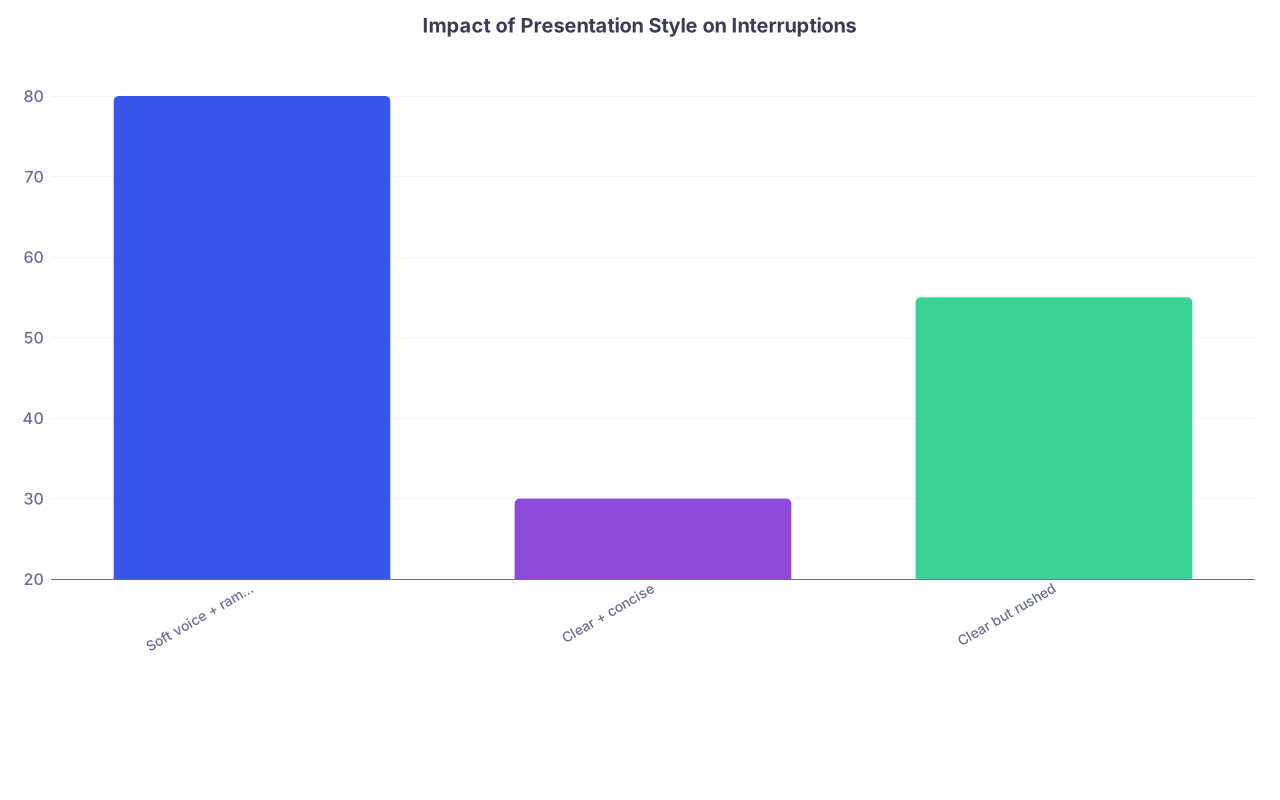
| Category | Value |
|---|---|
| Soft voice + rambling | 80 |
| Clear + concise | 30 |
| Clear but rushed | 55 |
(Think of the values as “relative likelihood of being interrupted” — not precise numbers, but you get the point.)
C. Claim the Assessment
This is where women get undercut most—on the plan and reasoning. You must claim it.
Use ownership language:
- “My assessment is…”
- “I’m concerned about…”
- “I recommend…” rather than “I was kind of thinking maybe we could…”
Then invite correction: “I’d appreciate feedback on that plan.” That shows you’re teachable, not timid.
6. What If You Freeze Or Say Nothing?
You will not handle this perfectly every time. Sometimes you’ll walk away from rounds replaying the moment thinking, “Why did I just let that happen?”
Fine. Next time, you’re going in with a plan.
You can still salvage something after the fact:
Quick email or message to attending:
“I realized on rounds I didn’t get to fully present my assessment on Mr. X. For completeness, here’s how I was thinking through his acute kidney injury…”Brief check-in with the interrupter later:
“Earlier on rounds, I felt talked over when I tried to answer about Mrs. Y. Next time I’d like to have a chance to respond before others jump in.”
You’re training yourself as much as you’re training them.

| Step | Description |
|---|---|
| Step 1 | Talked over on rounds |
| Step 2 | Use brief reclaim line |
| Step 3 | Reclaim + document |
| Step 4 | Adjust presentation style |
| Step 5 | One on one convo |
| Step 6 | Continue monitoring |
| Step 7 | Involve chief or PD |
| Step 8 | First time or pattern |
| Step 9 | Improves? |
7. Ethics: This Is Not Just About You
You’re in the “personal development and medical ethics” bucket for a reason. This is not just career tactics. It’s about the kind of physician you become.
A few ethical angles people ignore:
- Patient care suffers when the person who knows the patient best is silenced. If you admitted the patient and you’re not allowed to share key context because someone cut you off, that’s a safety issue.
- Modeling. The med students are watching. The female M2 on your team is learning from you how a woman “should” tolerate being interrupted. You’re teaching her something whether you intend to or not.
- Justice. Letting patterns of talking over women continue unchallenged reinforces structural bias. You don’t have to burn down the hospital, but you also don’t have to pretend it’s fine.
There’s an ethical middle path: you protect your learning and your voice, you speak up in proportion to your power, and you use allies when needed.
8. How to Be an Ally If You’re Not the One Being Talked Over
If you’re a man reading this—or a woman with more seniority—you have obligations too.
On rounds, ally behavior looks like:
- “Let’s let Dr. Patel finish.” (Simple, direct, then silence.)
- If you notice an idea from a woman getting ignored then repeated by a man: “That’s similar to what Dr. Nguyen suggested a moment ago about starting anticoagulation.”
- In debrief with the attending: “I’ve noticed the students get interrupted a lot when presenting—it might help their learning to let them finish their assessments.”
The bar is low. Say one sentence and you’ve done more than most.
FAQs
1. What if I’m evaluated by the same person who keeps talking over me? Won’t speaking up hurt my evaluation?
Possibly, if they’re fragile. That’s the tension. In that case, start with the lowest-risk moves: tighten your presentation, stand where you’re visible, use gentle reclaim phrases (“I’d like to finish my assessment first”), and involve allies (senior residents, chiefs) rather than confronting aggressively. You can also document specific incidents and, if your eval is unfair, bring that record to your program leadership afterward.
2. How do I know if I’m being interrupted because of gender or just because rounds are chaotic?
Watch how others are treated, especially men at your same training level on the same team. If everyone gets cut off equally, you’re dealing with a chaotic attending or culture. If you and other women consistently get interrupted or redirected while men are allowed to finish, gender is likely playing a role. You handle the immediate behavior the same way either way—but patterns tell you how much energy to invest in changing the local culture.
3. I’m naturally quiet and hate confrontation. Do I really have to be this direct?
You don’t have to turn into a different personality, but you do need at least one or two scripted lines you can say even when anxious. Think of them as part of your professional toolkit, like knowing how to call a rapid response. “I’d like to finish my assessment first” can be said softly and calmly; it’s not aggressive. Practice it out loud a few times so it feels less foreign.
4. What if my attending is the main problem and there are no obvious allies?
Then you focus on controlling what you can: make your presentations excellent, claim the assessment clearly, and follow up one-on-one with the attending if you think they’re even remotely coachable: “I’m trying to improve my clinical reasoning—would it be possible for me to fully present my assessment before others jump in?” If they’re not receptive and it’s a short rotation, it may be safer to endure, document, and later give honest but professional feedback to the clerkship director or program. You’re not obligated to fix every broken attending, but you also don’t have to pretend this behavior is acceptable.
Key points: You need a few short, practiced lines to calmly reclaim the floor when you’re talked over. You should sharpen your presentation style so you sound like someone worth listening to. And you’re not just protecting your ego—you’re protecting your learning, your patients, and the women coming up behind you.