
The way medicine lets attendings call women “honey” and “sweetheart” is not harmless. It’s hierarchy, gender, and power rolled into one word.
You’re not overreacting. And you do need a plan.
This is the situation: you’re on rounds or in the OR, focused, working, and your attending drops a “Honey, can you grab that?” or “Thanks, sweetheart.” Your brain does that half-second freeze. You clock the micro-embarrassment, the weirdness, the way the room shifts. Then you immediately start calculating:
Do I say something?
Will this hurt my eval?
Am I making it weird if I bring it up?
Let’s walk through a stepwise response that protects three things at the same time:
- Your dignity
- Your evaluations and career trajectory
- Your sanity over the long term
Not theoretical. This is the playbook I’d want my younger self—and every woman in medicine—to have on hand.
Step 0: Rapid Internal Triage (In the Moment)
Before you react externally, you need to do a 5–10 second internal check.
Ask yourself:
- Setting: Are you in front of patients, nurses, other residents, OR staff, or just one-on-one?
- Power: Is this attending known as supportive, neutral, or retaliatory? Have you seen them trash people on evals?
- Pattern: Is this a one-off slip or part of a larger pattern (diminishing you, ignoring your input, talking differently to male trainees)?
- Risk: Are you on a high-stakes rotation (core clerkship, sub-I, fellowship-application-relevant) where an angry attending could do damage?
Those answers don’t decide whether it’s okay or not. It’s not okay. They decide how and when you respond.
You have three broad options:
- Address it immediately, lightly but firmly.
- Make a small in-the-moment redirect, then follow up privately.
- Bank the incident, document it, and address it later or at a systems level.
Notice what’s not an option: “Just suck it up indefinitely.” That’s how women burn out or internalize this garbage as normal.
Step 1: Low-Risk, In-the-Moment Redirect
If this attending doesn’t seem retaliatory and the setting allows, the cleanest move is a quick, low-drama correction. You’re not giving a TED talk on patriarchy during rounds. You’re simply signaling:
I heard what you said. I’m not okay with it. Here’s how you can fix it.
Here are scripts that actually work in real clinical spaces.
Script style 1: Name reset, neutral tone
Attending: “Honey, can you grab the chart?”
You (small smile, steady eye contact):
“Sure. And it’s Dr. Patel / Sarah, by the way.”
Then move on. You’ve corrected them without making it a debate. Most decent people will recalibrate.
Script style 2: Direct but not aggressive
Attending: “Thanks, sweetheart.”
You: “I prefer Sarah / Dr. Lopez, actually.”
You’re not asking permission. You’re stating a preference.
Script style 3: Gentle humor, clear boundary
Attending (post-op): “Nice work, honey.”
You (light tone): “Happy to help. Let’s stick with ‘Dr. Singh’ though.”
Humor lowers the temperature for everyone else in the room. The boundary is still crystal clear.
The key ingredients:
- You say it once, clearly.
- You don’t over-explain.
- You don’t apologize for being “sensitive.”
Your attending’s reaction is data. If they say “Oh, sorry, force of habit,” and adjust, that’s a decent outcome. If they roll their eyes, dismiss, double down—now you know who you’re dealing with.
Step 2: When It Happens in Front of Others
When you’re publicly diminished, the stakes feel higher. But this is also where a quick correction is most powerful—because everyone hears both the original comment and your boundary.
Scenario: Morning rounds. Team of interns, students, nurse, plus attending.
Attending: “Sweetheart, can you present the patient in 14B?”
You (matter-of-fact): “Yes. And I go by Dr. Morales / Ana.”
Then you present. Like nothing’s wrong with you. The awkwardness belongs to the comment, not to your boundary.
If a nurse or resident gives you the “did that just happen?” look, that’s more data. Sometimes they become witnesses or allies later if you need to escalate.
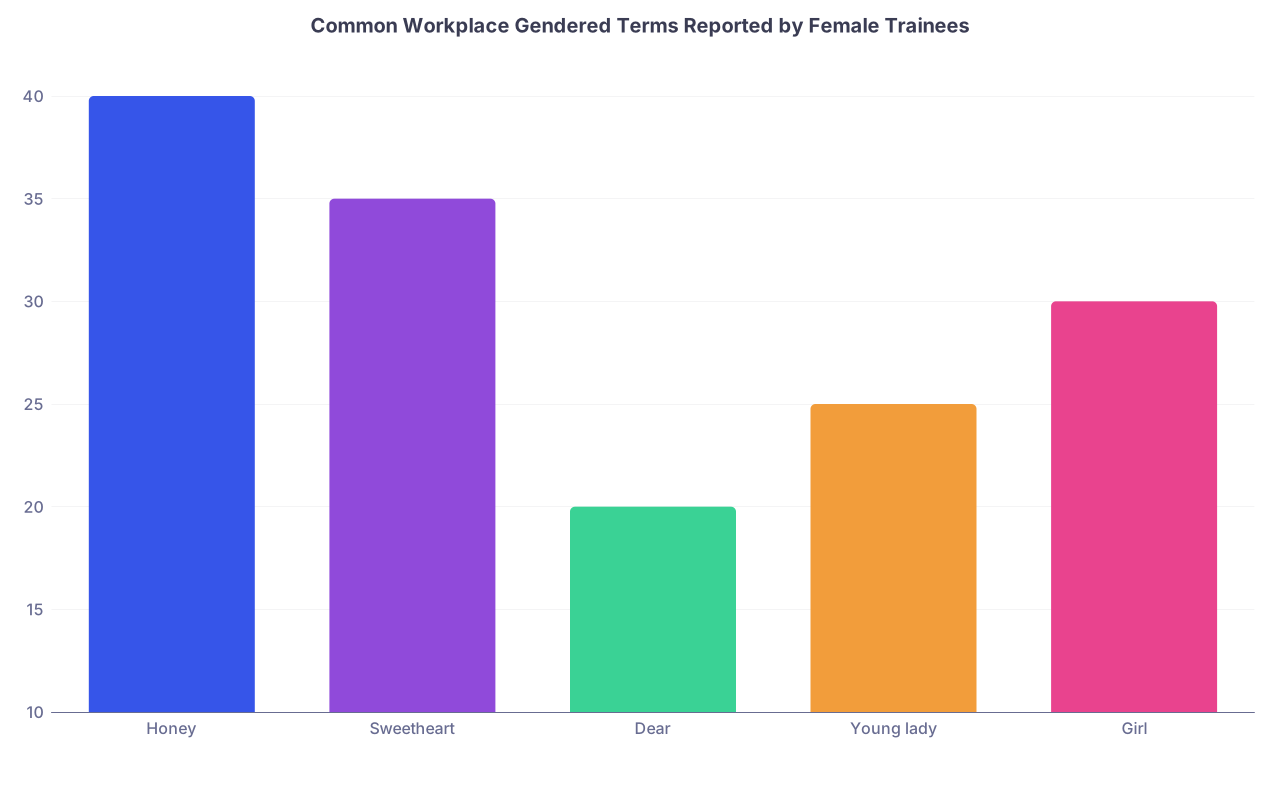
| Category | Value |
|---|---|
| Honey | 40 |
| Sweetheart | 35 |
| Dear | 20 |
| Young lady | 25 |
| Girl | 30 |
Step 3: When You Can’t or Don’t Want to Call It Out Live
Sometimes this isn’t the hill to die on—at least not in the moment. For example:
- You’re a third-year on your first core rotation, and this attending is known for revenge evals.
- You’re in front of a vulnerable patient whose trust you don’t want to shake with visible conflict.
- It caught you so off-guard your brain blanked.
If that’s you, do not turn this into a self-criticism spiral. You didn’t fail. You made a quick risk calculation with limited resources.
Here’s what you do:
Document the incident.
Same day. Short, factual, no editorializing.“8/7, AM rounds, SICU: Dr. X referred to me as ‘honey’ twice in front of team (Dr. Y, RN Z, med student A present). Context: asking me to retrieve labs, then thanking me post-presentation.”
Save in a private document (not on a shared work drive). This is your paper trail if this becomes a pattern.
Decide if you want a private follow-up.
If they’re generally decent or teach well, a short, calm 1:1 can be very effective.Sample:
“Dr. X, can I mention something quickly?
Earlier on rounds you called me ‘honey’ a couple of times. I know you probably didn’t mean anything by it, but it felt a bit diminishing in front of the team. I’d appreciate being called Dr. Lee or just Sarah instead.”Then stop talking. Let them respond. Most embarrassed, non-malevolent attendings will adjust. If they blow you off, that tells you whether escalation is worth considering.
Talk to someone you trust on the team.
A senior resident is often your best first stop.“Can I run something by you? Dr. X has called me ‘honey’ a few times on rounds. I’m not okay with it, but I’m weighing how to handle it given evals. Have you seen this before?”
Good seniors have seen everything. Some will say, “Yeah, they’re old-school but will listen if you say something once,” or “They’ve retaliated before—let’s be careful and maybe go through the clerkship director.”
Step 4: When It Becomes a Pattern
Once is annoying. Twice is a pattern. Five times is an environment.
If the behavior repeats after you’ve clearly stated your preference, we’re not in “harmless term of endearment” territory anymore. We’re in disrespect and boundary violation.
At this point, you decide:
- Do I want to address it more firmly?
- Do I want to escalate through institutional channels?
- Is my goal to modify this attending’s behavior, or to get this on the record for the next trainee?
You can absolutely do both.
Second boundary: firmer, still professional
Attending: “Okay, sweetheart, prep the note.”
You (calm, steady):
“Dr. Smith, I’ve mentioned this before—I’m not comfortable being called ‘sweetheart’ or ‘honey’ at work. Please use my name or ‘doctor.’”
You’re naming the pattern: I’ve mentioned this before. You’re also attaching the request to professional identity, not your feelings alone.
If they mock you, minimize it, or twist it into you being the problem (“You’re too sensitive,” “It’s just a joke,” “Lighten up”)—good. Now they’ve made your future report much stronger.

| Step | Description |
|---|---|
| Step 1 | Attending uses honey or sweetheart |
| Step 2 | Quick name reset |
| Step 3 | Document and consider private follow up |
| Step 4 | State preference clearly |
| Step 5 | Monitor for recurrence |
| Step 6 | Document pattern and consider escalation |
| Step 7 | Is this first time? |
| Step 8 | Safe to correct in moment? |
| Step 9 | Already asked them to stop? |
| Step 10 | Behavior continues? |
Step 5: Escalation – When, Where, and How
Here’s where people get paralyzed. You start worrying:
- I’ll get labeled “difficult” or “not a team player.”
- No one will believe me.
- They’re powerful; I’m disposable.
Those fears are not imaginary. Medicine protects its high-billing attendings. But you still have more levers than you think, especially in 2024-plus, when institutions are terrified of documented patterns of gender-based disrespect and harassment.
Who you can talk to (in roughly increasing formality)
- Trusted chief resident or senior resident
- Clerkship director / program director
- GME office or ombudsperson
- Office of Professionalism / Title IX / HR (names vary)
Don’t start by emailing the dean with a novel. Start with, “Can I schedule a time to discuss a professionalism concern?” and keep notes.
How to frame it
You’re not going in to talk about your feelings in isolation. You’re going in to talk about:
- Professionalism
- Gendered conduct in a hierarchical environment
- Impact on learning climate and patient perception
Example framing for a clerkship director or PD:
“I wanted to raise a recurring professionalism concern. On multiple occasions during my [service] rotation, Dr. X referred to me as ‘honey’ and ‘sweetheart’ during rounds and in front of patients, despite my requesting to be addressed by my name or as ‘doctor.’ I’m concerned about the impact on my professional identity, the team climate, and how patients perceive me.”
Then you provide:
- Dates (approximate is fine)
- Settings (rounds, OR, clinic)
- Exact phrases used, plus your responses
- Any witnesses (even just roles: “chief resident was present”)
Now you don’t sound “sensitive.” You sound like a professional reporting unprofessional behavior.

Step 6: Protecting Yourself While You Push Back
You’re not obligated to martyr your career to fix one attending. I want you to be strategic, not sacrificial.
A few concrete safeguards:
Document everything.
Brief, factual entries after each incident. Dates, words used, who was there, what you said. This is how patterns get proven.Loop in allies quietly.
“Hey, if you’re comfortable, if anyone ever asks about the climate on this service, would you be willing to share what you’ve seen around Dr. X’s comments?”
Some will say yes. Some won’t. That’s fine.Use end-of-rotation evaluations intentionally.
If there’s a free-text box about “learning environment” or “professionalism,” this is where you mention it—factually, with specific examples, and (if available) check any “concern” box about mistreatment.Ask explicitly for non-retaliation.
When speaking with leadership:
“I’m concerned about potential retaliation, especially in terms of evaluations or future opportunities. What protections are in place for trainees who raise these kinds of concerns?”
An honest program director or dean will take that seriously. If they brush it off, they’ve just told you how they’ll handle the next issue too.
| Response Type | Power Required From You | Retaliation Risk | Impact on Behavior |
|---|---|---|---|
| Quick in-the-moment correction | Low | Low-Medium | Medium-High |
| Private follow-up conversation | Medium | Medium | Medium-High |
| Report to chief/PD | Medium | Medium | High (if repeated) |
| Formal HR/Title IX complaint | High | Medium-High | High (system-level) |
Step 7: Handling the Emotional Fallout
What no one admits loudly enough: this stuff gets under your skin.
You may feel:
- Embarrassed for even caring
- Angry for hours afterward
- Distracted from learning because you’re replaying the moment
- Guilty that you “let it slide” or, conversely, “made it awkward”
Let me be blunt: none of that is a you problem. It’s a system that still treats women’s professional identities as optional.
What helps:
- Name it clearly. “That was gendered disrespect.”
- Reality-check with peers. Text a co-resident: “He just called me ‘sweetheart’ in front of the whole team. I’m not crazy for hating that, right?” You already know the answer, but having someone say, “Nope, that’s trash,” stabilizes your sense of reality.
- Separate competence from treatment. The fact that someone talks down to you does not mean you are less competent. It means they’re comfortable with a hierarchy that works in their favor.
And if this is one of many small cuts you’re dealing with—mansplaining, being mistaken for a nurse repeatedly, being talked over in rounds—you may need more structural support: therapy, women-in-medicine groups, or mentorship from senior women who’ve survived this and are still sane.
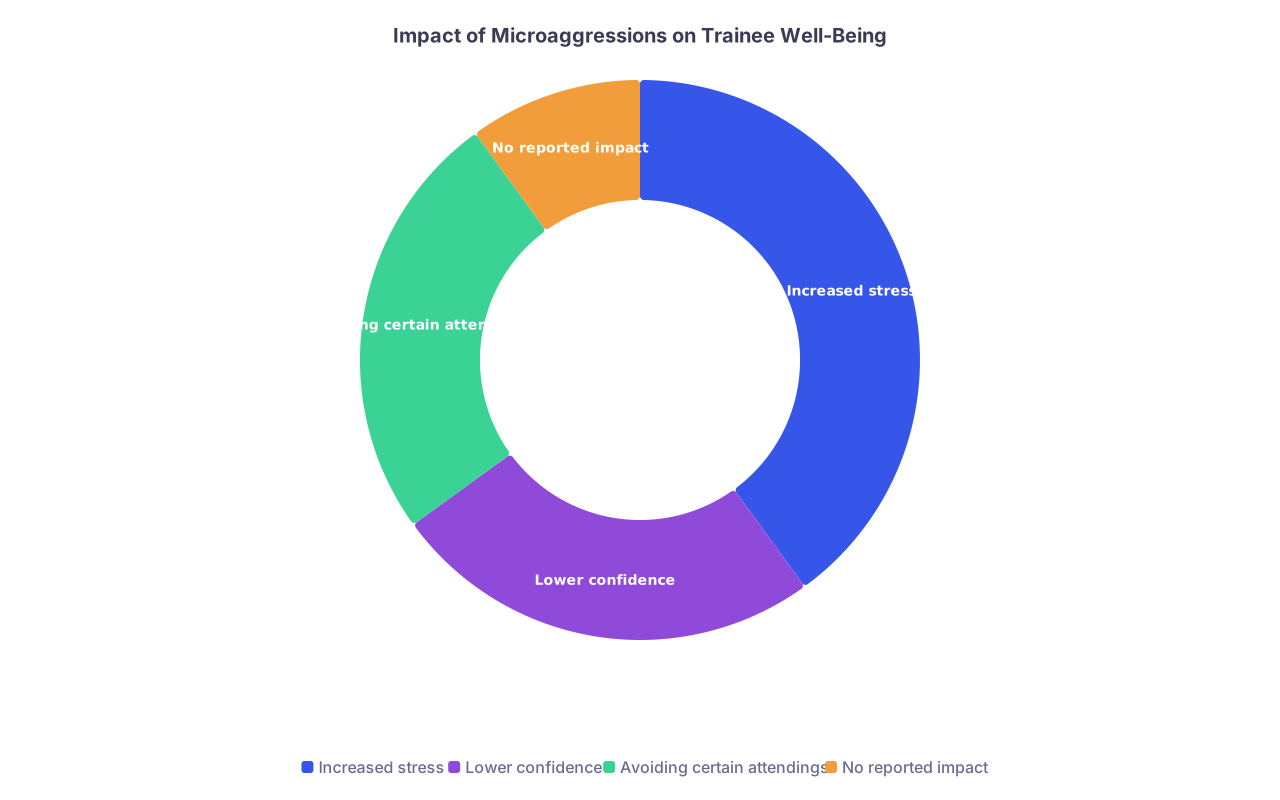
| Category | Value |
|---|---|
| Increased stress | 40 |
| Lower confidence | 25 |
| Avoiding certain attendings | 25 |
| No reported impact | 10 |
Step 8: Building Your Long-Term Boundary Skill Set
This isn’t just about one attending. It’s practice for your whole career.
You’re going to encounter:
- Patients calling you “nurse,” “sweetheart,” or “young lady”
- Colleagues joking about your appearance, relationship status, or “being too emotional”
- Staff directing questions to your male junior instead of you
The more you build a simple, repeatable boundary script now, the less exhausted you’ll be in ten years.
You want 2–3 go-to lines that you can adapt anywhere:
- “I prefer Dr. [Last Name].”
- “Please call me by my name, not ‘honey’ or ‘sweetheart.’”
- “In this role, I’m your doctor. You can call me Dr. [Last Name].”
You’re not delivering speeches. You’re changing the default script in the room.

Step 9: Ethical Frame – You’re Not Being Petty
Let’s connect this to ethics, because that’s the category you’re in.
Professionalism isn’t just about you showing up on time, writing good notes, and not screaming at nurses. It’s about how power is used, and how identities are respected.
When an attending calls a woman trainee “honey” or “sweetheart”:
- It blurs boundaries in a way they almost never do with male trainees.
- It undermines how patients and staff perceive your authority.
- It signals to the room that your role is more “helper” than physician.
All of that affects patient care, team dynamics, and the learning environment. So when you speak up, you’re not bringing “personal drama” into the workplace. You’re enforcing ethical, professional norms that the institution claims to care about.
Medicine loves to talk about “speaking up for patient safety.” We’re terrible at speaking up for trainee safety and dignity. But the skill set is similar:
Notice the problem → assess risk → speak clearly → document → escalate if needed.
You’re allowed to use that process for yourself.

FAQs
1. What if other women on the team say they don’t mind being called “honey” or “sweetheart”? Does that make me the problem?
No. Some women genuinely don’t care, some tolerate it for survival, and some have given up fighting every battle. None of that invalidates your boundary. Professional norms aren’t determined by “who’s willing to swallow the most disrespect.” You’re allowed to say, “I’m not comfortable with that,” even if someone else is.
2. What if I correct the attending once and they actually stop—should I still report it?
Usually, no. If you clearly set a boundary, they respect it, and there’s no pattern of other problematic behavior, you can let it go and move on. You successfully corrected unprofessional language with a low-level intervention. If you do put it in an eval, frame it as: “Initially used gendered terms like ‘honey,’ but was responsive when I requested to be addressed by name.”
3. How do I handle it when patients call me “sweetie” or assume I’m not the doctor?
Slightly different power dynamic, but same basic script. Calm correction with clarity about your role: “I’m actually your doctor; you can call me Dr. Jones.” If they persist, you decide how much you want to push based on acuity, cognitive status, and your own energy. You’re not obligated to educate every patient, but you’re allowed to correct them when it affects your care or authority.
4. I’m afraid speaking up will tank my evals. Should I just wait until I’m an attending to care about this?
If a single eval on a single rotation will make or break your career, the system is already broken. That said, your fear is rational, and you get to be strategic. On a brutally high-stakes rotation with a known retaliatory attending, you might choose lighter in-the-moment corrections and then use anonymous evaluations or later reporting. You’re not selling out if you pick your battles. You’re playing the long game so that someday, you’re the attending who never lets this slide for your trainees.
Key points:
Set a clear, simple boundary early—even a one-line correction changes the dynamic.
Document patterns and use your institution’s professionalism structures when needed; you’re not overreacting.
You’re not just protecting yourself—you’re making it easier for the next woman who steps onto that service.