
The reaction when a woman resident pushes back on an attending isn’t random. It’s patterned, predictable, and very rarely about the medicine.
Let me tell you what actually happens behind the scenes when you, as a woman resident, challenge an attending in real time.
The Unwritten Rule You’re Breaking
There’s a rule that’s never written in your residency handbook but gets enforced every single day:
Male residents “challenge.” Women residents “have an attitude.”
Same content. Same question. Same level of evidence. Different label.
I’ve watched this play out in internal medicine, surgery, EM, OB/GYN, pediatrics—community programs and big-name academic centers. The informal reactions from attendings and senior staff fall into a few repeatable patterns. Once you see the patterns, you’ll stop thinking you’re “crazy” and start realizing you’re stepping into a power-and-gender minefield most faculty won’t admit exists.
Before we get into the fallout, you have to understand what’s running silently in the background:
- Attendings see themselves as responsible for patient safety, billing, and the service running.
- They are under pressure you don’t see: metrics, RVUs, complaints, and peer reviews.
- Many of them were trained in an era when “pushing back” from a trainee was career suicide.
Now add gender.
A male resident who pushes back is often typed as “confident, future leader.” A woman? “Difficult, emotional, not a team player.” They won’t put those words in your evaluation. But they’ll say them in the workroom when you leave.
What Actually Happens in the Moment
Let’s say you push back on an attending about a management decision on rounds.
The case:
CHF exacerbation, CKD stage 4, creatinine creeping up. Attending wants to push IV diuresis harder. You say, “I’m worried about worsening her kidney injury. There’s a JACC paper suggesting…”
Or in the OR:
You say, “I’m not comfortable placing this port here; her body habitus and prior surgeries increase the risk we’re over the pleura. I think we need imaging guidance.”
Here’s the menu of immediate reactions I’ve seen, over and over.
1. The “Tone Check”
You’ll hear versions of:
- “You need to be careful how you speak in front of the team.”
- “Watch your tone.”
- “We can discuss this later, not in front of the patient.”
A male resident saying the exact same words often gets: “Good point—let’s think that through.”
This isn’t about tone. It’s about hierarchy discomfort. When the attending feels “challenged,” they grab the nearest lever of control. For women, that lever is almost always “tone” and “professionalism.”
2. The Public Shutdown
Especially common in procedure-heavy fields and macho environments (surgery, EM, some ICUs).
- “We’re not going to argue about this now.”
- “This is my call.”
- “You’re not seeing the bigger picture yet.”
Translation: You’ve stepped out of your assigned role. Back in line.
And crucially, this isn’t just for you. It’s a show for everyone watching—interns, students, nurses. It reasserts the pecking order.
3. The “You’re Emotional” Reframe
This one is insidious.
You raise a patient safety concern calmly. The attending’s voice gets sharper, they’re the one visibly agitated. After, you hear:
- “She got really worked up during rounds.”
- “She got emotional about the plan.”
- “She gets defensive when questioned.”
You’re the one labeled “emotional,” even if your heart rate never broke 80. Because for women, disagreement gets pathologized. For men, it gets framed as “passion.”
I’ve precepted residents where a woman simply said, “I disagree; here’s why,” in a normal tone. Two hours later in the workroom: “She’s very intense. A bit much.” When a male resident did it? “He’s really engaged.”
What Happens After: The Back-Channel Conversations
The real damage usually doesn’t happen in the room. It happens in the hallway, the physician lounge, and the end-of-rotation eval form.
Let’s be very clear: most attendings do not consciously think, “I’m going to punish this woman for pushing back.” But they do unconsciously shift how they talk about you and what boxes they check.
Here’s how the archetypes get assigned.

The Three Stereotypes: “Difficult, Dramatic, or Disengaged”
Over the following days and weeks, your pushback is recoded into one of these:
“Difficult / not a team player”
You’ll hear this line in whispers: “Good clinician, but…”
That “but” kills fellowship letters, chief nominations, teaching positions.“Dramatic / emotional”
Your legitimate patient safety concern is rebranded as you being “worked up,” “overly anxious,” or “not calm under pressure.”“Disengaged / not receptive to feedback”
This one is about control. You questioned them; now they decide you “don’t take feedback well.”
Once one of these labels attaches to you in a program, it spreads. Chiefs hear it. PD hears it. Other attendings go into their first interaction with you already primed: “She’s strong, but be careful—she can be… a lot.”
And because evaluations are vague, it all gets laundered into words like:
- “Can come across strongly at times.”
- “Should continue to work on receptiveness to feedback.”
- “Needs to be mindful of team dynamics.”
Nobody writes: “She challenged me about diuresis in front of the team and I didn’t like it.”
The Gender Double Standard: Same Behavior, Different Outcome
Let’s make this explicit.
| Resident Action | Male Resident Label | Female Resident Label |
|---|---|---|
| Challenges plan on rounds | Confident, engaged | Aggressive, confrontational |
| Insists on patient safety concern | Strong advocate | Emotional, rigid |
| Says “I disagree” with evidence | Critical thinker | Difficult, not receptive |
| Asks attending to explain reasoning | Curious, thorough | Questioning authority |
I’ve watched a male PGY-2 flat-out say on MICU rounds, “I don’t think that’s supported by the literature,” to a senior intensivist. Raised eyebrows, short debate, then respect.
A female PGY-2 on the same service three months later: “I’m not comfortable with that; the data I’ve seen suggests…” Same attending. The comment after: “She needs to be careful about challenging publicly before she’s seen more.”
Same act. Different cost.
When Pushing Back is About Ethics, Not Ego
The hardest cases are not the borderline antibiotic choice or the diuresis dose. They’re the ethics calls.
You know the ones:
- The attending wants to document a level of exam that did not happen, to bill higher.
- They’re minimizing a medication error and trying to avoid a safety report.
- They’re pushing for a procedure on a frail patient because “the family expects us to do something,” when you know it will add suffering, not benefit.
When a woman resident pushes back in these scenarios, the stakes are high on two axes: ethics and gender.
I’ve seen this play out:
A female senior resident in IM: attending wants to list a time-critical exam as performed before a stroke code was called to protect the service’s numbers. She says, in front of the team, “I’m not comfortable documenting that time; I wasn’t in the room then.”
Attending smiles tightly, moves on. After rounds? He walks into the PD office and says: “She undermined me in front of the team. We need to talk about her professionalism.”
And now you see the real trap: your ethical stand is reframed as a personality problem.
This is exactly where a lot of women get burned. Men do too, but they’re less likely to get the “emotional/unprofessional” label on top of it.
Short-Term vs Long-Term Consequences
Let’s split the consequences into two buckets: what you feel immediately, and what quietly follows you.
Immediate Fallout
You might notice:
- Cooler interactions with that attending.
- Less teaching offered to you.
- You get skipped for procedures you would have been offered last week.
- Subtle sarcasm in front of the team: “Let’s see what Dr. X thinks; she has strong opinions.”
That’s how power reasserts itself. Not always by yelling. Often by quietly cutting access.
Long-Term Fallout
The long game is where careers get bent.
- End-of-rotation evaluations with those vague-but-deadly professionalism comments.
- Chiefs being “advised” to keep an eye on you.
- You get passed over for chief, research projects, or letters with this line: “We just weren’t sure how programs would perceive your fit.”
Basically, the system starts seeing you as “riskier” to endorse. Not because of your clinical care. Because you didn’t stay quiet when truth rubbed against hierarchy.
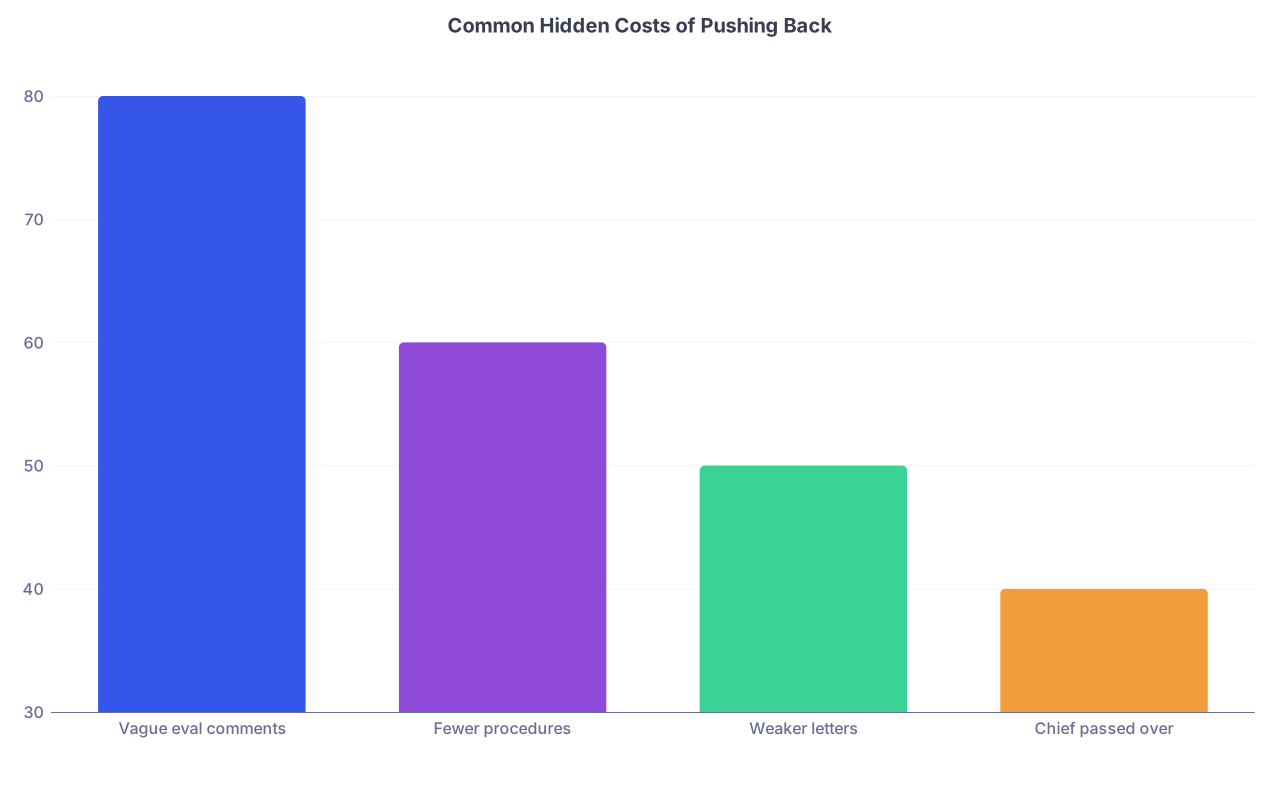
| Category | Value |
|---|---|
| Vague eval comments | 80 |
| Fewer procedures | 60 |
| Weaker letters | 50 |
| Chief passed over | 40 |
Numbers above aren’t from a paper. They’re the rough proportions I see when I listen to residents’ stories year after year. These patterns are not rare outliers. They’re baked into the culture.
Strategic Pushing Back: How Women Survive It
You don’t fix this by being nice enough. You also don’t fix it by going nuclear on every micro-issue. The residents who make it through with their integrity and careers intact do something else: they get strategic.
I’m not going to hand you the usual “use I-statements” fluff. That’s not how power works at 3 a.m. when the septic patient is crashing.
Here’s what actually helps.
1. Decide Early: What Hill is Worth Dying On
You cannot, and should not, fight every battle. If you push back on everything, they’ll tune you out.
The residents I respect most have a clear internal hierarchy:
- Patient safety and ethics: non-negotiable hills.
- Style differences and minor preferences: usually not worth public war.
So yes, maybe you let the attending do the slightly outdated sepsis fluid volume that isn’t dangerous, even if it’s not your style. But you do not let them falsify documentation, bully a family into a procedure, or ignore a life-threatening allergy.
You save your credibility for the hills that matter.
2. Change the Frame in Real Time
When you know gender is already stacked against you, how you frame your pushback changes how survivable it is.
I’ve watched smart women do this very effectively:
Instead of:
“I don’t agree with that plan.”
Try:
“I’m worried about X specific risk with that plan, given Y. Can we walk through your thinking so I understand what I’m missing?”
You’re not actually “so confused.” You’re signaling respect for hierarchy while still forcing the reasoning into the open. That’s very different from rolling over.
Or in ethics situations:
“I’m concerned about how this might look if it’s reviewed later. How can we document this so it’s absolutely clear and defensible?”
You’ve moved the issue from “I think you’re wrong” to “Let’s protect us both.” Still ethical. Less threatening to fragile egos.
3. Build Witnesses and Allies
The worst place to be is alone in your own narrative. The attendings will tell their version louder and to people with more power.
You need witnesses—not just for lawsuits or formal complaints, but for credibility.
That means:
- Debriefing with a trusted co-resident or fellow: “Hey, did I come across as out of line? Here’s what happened.”
- Quietly looping in a supportive attending: “I want to reality check something that happened on rounds.”
- If it’s outright unethical or dangerous, documenting contemporaneously in a factual way (yes, a simple dated note to self or email to your institutional account makes a difference later).
When a PD or ombudsman hears the story from you and also from two others who say, “Yeah, that’s how it went,” your gendered label has less power.
4. Use the “Time Shift” Move
You don’t have to win every fight in the room where it starts.
A move I’ve seen very sharp women use: they let the immediate ego moment pass, then circle back later in private, when the attending is less performative.
On rounds:
Attending doubles down. You briefly state your concern, don’t escalate, move on.
After:
“Dr. Smith, can I ask you about that case from 9A? I was worried because…”
This does two things:
- Preserves the attending’s public image in the moment (yes, annoying, but sometimes necessary).
- Shows them you’re not trying to humiliate them; you’re genuinely concerned.
There are attendings who’ll actually soften in that second conversation and adjust the plan quietly. They’ll never say, “You were right.” They’ll just order the imaging tomorrow and act like it was their idea all along. Fine. The patient wins.
When Things Cross the Line: Formal Paths vs Real Risks
Sometimes, the fallout from your pushback gets abusive: retaliation, bullying, hints about your evaluations, threats about board letters.
Here’s the unvarnished truth: formal reporting mechanisms exist, but they are not risk-free. Programs say “No retaliation,” but retaliation just gets more subtle.
So what do savvy women do?
They gather information before they act.

| Step | Description |
|---|---|
| Step 1 | Push back on attending |
| Step 2 | Negative response |
| Step 3 | Document facts now |
| Step 4 | Debrief with trusted resident |
| Step 5 | Consult trusted faculty or chief |
| Step 6 | Consider ombudsman or GME |
| Step 7 | Strategic disengagement |
| Step 8 | Patient safety at risk |
| Step 9 | Pattern or one time |
The key moves:
- Document specifics (date, time, who, what language actually used). Not your feelings—facts.
- Talk to someone who’s seen cycles of residents go through: a senior chief, a mentor in another department, or a GME faculty member with a reputation for being straight.
- Ask very direct questions: “If I report this, what usually happens here? Who actually has power?”
You’re not naive, and you’re not obligated to light yourself on fire for institutional PR. Sometimes the best move is to survive, finish, and then leave—and then be brutally honest to future trainees about what that place is like.
What Good Attendings Actually Want (And How to Spot Them)
Not every attending will punish you for pushing back. Some are starving for residents who will think, question, and protect patients—even when it’s uncomfortable.
The good ones have telltale habits:
- They explicitly invite disagreement: “If you see something that doesn’t make sense, I expect you to say it.”
- When you challenge them with evidence, they engage with the argument, not your tone.
- They will occasionally say, in front of the team, “You were right, let’s do it your way.”
Those attendings exist. Lean into them. They can buffer the damage when other attendings label you.
And if you ever become that attending—which, frankly, we need you to—you’ll remember precisely how it felt to be the woman resident paying a social tax for practicing good medicine.
FAQ (Real Questions Women Residents Ask Me)
1. “How do I know if I’m actually being ‘difficult’ vs appropriately assertive?”
Look at patterns and context. If multiple trusted peers and at least one faculty member who has no incentive to protect the program tell you, “You’re solid; this is about them, not you,” believe that. If the only people calling you “difficult” are the same attendings who get angry when questioned by anyone, that’s on them. But if you frequently escalate over minor stylistic choices, or you need to win every debate, you might be burning capital you need for the real fights. Use one or two brutally honest friends to reality check, not ten vague opinions.
2. “Should I apologize if an attending says I was ‘unprofessional’ for pushing back?”
Apologize for impact if it helps, not for substance. “I’m sorry if my timing on rounds felt challenging—that wasn’t my intention. I am genuinely worried about X risk to the patient.” That sentence does three things: it lowers their defensiveness, it doesn’t admit you were wrong about the concern, and it puts the focus back where it belongs: on the patient. What you do not need to say is, “I was wrong to raise it.” Because you probably weren’t.
3. “Can this really affect fellowship and future jobs?”
Yes. Not always, but enough that you should take it seriously. Letters with phrases like “strong clinically but occasionally has interpersonal challenges” read like landmines to fellowship directors. That’s why you need at least two attendings who see and value your assertiveness and will write for you. If you know one attending dislikes you after a pushback episode, do not use them for a letter out of guilt or hierarchy. Protect your paper trail.
4. “Is it ever better to just stay quiet to ‘protect my career’?”
There are situations where staying quiet about a non-dangerous judgment call is a reasonable strategic choice. But when patient safety, outright dishonesty, or abuse is on the table, silence is complicity. You’re not a note-writing machine; you’re a physician with a license and a conscience. The art is in how you raise the concern, who you loop in, and how you protect yourself while you do it—not in whether you pretend you didn’t see the problem.
Key truths to leave with:
First, when a woman resident pushes back on attendings, the reaction is less about the medicine and more about ego, hierarchy, and gendered expectations.
Second, you can’t eliminate the bias, but you can see the game clearly and play it strategically—choosing your hills, framing your objections, and building allies.
Third, your integrity and your patients are never “unprofessional.” The system may punish you for holding that line. Hold it anyway, but do it with your eyes open and your strategy sharp.