
The way women residents get labeled “unprofessional” is often less about what they do and more about who’s watching them do it.
You’re not imagining it. I’ve watched male interns slam doors, curse at pagers, and still be called “passionate.” A woman resident shows 10% of that intensity and suddenly someone is “concerned about her professionalism.” That double standard will not disappear because you’re perfect. But you can stop stepping into the most predictable traps.
This is not about blaming you for bias. The problem is the system. The goal here is tactical: understand the subtle behaviors that reliably trigger unfair labels so you can:
- Spot biased feedback early
- Decide when to adjust and when to push back
- Document and protect your reputation and future
1. The “Tone” Trap: How Normal Assertiveness Gets Reframed as “Rude”
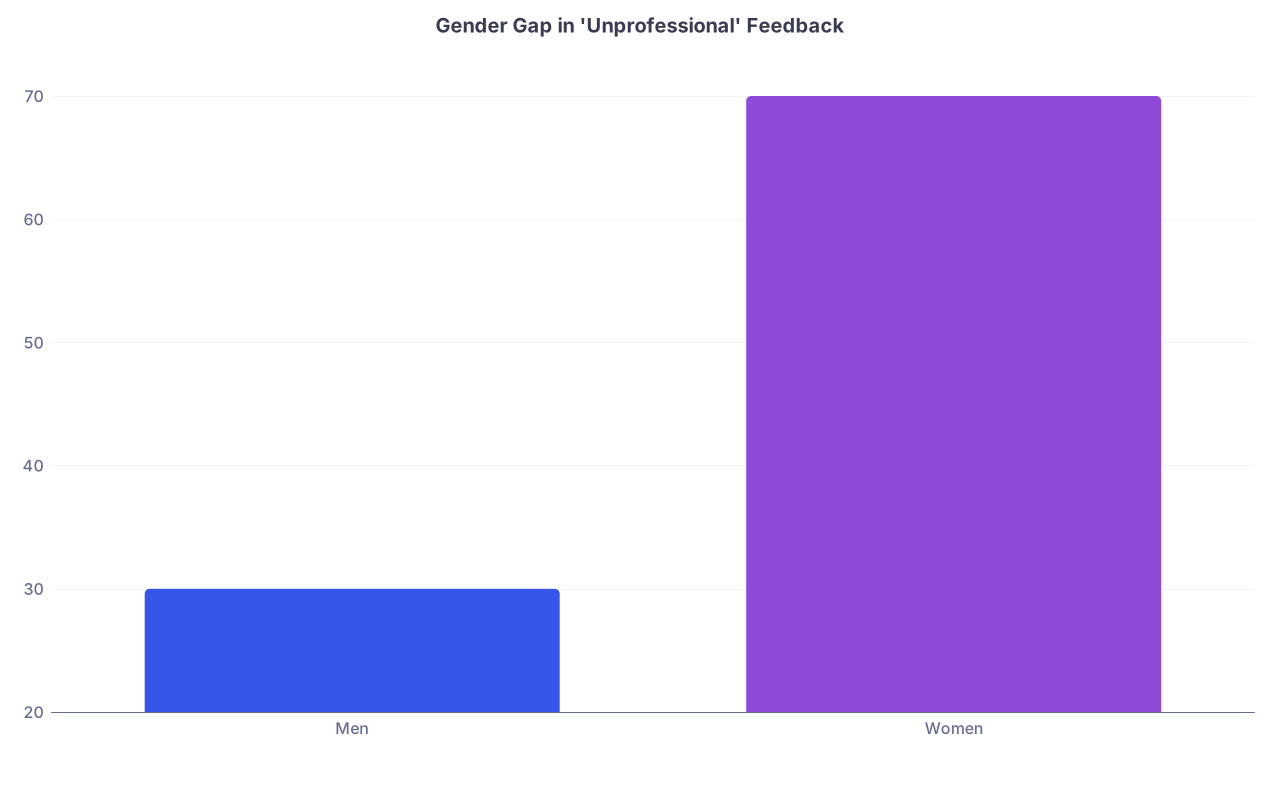
| Category | Value |
|---|---|
| Men | 30 |
| Women | 70 |
The fastest way a woman resident gets tagged as unprofessional? “Tone.” Not errors. Not missed calls. Tone.
Typical pattern I keep seeing in evals:
- Men: “strong advocate,” “confident,” “takes charge”
- Women: “can be abrasive,” “comes across as defensive,” “needs to work on communication style”
Same behavior. Different label.
Common mistakes that feed the tone trap
Answering with blunt efficiency on a busy day
- You: “I already ordered that, it’s in the chart.”
- Biased attending: “She snapped at me. Not a team player.”
The content is fine. The perception kills you.
Safer version that preserves your boundaries without feeding the stereotype:
- “Yup, ordered about ten minutes ago — it’s in Results now.”
You do not need to grovel. Just add 3–4 softening words that cost you nothing but save you six months of whispered “attitude” comments.
Correcting someone publicly
- You: “That’s actually not how you manage DKA anymore.”
- What gets heard: “She’s trying to show me up.”
Better move:
- “I think guidelines changed recently — should we double check?”
Or later, one-on-one: “I was worried we might be off guideline, so I looked it up after.”
Email replies that are technically correct and emotionally empty
- “Done.”
- “See above.”
- “Already addressed.”
These read harsher on a woman than on a man. Unfair but real.
- “Done, thanks for flagging.”
- “Already addressed earlier today — see note at 14:30.”
Mistake to avoid
Thinking, “If a male resident can say it, so can I.” On paper, yes. In real life, you’ll pay more for it. Be strategic:
- Keep the same content
- Change the packaging by 5–10%
- Avoid feeding people easy language like “snappy,” “cold,” “abrasive”
That small adjustment is not surrender. It’s you refusing to hand someone lazy ammunition.
2. Emotional Expression: Where Men Get “Stressed” and Women Get “Unstable”

You’re allowed to feel things. Patients die. You get humiliated in front of a room. Sleep is a rumor.
But here’s the problem: the system often reads women’s visible emotion as “unprofessional” much faster than men’s.
Where this bites women residents
Crying in visible spaces
I’ve seen this over and over:
- Male resident crying in the call room after a code: “He cares so much.”
- Female resident tearing up at the workstation after a brutal day: “I’m worried she can’t handle stress.”
Is that fair? No. Am I telling you to become a robot? Also no. I’m telling you to pick where you melt down.
Safer spaces:
- Bathroom stall on a non-patient floor
- Stairwell that staff rarely use
- Call room with a trusted co-resident guarding the door
Letting frustration leak into patient interactions
You’re exhausted. You’re behind. A patient’s family has asked the same question six times. You let your facial expression show one extra beat of irritation.
For a male resident, this becomes “working on patience.”
For a woman, I’ve seen written: “unprofessional around families,” “raised her voice,” “family complained she was rude.”Boundary:
- If you feel your voice tightening, buy time:
“I want to give you a real answer, not a rushed one. Let me finish this order and come back in five minutes.”
- If you feel your voice tightening, buy time:
Venting in the wrong company
Casual complaining with:
- Female co-residents → “We’re all dying, same.”
- The wrong attending/nurse/admin → “She’s negative,” “unprofessional,” “bad team energy.”
Mistake to avoid
Treating everyone as a safe audience for your stress. They’re not.
You need:
- 2–3 people you can vent to unfiltered (co-resident, partner, therapist, friend)
- A neutral-to-positive default with almost everyone else:
- “It’s been a heavy day, but we’re getting through.”
- “Long week — I’ll catch up this weekend.”
This is damage control, not emotional suppression. You’re protecting your professional record from cheap shots.
3. Appearance and Dress: The Invisible Double Standards
| Scenario | Men Labeled As | Women Labeled As |
|---|---|---|
| Scruffy after call | Tired but hardworking | Sloppy, unprofessional |
| Fitted clothes, visible makeup | Well put together | “Too much,” distracting |
| Casual shoes on overnight | Practical | Not taking job seriously |
| Visible tattoo or nose ring | Individualistic | Unprofessional |
No, you should not have to manage other people’s projections about your body, clothes, or hair. But they will impact your evals, especially where culture is rigid.
The quiet reality: women get called “unprofessional” in dress code feedback at much higher rates than men, usually with zero concrete examples.
Common appearance landmines
“Too casual” scrubs or loungewear creeping into day shift
Night float / weekends:
- Hoodie, compression socks, hair in a loose bun — no one cares much.
Monday morning academic rounds:
- Same outfit, same you → “unprofessional appearance.”
If you’re in a conservative department, protect yourself:
- Daytime: clean scrubs or business-casual equivalent, closed-toe shoes, badge visible
- Night: you have more leeway, but make sure you could be seen by leadership and not regret it
Clothing that gets sexualized against you
The issue is not whether your outfit is objectively fine. The issue is who’s in the room and what culture you’re in.
Things that repeatedly trigger nonsense:
- Fitted dresses or tops on rounds in certain surgical or older-male-heavy departments
- Bare shoulders, deep V-necks, short skirts, or very tight pants on service days
Again, I’m not moralizing your clothing. I’m telling you how biased people behave so you’re not blindsided.
Hair, nails, and makeup bias
Particularly for Black women and women of color:
- Natural hair, braids, or twists get described as “unprofessional” by people who won’t say it to your face
- Bold nails or bright lipstick magically become “distracting”
You have a right to show up as yourself. You also have the right to make short-term tactical choices to avoid fights you do not have the bandwidth for during 80-hour weeks.
Mistake to avoid
Assuming silence means approval. Often it means people are quietly judging and waiting for a narrative to attach it to.
If your program has vague policies, get specifics in writing:
- “Is there a written dress code for residents?”
- “I want to be sure I’m aligned with expectations — is this appropriate for clinic/OR/rounds?”
If anyone ever uses “unprofessional appearance” without examples, push once:
- “Can you give me a concrete example so I can address it directly?”
Now they either have to backtrack or reveal the bias.
4. Communication Style: The “Too Much / Not Enough” Tightrope
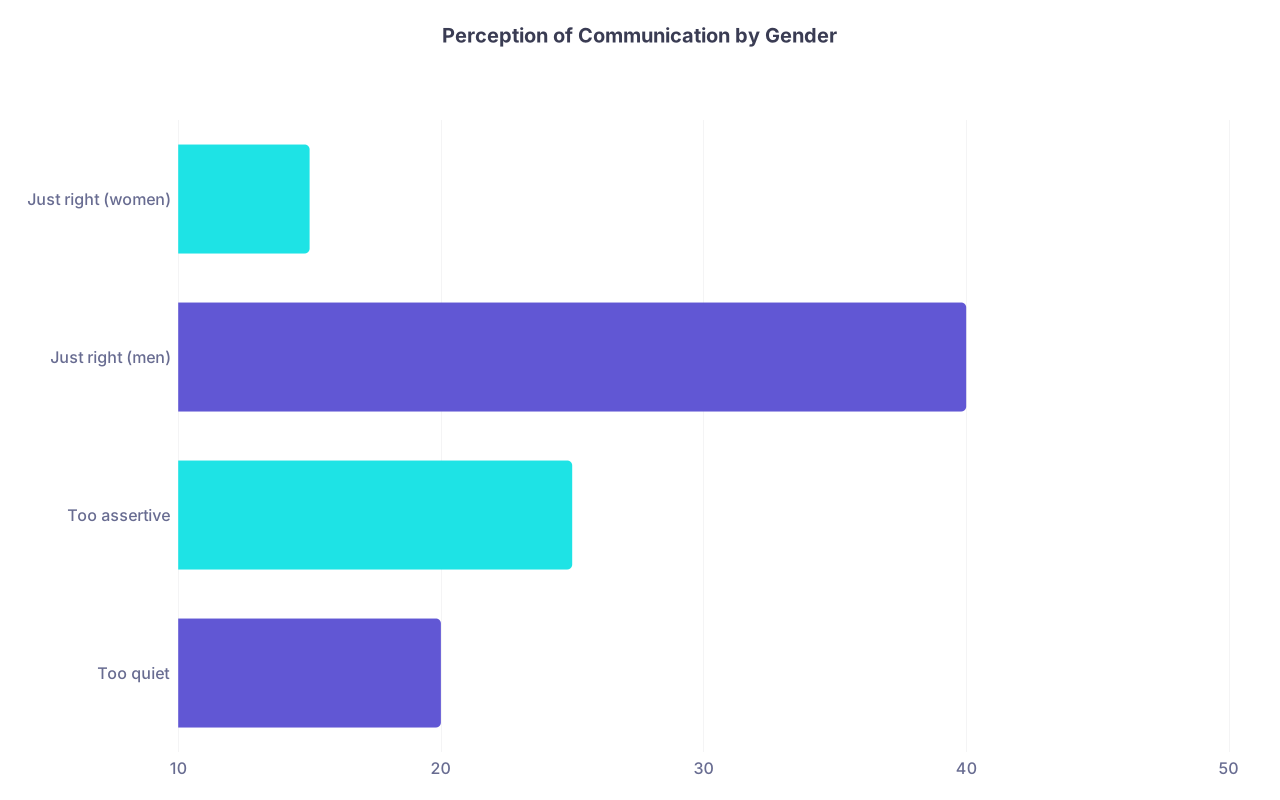
| Category | Value |
|---|---|
| Too quiet | 20 |
| Too assertive | 25 |
| Just right (men) | 40 |
| Just right (women) | 15 |
Women residents get squeezed from both ends:
- If you speak up: “pushy,” “dominating,” “interrupts”
- If you don’t: “not engaged,” “lacks confidence,” “unprepared to lead”
You’re not going to win this game perfectly. But you can avoid the most common traps.
Behaviors that get women labeled “unprofessional” in communication
Directly contradicting an attending in a group
You’re right on the medicine. The data is on your side. But the culture punishes you more for public contradiction.
Instead of:
- “That’s actually not correct.”
Try:
- “I might be misunderstanding, but I thought the recent trial suggested X — should we consider that here?”
Same point. Less ego threat.
Using email like Slack
Short, context-free, late-night messages get women tagged as abrupt or disorganized.
Don’t send:
- “Did you sign that?”
- “We need that letter.”
Do send:
- “Hi Dr X — just checking in on the consult note from 3 West earlier today. We’re waiting on it to finalize discharge. Thanks.”
Functionally similar length. Huge difference on how “professional” it reads.
Over-sharing in professional channels
Group text or email is not your diary. I’ve seen residents (almost always women) try to be transparent and get burned by it.
Messages that backfire:
- “Sorry I’m a mess today, I’m on my period and barely slept.”
- “I’m so anxious I feel like I’m going to vomit before rounds.”
On a trusted 1:1 or close friends thread? Fine. On a team chat with attendings lurking? No.
Mistake to avoid
Treating all spaces as casual because your co-residents feel like friends. They’re not always your audience. Attendings read those threads. Chiefs forward screenshots. GME sees emails.
Default rule:
- If you’d be uncomfortable seeing those words in your official file, don’t send them in writing.
5. Boundaries and Saying No: When Protecting Yourself Gets Called “Not a Team Player”

There’s a nasty pattern: men who push back on unsafe workloads are “strong advocates.” Women who do the same are “rigid,” “difficult,” or, yes, “unprofessional.”
You absolutely must protect certain boundaries. But there are cleaner and dirtier ways to do it.
High-risk boundary behaviors
Flat “No” without framing
- “No, I can’t admit another patient.”
- “No, I’m already too busy.”
You’re not wrong. But this phrasing tees people up to call you “unprofessional” or “refusing reasonable tasks.”
Try:
- “I’m currently managing 18 patients and just picked up a new admission. I’m worried another will be unsafe. Can we redistribute or clarify priorities?”
Public confrontation about workload or fairness
Calling out inequity is important. Doing it at the nurses’ station, loudly, in front of patients’ families?
That’s the scene that will live in your faculty’s memory as “she blew up at the team in front of everyone.”
Better:
- Step away first. “Can we talk about this in the workroom?”
- Then: “I’m concerned my workload is consistently heavier than X’s. Here are the numbers from the last week.”
Refusing extra work without offering alternatives
Everyone is drowning. The attending asks for one more “quick” task. You hit your limit.
Instead of:
- “I’m done. I can’t.”
Use:
- “I can do X or Y safely, but not both. Which is your priority?”
- “I’m at the edge of safe right now. I need help to add anything else — can we pull in night float/another team?”
Mistake to avoid
Equating professionalism with self-sacrifice and then snapping when you break.
You staying late every day “to be a team player”:
- Trains everyone to expect that from you
- Makes your reasonable no’s later look like attitude instead of self-preservation
Set boundaries early and consistently in neutral language. That’s harder to define as “unprofessional” without exposing the double standard.
6. Social Situations: Off-Duty Moments That Don’t Stay Off-Duty

| Step | Description |
|---|---|
| Step 1 | Social event |
| Step 2 | Comment or behavior |
| Step 3 | Observed by senior |
| Step 4 | Informal story shared |
| Step 5 | Word choice in eval |
| Step 6 | Professional label sticks |
People pretend what happens at social events “doesn’t count.” That’s delusional. For women residents, those off-duty moments often get weaponized later.
Behaviors that quietly tank reputations
Alcohol at department events
You’re absolutely allowed to drink. The bar is free for a reason. But look around: the man with three cocktails will be called “fun.” You, after two-and-a-half glasses of wine, might become “questionable judgment at events.”
Hard rule I recommend:
- Max 1 drink at any event where attendings, leadership, or fellows are present
- If anyone there has signing power on your evals or letters, this applies
Vent sessions in mixed company
You start venting to co-residents about a toxic attending. Unknown to you, the fellow’s partner is close to that attending. Guess what shows up on your eval?
“Has difficulty respecting authority,” “speaks negatively about faculty.”
Safe rule:
- Deep venting: 2–3 people you fully trust, no titles above you, and preferably away from hospital grounds
- At official events: “Yeah, it’s been intense, but I’m learning a lot.”
Flirty behavior and blurred boundaries
You shouldn’t have to worry about this more than men. But you do. Because if things sour, who gets labeled unprofessional? Usually not the attending.
High-risk:
- Getting drunk around attendings/fellows
- Texting late at night with unclear tone
- Jokes that can be reframed later as “inappropriate”
If power differential exists, assume:
- You will be blamed first
- Your reputation will be harder to repair
Mistake to avoid
Believing “they’re like family” means you can act like you’re actually with family. You’re at work, just without the pager.
Assume:
- Every event is partly a job function
- Every senior person is always, on some level, observing
That doesn’t mean be paranoid. It means don’t hand anyone easy stories to distort later.
7. Social Media and Digital Footprints: Screenshots Last Longer Than Fellowships

The quickest way I see women residents get “unprofessional” slapped on them these days? Screenshots.
You’re tired. Angry. You post or comment. Someone saves it. Months later, you’re up for chief or fellowship. Suddenly, there’s a “concern about judgment and professionalism.”
High-risk online behaviors
Posting about specific shifts or cases
You don’t name the hospital. You don’t name the patient. You think you’re safe.
But if anyone on your team can recognize the situation, it’s not anonymous.
Problems:
- “Today our attending completely humiliated a resident in front of a patient, I’m so done with this program.”
- “I had a 25-year-old intubated with COVID again — this is why antivaxxers deserve nothing.”
Both sound understandable. Both can be labeled “unprofessional conduct online.”
Publicly trashing institutions or colleagues
Even vague:
- “Wild how some programs protect abusers instead of residents.”
Do I believe you? Probably. But leadership will see “hostile,” “disloyal,” “not a team player.”
Safer:
- Advocate in structured ways (GME, ombuds, formal complaints) and private groups you trust, not public timelines.
Over-sharing personal life in a way that gets moralized
Women get judged harder for:
- Party photos with a lot of alcohol
- Thirst-trap style pictures
- Posts about sex, drugs, or anything coded as “wild”
Decide intentionally:
- If your account is public with your full name, assume program leadership will see it.
- If you want a private life online, lock it down hard: private account, careful with followers, never mix with work people.
Mistake to avoid
Believing “I’m on my personal account, this has nothing to do with work.” If your name or face is linkable to your role, it can and will be dragged into “professionalism” debates.
Before you post anything even semi-spicy, ask:
- “Would I be okay with my PD reading this out loud in a meeting about me?”
If not, don’t post it. Or send it in a group text to actual friends instead.
The Bottom Line: How Not To Get Trapped by Someone Else’s Bias
You’re not going to erase sexism by being perfectly “professional.” That’s not how this works. But you can:
Control the easy ammunition
- Tone, emails, public venting, visible breakdowns, social media — these are the fastest, laziest routes people use to call women “unprofessional.” Close those doors where you can.
Document and ask for specifics
- Any time “unprofessional” appears without clear examples, calmly ask, “Can you give me a specific behavior so I can address it?” Vague criticism is harder to weaponize when you call it out.
Build your protection squad early
- You need 2–3 faculty who know your work and will go to bat for you when some biased comment shows up. Make sure the people who see your best work are the ones writing your letters.
You shouldn’t have to play this game. But until the rules change, I’d rather you know exactly where the mines are buried.