
The most dangerous career mistakes female trainees make with mentors are the ones that feel flattering in the moment.
You are not just choosing “someone nice to help you.” You are making decisions that will determine:
- Whose reputation you’re tied to.
- Who controls access to opportunities.
- Who will be believed if something goes wrong.
Get this wrong, and you can lose years. Or your love for medicine. Or both.
This is not about blaming women for bad behavior by senior people. It is about seeing the red flags early enough to walk away.
Let me walk through the most common mistakes I see female medical students, residents, and fellows make when choosing academic mentors — and how to avoid getting burned.
Mistake #1: Confusing “Supportive” With “Safe”
The biggest trap: equating warmth with safety.
You meet an attending who:
- Compliments your work.
- Tells you that you are “different from the other students.”
- Gives you their personal cell and says, “Text any time, day or night.”
Feels supportive. Feels special. But it might not be safe.
Here is what I have seen too many times:
- The “cool” mentor who blurs all boundaries: late-night texts, social media follows, invites to drinks “to celebrate.”
- The attending who insists you meet “off campus” to talk career because “the hospital is too busy.”
- The senior physician who says inappropriate things in a joking tone, then frames you as “too sensitive” if you look uncomfortable.
Do not confuse:
- Being kind with
- Respecting professional boundaries and power differentials.
Red flags to watch for early:
- They share overly personal relationship or sexual details about themselves “to be real” with you.
- They comment on your appearance or clothing in ways not tied to professionalism (“You look so pretty in that dress,” “You should wear your hair down more”).
- They insist on private, closed-door meetings with no clear agenda.
- They seem to collect young, mostly female mentees and joke about their “team” or “harem.”
The safe mentors are often a little more boring at first:
- Meetings scheduled during business hours.
- Clear agendas.
- Feedback about your work, not your personality or looks.
- Respect when you say “No, I cannot meet then.”
If you feel flattered and uneasy at the same time, trust that unease. Do not talk yourself out of it because “they are a big name” or “everyone loves them.”
Mistake #2: Choosing Only Based on Prestige and Power
Another common mistake: chasing the biggest name in the department and ignoring the rest of the evidence.
You know this logic:
- “Dr. X is the division chief. If I can get them as my mentor, I’m set.”
- “Dr. Y is on tons of national committees. They can open every door.”
- “Everyone who works with Dr. Z matches into top programs, so I need them.”
Prestige does matter. Doors do open faster when a high-profile mentor emails for you. But you pay for that access with your time, your sanity, and sometimes your integrity.
The problems with choosing purely based on status:
You become disposable.
High-status people often take on too many trainees. Their name on your CV looks good, but:- Emails go unanswered for weeks.
- Projects stall because you are number 17 on their priority list.
- They forget what you are working on together.
They may not actually mentor — they just use labor.
Classic pattern:- You are pulled into endless data cleaning, chart reviews, IRB paperwork.
- Authorship order magically shifts later, often not in your favor.
- They show up right before submission, add comments, and call it “joint work.”
They may be powerful enough that people protect them no matter what.
If they cross a line, others will tell you:- “That is just how they are.”
- “You do not want to go against them; it will hurt your career.” And they will say this after you are already tied to them on grants, papers, and letters.
A smarter move:
- Have one or two “big name” sponsors who know your work and will advocate for you.
- But choose your day-to-day mentors based on behavior, reliability, and values.
Ask yourself:
- “When they say they will do something for a trainee, does it actually happen?”
- “Who has worked with them and would privately recommend (or warn against) them?”
- “If this person went on leave tomorrow, do I have other mentors who know me well?”
Do not mortgage your safety and sanity for someone else’s prestige.
Mistake #3: Ignoring Gender and Power Dynamics (Especially With Male Mentors)
No, you do not need to avoid all male mentors. That would be absurd. Some of the best, most ethical mentors I have ever seen are men who are crystal clear about boundaries and advocacy.
The mistake is pretending gender and power do not change the risk calculus.
Common patterns I have watched play out:
The “protective” male mentor who:
- Starts out advocating fiercely for you.
- Becomes possessive about your time, projects, and where you rotate.
- Gets jealous or undermining when you work with other mentors.
The “friendly” advisor whose tone shifts:
- Comments move from “You did great on that talk” to “You looked gorgeous up there.”
- “Let’s grab coffee to discuss data” becomes “dinner with drinks, just us, out of the hospital.”
- Suddenly you are fielding messages that feel more romantic than professional.
The “rescuer” who likes vulnerable trainees:
- Targets people who feel isolated, burnt out, or unsupported.
- Frames himself as the only one who really “gets” you.
- Uses your gratitude to ask for more time, more emotional labor, more access.
The risk is not just harassment. It is also:
- Being perceived by others as “in a relationship” with your mentor, even if you are not.
- Colleagues quietly questioning whether your achievements are earned.
- Losing professional opportunities because others avoid the drama.
You can reduce risk without throwing out male mentorship entirely:
Prefer mentors (of any gender) who:
- Have a track record of mentoring multiple kinds of trainees (not just “stars,” not just “young women”).
- Use formal communication channels (institutional email, scheduled meetings).
- Keep physical and emotional boundaries clear.
Be very cautious if:
- You are the only female trainee they work with closely.
- They ask you not to tell others about certain meetings or offers.
- They describe other women (colleagues or trainees) in demeaning or sexualized ways.
If you feel like you need to downplay or hide your interactions with a mentor, or you dread how it might look if someone walked in, that is not mentorship. That is a liability.
Mistake #4: Overvaluing “Vibe” and Undervaluing Concrete Behavior
A lot of trainees choose mentors like they choose friends. “We clicked.” “She seems nice.” “He remembers my name.”
That is not enough.
I have seen plenty of charismatic attendings who are phenomenal at first impressions and absolutely terrible at sustained mentorship.
You must look at behavior over time, not your initial emotional reaction.
Questions that matter far more than “Do we vibe?”:
- Do they respond to emails within a reasonable timeframe, or do they disappear for weeks?
- Do they show up to meetings on time, prepared, with specific feedback?
- When deadlines approach, are they present and engaged, or suddenly unavailable?
- Have they helped mentees publish, present, and progress to the next step — repeatedly?
Here is where you can make a very costly mistake as a female trainee:
- You excuse unreliability because “they are busy” or “I do not want to bother them.”
- You work twice as hard to “earn” attention from a charismatic mentor who keeps stringing you along.
Meanwhile, your male colleague chooses a less flashy but more reliable attending, churns out two papers, gets strong letters, and quietly passes you in opportunities.
Reliability is not sexy. But it is what moves your career.
Stop saying:
- “I feel bad following up again.” Start saying:
- “I need a mentor who treats my time and work as valuable. If they cannot, I will find someone who can.”
Mistake #5: Staying With a Bad Mentor Because You Feel Trapped or Guilty
Once a mentorship relationship is established, many women feel stuck. Especially if:
- You are on a paper together.
- They wrote one of your letters.
- They control a rotation, elective, or fellowship opportunity.
So you stay. Even when:
- They yell, belittle, or humiliate you in front of others.
- They take credit for your work and minimize your contributions.
- They violate boundaries or make comments that are absolutely not okay.
Two things tend to hold female trainees in place:
- Fear of retaliation.
- Misplaced loyalty and guilt.
You think:
- “If I leave, they will bad-mouth me.”
- “I owe them; they did help me early on.”
- “Switching now would look ungrateful or flaky.”
Here is the hard truth:
A mentor who will punish you for protecting yourself is not a safe or ethical mentor. You do not “owe” them continued access to your time or emotional energy because they once wrote an email.
Exiting badly chosen mentorships must be a skill you are willing to use.
You do not need to make a dramatic accusation every time. Some exits can be neutral and quiet:
- “My research interests have shifted more toward X, so I’m going to transition to working with Dr. Y.”
- “I am overcommitted this year and need to step back from new projects to focus on my core work.”
- “Given my schedule, I cannot commit to ongoing meetings, but I appreciate your support to this point.”
If there is harassment, discrimination, or serious misconduct:
- Document everything (dates, times, exact phrases).
- Talk to someone outside their sphere of influence — a trusted program director, ombudsperson, or institutional office.
- Do not confront them alone in a way that puts you at risk.
Staying out of guilt or fear never improves the situation. It just trains them that this behavior “works” on trainees like you.
Mistake #6: Choosing Mentors Who See You Only As “The Woman”
Here is a more subtle but equally career-limiting mistake: choosing mentors who frame your gender as the entire story.
You know this type:
- “We need more women in leadership — you’d be perfect for diversity committees and panels.”
- “You’d be a great role model for young girls in STEM. Can you help with our outreach event?”
- “I want you on this grant because we need more female representation.”
Sounds good. Until you realize:
- You are being pulled into endless labor centered around your gender, not your scholarly growth.
- You are doing a lot of emotional and representational work (panels, brochures, mentoring high-school students) that does not translate into publications or promotion.
- You are praised as a symbol, not developed as a scientist, clinician, or educator.
The ethical mentor recognizes:
- Gender matters in medicine and academia.
- But you are not a checkbox. You are a professional with content expertise and career goals that extend beyond “being the woman on the poster.”
Watch for this pattern:
- Your projects and invitations are disproportionately about “women in X,” “diversity,” “work–life balance,” but not substantive academic work in your field.
- They introduce you with, “She is one of our strong female residents,” instead of “She led the XYZ project that changed our protocol.”
- They keep steering conversations back to your personal life, family plans, or future fertility.
You deserve mentors who:
- Acknowledge gendered barriers honestly.
- Help you strategize around real biases.
- Still see you first as a serious academic, not a mascot.
If they cannot stop talking about you as “the woman,” they are not seeing your full professional self.
Mistake #7: Not Building a Mentor Team — Overrelying on One Person
Putting all your faith in one mentor is seductive. It feels simple:
- “She has done exactly what I want to do — I will just follow her path.”
- “He knows everyone in this subspecialty — that is all I need.”
And then:
- They go on sabbatical.
- They burn out and disengage.
- They develop a conflict with your program or leave the institution.
You are left with what I have heard too often in panicked tones: “My mentor left and I have no one.”
Relying on a single mentor is especially dangerous for women because:
- If that mentor’s reputation tanks (for harassment, bullying, unethical behavior), people may question everyone associated with them.
- If your relationship with them sours, they can do disproportionate damage.
You need redundancy and diversity:
- A research mentor (helps with projects, publications).
- A career mentor (helps with big-picture planning, job choices).
- A sponsor (uses their influence to nominate you for talks, committees, awards).
- A peer or near-peer mentor (someone a step ahead who remembers what this stage feels like).
These can overlap in one person, yes. But they should not only exist in one person.
A quick way to make yourself less vulnerable:
- Every 6–12 months, look at your “mentorship map.” Who knows your work well enough to write a detailed letter? Who would pick up the phone for you?
- If all the arrows point to one name, fix that. Intentionally deepen relationships with two or three others.
Strong systems do not have single points of failure. Neither should your career.
Mistake #8: Ignoring How They Treat Other Women
Here is a test I almost never see trainees use, and it is a costly omission:
Watch how your potential mentor treats other women — colleagues, staff, and trainees.
Red flags that too many people ignore because “they are so good to me”:
- They dismiss or interrupt female colleagues in meetings, but let male colleagues finish.
- They call female nurses or staff “sweetie,” “honey,” or similar diminutives.
- They describe women who assert themselves as “difficult,” “emotional,” or “crazy.”
- They have a reputation for “clashing with strong women.”
If they consistently:
- Criticize female attendings as “too aggressive” while calling male attendings “strong leaders.”
- Talk about women’s appearances in professional contexts.
- Joke about #MeToo, “cancel culture,” or how “men cannot say anything anymore.”
Then understand something clearly:
Whatever kindness they show you now is conditional. It will evaporate the moment you stop being compliant, flattering, or useful to their image.
You want mentors who:
- Speak respectfully about women who are not in the room.
- Credit female colleagues publicly and without resentment.
- Have real, long-standing professional relationships with women at and above their level.
If you are the exception to their usual contempt for women, you are not safe. You are next.
Mistake #9: Not Protecting Your Time and Boundaries Up Front
Female trainees are repeatedly socialized to be:
- Helpful.
- Flexible.
- Grateful.
Mentors — even well-intentioned ones — can exploit that.
Common traps:
- Taking on unending “just one more” tasks for a mentor: extra charts, extra slides, last-minute edits.
- Agreeing to weekend or late-night work because “that is when they are free.”
- Letting meetings routinely run 30–40 minutes over because you are too polite to stand up and leave.
Over time, this eats your study time, sleep, personal life, and mental health. And the worst part? It often does not even yield proportional benefits.
You have to set and maintain boundaries early. That is not selfish. It is survival.
That means:
- Saying clearly, “I can commit 3–4 hours per week to this project. If it looks like more than that, we will need to adjust scope or timeline.”
- Ending meetings on time: “I have to get to the ward now; I can follow up by email on the remaining points.”
- Declining requests that do not fit your priorities: “I cannot take on another committee this year; I am focusing on finishing my project.”
Ethical mentors will:
- Respect that.
- Work with you to prioritize.
- Not guilt-trip you or question your dedication.
If a mentor responds to appropriate boundaries with:
- Sulking.
- Threats (“People who succeed here go the extra mile”).
- Guilt (“I thought you were serious about this field”).
Walk away. They are showing you exactly how they will treat you long term.
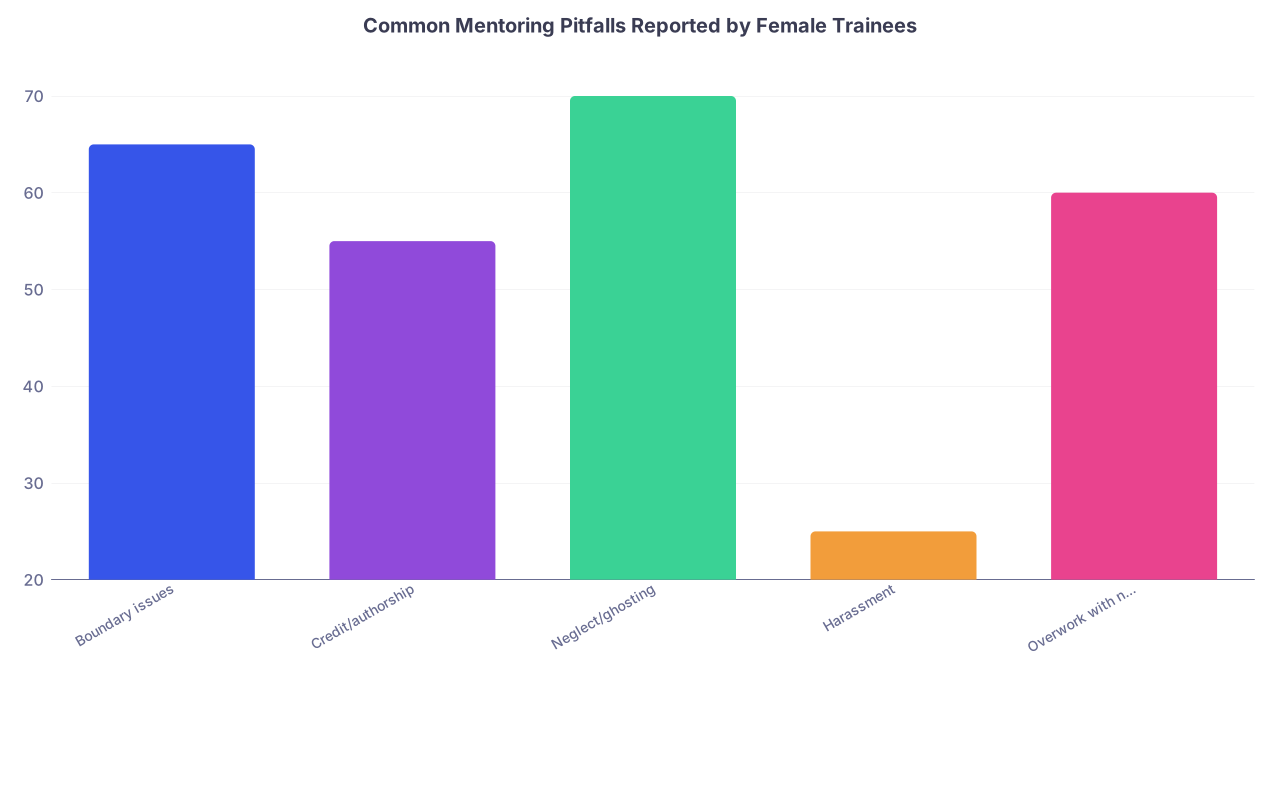
| Category | Value |
|---|---|
| Boundary issues | 65 |
| Credit/authorship | 55 |
| Neglect/ghosting | 70 |
| Harassment | 25 |
| Overwork with no gain | 60 |
Mistake #10: Not Asking Other Trainees The Blunt Questions
Female trainees often hesitate to “gossip” or “speak badly” about attendings. So they never ask the people who actually know:
- “Would you choose them again as a mentor?”
- “Did they follow through on what they promised?”
- “Did you feel safe and respected working with them?”
- “Was there anything that surprised you in a bad way?”
You are not being disloyal. You are doing due diligence on someone who will have massive influence on your career.
Three groups to talk to:
- Current mentees.
- Former mentees.
- People who left working with them.
Pay close attention to:
- Hesitations before they answer.
- The difference between what they say with others around vs one-on-one.
- Phrases like “He is intense” or “She has very high standards” said in a strained tone — often code for punitive, demeaning, or abusive behavior.
If you keep hearing:
- “He is amazing, if you can handle his personality.”
- “She is great, but not everyone can survive her style.” You are not special enough to be the exception. You will eventually run into whatever they are politely avoiding describing.
Do not be afraid to ask, quietly but directly:
- “Did you ever feel uncomfortable?”
- “Were there any boundary issues?”
- “Did anyone ever raise concerns about them to leadership?”
You deserve that information before you tie your name to theirs.

A Simple Mental Model: The Mentor Risk–Benefit Grid
To prevent these mistakes from stacking up, use a blunt but effective mental model:
| Type | Benefit to Career | Risk to Well-being | What To Do |
|---|---|---|---|
| High benefit, low risk | High | Low | Actively pursue |
| High benefit, high risk | High | High | Consider distance, backups |
| Low benefit, low risk | Low | Low | Fine as secondary support |
| Low benefit, high risk | Low | High | Avoid |
Most of the worst situations female trainees end up in come from:
- Overrating the “high benefit, high risk” mentor and
- Underrating the value of the “high benefit, low risk” mentor who is less flashy but more ethical.
Strong mentors sit in that top-left box:
- They help you publish, present, and progress.
- They keep boundaries clear.
- They respect your time and identity.
- They do not flirt with, belittle, or control you.
That is what you are looking for. Everything else is noise.

| Step | Description |
|---|---|
| Step 1 | Identify Potential Mentor |
| Step 2 | Check Reputation With Trainees |
| Step 3 | Do Not Proceed |
| Step 4 | Assess Behavior and Boundaries |
| Step 5 | Evaluate Career Alignment |
| Step 6 | Keep as Secondary Contact |
| Step 7 | Start With Small Project |
| Step 8 | Reassess After 3-6 Months |
| Step 9 | Positive and Consistent? |
| Step 10 | Reliable and Respectful? |
| Step 11 | Supports Your Goals? |

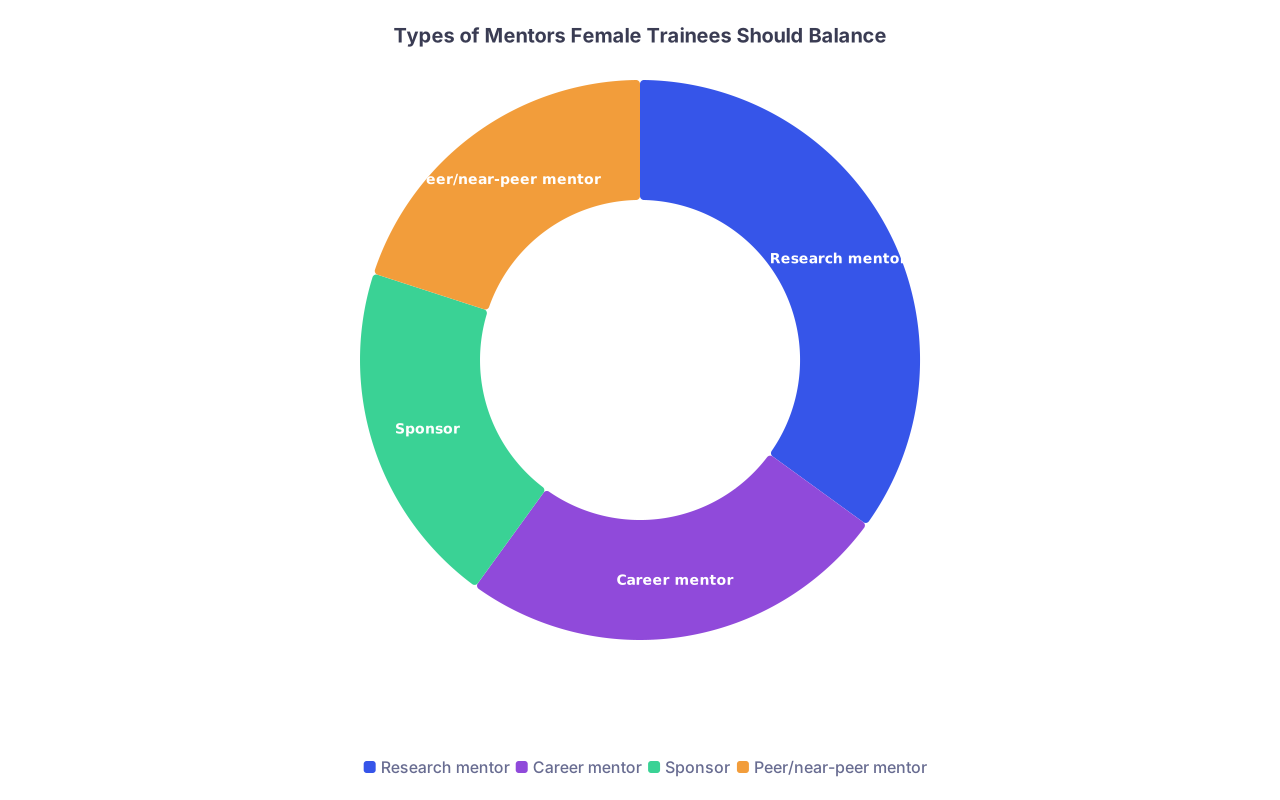
| Category | Value |
|---|---|
| Research mentor | 35 |
| Career mentor | 25 |
| Sponsor | 20 |
| Peer/near-peer mentor | 20 |

Bottom Line
Three points to keep front and center:
- Do not confuse charisma, flattery, or power with safety. Judge mentors by long-term behavior, boundaries, and how they treat other women.
- Do not tie your entire career to one person. Build a small, diverse team of mentors and sponsors so no single relationship can make or break you.
- Do not stay loyal to a harmful mentor out of guilt or fear. Protect your time, your boundaries, and your reputation first — the right mentors will respect you more for it.