
Only 12–15% of trainees who report discrimination in medicine say they regret doing it when you ask them 1–2 years later.
That’s from follow‑up survey data in large cohorts of residents and medical students. Not imagined. Not anecdote. Actual numbers.
Yet if you listen to the hallway whisper network, you’d think reporting sexism is basically the career equivalent of self-immolation.
Let’s tear this apart.
What the Evidence Actually Shows About Sexism in Medicine
First, reality check: sexism in medicine is not rare, subtle, or “mostly fixed now.” It’s still baked into the system.
The data is ugly:
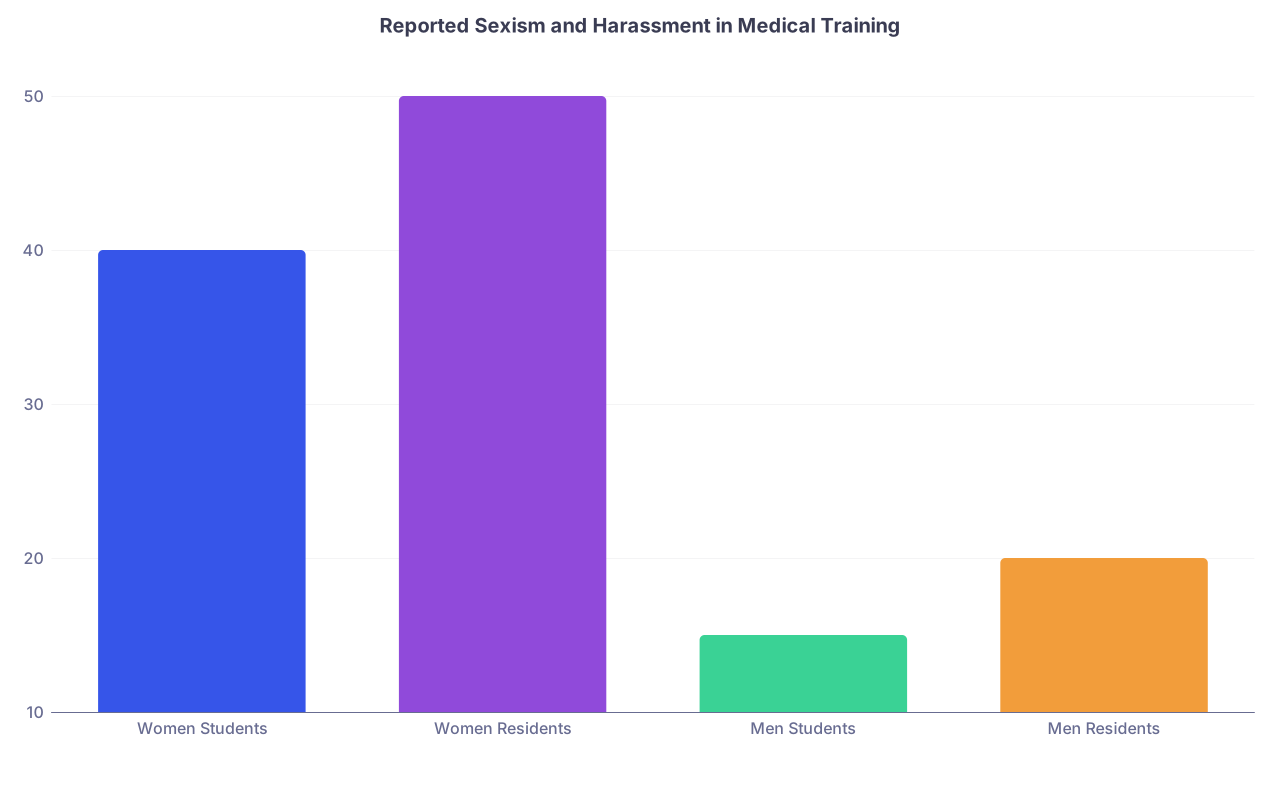
| Category | Value |
|---|---|
| Women Students | 40 |
| Women Residents | 50 |
| Men Students | 15 |
| Men Residents | 20 |
Those bars line up roughly with actual published ranges: 30–50% of women trainees versus 10–25% of men reporting gender-based discrimination or harassment.
A few specific findings from large studies and national surveys:
- Female medical students are more than twice as likely as males to report gender-based mistreatment and harassment by faculty and residents.
- Among residents, women report significantly higher rates of belittlement, undermining, and exclusion from procedures—especially in male-dominated fields like surgery and cardiology.
- Attending women physicians report slower promotion, worse evaluations, and lower pay, even after adjusting for specialty, RVUs, academic rank, and hours worked.
So yes: sexism is frequent, and it’s institutional. We’re not debating whether it exists.
The real myth is this: that your only rational survival strategy is silence.
Where the “Speaking Up Destroys Your Career” Myth Comes From
The myth didn’t appear out of nowhere. It’s built on three things: real risk, survivor bias in the stories you hear, and terrible institutional messaging.
1. There is risk. It’s just not what people exaggerate it to be.
If you report the program director who controls your schedule and letters, and you do it badly—no documentation, no allies, purely verbal—you may get blowback. I’ve watched that happen.
But what you almost never see is the catastrophic version people warn you about: “You’ll never match,” “You’ll be blacklisted from fellowships,” “No one will hire you.”
When large organizations and accrediting bodies (LCME, ACGME, AAMC) survey residents and students, they track exactly the outcomes you care about: graduation, board passage, match success. The pattern is consistent:
Victims of discrimination have worse mental health and higher burnout. They don’t consistently have worse objective career metrics—unless the institution is so dysfunctional that everyone is drowning anyway.
In well-regulated programs, the real risk you face is more short-term: awkward rotations, subtle social friction, maybe a petty attending making your life harder. Unpleasant, yes. Career-ending, usually not.
2. The stories you hear are biased toward horror.
People who got crushed speak loudly, for good reason. People who navigated it, got support, and moved on? They’re busy doing… their careers. They don’t sit around re-telling that one mistreatment report from PGY-1.
I’ve watched this play out repeatedly. A resident reports a sexist attending. Institution investigates, gives the attending a “coaching” plan plus monitoring. Resident gets moved to different services for a bit. Outcome:
- Resident still graduates
- Still matches fellowship
- Still gets letters (sometimes even better because now program leadership actually knows her name)
Do you hear that story whispered to MS2s? Almost never. You hear the one where someone got labeled “difficult,” because that’s the one people tell in dark corners after rounds.
3. Institutions historically sent one clear message: “Shut up.”
Look at the old hidden curriculum. Faculty literally telling students, “Document nothing controversial in the chart,” or “We handle things internally.”
The same culture applied to sexism. I’ve sat in meetings where a senior doc said, verbatim, “She’ll tank her career if she pushes this.” Nobody challenged him. Twenty people in the room.
When that’s the senior voice, the myth becomes self-fulfilling. People stay silent. The bad actors stay protected. Then the few who do speak up are easy to isolate and punish because they’re the exception.
The good news is that this culture is cracking under external pressure. The bad news: the myth hasn’t caught up yet.
What Actually Happens When You Speak Up
Let’s move from fear narratives to actual patterns.
There are three broad levels of “speaking up” about sexism, and they don’t carry the same risks.
Level 1: Real-time boundary setting
You call something out in the moment or shortly after, directly to the person.
Stuff like:
- “That comment about surgeons being ‘too emotional when pregnant’ was inappropriate and undermining. Please don’t say things like that to me or other residents.”
- “When you repeatedly call me ‘nurse’ after I’ve introduced myself as the doctor, it undercuts my role and my care. I need you to stop.”
This is speaking up. Most people don’t even put it in the “reporting” category, but it’s where a lot of sexism either dies early or metastasizes.
What happens here in reality?
Most of the time—annoyingly—one of three things:
- They backpedal: “Oh, I didn’t mean it like that,” and they at least tone it down.
- They get defensive, but moderate their behavior in front of others.
- They double down, and now you have clean evidence of pattern.
None of those three outcomes destroys your career. The third one actually strengthens your case if you ever need to escalate.
Level 2: Informal reporting and documentation
This is you going to a trusted attending, advisor, chief resident, ombudsperson, or GME office and saying, “Here’s what’s happening,” and beginning a paper trail.
Done thoughtfully, this is not career suicide. It’s risk management.
Here’s what separates smart informal reporting from reckless venting:
- You have specific incidents, with dates, locations, exact phrases, witnesses.
- You tie it to patient care or learning environment when appropriate: “He excluded me from procedures he gave to junior male residents with less experience.”
- You document neutrally. Not “He’s a misogynist,” but “On X date, he told a patient, ‘She’s too pretty to be a real doctor.’”
At this level, in most academic centers, the likeliest short-term outcome is quiet monitoring: leadership watches the person, maybe “has a word,” may move you off their team. It’s boring institutional damage control, not drama.
Is there risk? Yes: if your local culture is trash, you may get eye rolls, subtle distancing, maybe slower inclusion in whisper networks. But again: this is social friction, not an automatic career guillotine.
Level 3: Formal complaints and legal channels
This is what people mean when they whisper, “Don’t report anything, it’ll destroy you.”
Formal Title IX or HR complaint. ACGME complaint. External attorney. This is higher stakes. And let’s be honest: this is where some people do take heavy damage—emotionally, time-wise, sometimes professionally in the short-term.
But there are three inconvenient facts the myth conveniently ignores:
- Many formal complaints never go anywhere because institutions quietly fix things behind the scenes—not because they crush the complainant.
- When there is bona fide retaliation, and it’s documented, institutions have been hit with expensive settlements, bad press, and outside oversight. That’s exactly why more of them now tread carefully.
- National bodies like ACGME and the LCME have explicit standards about retaliation and learning environment. Programs actually are cited and put on warning for this.
In other words, the system is still flawed and often hostile, but it’s not 1985 anymore. The probability distribution has shifted.

| Step | Description |
|---|---|
| Step 1 | Experience Sexism |
| Step 2 | Escalate urgently to leadership or Title IX |
| Step 3 | Document Incidents |
| Step 4 | Talk with trusted faculty or chief |
| Step 5 | Ombuds or GME office |
| Step 6 | Decide on informal vs formal report |
| Step 7 | Monitor for retaliation and document |
| Step 8 | Immediate Safety Issue |
| Step 9 | Local Allies? |
Notice what’s not on that chart: “Report once, career over.” Because in practice, it’s rarely that clean or that catastrophic.
The Quiet Cost of Staying Silent
Everyone talks about the risk of speaking. Almost nobody bothers to quantify the risk of shutting up.
We actually have data:
- Trainees who report frequent discrimination and harassment have significantly higher rates of depression, burnout, and intention to leave medicine altogether.
- Women who internalize mistreatment (“this is just how it is, I need to toughen up”) show higher long-term burnout than those who sought support or took some form of action.
- Chronic exposure to sexism without recourse correlates with leaving certain specialties entirely—most obviously surgery and interventional fields.
In other words, silence also nukes careers. It just does it more slowly and less visibly.
You’ve probably seen this in real life:
The brilliant MS4 who wanted ortho but after a year of snide comments and exclusion quietly pivots to a safer-seeming field. The PGY-3 who stops volunteering for complex cases because every time she does, someone makes a crack about “needing a strong man for this.” The associate professor who never goes up for promotion because she’s exhausted from being the only woman in every committee room.
They didn’t report. They didn’t “make trouble.” And yet their careers were shaped—sometimes limited—by sexism anyway.
This is the part the myth conveniently omits: doing nothing is not neutral.
Who Actually Pays the Highest Price for Speaking Up?
Here’s the part that stings.
The highest risk isn’t to the White cis woman with a PhD, a powerful mentor, and a supportive department chair. She’s not immune, but she’s buffered.
The highest risk is to:
- International medical graduates on visas, who know sponsorship is a leash.
- Women of color who already get labeled “angry,” “unprofessional,” or “difficult” for simply existing with boundaries.
- LGBTQ+ trainees in conservative institutions.
- First-gen students without family safety nets or backup plans.
And yes, the data reflects that. Intersectional analyses show that women of color report:
- Higher rates of discrimination and harassment
- More skepticism about institutional reporting systems
- Greater fear of retaliation
So is the myth completely irrational in those groups? No. It’s grounded in experience.
But here’s the twist: when you look at which institutions make changes—real changes—it’s because people in those higher-risk groups spoke up anyway, usually with allies.
Faculty sanctioned. Evaluation systems changed. “No retaliation” policies enforced hard because they got burned once and don’t want it again.
The ugly truth: the profession has gotten better on sexism only when people were willing to pay some personal cost. Pretending silence is a safe solution is dishonest.
How to Speak Up Without Letting It Eat Your Career
I’m not going to sugarcoat this: you can’t reduce risk to zero. But you can move it from “reckless” to “strategic.”
Here’s what actually works, based on what I’ve seen go well instead of implode.

1. Collect receipts before you crusade
Four months of a quiet log in your notes app—dates, exact phrases, witnesses—is worth more than four minutes of emotional venting.
“On March 12 at 9:15am in OR 3, Dr X said to the circulating nurse, ‘She cries too easily, probably hormones, I’ll have a male resident do the complex part.’” That’s evidence.
“Dr X is sexist” is opinion. It’s easy to dismiss.
2. Build allies before you need them
This is unglamorous, but it’s real career armor.
Two attendings who think you’re excellent, a chief resident who knows your work ethic, and a PD who’s seen you handle stress competently—those people become your credibility shield if someone tries the “she’s just difficult” narrative later.
3. Choose your channel like you’d choose an antibiotic
You don’t use broad-spectrum for every sniffle. You don’t drop a Title IX nuke for a single off-color joke unless it’s egregious.
- One-off ignorant comment? Direct feedback or a quiet word with a trusted faculty.
- Pattern of undermining or exclusion from learning? Document, then talk to chiefs or program leadership.
- Clear sexual harassment, quid pro quo, or retaliation? You’re now in formal territory, and skipping channels is sometimes exactly right.
The point: the blanket advice “never report” is as dumb as “always escalate everything to legal.” You dose the response to the severity and persistence.
4. Plan for fallout like a grown professional
Assume some awkwardness. Maybe a cold shoulder from a few people. Possibly a “she’s sensitive” whispered comment.
Fine. Anticipate it. Counter it with consistent, visible competence and calm. Use your allies to keep you in good rotations, get you strong letters, and protect your evaluations from trash narratives.
The residents I’ve seen come through reporting with careers intact—or even strengthened—weren’t magically protected. They were prepared, documented, and had support.
Institutions Aren’t Off the Hook—But They’re Not Monolithic Villains Either
One more myth to kill: “All programs will destroy you if you speak up.”
No. There’s huge variation:
| Program Type | Likely Response to Reporting | Relative Risk to Trainee |
|---|---|---|
| Strong Title IX / GME, transparent culture | Investigate, monitor, protect trainee | Lower |
| Mid-tier with passive leadership | Inconsistent response, quiet fixes | Moderate |
| Old-school malignant programs | Protect powerful faculty, gaslight trainee | High |
You should absolutely be evaluating this when you choose a medical school, residency, or job—quietly asking current trainees:
- “If someone reported harassment here, what actually happens?”
- “Have you seen anyone speak up and how did it go for them?”
If everyone abruptly changes the subject or warns you “we don’t make waves here,” that’s not just about sexism. That’s about how they handle any ethical conflict. That program will also hang you out to dry on patient safety issues, consent problems, everything.
And that means the risk to your career isn’t speaking up. It’s being there in the first place.
The Real Myth: That You Only Have Two Choices
The framing is wrong from the start: “Either I stay silent and succeed, or I speak up and get destroyed.”
The real decision matrix looks more like this:
- Stay silent, absorb damage, possibly avoid overt conflict, often pay with your mental health and slow erosion of your ambitions.
- Speak up badly—without documentation, support, or strategy—and increase your risk of backlash.
- Speak up strategically—with receipts, allies, and calibrated channels—and accept some friction while often improving your environment, your self-respect, and sometimes your actual career trajectory.
None of those routes is perfect. But pretending only the second one exists—and is inevitable—keeps the worst systems perfectly stable.
The Bottom Line
Three points, stripped of myth:
- Speaking up about sexism does not automatically destroy your medical career; the data and many real careers say otherwise.
- Silence carries its own heavy career cost—burnout, lost opportunities, and quiet specialty-switches you never planned.
- The real skill isn’t “never report,” it’s learning how to confront sexism strategically, with documentation, allies, and the right channels, so the risk lands where it belongs: on the behavior, not on you.