
Medicine has not achieved gender equality. Not even close. And the data is painfully clear if you stop listening to the victory speeches and start looking at the numbers.
The problem is not that women are “underrepresented” in medicine anymore. They are not. Women are over half of U.S. medical students and a growing share of residents. The problem is that the system still behaves like medicine is a male default profession that women are trying to squeeze into.
Let’s dismantle the feel‑good myths one by one.
Myth #1: “We Have Equal Numbers of Women in Medicine, So the Problem Is Solved”
This is the laziest myth, and it usually comes from two places: an older attending who remembers when their class had 5 women total, or an institution trying to pat itself on the back with a diversity slide in Grand Rounds.
Here’s what the data actually shows.
Women now make up:
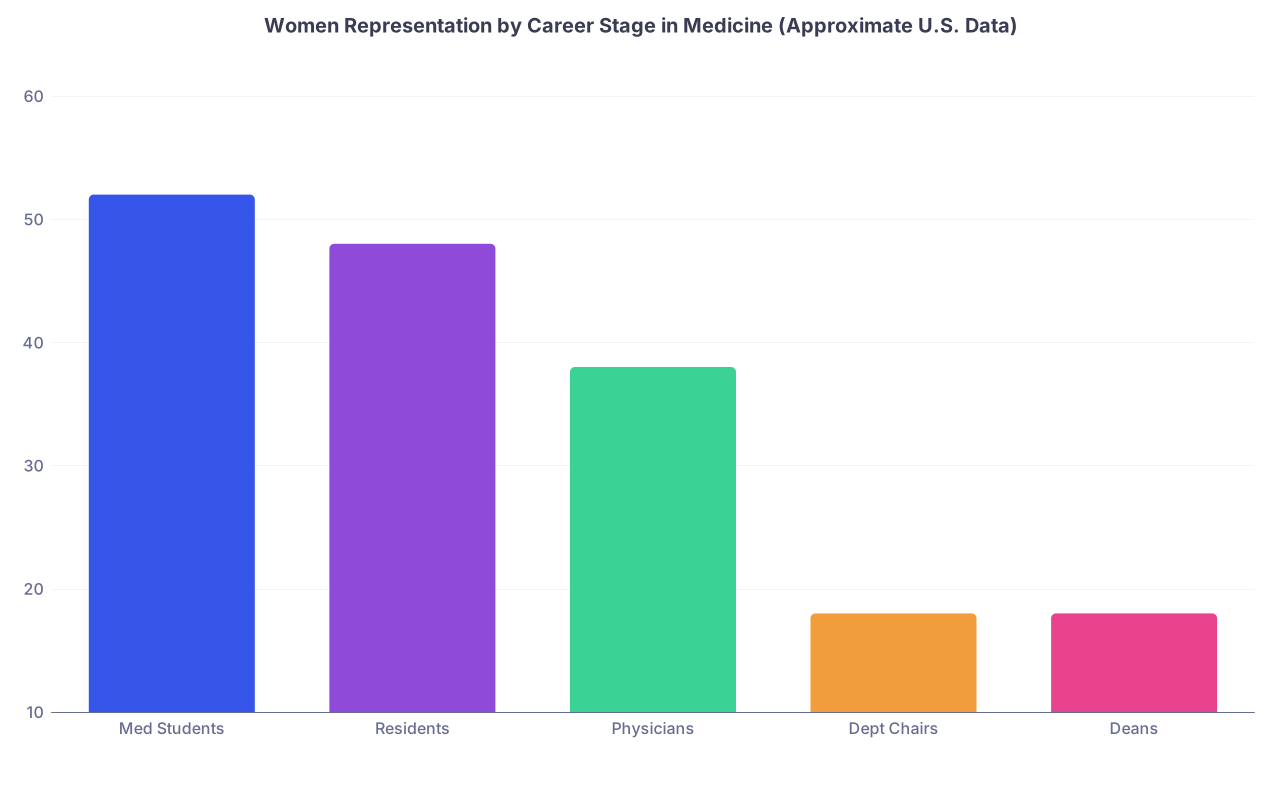
- About 50–55% of U.S. medical students (AAMC data, recent years)
- Roughly half of residents overall
- Around 37–40% of practicing physicians, depending on specialty and cohort
On a raw headcount level, you could argue, “Look, we did it.” But distribution and power matter more than the intake pipeline.
| Category | Value |
|---|---|
| Med Students | 52 |
| Residents | 48 |
| Physicians | 38 |
| Dept Chairs | 18 |
| Deans | 18 |
That last part is the issue. Leadership. Decision‑making. Control over money, policy, prestige.
Women are:
- Around 18–20% of department chairs
- Around 18–20% of medical school deans
- Drastically underrepresented in high‑paying, procedure‑heavy specialties like orthopedics, neurosurgery, and interventional cardiology
So the funnel looks like this: parity at the front door, leakage and stratification everywhere else.
Gender equality is not “we have a lot of women in the building.” Gender equality is “women have proportional access to pay, leadership, prestige, and sane working conditions.” By that standard, we are nowhere near done.
The uncomfortable truth: if you stop the analysis at “but our med school class is 50% women,” you are either uninformed or choosing not to look any deeper.
Myth #2: “Pay Is Based on Productivity, Not Gender”
This one is a favorite among senior partners in private groups and hospital administrators who love compensation formulas. “We pay based on wRVUs. The system is gender‑neutral.”
No, it is not.
Multiple large studies have shown that women physicians earn less than men even after adjusting for specialty, hours worked, academic rank, and productivity measures.
A few uncomfortable facts:
- A 2020 study in Health Affairs found female physicians in academic medicine earned about $20,000–$40,000 less per year than male peers after adjustment for nearly every confounder they could measure.
- An analysis in JAMA Internal Medicine showed women in academic medicine earned about $51,000 less annually than men, even after adjusting for specialty, rank, and research productivity.
- In primary care, multiple datasets show women spend more time per patient, address more problems per visit, and score higher on patient satisfaction and communication metrics—yet still earn less.
The “but wRVUs!” defense is flimsy, because productivity metrics themselves are not neutral.
Women are more likely to:
- Spend additional unbillable time on counseling, complex conversations, and social issues
- Take on more teaching, mentoring, and committee work that rarely translates into pay
- Get scheduled more complex or non‑procedure‑based visits that generate fewer wRVUs per hour
So yes, the formula may be “the same,” but what flows into that formula is not. Equal rules applied to unequal inputs do not produce fairness.
| Setting | Adjusted Annual Gap | Source Type |
|---|---|---|
| Academic medicine (multi‑specialty) | \$20k–\$50k less for women | Large observational studies |
| Primary care | ~8–15% less for women | Claims-based analyses |
| Surgical specialties | Often >\$40k gap | Compensation surveys |
Whenever someone says, “It’s not gender, it’s productivity,” they’re usually ignoring the structural ways we assign “productive” vs “unproductive” work—and who gets stuck doing the latter.
Myth #3: “Specialty Choice Is Just Personal Preference”
I hear this constantly: “Women just like pediatrics more. Men like surgery.” As if this is all a happy coincidence of innate preference and not shaped by culture, bias, and gatekeeping.
Look at specialty distributions:
- Women are the majority in pediatrics, OB/GYN, and a good chunk of psychiatry and family medicine
- Men dominate orthopedics, neurosurgery, interventional cardiology, radiology, and many procedural subspecialties
If you truly believe that women collectively “prefer” lower‑paying, lower‑prestige specialties and men magically “prefer” the highest‑paid, most powerful ones, you’re not analyzing—you’re rationalizing.
Here’s what actually happens:
- Early clinical years:
Female students report more discouraging comments when expressing interest in surgery, cardiology, or other male‑dominated fields. Some of you have heard the lines:- “You’re so nice, have you thought about pediatrics?”
- “This lifestyle can be tough if you want a family.”
- “Ortho is very physical; it’s not for everyone.”
- Mentorship and representation:
If every cardiology attending you see is male, and the women you encounter are mostly in pediatrics and OB, that shapes what feels “normal” and what feels like swimming upstream. - Culture and harassment:
Some specialties have reputations—often accurate—for toxic, macho cultures. Residents will quietly tell students, “You don’t want to be here, trust me,” especially if you’re a woman or visibly not fitting the bro‑surgeon mold.
This is not free choice. It is constrained choice.
And then we blame women for “choosing” lower‑paid fields and use that to explain away pay gaps and leadership disparities. Circular logic at its finest.
Myth #4: “Harassment Is Rare Now; That Was an Old‑School Problem”
People like to believe sexual harassment in medicine is some relic of the 1970s when attendings could say explicitly vile things on rounds with no consequences.
Reality check: it’s not gone. It’s just more subtle, more coded, and more shielded by power hierarchies.
Data first:
- Surveys of medical students and residents across multiple countries consistently show large proportions of women reporting gender‑based discrimination and harassment.
- Studies of surgical trainees have found that 30–60% of women report sexual harassment during training, depending on the survey and definition used.
- LGBTQ+ women and women of color experience even higher rates and often more severe forms.
But let’s get specific, because the word “harassment” sounds abstract until you’ve watched it play out:
- The attending who “jokes” about a resident’s appearance on every call shift.
- The senior surgeon who offers a coveted case, then adds, “You owe me dinner for that” with the smile that everyone recognizes.
- The faculty member who “mentors” by late‑night texts, inappropriate comments, and “accidental” touches in the call room.
- The ad boards and grievance processes that quietly “investigate” and then decide there’s “insufficient evidence,” while the complainant’s rotation schedule suddenly gets worse.
Harassment persists because medicine has extreme hierarchies, opaque evaluation processes, and huge power differences between trainees and evaluators. It is structurally designed to silence complaints. You depend on these people for letters, grades, and future jobs.
So no, it is not rare. It is just underreported and often rebranded as “miscommunication,” “generational difference,” or “misunderstood humor.”
When someone says, “That doesn’t happen here,” what they usually mean is, “No one has felt safe enough to make it official here.”
Myth #5: “Motherhood Is Just a Personal Choice, Not a System Problem”
You hear this a lot when talking about women “choosing” part‑time work or having “gaps” in their CVs: “Well, they had kids; that’s their decision.”
Sure. Pregnancy is a personal decision. What happens next is very much a systems design issue.
The data is brutal:
- Studies show women physicians experience a “motherhood penalty”—slower promotion, pay stagnation, and assumptions about reduced commitment—even when productivity remains high.
- Male physicians who become fathers often experience a “fatherhood bonus” in perception and pay—seen as more stable, more committed, more deserving of support.
- Many residency programs offer minimal or chaotic parental leave policies, forcing trainees to cobble together sick days, vacation, and goodwill to avoid extending training.
A few patterns I’ve seen repeatedly:
- Female residents pumping in supply closets, call rooms, bathroom stalls, because “there’s no dedicated space” and “we’re working on it.”
- Women being told informally that pregnancy during certain rotations would be “poorly received” or “unprofessional.”
- Evaluation comments like “less available,” “seems distracted,” “not as committed as peers” magically appearing post‑pregnancy but not for male residents with kids.
What looks like “choice” on paper often looks like this in real life: “I burned myself to the ground trying to do it all in a system that never adjusted around basic reproductive reality, and eventually I had to pick something to drop.”
Blaming women for the downstream effects of a system built around an unencumbered male worker is not analysis. It is moral laziness.
Myth #6: “You’ll Be Treated the Same if You Just Work Hard and Don’t Make It About Gender”
This is the respectability politics version of advice. Keep your head down. Outperform everyone. Don’t “complain.” The system will reward you.
Except the data says otherwise.
Women who push back on unfairness—whether it’s scheduling, harassment, credit on papers, or promotion criteria—often get hit with the “difficult,” “not a team player,” or “too emotional” labels. Those labels travel. Into rank meetings, into promotion committees, into whispered back‑channel conversations that never make it into your file but somehow shape your whole career.
This is how bias shows up:
- The male resident who’s “assertive, strong leader” vs the woman who’s “abrasive, rubs people the wrong way” while doing the same thing in codes and on rounds.
- The guy who pushes for authorship being “appropriately career‑focused,” the woman doing the same being “selfish” or “not understanding the big picture.”
- Patient complaints weighted differently when directed at women—especially women of color—and weaponized during evaluations.
Working hard is necessary. It is not sufficient. You cannot outperform a biased system that moves the goalposts based on who you are.
Is it hopeless? No. But the individual “just don’t rock the boat” strategy is not a solution. It’s a survival tactic that comes with a long‑term cost: burnout, moral distress, and the slow erosion of any sense that this profession is fair.
Myth #7: “Talking About Gender Inequality Is Divisive; Medicine Should Be Merit‑Based”
This one sounds noble: “Let’s stop talking about identity and just focus on excellence.” The problem is simple: you cannot have a meritocracy when the starting conditions and ongoing evaluations are not merit‑based.
Meritocracy is not “whoever survives our broken system deserves what they got.” Meritocracy is “people are evaluated fairly, by consistent criteria, without hidden penalties for gender, race, pregnancy, or caregiving.”
We are nowhere near that.
You do not fix biased systems by refusing to measure or discuss the bias. That is how you keep it invisible and self‑protecting.
Real meritocracy in medicine would require:
- Transparent salary ranges and promotion criteria
- Standardized, bias‑aware evaluation tools for students, residents, and faculty
- Actual accountability when harassment or discrimination is substantiated, not quiet reshuffling
- Work structures that do not assume a 1950s housewife at home absorbing all domestic labor
That is not “division.” That is house‑cleaning.
What To Do If You’re a Woman in Medicine (or Training to Be One)
You are not going to personally fix the system during M3 year or intern year. But you do have more power than you think over how you move through it and who you align yourself with.
A few concrete, non‑fluffy points:
- Be strategic about mentors. Do not just look for women; look for people who have a track record of actually sponsoring their mentees into opportunities—papers, talks, leadership roles. Plenty of “supportive” attendings will listen sympathetically and then never lift a finger for you.
- Document everything that smells off. Harassing comments, retaliatory behavior, inconsistent evaluations—write it down with dates and witnesses. If you never need it, great. If you do, you’ll be glad you did.
- Learn the policies at your institution cold. Parental leave, harassment reporting, promotion criteria. Institutions rely on people not knowing the rules. Knowledge is leverage.
- Do not internalize systemic failure as personal inadequacy. When you’re exhausted and thinking, “Maybe I’m just not cut out for this,” ask: “Or maybe I’m cut out for medicine but not for a system that runs on unpaid emotional labor and hidden penalties.”
And if you’re a man in medicine who somehow made it this far: your role is not to feel guilty or to post something performatively supportive on social media. Your role is to:
- Decline the all‑male panel and suggest qualified women instead
- Call out sexist behavior in rooms where women are not present
- Share credit. Authorship. Opportunities. Invitations.
You do not get extra credit for this. You’re just doing the job properly.

The Bottom Line: Progress Is Not the Same as Equality
Here’s the hard truth: medicine loves a good progress narrative. “Look how far we’ve come.” And it is true—we have come far from the days when women were openly barred from medical schools.
But progress is not a finish line. It is a trajectory. And right now, that trajectory flattens out the closer you get to power, pay, and prestige.
If you are a woman in medicine feeling like you must be the problem because everyone keeps insisting the system is fair now—stop. The system is not fair. The data backs you up.
Your job is not to gaslight yourself into gratitude for half‑measures. Your job is to practice excellent medicine, protect your own sanity, and wherever possible, refuse to participate in the comforting myths that keep everything stuck exactly where it is.
Years from now, you will not remember every call night or every snide comment from a dismissive attending. You will remember whether you believed the myths that told you to shrink—or whether you trusted the evidence, backed yourself, and insisted that equality means more than just getting in the door.