The belief that women doctors advance faster by being “nice” is not just wrong. It is professionally dangerous.
The “Nice Woman Doctor” Myth
You know the script. Women in medicine are told to be:
- collaborative not confrontational
- agreeable not “difficult”
- supportive not “ambitious”
The subtext: if you’re pleasant enough, people will “open doors” for you. Mentors will appear. Promotions will follow. Everything will work out.
That story sells well on wellness panels and HR posters. It collapses fast when you look at actual data on promotions, pay, leadership roles, and evaluations.
Here’s the blunt version:
Being perceived as “nice” often helps men look like “team players.”
For women, the same “niceness” is frequently read as “not leadership material.”
And the research backs this up, repeatedly.
What the Data Actually Shows About Advancement
Let’s strip away the folklore and look at outcomes: promotion, pay, leadership positions.
Promotions and Rank
Study after study across specialties and institutions tells the same story: women physicians lag behind in academic rank even when qualifications are similar.
A widely cited JAMA study (Jena et al., 2016) looked at thousands of US academic physicians. Women were significantly less likely to be full professors than men, even after adjusting for age, specialty, research productivity, NIH funding, and clinical volume.
Translation: same CV, lower title.
Not because women weren’t “nice” enough. If anything, academic medicine runs on women doing the “nice” invisible labor: extra teaching, mentoring, committee work, patient counseling. The stuff that gets praised in emails and largely ignored in promotion meetings.
Here’s the punchline: those “nice” activities are often anti-correlated with faster advancement, because they displace time spent on metrics that actually move promotion committees—grants, first/last-author papers, high-visibility roles.
Leadership Positions
If “being nice” worked as well as people claim, we’d see hospitals crawling with women CMOs, department chairs, and division chiefs. We do not.
| Role Level | Women (%) |
|---|---|
| Medical school graduates | ~50 |
| Practicing physicians | ~37–40 |
| Department chairs | ~18–20 |
| Deans/CEOs/CMOs | ~16–18 |
The funnel is obvious. Women enter medicine in near-equal numbers, then disappear as you move up the hierarchy.
It’s not because the pipeline is empty. It’s because of how competence, authority, and likeability are interpreted—and those interpretations are not gender-neutral.
Pay and “Productivity”
US data (Doximity reports, academic salary surveys, Medicare billing data) consistently show women physicians earn less than men, often by six figures over a career, even controlling for specialty, hours, and practice setting.
If “being nice” really translated into “people reward you,” we would not see:
- lower starting offers
- smaller raises
- fewer lucrative leadership stipends
- less negotiation success
Yet that’s the pattern. Plenty of very “nice,” high-performing women. Slower advancement, less money.
So no, the system is not primarily rewarding pleasantness.
How “Niceness” Actually Gets Interpreted
Here’s where it gets messy. The problem isn’t that kindness or collegiality are bad. The problem is how they’re read through a gendered lens.
The Double Bind: Competent vs Likeable
There’s a well-documented phenomenon in social psychology: the competence–likeability tradeoff for women in male-dominated fields.
- Be warm, agreeable, communal → liked, but seen as less authoritative or less leader-like
- Be assertive, decisive, direct → seen as more competent, but often penalized as “aggressive,” “difficult,” “intimidating”
Medicine adds a twist: patients expect warm behavior from women physicians more than from men, but institutions still tend to define leadership in stereotypically “masculine” terms.
So women get squeezed from both sides:
Patients, nurses, and colleagues: “She should be more caring, available, patient.”
Leadership: “Does she really have the gravitas / edge / authority for this role?”
When women over-index on “nice” to satisfy the first group, they often look less like leadership material to the second. When they push for authority, some parts of the first group revolt.
Evaluations: Same Behavior, Different Labels
If you’ve ever read a stack of trainee evaluations, you’ve seen this asymmetry.
Same behavior:
- Man: “confident,” “decisive,” “natural leader”
- Woman: “abrasive,” “bossy,” “hard to work with”
Same error:
- Man: “still learning but shows potential”
- Woman: “may lack judgment, needs supervision”
There are numerous studies on gendered evaluation language in medicine. Women get more personality-based comments; men get more skill-based comments. Women are more likely to be described as “helpful,” “caring,” “nice.” Men get “brilliant,” “strategic,” “ambitious.”
When “niceness” is how people summarize you, they’re often not seeing—or not choosing to foreground—your strategic or intellectual value. That matters in selection meetings.
I’ve sat in them. I’ve heard lines like:
- “She’s so nice, always willing to help—maybe we keep her as associate program director.”
- “He’s rough around the edges, but he’s a real go-getter; I could see him as chair.”
You can almost hear the promotion track shifting in real time.
Niceness vs Strategic Professionalism
Let’s separate three things people usually lump together:
- Basic professionalism (respectful, reliable, not a jerk)
- Genuine kindness and empathy
- Performative “niceness” (conflict-avoidant, over-accommodating, self-effacing)
The first two are non-negotiable in medicine. For everyone. Male, female, whatever.
The third one—performative niceness—is where women are pushed harder and punished more if they resist. And that’s the version that usually slows advancement.
What it looks like in practice:
- Saying yes to every “can you just…” request because you “don’t want to disappoint anyone”
- Agreeing to uncompensated DEI/mentoring work that mysteriously does not show up in your promotion packet as “impact”
- Backing down in salary or resource negotiations because you don’t want to be seen as “greedy” or “demanding”
- Softening your opinions so much in meetings that people forget you actually had a clear stance
That’s not kindness. That’s self-erosion.
And institutions absolutely know how to exploit it.
Where Being Perceived as “Nice” Does Help (And Where It Hurts)
Let’s be precise. Niceness isn’t universally bad. It’s just not the lever for advancement people pretend it is.
Where It Helps
Day-to-day team dynamics
If nurses, residents, and colleagues find you easy to work with, your life is better. Informal support, smoother consults, fewer complaints. That social capital matters.Patient trust and satisfaction
Women physicians tend to have slightly better patient communication scores and, in some studies, even better outcomes (e.g., lower mortality/readmission in hospitalized Medicare patients treated by women). A big piece of that is relational skill.Building allies (if you pair it with boundaries)
When you’re respectful and clear about your value, you can convert some of that goodwill into sponsorship and opportunities.
Where It Hurts
Promotion and pay decisions
Committees still fixate on CV “hard” metrics. Nobody gets promoted because “everyone likes her” if the numbers aren’t there. Meanwhile, all the “nice” service work you did to keep the ship afloat? Often barely mentioned.Negotiations
There’s data showing women negotiate less often and with less aggressive targets. When they do push, they risk backlash. So many are coached, implicitly, to “be nice” in negotiation. Result: lower offers, weaker start-up packages, fewer protected resources.Boundary setting
Chronic niceness with no boundaries makes you the default person for all the “soft” work: wellness committees, organizing retreats, “can you mentor this student, she really needs a female role model.” Some of that may be meaningful to you. But too much of it eats the time you need for the work that actually counts.
The Real Levers That Move Careers
If “nice” isn’t the accelerator, what is?
No mystery here. Advancement in medicine—especially academic or leadership tracks—is still driven by:
Measurable output
Publications, RVUs, grants, QI outcomes, program building. Put bluntly: receipts.Visibility
Being known outside your immediate hallway: talks, panels, guideline committees, national societies.Sponsorship
Not just mentorship. People in power who say your name when you’re not in the room, nominate you for roles, suggest you for committees that actually have budget and authority.Negotiation and boundary control
Protecting your time for high-value work. Saying “no” without apologizing for existing.
These are structurally harder for women to access—not because women are too nice, but because of implicit bias, unequal access to networks, and punishment when they don’t conform to the “nice” script.
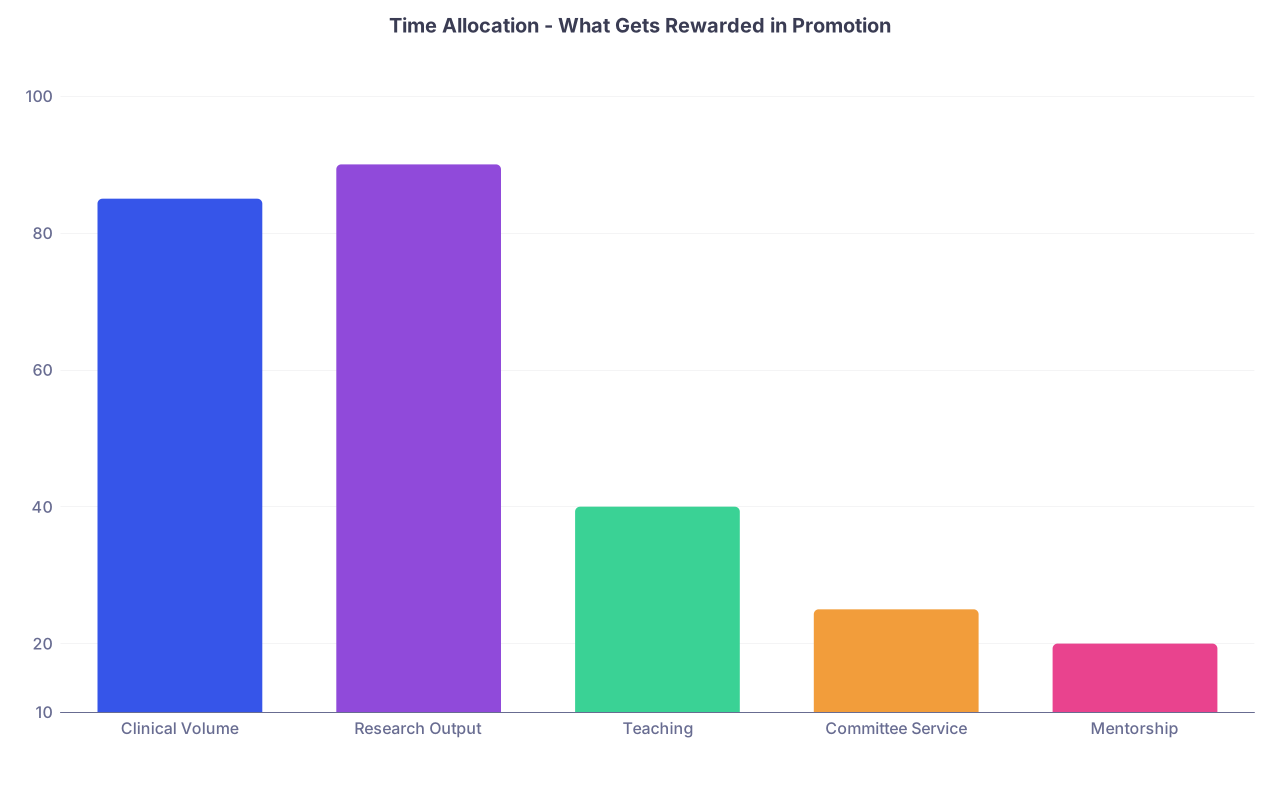
| Category | Value |
|---|---|
| Clinical Volume | 85 |
| Research Output | 90 |
| Teaching | 40 |
| Committee Service | 25 |
| Mentorship | 20 |
(Think of those numbers as “relative weight” in promotion decisions, not hours spent. You can grind yourself down teaching and mentoring and still lose to the person publishing more and negotiating better.)
So What Do You Do With This?
I’m not going to tell you to “stop being nice.” That’s as useless as the original myth.
The play is more nuanced: stop optimizing for “nice” as an identity, and optimize for respect plus results.
Concrete shifts I’ve seen work for women physicians:
- Swap “I don’t want to bother them” for “My work requires X, and I’ll ask for it once directly and clearly.”
- When asked to do unpaid, invisible labor: “I can take this on if we drop [lower-priority task] and ensure it’s documented in my workload and promotion file.”
- In meetings, state a clear position once, concisely. You don’t need three disclaimers beforehand and two apologies after.
- Track your actual contributions—outcomes, revenue, programs built—and practice stating them in objective terms without undercutting language.
Notice none of that requires you to become an unkind person. It does require you to give up the fantasy that likability will save you.

| Step | Description |
|---|---|
| Step 1 | Get request |
| Step 2 | Say no clearly |
| Step 3 | Ask for credit or resources |
| Step 4 | Accept strategically |
| Step 5 | Advances my goals? |
| Step 6 | Recognized/compensated? |
This is the opposite of default niceness. It’s deliberate.
The Ethics Question: Is “Nice” Always the Moral High Ground?
Now let’s talk ethics, since this is supposedly in the “personal development and medical ethics” bucket.
There’s a quiet assumption that being “nice” is morally superior. I disagree.
If your chronic niceness means:
- you’re burnt out and cutting corners
- you say yes to everything and then miss deadlines
- you avoid hard conversations about unsafe care or discrimination
- you let toxic colleagues skate by because you “don’t want to start something”
That’s not ethical. That’s complicity dressed up as kindness.
Sometimes the ethical move is:
- saying “No, this schedule is unsafe”
- documenting and escalating harassment or bias
- refusing to cover endlessly for a chronically underperforming colleague
- negotiating hard for staff, equipment, or changes that patients need
Those actions will not always be read as “nice.” They might be exactly what good medicine and good leadership require.
And yes, women often pay a higher interpersonal price for taking those stands. That’s the structural injustice. The answer isn’t to stay small; it’s to be strategic about when and how you push, and to cultivate allies who’ll back you when you do.
The Bottom Line
Let me strip it down.
Being basically decent and collegial is mandatory for everyone. But “nice” as in self-effacing, ever-accommodating, conflict-averse? That does not make women advance faster; it usually makes them easier to exploit and easier to overlook.
What actually moves careers in medicine are measurable results, visibility, sponsorship, and boundary-setting. Women are systematically disadvantaged on those fronts, and the “just be nice and it’ll work out” narrative helps keep that system intact.
The ethical, sustainable path is not to become less kind. It’s to stop confusing moral worth with likability, and to build a professional identity around competence, clarity, and respect—even when that means some people will decide you’re “not that nice anymore.”