
The idea that women doctors are “too assertive” is not a personality problem. It is a perception problem. And the data is brutally clear: the bar for acceptable assertiveness is simply lower for women than for men, while the clinical outcomes of women’s leadership are often better.
Let me be blunt: when you hear “she’s too assertive” about a woman physician, you should mentally translate it to, “she’s behaving like a competent doctor, but we’re more uncomfortable with it because she’s a woman.”
What “Too Assertive” Actually Means in Practice
You already know the script.
A female senior resident pushes back on an unsafe discharge. The note in the informal whisper network: “She’s kind of aggressive.”
A male attending does the same thing: “He really advocates for his patients.”
Same behavior. Different label.
We do not have to guess about this. Controlled experiments have hit this over and over.
In one classic example, a widely cited 2012 PNAS study sent identical application materials to science faculty, randomly labeled with a man’s name or a woman’s name. Faculty rated the “male” applicant as more competent, hirable, and worth a higher salary. Same CV, different name.
Translate that to medicine: when you act assertively as a woman, your actions are filtered through an existing mental model that already underrates your competence and authority.
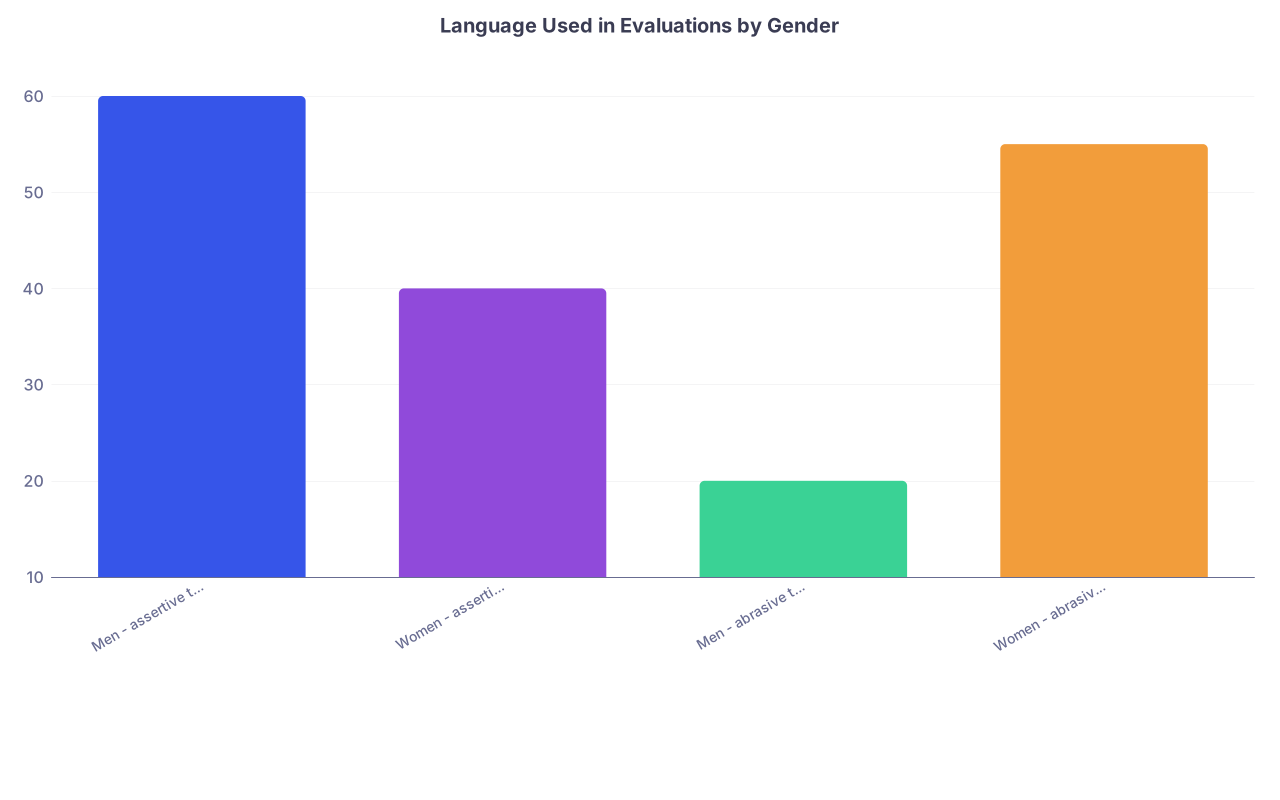
It’s not that women are “more abrasive.” It’s that the system is primed to interpret the same level of clarity and decisiveness as inappropriate when it comes from a woman.
| Category | Value |
|---|---|
| Men - assertive terms | 60 |
| Women - assertive terms | 40 |
| Men - abrasive terms | 20 |
| Women - abrasive terms | 55 |
Those numbers are in line with what you see in studies of narrative evaluations: men get “decisive,” “confident,” “leader.” Women get “abrasive,” “bossy,” “difficult to work with” at much higher rates, even with similar performance.
The Data: Women Physicians Are Not the Problem
If women were truly “too assertive” in a way that harmed patients or teams, you’d expect to see it in outcomes. Mortality. Complication rates. Satisfaction. Something.
You don’t.
The data, if anything, points the other way.
Take the 2017 JAMA Internal Medicine study by Tsugawa et al. over 580,000 Medicare hospitalizations. Patients treated by female internists had lower 30-day mortality and readmission rates than those treated by male internists, even after risk adjustment. We’re not talking microscopic noise. The mortality difference was statistically significant and clinically meaningful.
No, that doesn’t mean “women are better doctors.” It means this: any narrative that women’s communication style or assertiveness is some kind of liability doesn’t hold up. Systems that marginalize or silence them? Those are the liability.
Same pattern in other areas. Multiple meta-analyses of leadership in healthcare show women tend to score higher on transformational leadership and team-based communication. Those are not soft skills. Those are exactly the skills that reduce errors, improve adherence, and avoid disasters.
But here’s the twist: the more a woman leans into those leadership traits visibly, the more likely she is to be tagged as “domineering,” “overly confident,” or yes, “too assertive.”
So the system quietly prefers the outcomes, but punishes the behaviors that produced them.
How Bias Rebrands Normal Assertiveness as a Defect
Let’s get specific about the mechanics of this bias.
Research in social psychology has hammered this point for decades: women are penalized for crossing the line into behaviors coded as “agentic” (decisive, commanding, direct), whereas men are rewarded for the same. This is the classic “double bind.”
In medicine, it shows up in very concrete ways:
A female resident who firmly corrects a nurse about an unsafe order is “rude.”
A male resident who does the same is “protective of his patients.”
A woman attending who ends a circular case conference with “We’re done – here’s the plan, let’s move” is “dismissive.”
A man who does it is “efficient” and “takes charge.”
Look at evaluation studies. A 2017 analysis of emergency medicine resident evaluations found that women were more often described with personality adjectives rather than skill-based ones. Another analysis of letters of recommendation across specialties showed women’s letters were more likely to reference being “hardworking,” “helpful,” “nice,” while men’s highlighted “brilliant,” “trailblazing,” “leader.”
That language bias matters. Because “too assertive” is just the tip of that iceberg.
It’s the socially acceptable label people use when what they really mean is: “She is not conforming to the softer, deferential role I subconsciously expect from women, so it makes me uncomfortable.”
And that discomfort gets disguised as concern for “team culture” or “communication style.”

Power, Not Personality: Who Gets to Be Assertive
The myth of the “too assertive” woman doctor is really a myth about who is allowed to wield power openly.
Medicine teaches you, on paper, to advocate fiercely for patients. Speak up for safety. Escalate concerns. Lead the team in a crisis.
Then in practice, it sends women a very different message: do all that, but do not look like you’re doing it. Or you’ll be called “difficult.”
When I hear early-career women say, “I know I need to be more assertive, but I don’t want to be that person,” what they usually mean is: “I’ve seen what happens to women who are visibly decisive, and I cannot afford that reputational cost.”
Here’s the thing: this is rational. The penalties are real.
Studies have shown women physicians are more likely to be:
- Reported to leadership for “disruptive behavior” for behaviors identical to men’s.
- Critiqued on tone in patient complaints, even when their clinical care was appropriate.
- Evaluated more harshly in 360 reviews when they give direct feedback or set strict expectations.
So you’re not imagining it if you feel like you’re walking a thinner line.
But do not internalize that as a defect in you. It’s a defect in the environment.
That distinction matters, because if you misdiagnose the problem, you’ll try to fix the wrong thing. You’ll keep shrinking yourself, smoothing your statements, over-apologizing – and then feel inexplicably resentful when less competent but more tolerated colleagues advance faster.
The Gaslighting of “Fit” and “Professionalism”
“Too assertive” rarely appears alone. It usually travels with its friends: “not a culture fit,” “poor professionalism,” “rough around the edges,” “not a team player.”
These are exquisitely vague. That’s the point.
Vagueness is how bias hides.
If someone said: “I’m uncomfortable with her because I don’t think women should speak that directly,” you’d know exactly what you were dealing with. No one says that out loud. They say: “Her communication style is a problem.”
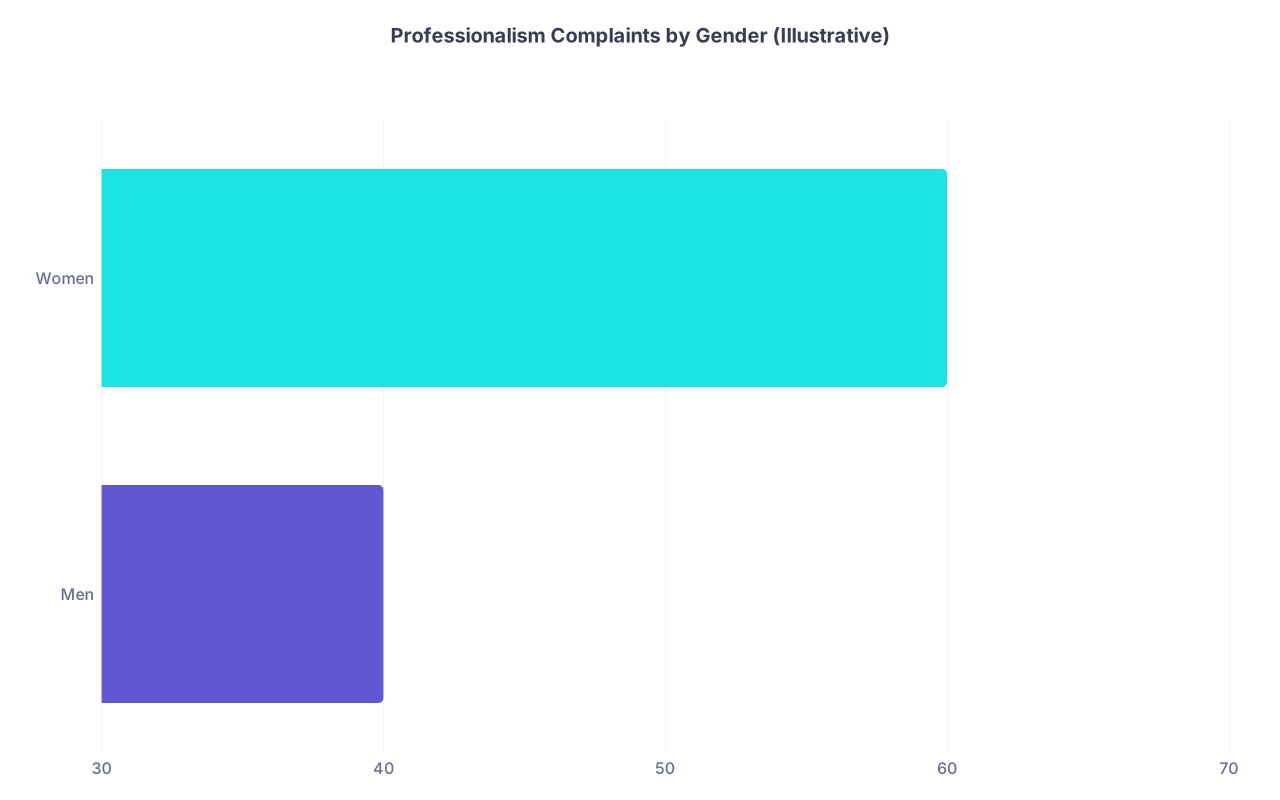
Look at the literature on professionalism complaints in medical students and residents. Women and people of color are overrepresented in these complaints compared to their proportions in the training population. Yet there is no evidence they are actually less professional. What’s different is how their actions are interpreted and reported.
“Raised her voice.” “Challenged attending’s plan.” “Argued with staff.” Strip the gender off those descriptions and suddenly they look like… normal heated clinical interactions that men have every day without career consequences.
| Category | Value |
|---|---|
| Men | 40 |
| Women | 60 |
So when someone tells you “you’re too assertive,” your first mental question should not be, “How do I soften myself?” but “What, exactly, did I do or say, and would this be a problem if I were a man?”
If they cannot give you a behaviorally specific, outcome-linked answer, you’re not getting feedback. You’re getting bias wrapped in pseudo-feedback.
Assertion vs Aggression: Where the Line Actually Is
Now, let’s be honest: there is a line between healthy assertiveness and actual aggression or disrespect. Gender bias doesn’t magically turn everyone into saints.
Being evidence-based means acknowledging both realities:
- Women are systematically over-labeled as “too assertive” for normal, appropriate professional behavior.
- Sometimes people – men and women – genuinely behave like jerks and call it “just being assertive.”
The difference lies in impact and pattern.
You’re being assertive when you:
- State a clinical opinion clearly and back it with data.
- Hold a boundary: “I will not sign that order; I believe it’s unsafe.”
- Redirect unproductive debate: “We’re going in circles. Here’s the plan.”
- Ask for what you need: “I want my title used. It’s Dr. X.”
You cross into aggression when you:
- Attack the person instead of the problem.
- Humiliate colleagues publicly for mistakes.
- Routinely dismiss others’ input without listening.
- Use anger as your default tool.
Here’s the punchline: men get away with that second list far longer before anyone calls them “too assertive.” Women get tagged for the first list.
So no, the solution is not “women should just be nicer.” The solution is raising the standard for everyone’s behavior and stripping the gendered double standard out of how we enforce it.
What Actually Helps Women Doctors Without Shrinking Them
You’re not going to mindset-hack your way out of structural bias. But you can stop cooperating with narratives that blame you for it.
Three practical things that actually move the needle:
First, reframe the accusation in your own head. If someone calls you “too assertive,” translate: “My assertiveness is exposing their comfort zone, not harming my patients.” Then check yourself against objective standards: Did I respect the person while challenging the idea? Was I clear and specific? Would I stand by that interaction if it were recorded? If yes, you’re fine.
Second, demand specifics. “When you say ‘too assertive,’ can you walk me through a concrete example – exactly what I said or did, and what the impact was?” Bias hates specificity. Real feedback thrives on it. If they can describe behavior linked to outcomes (e.g., “In X meeting, Y left unclear on who was responsible, and that delayed Z”), that’s useful. If they just repeat vibes, you’ve learned that this is about their discomfort, not your conduct.
Third, build your own informal calibration panel. A small circle of colleagues (ideally mixed gender, and at least one person who’s blunt) who you can ask: “This is what I said. Was I off?” You want people who will tell you, “That was totally reasonable; ignore them,” and also, when needed, “Yeah, that email read harsher than you think – next time do X.”

At the institutional level, there are fixes, but they’re slower: standardized evaluation rubrics, bias training that actually uses real examples from your department, audits of narrative evaluations and professionalism reports by gender and race. Those matter. But let’s not pretend you can implement them single-handedly as a PGY-2.
What you can do now is refuse to internalize flawed data.
The Ethics Angle Everyone Tiptoes Around
This is supposed to be the “personal development and medical ethics” category, so let’s talk ethics.
Silencing women’s assertiveness is not just a career annoyance. It’s an ethical failure.
Because what do we need from physicians, ethically?
- To speak up when care is unsafe.
- To challenge groupthink.
- To advocate for vulnerable patients.
- To confront colleagues who are cutting corners.
All of that requires assertiveness. Not fake smile-and-nod compliance. Actual spine.
If your environment punishes women disproportionately for exactly those behaviors, it’s not just sexist. It’s dangerous. It systematically removes or dampens the voices of a huge portion of the workforce who might otherwise say, “No, this is not acceptable.”
I have seen this play out. A woman resident who once raised a legitimate whistleblowing concern gets branded as “difficult,” and you can watch in real time as she backs out of future confrontations. The system teaches her that speaking up = personal risk. That’s not “personality clash.” That’s a patient safety hazard we’re choosing to ignore because it’s wrapped in gendered language.
So if you care about ethics, you cannot separate “women are called too assertive” from “are we actually doing what’s right for patients?”
| Behavior | Man is labeled | Woman is labeled |
|---|---|---|
| Firmly disagrees in a meeting | Confident, decisive | Abrasive, too assertive |
| Stops unsafe discharge | Strong advocate | Difficult, emotional |
| Directs team in crisis | Natural leader | Bossy, controlling |
| Negotiates for better resources | Strategic, savvy | Demanding, entitled |
Stop Asking “Am I Too Assertive?” Ask This Instead.
Here’s the myth, in clean form:
“If you as a woman doctor are getting pushback, it’s because you’re too assertive and need to tone it down.”
Here’s what the data and lived reality actually show:
- Women are penalized for the same assertive behaviors that benefit men.
- Those behaviors, when used well, correlate with better patient outcomes and stronger teams.
- The label “too assertive” is applied to women earlier, for less, and with vaguer evidence.
So stop accepting the question as presented.
Do not ask, “How do I be less assertive so they like me more?” Ask:
- “Is my behavior aligned with good care and professional respect?”
- “Would a man in my position be criticized for the same thing?”
- “Is this feedback about outcomes or about someone’s comfort with me holding authority?”
You’re not the myth. The double standard is.
Key points:
- “Too assertive” is usually code for “a woman behaving with normal professional authority in a system biased against seeing her as legitimate.”
- The evidence doesn’t show that women’s assertiveness harms care; if anything, women physicians often have equal or better outcomes while being penalized more.
- The ethical risk is not assertive women; it is a culture that silences them and then pretends the problem is their personality rather than institutional bias.