
The idea that women in medicine just need to “lean in” is not just incomplete. It’s empirically wrong.
The Problem With “Fix The Woman” Advice
Sheryl Sandberg didn’t invent the lean-in mindset, she just branded what medicine had been quietly pushing for decades: speak up, volunteer for leadership, negotiate harder, project confidence. The implied diagnosis is clear: if women are not advancing, they must not be trying hard enough, or the right way.
The data absolutely demolishes that story.
Women now make up roughly half of medical school classes in the U.S., and majorities in many countries. They’re not short on ambition, training, or willingness to work. Yet:
- They’re underrepresented in full professors, division chiefs, and deans.
- They earn less, even after adjusting for specialty, hours, and rank.
- They receive fewer awards, less grant money, and less authorship credit.
And before someone says, “well, maybe women choose different paths,” let’s look at what actually happens when men and women start in the same place and “lean in” at similar levels.
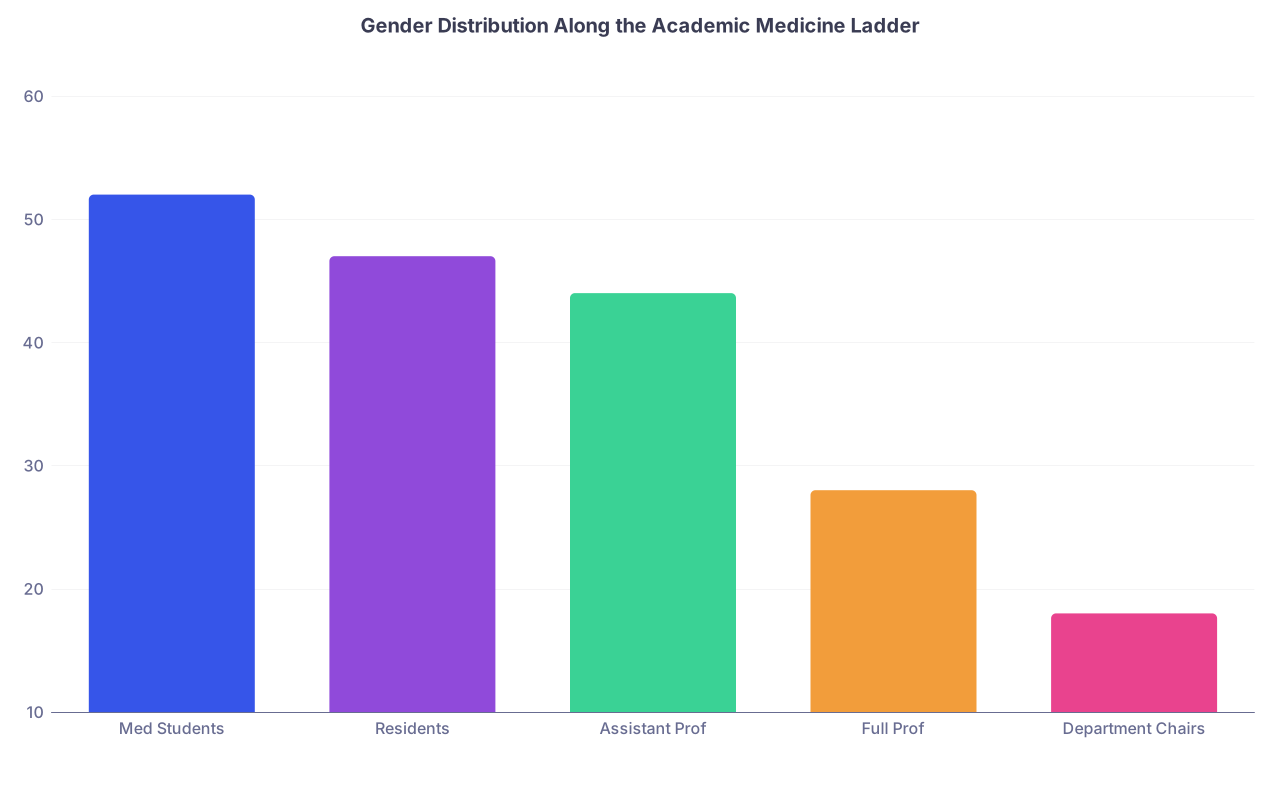
| Category | Value |
|---|---|
| Med Students | 52 |
| Residents | 47 |
| Assistant Prof | 44 |
| Full Prof | 28 |
| Department Chairs | 18 |
Those aren’t “preference” curves. That’s a leaky pipeline, and the leaks are not from insufficient confidence.
I’ve sat in promotion meetings where a woman’s file is described as “solid but not exceptional” with three R01s and strong teaching reviews, and a man with one moderate grant is praised as “high potential.” Same institution. Same committee members. Same year.
You can’t lean your way out of that kind of bias.
What The Evidence Actually Shows About “Leaning In”
Let’s unpack the big claims that get thrown at women in medicine and compare them to reality.
Myth 1: Women don’t advance because they don’t ask
There’s a popular line: “Women don’t negotiate; that’s why they earn less.” The actual research is uglier.
Studies in both corporate and academic settings show:
- Women do negotiate, especially in male-typed professions like medicine.
- When they negotiate assertively, they’re more likely to be penalized in evaluations and likability ratings than men using the exact same scripts.
- They’re more often told “this isn’t negotiable” for things their male colleagues successfully negotiate.
In one study of academic physicians, women were less likely to receive start-up packages and lab space on hire, even when controlling for rank and field. That’s before any supposed “failure to ask” can be blamed.
The paradox: if women negotiate like men, they’re pushy. If they don’t, they’re “not leadership material.” That’s not a skills gap. That’s a backlash problem.
Myth 2: Confidence is the missing piece
I’ve lost track of how many leadership workshops for women in medicine boil down to “be confident, speak up, sit at the table.” Fine. Confidence is useful. But confidence without structural support is just a better view of a broken system.
Look at promotions data:
- Women have similar or higher teaching evaluations.
- Comparable publication counts at early career stages.
- High ratings from patients and peers.
And still slower promotion rates.
That gap persists even when you control for metrics that supposedly reflect “merit.” So either medicine is stunningly bad at recognizing talent, or something else is happening. Spoiler: it’s discrimination, subtle but consistent. The literature on “maternal wall” bias in academic medicine is clear: once you’re perceived as a mother, evaluators discount your commitment and potential, regardless of actual productivity.
You can be the most confident person in the room; if the room has already filed you under “less serious because kids,” your ceiling drops.
Myth 3: Mentors and role models will fix it
Another comfortable story: women just need more mentors. Except women in medicine already tend to be over-mentored and under-sponsored.
Mentorship is advice. Sponsorship is power.
A sponsor puts your name forward for the invited lecture, the guideline committee, the big multi-center trial. They push your promotion. They move resources.
The evidence shows men get more of that. Women get coffee chats and “you’re doing great, keep it up,” followed by another year of committee work that won’t count toward promotion. The time cost is real; the advancement benefit is not.
Plenty of women have terrific mentors and still hit a wall. Because their mentors will talk with them for an hour about impostor syndrome but won’t walk down the hall and say to the chair, “She should be next in line for that role.”
“Leaning in” to mentorship without changing who holds and wields power just gives you smarter, more self-aware women staying stuck.
Women In Medicine: What Actually Moves The Needle
So no, leaning in is not enough. But that’s the easy part to say. The harder question is: what does work?
Here’s where the evidence and real-world experience converge.
1. Individual strategy has to be brutally selective
You can’t fix the whole system by yourself, but you can stop playing the most rigged games.
I’ve watched junior women bleed hours on work that leadership gushes about and then promptly ignores at promotion time. Diversity committee. Wellness task force. Curriculum redesign “help.” Grant that never gives them first or last authorship.
The academic medicine promotion systems, as they currently exist, mostly reward three things: publications, grants, and visible leadership titles. Not how much you “helped” a department run smoothly.
So if you want a career that advances:
- Say no to work that doesn’t translate into tangible credit: authorship, title, funding, or clear leadership.
- Stop accepting vague promises: “This will look good on your CV” is almost always a lie unless there is a line item you can literally type.
- Document everything. Every role. Every contribution. You shouldn’t, in principle, have to prove you did the work. In practice, you do.
You’re not selfish for prioritizing promotable work. You’re doing what male colleagues have been quietly doing for decades.
2. Sponsorship matters more than another “women’s leadership seminar”
The women I see actually breaking through into significant leadership in medicine almost always had at least one senior sponsor with real institutional clout.
That sponsor is often a man in a traditional power seat. Not because women don’t want to sponsor, but because there still aren’t enough women chairs, chiefs, and deans to cover the pipeline.
The evidence from other sectors applies here: women with sponsors advance faster, earn more, and get more stretch roles. And no, that doesn’t mean attaching yourself to the most famous person on Twitter/X. You want proximal power. The person who actually sits in the room where decisions are made.
Concrete indicators you have a sponsor rather than a cheerleader:
- Your name is showing up on high-level emails and invitations without you asking.
- You’re being recommended for roles you didn’t know existed.
- Senior people you barely know say, “Oh, I’ve heard good things about you” and then mention that sponsor’s name.
If none of that is happening, you don’t have a sponsor yet. Leaning in harder won’t conjure one. You need to be strategic about where you spend your energy and visibility so you become useful and visible to people who can open doors.
3. Structural fixes are non-negotiable
Here’s the part almost no “empowerment” book wants to lead with: without structural change, you’re playing a rigged game with better posture.
The institutions that have narrowed gender gaps in advancement, pay, and leadership didn’t do it by teaching women to ask nicely. They did it by changing rules and transparency. Think:
- Standardized starting packages and salary ranges by rank and specialty, made visible.
- Clear, written promotion criteria with real weighting. Not just “we value service” while promotions are driven almost entirely by publications and revenue.
- Stop-the-clock policies for parental leave that are automatic and stigma-free, plus relief from penalties in RVU-producing specialties.
- Pay equity audits with consequences, not just reports that gather dust.
| Intervention Type | Typical Effect on Gender Gap |
|---|---|
| Confidence workshops | Minimal, often no measurable |
| Mentorship programs | Small, inconsistent |
| Sponsorship initiatives | Moderate, clearer benefits |
| Transparent pay scales | Moderate to large |
| Standardized promotion criteria | Moderate to large |
You, as an individual physician, cannot implement all of these alone. But you can stop believing that if you just were more confident or “resilient,” you’d somehow escape a system that pays your male colleague more for the same job.
Resilience is valuable. As a coping skill. It’s not a substitute for fairness.
The Motherhood Penalty (And The Fatherhood Bonus)
This one is especially brutal in medicine.
Data from multiple studies show a consistent pattern:
- Women physicians who become mothers are perceived as less committed, even when productivity metrics don’t drop meaningfully.
- Men who become fathers are often perceived as more stable, more dedicated, and more deserving of higher pay or leadership roles.
Same life event. Opposite career effect.
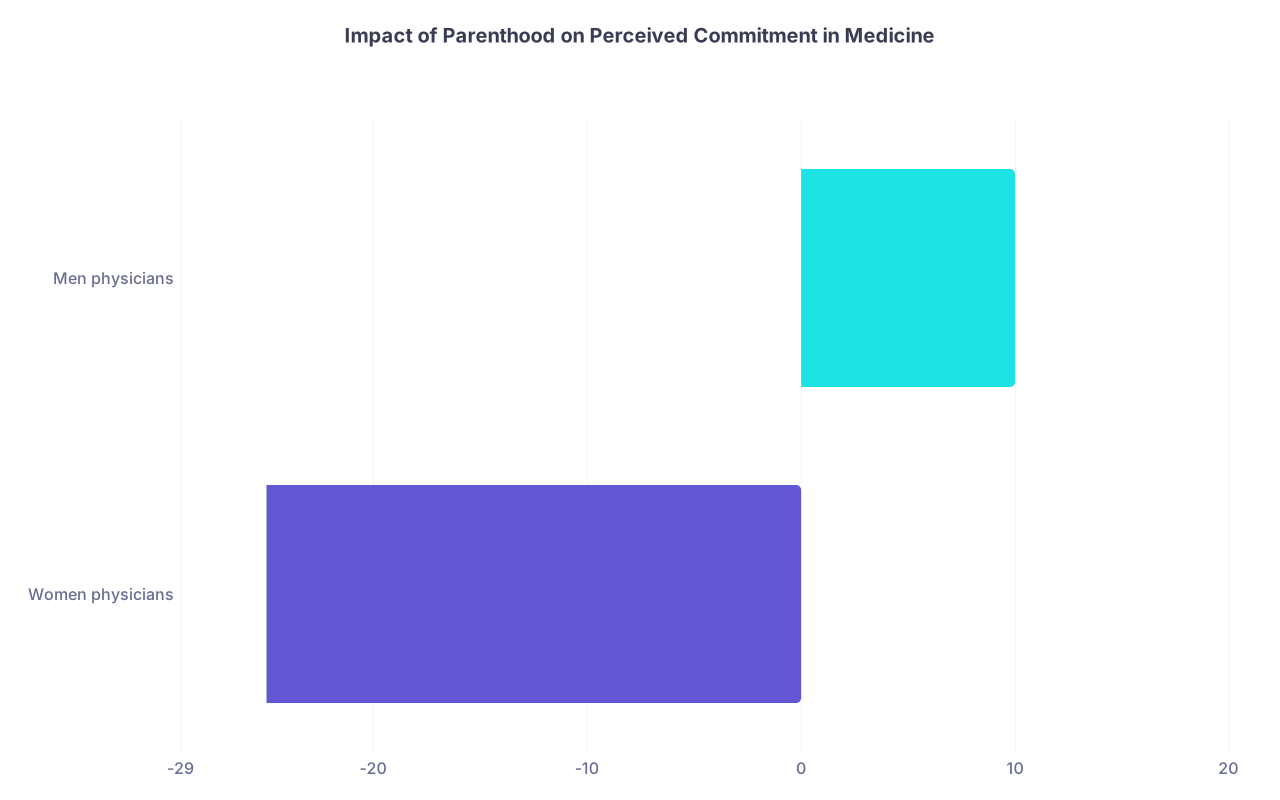
| Category | Value |
|---|---|
| Women physicians | -25 |
| Men physicians | 10 |
That negative number for women isn’t a typo. That’s the direction of bias in evaluation language and promotion discussions in multiple studies: “less available,” “not as career focused,” “distracted.” I’ve heard versions of this in real promotions committees. “She just had twins; maybe we wait a year and see if she’s still on the same trajectory.”
No one says that about the male surgeon whose wife just delivered their third child.
You can lean in until you snap your spine; if your institution ties leadership potential to a 1950s vision of family roles, you will hit the glass.
The ethical problem is obvious: we’re punishing women for doing something society claims to value. The business problem is also obvious: you’re sidelining a significant portion of your trained workforce during their most productive years.
Leaning in does not neutralize stereotypes. Intentional policies sometimes do: normalized parental leave for all genders, flexible scheduling that doesn’t derail promotion, and explicit rules that parental leave and part-time periods don’t penalize candidate evaluation.
Subtle Bias Is Not Subtle In Its Effects
One reason the “just try harder” narrative has survived so long is that modern discrimination is rarely the cartoon version. No one stands up in Grand Rounds and announces, “We don’t promote mothers here.” Instead you get:
- Slightly different adjectives on evaluations.
- Slightly different thresholds for “readiness.”
- Slightly different reactions to the exact same behavior.
The literature on gendered language in evaluations is painfully consistent: men are “brilliant,” “strategic,” “rising star.” Women are “hard-working,” “dependable,” “good team player.” Translation: he’s leadership; she’s support staff.
Those small differences compound over years into grant funding, promotions, and who’s in the pipeline for division chief.
I’ve watched a hospital decide between two candidates for a high-profile leadership role. The man: “visionary but rough around the edges.” The woman: “might benefit from a bit more seasoning.” Neither comment was consciously sexist. The outcome sure was.
You cannot “lean” your way out of people perceiving your assertiveness as abrasive and his as strong leadership. That requires institutional self-awareness and deliberate correction—things like:
- Bias training focused not on guilt, but on measurable decision checks.
- Structured evaluations with defined criteria rather than open-ended “impressions.”
- Diverse decision-making panels that aren’t just one woman surrounded by seven men.

The Ethical Angle: This Isn’t Just Career Strategy
Since you specifically flagged medical ethics, let’s get blunt: using “lean in” language to frame gender inequity in medicine is not neutral. It shifts responsibility for injustice onto the people being harmed.
When institutions respond to pay gaps and leadership disparities by offering yet another “women in medicine empowerment workshop” without changing any underlying policies, that’s cosmetic. It lets them feel progressive while preserving the structure that created the problem.
That has ethical teeth:
- It violates basic justice: equal work, equal opportunity, equal pay.
- It undermines professionalism: we claim to allocate leadership and prestige based on merit and service; the data say otherwise.
- It erodes trust: trainees see the gap between rhetoric and reality and conclude—correctly—that the system is rigged.
There’s also a patient-care implication. Diverse leadership improves decision-making, safety culture, and innovation. When women are systematically filtered out of those roles, patients lose. Not abstractly. Directly.
So no, this is not just “personal development.” It’s resource allocation in health systems. It’s who designs clinical trials, who writes guidelines, who decides what gets funded. If those tables are male-dominated because women “didn’t lean in enough,” we’re lying to ourselves.
So What Should You Actually Do?
If you’re a woman in medicine trying to build a career, you don’t have the luxury of waiting for the system to fully reform. You also don’t have infinite bandwidth to single-handedly fix it.
So you need a hybrid strategy: individual realism plus targeted pressure.
That looks like:
- Being strategic, not self-sacrificial, with your time. You’re not obligated to fix every DEI problem in your institution at the expense of your own promotable work.
- Actively seeking sponsors, not just mentors. Yes, that’s unfair work you have to do because of systemic bias. Do it anyway; it actually pays off.
- Refusing to internalize systemic failure as personal inadequacy. When you hit walls, ask “what policy or norm is at play here?” not just “what is wrong with me?”
And if you’re in any position of authority—fellowship director, chief, chair—you have an ethical obligation to stop pushing “confidence” as the main solution and start changing the rules of the game where you can: transparent criteria, standardized offers, clear credit for work, and real consequences for inequity.

| Step | Description |
|---|---|
| Step 1 | Woman in Medicine |
| Step 2 | Strategic choices |
| Step 3 | Policy change |
| Step 4 | Select promotable work |
| Step 5 | Seek sponsorship |
| Step 6 | Transparent pay |
| Step 7 | Standard promotion rules |
| Step 8 | Career Barrier |

The Bottom Line: Is Leaning In Enough?
No. And pretending it is lets institutions off the hook.
Three takeaways you should not forget:
- The core problem isn’t women’s confidence, ambition, or willingness to work; it’s structural bias baked into pay, promotion, and perceptions of leadership.
- Individual strategy matters—but only when aligned with what institutions actually reward: sponsorship, promotable work, and documented impact, not endless “help.”
- Real progress comes from structural fixes: transparent pay and criteria, standardized offers, and deliberate checks on bias. Anything less is just asking women to lean harder into a tilted floor.
You don’t need to lean in more. You need the ground to stop shifting under your feet.