
26% of the gender pay gap in medicine is explained by hours worked and specialty. The rest is not.
That’s from a 2020 JAMA Internal Medicine analysis of over 80,000 physicians. Translation: yes, hours and specialty matter. No, they do not come close to explaining why women in medicine are paid less.
Let’s dismantle the comfortable story people like to tell: “Women earn less because they choose to work less, go into lower-paying specialties, and care more about flexibility. It’s not discrimination, it’s choices.”
Reality is uglier. And more complicated.
Myth #1: “Once You Adjust for Hours, the Pay Gap Basically Disappears”
This is the favorite line of people who have never actually read the methods section.
You’ll hear it in subtle versions:
- “Well, women often work part-time…”
- “They take more time off for kids…”
- “Most of the gap disappears once you adjust for productivity.”
Except that’s not what the higher-quality data show.
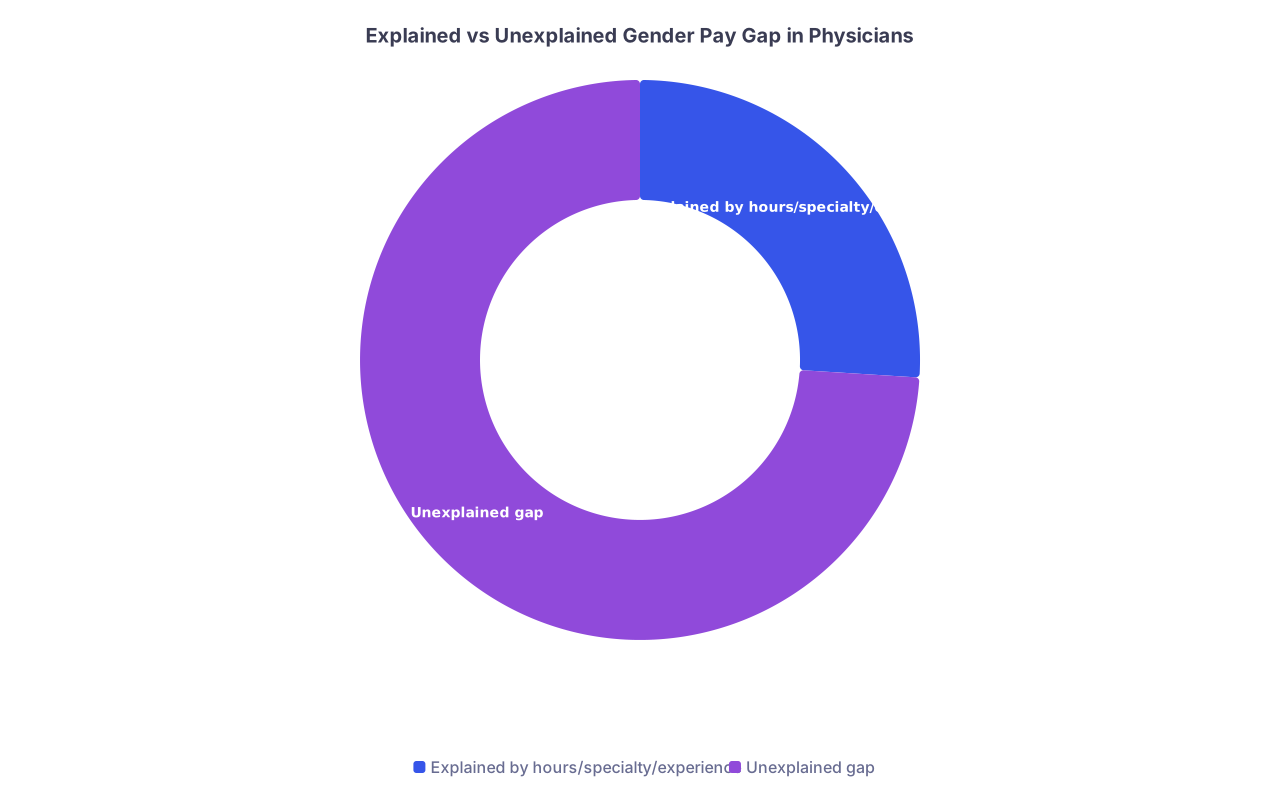
| Category | Value |
|---|---|
| Explained by hours/specialty/experience | 26 |
| Unexplained gap | 74 |
Take that 2020 JAMA Internal Medicine study (Powers et al.). They looked at early-career physicians in academic centers, with detailed data on:
- Specialty
- Hours worked
- Clinical effort vs research/teaching
- Productivity (RVUs)
- Academic rank and years since training
After all those adjustments, women still earned about $36,000 less per year than men. Same place. Same specialty mix. Same experience. Same percent effort. Gap still there.
And this is not a one‑off.
A few consistent findings across multiple large studies:
Medscape Physician Compensation Reports (year after year):
Even when looking within full-time physicians and within specialties, women report earning less than men.BMJ 2019 (general practitioners in the UK):
After adjusting for age, hours, experience, practice type, and patient volume, women GPs earned about 10% less than male GPs. Same national system. Same fee schedule. Still a gap.JAMA 2016 (US academic physicians):
After adjustment for specialty, rank, leadership positions, and productivity, women earned about $20,000 less annually.
If the gap were “just hours,” it would vanish once you control for hours.
It doesn’t.
So no, the pay gap is not primarily an artifact of women working less. Hours explain some variance. Not most of it.
Myth #2: “Women Just Choose Lower Paying Specialties, That’s All”
You’ll hear: “Of course cardiologists earn more than pediatricians. Women choose pediatrics. That’s not sexism; that’s the market.”
Superficial logic. Wrong in two ways.
First, yes, there’s gender segregation by specialty. More women in:
- Pediatrics
- OB/GYN
- Family medicine
- Psychiatry
More men in:
- Orthopedics
- Cardiology
- GI
- Radiology
- Neurosurgery
But here’s the problem: the pay gap exists within specialties too.
| Specialty | Men ($) | Women ($) | Approx Gap |
|---|---|---|---|
| Cardiology | 490,000 | 400,000 | -18% |
| Internal Med | 290,000 | 250,000 | -14% |
| Pediatrics | 240,000 | 210,000 | -13% |
| EM | 420,000 | 370,000 | -12% |
| Psychiatry | 300,000 | 265,000 | -12% |
These are consistent ballpark patterns from Medscape and AMGA data: in almost every specialty, male physicians out‑earn female physicians. Even in pediatrics and OB/GYN where women are the majority.
You cannot hand‑wave that away with “they pick different specialties.” That explains some cross‑section differences. It does not explain within‑specialty gaps.
Second problem: “choice” itself isn’t happening in a vacuum.
I have watched women med students who loved surgery get:
- Steered away by attendings (“You want a life, right?” said with a smirk)
- Told bluntly that ortho is “a boys’ club”
- Warned that program directors “don’t love maternity leaves during residency”
And then, after enough of those nudges and warnings, they “choose” anesthesia or pediatrics. Is that a free choice? Or a rational adaptation to structural hostility?
Saying “they choose lower-paying specialties” and stopping there is like saying, “People in polluted neighborhoods choose to have more asthma.”
Technically true. Intellectually lazy.
Myth #3: “Women Are Paid Less Because They See Fewer Patients and Bill Less”
Now we’re getting closer to the real battlefield: productivity.
Hospitals and groups love productivity metrics because they sound neutral. RVUs. Encounters. Collections. Clean numbers on a spreadsheet that make bias feel like it disappeared.
Here’s what the better research shows:
Yes, women on average bill slightly fewer RVUs in many settings.
But that “slightly” does not justify the income gaps observed.Patient behavior and case mix differ.
Women physicians often see more complex, psychosocially heavy patients. They have longer visit times. They spend more time counseling. That generates fewer RVUs per hour under many billing systems, even if the actual clinical work is more demanding.Even for the same RVUs, women often get paid less.
This is the part people skip.
There are studies from large health systems showing that for equivalent RVUs:
- Men receive higher base salaries
- Men get larger bonuses for “productivity”
- Men are more likely to be put onto compensation plans that reward high-margin procedures
And then there’s the straightforward stuff: men negotiate more aggressively and more often. But even when women do negotiate, they’re perceived as “difficult” faster and penalized socially in ways men are not. HR will never put that in the comp spreadsheet, but everyone has seen it.
So you end up with two physicians:
- Same number of RVUs
- Same hours
- Same clinic
Different pay.
And then some administrator shrugs and says: “Well, she just isn’t as productive.”
No. She’s not as rewarded.
Myth #4: “Motherhood Penalty, Fatherhood Bonus – That’s Just Life Choices”
Let’s be blunt: parenthood doesn’t hit men and women’s earnings in medicine equally.
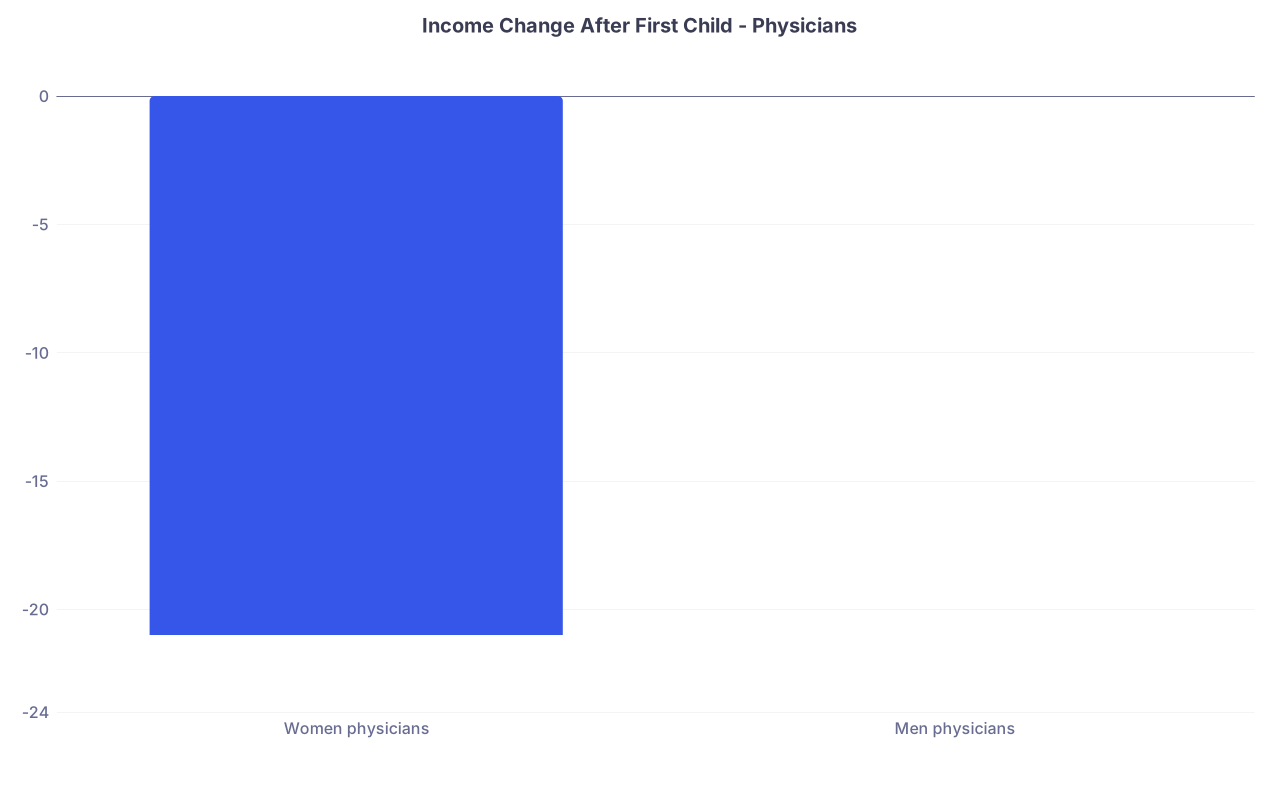
| Category | Value |
|---|---|
| Women physicians | -21 |
| Men physicians | 0 |
In a 2019 study in The BMJ (US physicians), after the first child:
- Women’s earnings dropped by over 20% and never fully recovered
- Men’s earnings were essentially unchanged
Yes, women may cut back hours more often around childbirth. That’s true. But the penalty is not strictly “you worked 0.7 FTE, you got 0.7 salary.”
The hit shows up as:
- Slowed promotions
- Fewer leadership titles
- Reduced access to lucrative opportunities (new programs, procedural ramp-ups, directorships)
- “We need reliability for this role” used as code for “no recent or anticipated maternity leave”
I’ve sat in those meetings. Someone says, “She just had a kid; she’s probably not looking to take on more right now.” As if that is a fact instead of a question.
Meanwhile, new fathers get subtle boosts:
- Assumed to be “more stable” and “committed”
- Encouraged to take on extra shifts “now that you’ve got a family to support”
- Seen as good bets for leadership tracks
Call it what it is: structural bias layered on top of personal choices. Not just “women worked less.”
And here’s the kicker—women without children still earn less than men without children. So you cannot blame it all on kids.
Myth #5: “It’s All Transparent Now, So Pay Inequity Can’t Be That Bad”
Comp committees love to say, “Our compensation model is objective.” Then you scratch one layer below the PowerPoint slide.
A few places where inequity sneaks in, even with “transparent” models:
Starting salary and initial step:
Two new hires. Same PGY level. Same specialty. Man negotiates harder, gets a higher starting salary or extra “market adjustment.” Then annual percentage raises lock in that difference for years. By year 8, he’s tens of thousands ahead without working more.Who gets RVU-boosting work:
Cath lab time, procedural blocks, high-paying clinics, institutional referrals—these are not evenly assigned. Men are more likely to be funneled into high-margin niches; women into “team player” roles, panel management, teaching, committee work.Unpaid or underpaid academic work:
Women do more mentoring, more committee service, more “DEI” work that institutions love to market but rarely compensate at market value. That time is not magic; it comes out of billable hours.Different tolerance for “exceptions”:
I’ve seen comp committees approve one-off salary adjustments or bonuses for male physicians “to keep them from leaving,” while women in the same situation are told “we can’t make exceptions; it wouldn’t be fair.”
So when leadership says, “We would pay her more if she were as productive,” what they often mean is: “We designed a system that values what he does more than what she does. Then we acted like the system is neutral.”
Myth #6: “If Women Just Negotiated Better, This Would Go Away”
This one sounds empowering on the surface. Underneath, it blames women for reacting rationally to punishment.
Here’s what the research shows outside of medicine and echoed informally within it:
- Women do negotiate less often on average.
- When women negotiate assertively, they’re more likely to be perceived as “abrasive” or “not a team player” compared with men using the same behavior.
- The social and career cost of pushing hard is higher for women.
So yes, learning to negotiate is useful. Everyone should. But pretending the pay gap is just a “skills deficit” in women is nonsense.
The medical version of this:
- Female physician asks for a raise backed by RVU data and market comps. She’s told: “We’re all in this together, and it would set a bad precedent.”
- Male colleague threatens to leave for a private group. Suddenly, admin finds “market adjustment” money.
Is the problem that she didn’t negotiate? Or that the system responds very differently to the same ask?
You can tell people to “lean in” all you want. If leaning in gets one group rewarded and the other group labeled “problematic,” you have a structural bias problem, not just a training problem.
What the Data Actually Say: A More Honest Model
If you want an evidence-based explanation of the gender pay gap in medicine, it looks like a layered model:

Measured factors (hours, specialty, years in practice) explain a chunk. Around a quarter in some rigorous analyses.
The rest—most of it—is not explained by “they work less.”
It’s explained by:
- Biased starting points
- Different opportunities
- Systematic undervaluing of “feminized” work (counseling, communication, longitudinal care)
- Cultural expectations about who will carry domestic and caregiving loads—and institutional structures that treat that as an individual inconvenience rather than a design problem
So What Do You Actually Do About It?
If you’re a woman in medicine, you can’t fix a broken system alone. But you’re not powerless either. A few evidence-aligned moves:
Demand data, not vibes.
Ask for:- Salary ranges by specialty, rank, and years out
- Median and quartile data for your department, not just “your offer is competitive”
The more concrete the comparison, the less gaslighting.
Tie negotiations to objective metrics and external benchmarks.
Use MGMA/AMGA data if available. Show your RVUs, wRVUs/hour, panel size, or relative contribution compared with peers. Administrators listen when you speak their language.Document nonbillable work.
Committees, mentoring, curriculum development, DEI work—track it. Convert it to FTE estimates. Ask: “Where does this show up in my compensation or promotion file?”Insist on standardized offers and starting scales.
Within your group, push for:- Transparent starting salary bands by specialty and PGY year
- Written criteria for bonuses and “market adjustments”
Discretion is where bias lives.
Use allies strategically.
Whether you like it or not, a male colleague saying “she is underpaid relative to her contribution” sometimes lands differently with leadership. Use that. It shouldn’t be necessary; it often is.
And if you’re in leadership and still telling yourself “women earn less because they work less,” either you haven’t looked at your own data or you’re ignoring what they say.
Years from now, no one will remember the exact RVU numbers or the wording of your contract. But you will remember whether you accepted the story you were handed—or insisted on seeing what was really going on underneath it.