
What would happen to the gender pay gap in medicine if every woman tomorrow “freely chose” orthopedics, radiology, and cardiology instead of pediatrics and family medicine? Would it vanish, or would the system quietly rebuild the gap somewhere else?
That’s the real question hiding under the cliché: “Women just prefer lower-paying specialties.”
Let me be blunt: that line gets thrown around as if it’s a neutral observation. It’s not. It’s a story that conveniently shifts blame from systems to individuals. From biased structures to women’s “choices.”
Let’s break this myth with what the data actually shows.
The Myth in One Sentence
The common narrative goes like this:
Women doctors earn less because:
- They choose lower-paying specialties (primary care, pediatrics, OB/GYN).
- They work fewer hours and value “work–life balance” more.
- They negotiate less or don’t care about money as much.
So supposedly, the pay gap is a lifestyle preference problem, not a structural problem.
Reality: every one of those claims is only partially true, often exaggerated, and frequently misused. Once you look at what happens within specialties, controlling for hours worked, productivity, and experience, huge gaps remain.
That’s not “preference.” That’s a system that consistently values women’s work less.
What the Data Actually Shows About Pay Gaps
Start with the big-picture numbers.
Large studies in the U.S. and internationally have found:
- Women physicians earn about 20–30% less than men overall.
- Controlling for specialty shrinks the gap but doesn’t erase it. Within the same specialty, women often still earn 10–20% less.
- Over a career, this adds up to hundreds of thousands to more than a million dollars in lost income.
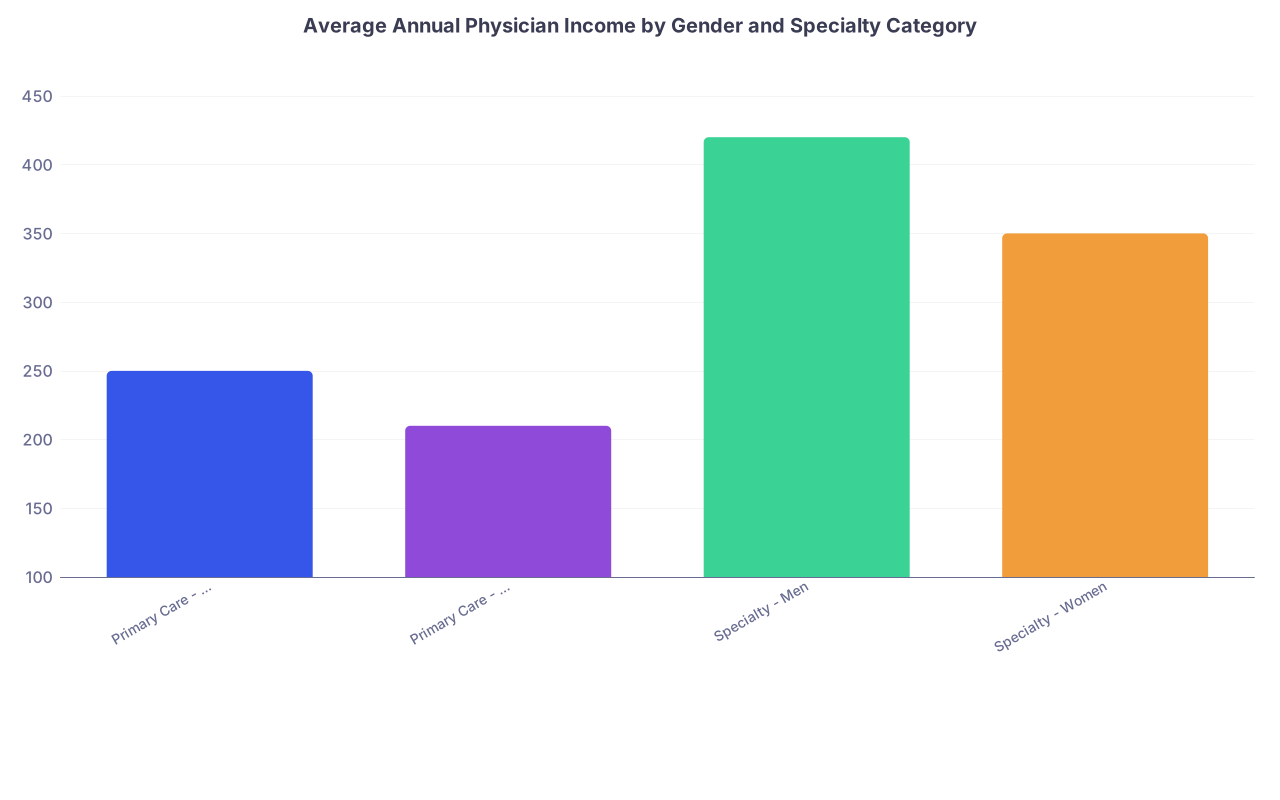
| Category | Value |
|---|---|
| Primary Care - Men | 250 |
| Primary Care - Women | 210 |
| Specialty - Men | 420 |
| Specialty - Women | 350 |
These are approximate illustrative numbers, but they match the pattern you see repeatedly in Medscape, Doximity, and peer-reviewed studies: women earn less in low-paying fields and less in the high-paying ones they do enter.
The key myth-busting point:
Even if women chose identical specialties as men tomorrow, a gap would still exist. Because it already does.
So the “choice of lower-paying specialties” can’t be the full story. Not even close.
Are Women Really Just “Drawn” to Lower-Paying Fields?
Let’s look at who ends up where.
Yes, women are overrepresented in:
- Pediatrics
- Family medicine
- Internal medicine (general)
- OB/GYN
- Psychiatry
And underrepresented in:
- Orthopedics
- Neurosurgery
- Interventional cardiology
- Radiology
- Anesthesiology (improving, but still skewed in some settings)
On the surface, this looks like preference. But you have to ask: preference formed where? In what environment? Under what pressures?
Here’s what keeps showing up when you actually ask women physicians and trainees:
Hostile or unwelcoming cultures in certain specialties
I’ve lost count of how many women have told me some version of:- “You’re too small for ortho.”
- “Surgery’s not great if you want a family.”
- “Interventional is a boys’ club; you sure?”
That’s not neutral. That’s steering.
Early discouragement
Unequal mentoring is massive. Male student shows interest in cardiology? Great, come to cath lab. Female student? “You’d be great in peds, you’re so good with families.”Lack of visible role models
Put simply: if you never see women attendings in a specialty, your brain quietly logs: “Not for people like me.” That is not some innate preference. That is a reaction to the environment.Misleading narratives about lifestyle
Surgery and ortho are painted as incompatible with family life, but look closely and you’ll see plenty of male surgeons with kids and partners who absorb the domestic hit. When women say, “I want a family,” they’re responding to a structure that expects them to absorb most of that hit.
Call it what it is: constrained choice. Not an open menu.
The Pipeline vs. The Paycheck: Two Separate Problems
People love to conflate two distinct issues:
- Specialty choice (who goes into what), and
- Pay within specialty (how people are valued once they’re in)
We need to separate them because the “women prefer lower-paying fields” line tries to solve both with one lazy explanation.
Here’s a simple comparison.
| Level | What Often Happens | Key Point |
|---|---|---|
| Specialty choice | Women steered toward lower-paid | Not pure preference |
| Training | Differential mentoring, culture | Shapes what feels “possible” |
| Within specialty | Women still earn less than men | Gap persists even after “choice” |
You cannot explain a consistent 10–20% within-specialty pay gap with “they chose pediatrics.” That gap exists in EM, cardiology, radiology, surgery, you name it.
One major NEJM study of primary care visits showed women earned less even when they saw fewer patients because they spent more time per patient. Translation: more time, same CPT codes, lower pay because the system rewards volume, not quality. Men playing by the volume rules get rewarded more; women more often get penalized for thorough care.
Not preference. Structure.
The “Women Work Less” Story: Half-True and Misused
Another convenient move:
“Women earn less because they work part-time or fewer hours. End of story.”
Reality is a bit more nuanced:
- Early in their careers, many studies show women and men work similar clinical hours, but women still earn less.
- Some women do go part-time or cut back hours mid-career, often due to:
- Childbearing and childcare
- Elder care (also disproportionately on women)
- Burnout from toxic work cultures
- But even when you compare hour for hour, pay gaps persist.
And there’s a particularly ugly twist:
When men and women both reduce hours, men often keep (or negotiate) better compensation structures, leadership roles, or high-RVU tasks. Women are more likely to be shifted into poorly compensated, “helper” roles: patient education, committee work, “can you help redesign this clinic flow?”
All essential. Almost all underpaid or unpaid.
So yes, hours matter. But the clean “they just work less” explanation is intellectually lazy. Hours explain some of the difference. Not most of it. And you still have to ask why the system is built in a way that punishes caregiving and rewards nonstop availability that someone else (usually a woman at home) quietly subsidizes.
The Sacred Cow: “Women Just Care Less About Money”
This one gets repeated like gospel, usually without anyone ever citing real data.
What do the few actual studies show?
- Women physicians do report valuing flexibility and work–life balance more highly on surveys.
- But when women are offered:
- Fair pay
- Reasonable flexibility
- A non-hostile work environment
they don’t magically turn down money. They negotiate. They leave bad jobs for better ones. They pursue promotions.
The problem isn’t that women don’t care about money. It’s that the cost of chasing every last dollar is higher for them:
- More pushback when they negotiate hard (“difficult,” “not a team player”).
- Greater likelihood of being penalized socially or professionally for assertiveness.
- More structural expectations around caregiving at home.
So some women rationally decide: I will not fight every battle for every dollar in a system that punishes me for doing what men are rewarded for. That’s not apathy. That’s risk calculation.
I’ve watched junior women faculty told, “Be grateful, this is a great starting package,” while their male counterparts quietly got signing bonuses and better RVU conversion rates.
“Preference” is a tidy word for “I don’t want to keep banging my head against a wall that only cracks for certain people.”
How Bias Gets Baked into “Neutral” Systems
The real trick of all this is how discrimination hides inside things that look neutral:
- RVU-based pay that rewards short, high-volume visits and procedural work.
- Academic promotion systems that value first/last author publications and grants over teaching, mentoring, and admin work.
- Leadership appointments made through “tap on the shoulder” networks instead of open calls.
Women disproportionately:
- Choose (or are nudged into) nonprocedural work.
- Spend more time with each patient.
- Do more non-RVU work: teaching, mentorship, committee service, “DEI” projects.
None of that shows up strongly on a paycheck. Or at all.
So when someone says, “Women earn less because of their choices,” they’re describing consequences of a biased structure as if those consequences were independent decisions.
If you design a system that underpays listening, teaching, and longitudinal care — and then watch women disproportionately end up doing those things — calling it “preference” is just convenient denial.
Quick Reality Check Across Specialties
A few patterns that show up across multiple datasets:
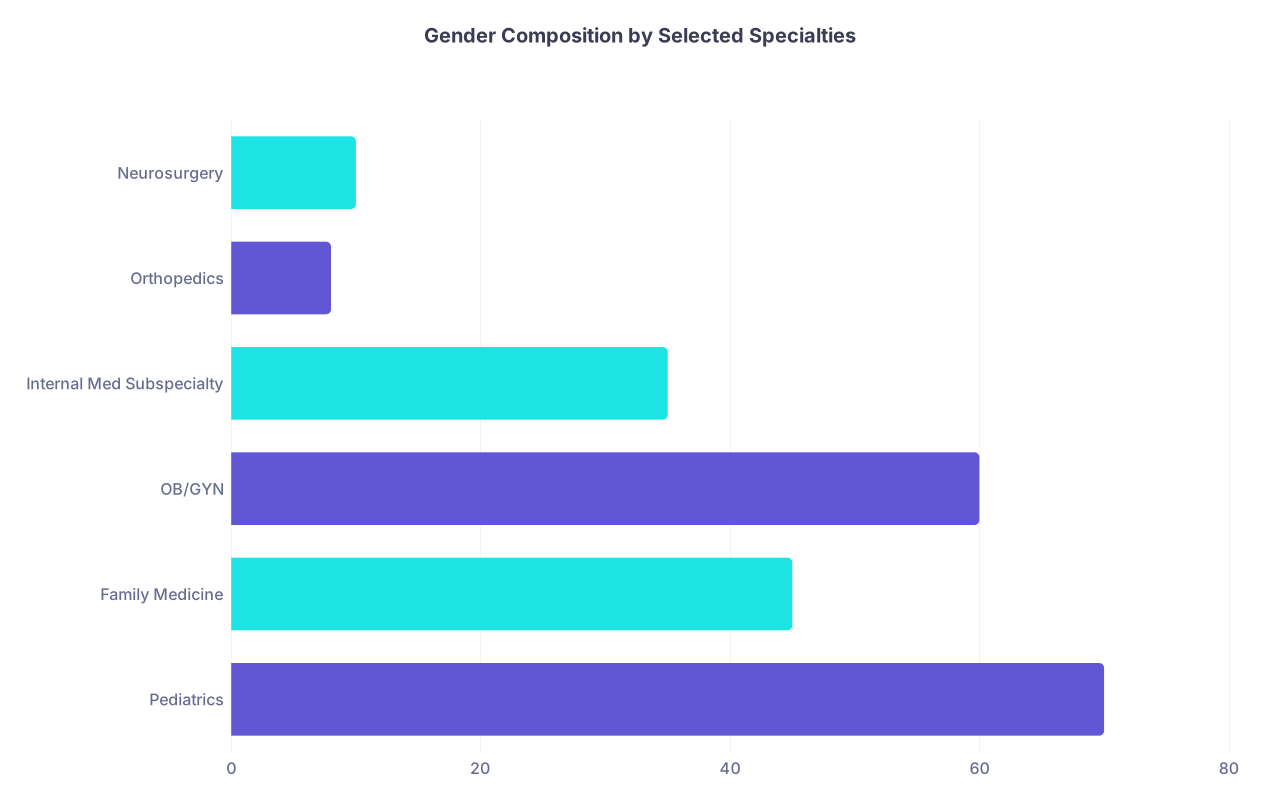
| Category | Value |
|---|---|
| Pediatrics | 70 |
| Family Medicine | 45 |
| OB/GYN | 60 |
| Internal Med Subspecialty | 35 |
| Orthopedics | 8 |
| Neurosurgery | 10 |
- Pediatrics: ~70% women in many training programs, yet leadership (chairs, high-earning admin roles) still disproportionately male at many institutions.
- EM: Gender mix improving, but women attendings still report pay gaps even in groups claiming “transparent” RVU models.
- Radiology: Women underrepresented, and when they’re there, they’re more often in breast imaging or peds radiology — vital, lower-paid niches vs. interventional.
The pattern:
Even within a specialty, women cluster in the less-compensated niches. Breast vs interventional. General vs procedural. Clinic-heavy vs OR-heavy. Again, this is not randomly “what they like.” It tracks closely with where they are welcomed, mentored, and not punished for having a body that might get pregnant.
So What Would “True Preference” Even Look Like?
If we really wanted to test whether women “prefer” lower-paying work, we’d need:
- Equal exposure to all specialties in medical school.
- No sexist comments about family, pregnancy, or “fit.”
- Equal mentoring and sponsorship for residencies and fellowships.
- Transparent, standardized salary structures with minimal subjective wiggle room.
- Cultures where women negotiating are treated like men negotiating.
Then watch where people go and what they choose.
We are nowhere close to that experiment.
What we have instead is a system that:
- Overvalues procedures.
- Undervalues primary and longitudinal care.
- Punishes caregiving and pregnancy.
- Normalizes quiet exclusion and gatekeeping in high-paying specialties.
And then we call the end result “preference.” It’s absurd.

| Step | Description |
|---|---|
| Step 1 | Gendered expectations |
| Step 2 | Experiences in training |
| Step 3 | Steered toward certain fields |
| Step 4 | Limited role models |
| Step 5 | Constrained specialty options |
| Step 6 | Observed income differences |
| Step 7 | Story - Women prefer low pay |
What You Can Actually Do (Depending on Where You Sit)
I’m not interested in just yelling “systemic bias” and walking away. Here’s where the leverage is.
If you’re a medical student or resident:
- Notice when “advice” is actually gatekeeping. When someone says, “You won’t like surgery with kids,” translate it to: “We have not built a system where people with caregiving roles thrive here.”
- Ask directly about salary structure, RVUs, parental leave, and part-time options when evaluating careers. Money is not dirty.
- Seek mentors outside your default specialty interest. Especially women in high-paying, male-dominated fields.
If you’re faculty or leadership:
- Push for transparent salary bands and published compensation formulas. When numbers see daylight, gaps shrink.
- Stop dumping unpaid “glue work” (DEI, wellness, endless committee service) disproportionately on women and then pretending promotion criteria are neutral.
- Track pay by gender within each rank and specialty. If you’re not measuring it, you’re complicit.
If you’re tempted to say “women prefer lower-paying fields”:
Maybe stop. And ask instead:
“Why does our system make certain fields so hostile, incompatible with caregiving, or financially irrational that women are voting with their feet?”
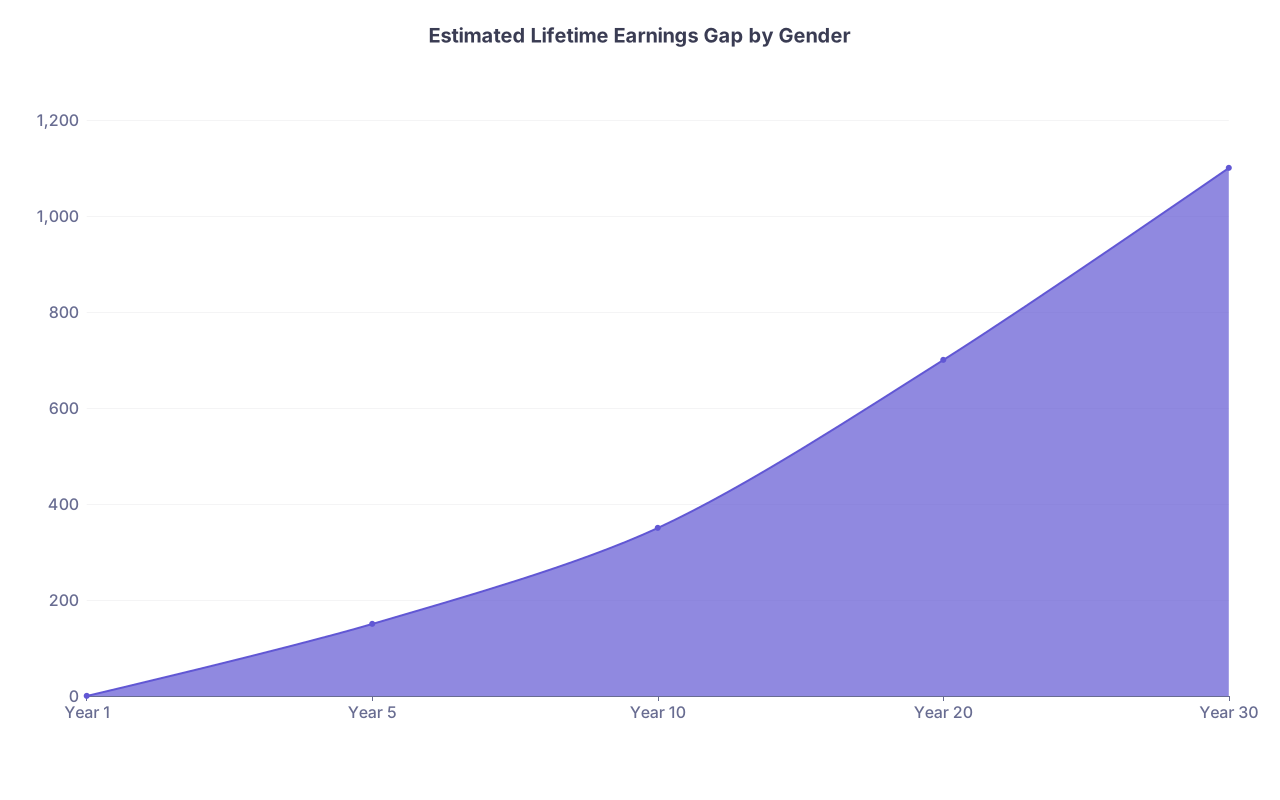
| Category | Value |
|---|---|
| Year 1 | 0 |
| Year 5 | 150 |
| Year 10 | 350 |
| Year 20 | 700 |
| Year 30 | 1100 |
That’s a rough visual of what a $30–40K annual gap does over decades. Those are structural losses, dressed up as personal tastes.
FAQs
1. Isn’t it still partly true that women choose lower-paying specialties more often?
Yes. But “partly true” is not the same as “causal explanation.” Women are more likely to end up in lower-paying specialties, but that pathway is heavily shaped by bias, culture, and practical constraints around pregnancy and caregiving. You cannot call that pure preference any more than you can say people “prefer” lower pay when their job options are narrowed by discrimination.
2. If we raised primary care pay, would that fix the gender pay gap?
It would help, but it would not fix it. Raising primary care and pediatrics compensation would narrow the between-specialty gap. You’d still have:
- Gaps within those fields (women vs men in the same job).
- Women clustering in lower-paid niches within any given specialty.
- Structural penalties for time spent on non-RVU tasks (teaching, mentorship, admin) that women currently shoulder more. Better primary care pay is necessary, not sufficient.
3. What’s the one concrete thing a hospital or group could do tomorrow to reduce inequity?
Publish a simple, de-identified salary and bonus distribution by gender, rank, and specialty, and tie future raises to a transparent formula. No secret side deals, no “we’ll make it up in your bonus,” no vague promises. When institutions are forced to put actual numbers in front of people, they are suddenly far less comfortable hiding behind the “women just choose differently” story.
Key points, without the fluff:
- Women do cluster in lower-paying fields, but that pattern is heavily shaped by bias, discouragement, culture, and caregiving realities — not pure “preference.”
- Even when women choose the same specialties and work similar hours, they still earn substantially less. The gap is structural, not just a pipeline issue.
- Blaming women’s “choices” is a convenient way to avoid fixing how medicine values time, procedures, caregiving, and the people who do the unglamorous work that keeps the system running.