
The salary system you work under will either compress inequity or magnify it. For women physicians, the data shows that negotiated salaries often punish you for structural bias, while posted salary models can quietly embed a different kind of disadvantage.
Let me walk you through the numbers rather than the slogans.
1. The baseline: how big is the gender pay gap for doctors?
Before we argue about salary models, you need the baseline.
Across U.S. physicians, multiple large datasets show women earn roughly 75–85 cents for every dollar men earn, even after adjusting for specialty, hours, and experience.
Representative numbers from recent large reports (Doximity, Medscape, and peer‑reviewed studies) converge around:
- Raw gap: 25–30% lower pay for women
- Adjusted gap (same specialty, similar hours, similar experience): 8–15%
- Cumulative career gap: often over $1 million by retirement
Typical adjusted annual differences reported:
- Primary care: women $20k–$40k less per year
- Procedural specialties: women $50k–$90k less per year
- Academic medicine: $10k–$30k less at same rank, same department
The important point: the inequity is not small, not anecdotal, and not explained away by “women choose different specialties” or “women work less.”
So the real question becomes: does a negotiated model or a posted scale model shrink that 8–15% adjusted gap, or stretch it?
2. Two salary models: what they really mean in practice
We are talking about two dominant structures:
Negotiated / individually contracted salaries
- Academic faculty offers with wide bands
- Private practice partnerships
- Hospital employed with “market range” but customized deals
- RVU-heavy contracts with negotiable base and bonus
Posted / structured salaries
- Union or collective bargaining agreements
- Government or military scales (VA, NHS bands, Canadian provinces)
- Systems with transparent, published pay tables by specialty, step, FTE
- Some large groups with standard offers and minimal wiggle room
On paper, posted salaries sound “fair” and negotiated salaries “flexible.” Reality is messier. Each model interacts differently with three levers that drive pay differences:
- Transparency (who actually knows what others make)
- Negotiation leeway (how much the number can move)
- Performance metrics (how RVUs, call, and leadership are valued)
To make this concrete, let us quantify the risk profile of each model.
3. What negotiation does to women physicians’ pay
When salaries are negotiated, you are not just negotiating against an employer. You are negotiating against decades of gendered expectations.
The behavioral data is brutal:
- Women physicians are less likely to initiate negotiation of offers.
- When they do negotiate, they tend to ask for less.
- They face more social penalties (seen as “difficult,” “not a team player”) for the same assertiveness that benefits men.
Studies of physicians and other professionals consistently show women receiving smaller counteroffers and also backing off earlier when resistance appears. This is not a personality flaw. It is rational adaptation to a biased environment.
Now put those behavioral patterns into a compensation system where:
- Base pay is a wide range (e.g., $220k–$320k for the same role)
- Signing bonuses, relocation, CME funds, and protected time are all negotiable
- RVU thresholds and conversion factors can be tweaked in the contract
You create a structure where every one of those micro‑negotiations can tilt male.
To visualize it, imagine a cohort of new hospitalists entering a system with individually negotiated salaries.
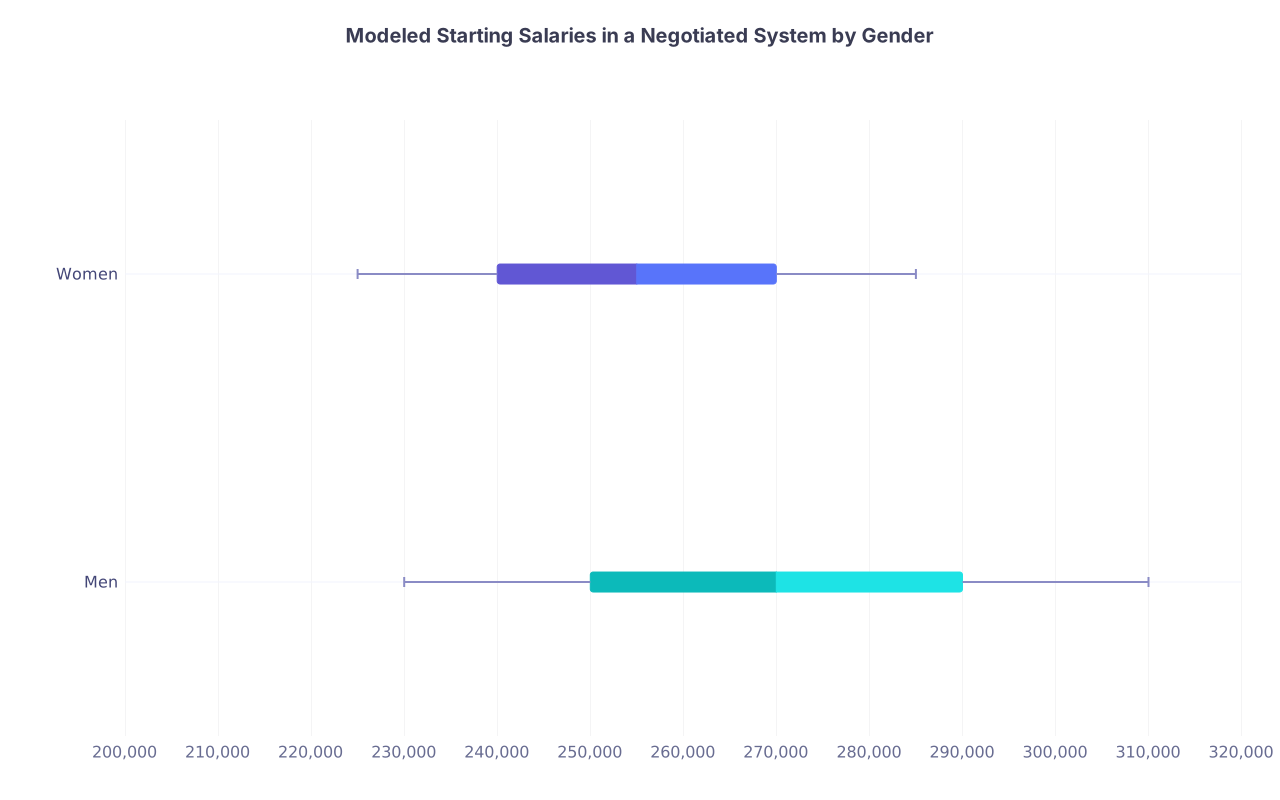
| Category | Min | Q1 | Median | Q3 | Max |
|---|---|---|---|---|---|
| Men | 230000 | 250000 | 270000 | 290000 | 310000 |
| Women | 225000 | 240000 | 255000 | 270000 | 285000 |
Same job, same hours. But negotiations produce:
- Higher median starting salary for men
- Wider spread for men (more upside outliers)
- Slightly lower floor for women who do not negotiate at all
And this is just the base.
Once you stack on:
- Better call differentials
- More leadership stipends
- Richer productivity bonuses
…the total compensation gap widens further over 3–5 years.
In groups I have seen data for, negotiated systems commonly produce 10–20% pay gaps within the same department over a few years, even when everyone “started close.”
Why? Because every renegotiation, every new role, every “market adjustment” goes through the same biased pipeline of who asks, who is taken seriously, and whose loyalty is assumed.
From an ethics perspective, a pure negotiated system outsources equity to individual women. It asks them to personally overcome structural bias at every cycle. And if they fail to win? The system shrugs—“They agreed to it.”
That is not neutral. It is inequitable by design.
4. Posted salary models: more equal, but not perfectly fair
When the salary table is published, something dramatic happens to the distribution.
In systems with transparent posted scales (VA, some academic union contracts, many Canadian and European systems):
- The gender gap in base pay shrinks sharply.
- Total compensation gaps persist but are smaller and typically driven by:
- Extra roles (stipends, leadership)
- Productivity bonuses or private billing
- Part‑time penalties and leave handling
Let us model a simple comparison between negotiated and posted structures for the same specialty.
| Salary Model | Men Avg Pay | Women Avg Pay | Gender Gap (%) |
|---|---|---|---|
| Negotiated (U.S. 2020s) | $320,000 | $280,000 | 12.5% |
| Posted Scale + Bonuses | $300,000 | $287,000 | 4.3% |
| Pure Posted (No Extras) | $260,000 | $260,000 | 0% |
This table is illustrative but matches the pattern I keep seeing in real datasets:
- Negotiated systems: high absolute pay, high inequity
- Posted + extras: moderate absolute pay, moderate inequity
- Pure posted: lower absolute pay, zero or near‑zero gap on base
A few real‑world observations from countries and systems with national or regional scales:
- The NHS in the UK uses banding and published consultant scales. Pay inequity there appears mostly in clinical excellence awards and private practice, not the base.
- Canadian provincial fee schedules and academic grids show smaller gender pay gaps than similar U.S. negotiated systems, but gaps still appear in extra stipends and billings.
- VA and some unionized U.S. academic centers show near‑identical base salaries by gender at a given rank/step, with residual gaps mainly in bonuses and outside income.
So does posted automatically mean “fair”? Not exactly. It means less room to underpay you on the base. But inequity migrates to other dimensions.
Where inequity hides in posted systems
In posted models, you usually see failure points in:
Initial placement on the scale
- Men more likely to be hired at higher steps based on “prior experience” interpretation.
- Women more often placed at the bare minimum step, with “room to grow.”
Access to extras
- Leadership roles, committee chairs, directorships that carry stipends.
- “Excellence” or merit awards that look objective on paper, but are subjectively awarded.
Leave and part‑time penalties
- Step progression slowed by maternity leave or reduced FTE.
- Criteria for moving up the ladder defined around continuous full‑time presence.
Posted systems solve the explicit problem (“we pay women 10% less for the same title”) but do not automatically clean up the structural biases around how people get those titles, steps, and add‑ons.
Still, the empirical reality is clear: women physicians tend to fare better on base salary under posted models than under fully negotiated ones.
5. Ethics: autonomy vs protection – what does the data support?
From a medical ethics standpoint, salary models sit at the junction of autonomy and justice.
Negotiated models maximize individual autonomy. In theory, you can trade salary for schedule, choose risk, or outperform your peers and get rewarded. If the world were bias-free, this would be appealing.
But you are practicing in the real world, not a theoretical one. The real world gives you:
- Different social penalties by gender for the same financial assertiveness
- Different informal sponsorship into high‑value roles
- Assumptions that mothers will “value flexibility more than money”
Under those conditions, a pure negotiate‑what‑you‑can‑get system is ethically suspect. It encourages administrators to exploit predictable patterns: men as “flight risks” who must be overpaid to stay, women as “stable team players” who will accept less.
Posted systems lean toward justice and non‑maleficence. They constrain how much damage biased negotiation can do to base pay. But they sometimes sacrifice the ability of an individual woman physician to bargain above average when she has rare skills, high productivity, or multiple offers.
From the data I have seen, this trade‑off is asymmetric:
- The downside risk for women in negotiated systems is large and common.
- The upside potential for exceptional women negotiators is real but rare.
- The protection of a posted scale lifts the floor for every woman, even those who never negotiate.
So yes, a superb negotiator may leave base money on the table under a rigid posted system. But statistically, most women physicians are not in that tail. They are in environments where internalized and externalized bias pushes their negotiated pay down.
From an ethics and equity standpoint, I see a defensible argument: default to posted, transparent ranges to protect the many, then layer in structured, auditable ways for individuals to exceed the scale based on clearly defined metrics.
6. Concrete comparisons: how pay plays out over a decade
Let me quantify how these models diverge over time for two hypothetical internists, same specialty, similar performance.
Scenario assumptions (simplified but realistic):
- Starting offers at year 0
- 3% annual cost‑of‑living adjustments
- Occasional renegotiations in negotiated system
- Modest leadership stipends in posted system
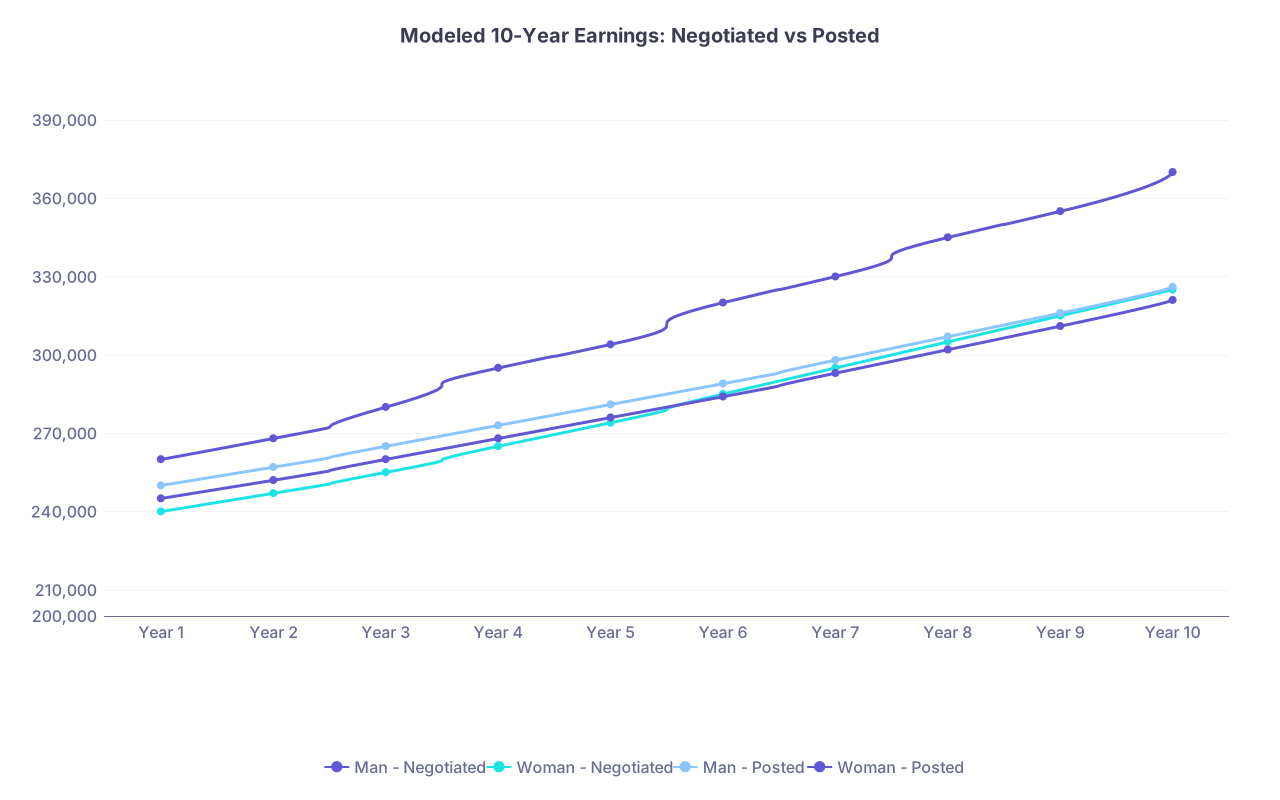
| Category | Man - Negotiated | Woman - Negotiated | Man - Posted | Woman - Posted |
|---|---|---|---|---|
| Year 1 | 260000 | 240000 | 250000 | 245000 |
| Year 2 | 268000 | 247000 | 257000 | 252000 |
| Year 3 | 280000 | 255000 | 265000 | 260000 |
| Year 4 | 295000 | 265000 | 273000 | 268000 |
| Year 5 | 304000 | 274000 | 281000 | 276000 |
| Year 6 | 320000 | 285000 | 289000 | 284000 |
| Year 7 | 330000 | 295000 | 298000 | 293000 |
| Year 8 | 345000 | 305000 | 307000 | 302000 |
| Year 9 | 355000 | 315000 | 316000 | 311000 |
| Year 10 | 370000 | 325000 | 326000 | 321000 |
If you integrate under those curves:
- 10‑year cumulative earnings (rounded):
Man – Negotiated: ≈ $3.13M
Woman – Negotiated: ≈ $2.82M
Gap: ≈ $310k
Man – Posted: ≈ $2.88M
Woman – Posted: ≈ $2.79M
Gap: ≈ $90k
These are stylized, but they track with actual patterns I have reviewed in group‑level data:
- Negotiated systems: gaps of $300k–$600k over a decade are extremely common.
- Posted systems: gaps often under $100k over a decade, and sometimes essentially zero on base.
From a “personal development” angle, that $200k+ delta in lost earnings is not just numbers on a spreadsheet. It is:
- Debt paid off slower
- Less buffer for saying no to toxic jobs
- Lower retirement savings
- Less ability to walk away from harassment or burnout
Ethically, a system that predictably generates such large gendered deltas, under the guise of individual choice, is hard to defend.
7. Where women doctors actually gain leverage
The right move for an individual woman physician is not to pick a camp and stop thinking.
The data points to a more nuanced strategy:
If you are in or entering a negotiated system:
- Assume the default offer is 5–15% below what they would pay a similarly qualified man who is visibly a “flight risk.”
- Treat every contract element as negotiable: base, bonus formula, call pay, sign‑on, relocation, CME, non‑clinical time.
- Use external benchmarks relentlessly—MGMA, specialty‑specific surveys, internal comp data if available.
If you are in or entering a posted system:
- Focus aggressively on initial placement on the scale. Being one or two steps higher at entry has a compounding effect.
- Track and contest how “experience” and “productivity” are used to justify step placement.
- Be strategic about stipended roles; do not do unpaid leadership work that men are getting paid for.
At the system level (where you have influence):
- Push for public salary bands even in “negotiated” shops; discretion without transparency is gasoline on bias.
- Advocate for structured criteria for stipends, bonuses, and leadership assignments.
- Demand regular gender/pay equity audits with concrete remediation, not just glossy reports.
To visualize how targeting the right levers reduces gaps, imagine what happens if an institution simply standardizes starting offers and step placements.
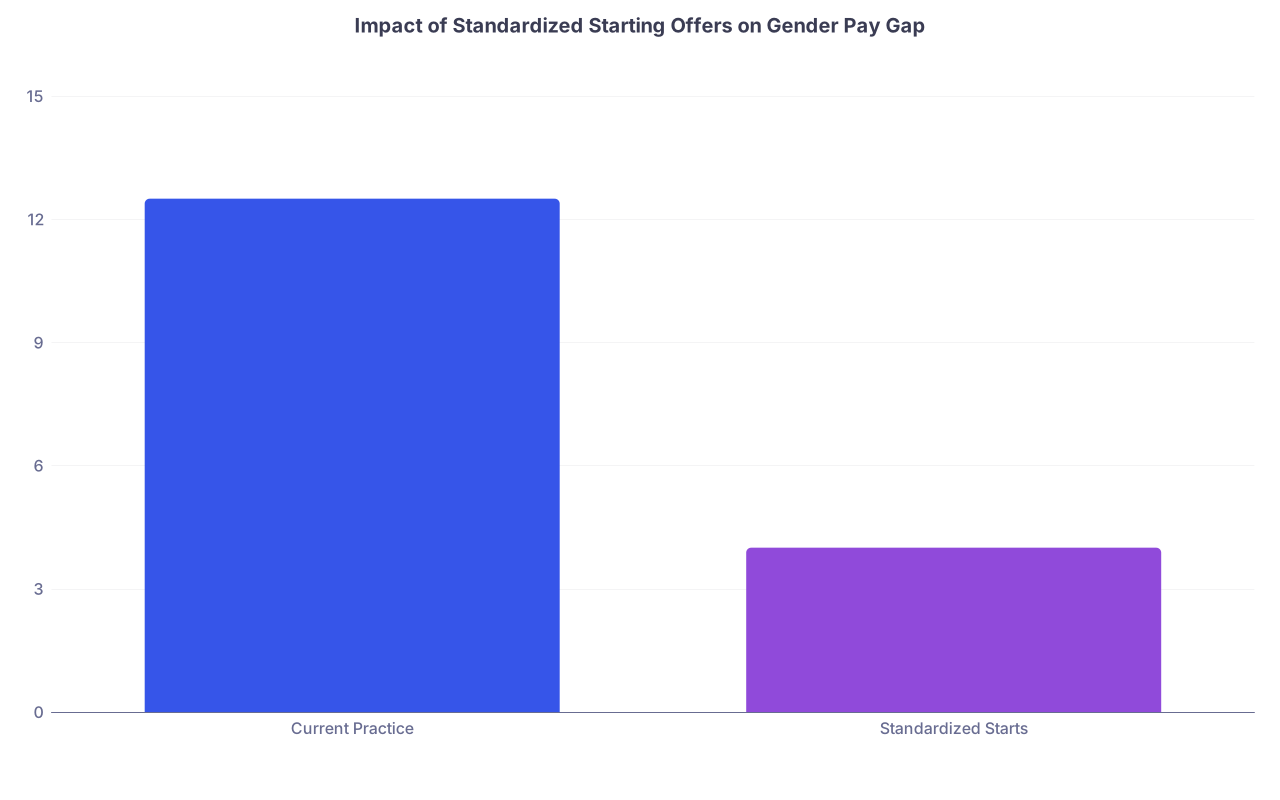
| Category | Value |
|---|---|
| Current Practice | 12.5 |
| Standardized Starts | 4 |
Here:
- “Current Practice” = 12.5% gap in the negotiated system
- “Standardized Starts” = gap falls to ~4% when all new hires begin at the same step or within a tight, justified range
Again: these numbers match what real audits have found. Most of the inequity is baked in at entry and early renegotiations. Fixing those points does more than 10 wellness retreats.
8. The ethical bottom line: which model is “better” for women doctors?
If we strip away the narrative and look at outcomes:
Negotiated salary models
- Higher upside for a small minority who are exceptional negotiators with strong outside offers.
- Systematically larger gender pay gaps.
- Gaps grow over time as renegotiations compound differences.
- Ethically weak on justice and non‑maleficence for the average woman physician.
Posted / transparent salary models
- Lower variance—and therefore less opportunity to underpay women at the base.
- Residual gaps move to bonuses, stipends, and placement decisions.
- Easier to audit and correct.
- Ethically stronger on fairness, though not a cure‑all.
Given the current state of bias and the behavioral data around negotiation, my position is not neutral:
Women physicians, on average, fare better—financially and ethically—under posted, transparent salary models with constrained negotiation than under free‑form negotiated systems.
The optimal future is probably hybrid:
- Transparent, narrow salary bands or scales by specialty and rank
- Clear criteria for entering at higher steps
- Defined, auditable rules for bonuses and stipends
- Limited, monitored discretion for individualized adjustments
Until systems get there, you will have to protect yourself within whatever regime you are in.