
Parenthood does not just “slow things down” for women physicians. The data show it systematically reshapes promotion trajectories in ways that are measurable, predictable, and, in many institutions, still largely ignored.
If you feel like your male colleagues with kids keep moving up while you are stuck at assistant or associate, you are not imagining it. The numbers back you up.
What the Data Actually Show About Promotion and Parenthood
Strip away the anecdotes and you see a consistent pattern: women physicians who become parents progress more slowly to promotion and leadership than three comparison groups:
- Men physicians with children
- Men physicians without children
- Women physicians without children
Not just by a little. By years.
Let me anchor this with typical benchmarks drawn from large academic medicine datasets (AAMC, JAMA, Academic Medicine studies over the last 10–15 years). Exact numbers vary by institution, but the direction is stubbornly consistent.
Time to Promotion: Mothers vs Everyone Else
Most academic medical centers still expect a rough timeline like this (assuming a “normal” clock, no formal extension):
- Assistant to associate professor: ~7–8 years
- Associate to full professor: ~7–9 years
Now compare that against what has actually been observed.
| Group | Median Years to Associate |
|---|---|
| Men physicians, no children | 7–8 |
| Men physicians, with children | 7–9 |
| Women physicians, no children | 8–10 |
| Women physicians, with children | 10–13 |
Women with children frequently take 2–4 additional years to reach associate professor compared with men, sometimes more. For full professor, the gap can widen further, especially in procedural specialties and research-heavy departments.
That is not a “small” effect. If your academic career is 30–35 productive years, losing 3–5 years at each promotion step is the difference between:
- Serving multiple terms as division chief or chair vs barely touching leadership
- Having time to build and lead a research program vs spending your peak years trying to get over the associate hump
Promotion Probability, Not Just Timing
The gap is not only about how long it takes. It is about whether promotion happens at all.
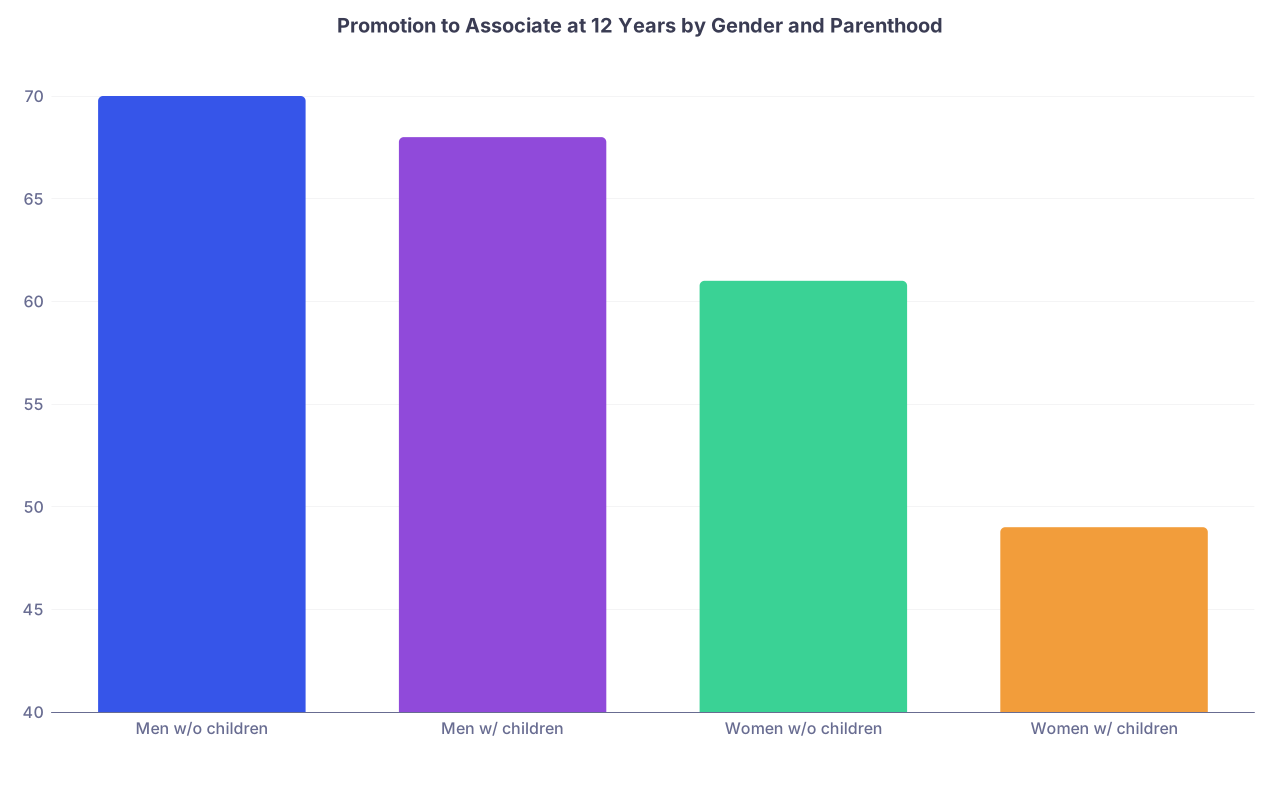
Several cohort studies have reported something like this: among faculty who start at the same time, women with children are less likely to be promoted to associate or full at 10–15 year follow-up, even after adjusting for specialty and part-time status.
A simplified version of what these studies show:
| Category | Value |
|---|---|
| Men w/o children | 70 |
| Men w/ children | 68 |
| Women w/o children | 61 |
| Women w/ children | 49 |
Interpretation: roughly 70% of men without children make associate by year 12 vs under 50% of women with children. Different study, different institution, the pattern repeats.
You can attack these numbers from different angles (control for publications, h-index, RVUs, degree type, protected time). The motherhood penalty in promotion probability never fully disappears.
Where the Promotion Gap Comes From: Workload and Output
Promotion is a lagging indicator. The real levers are earlier: hours, clinical productivity, academic output, and visibility.
The Workhour Shift After Children
National physician workhour surveys consistently find:
- Before children, male and female physicians in early career report similar total hours, often 55–60+ hours/week.
- After the arrival of children, women physicians reduce their paid clinical hours more often and more substantially than men, even among dual-physician couples.
Think typical patterns:
- Male physicians with kids might drop from 60 to 55 hours.
- Female physicians with kids might drop from 60 to 45–50, and often shift some of those hours into nights/weekends to accommodate childcare.
This is not because they “want it less.” The childcare data are clear: in physician couples, women still do the majority of childcare and household work, even when both partners are full-time attending-level physicians.
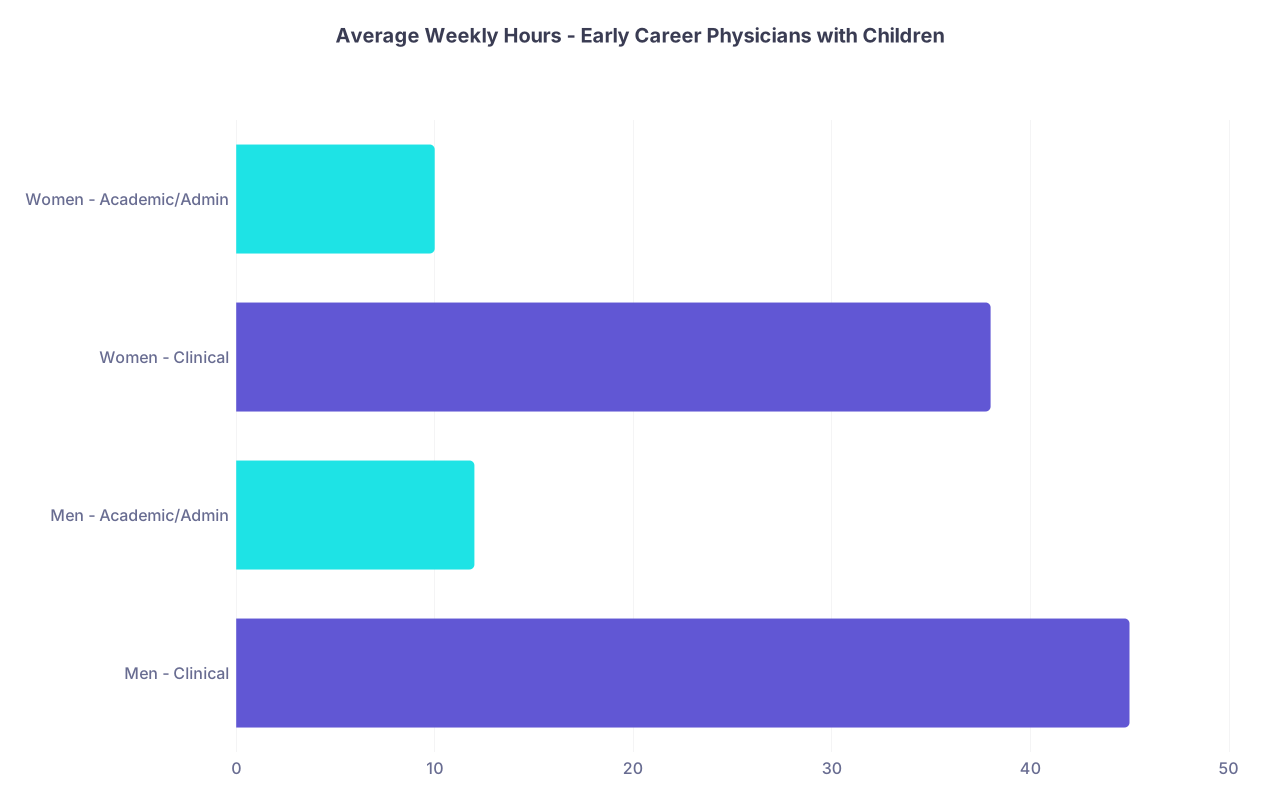
A rough picture from longitudinal data:
| Category | Value |
|---|---|
| Men - Clinical | 45 |
| Men - Academic/Admin | 12 |
| Women - Clinical | 38 |
| Women - Academic/Admin | 10 |
Those 5–10 “missing” hours per week are not just a small difference. Over a year that is 250–500 hours, the equivalent of 6–12 extra full-time work weeks. Over five years, it is a full extra year of work.
Promotion committees may say “we evaluate relative to opportunity” but most still count absolute output.
Clinical vs Academic Time: Misaligned Incentives
Women physicians with children are more likely to:
- Take jobs that are nominally more “family-friendly” (hospitalist shifts, outpatient heavy roles, fewer nights in some subspecialties).
- Accept more predictable schedules, less call, and “stable” positions that are often more clinically loaded and less research protected.
From a family standpoint: rational choice.
From a promotion standpoint: structurally punished.
Data from academic centers often show:
- Men physicians, especially those on tenure/research tracks, have higher fractions of protected time, even when equally junior.
- Women physicians, especially mothers, end up more often on “clinical educator” or non-tenure tracks with heavier clinical RVU targets and softer promotion criteria that in practice slow or cap advancement.
The downstream effect is obvious in the publications curve.
Publication and Grant Output: The Hard Numbers
Promotion decisions in academic medicine still heavily weight:
- Peer-reviewed publications
- First/last authorship
- External grant funding (K awards, R01-type grants, foundation awards)
- Leadership of trials, consortia, or major initiatives
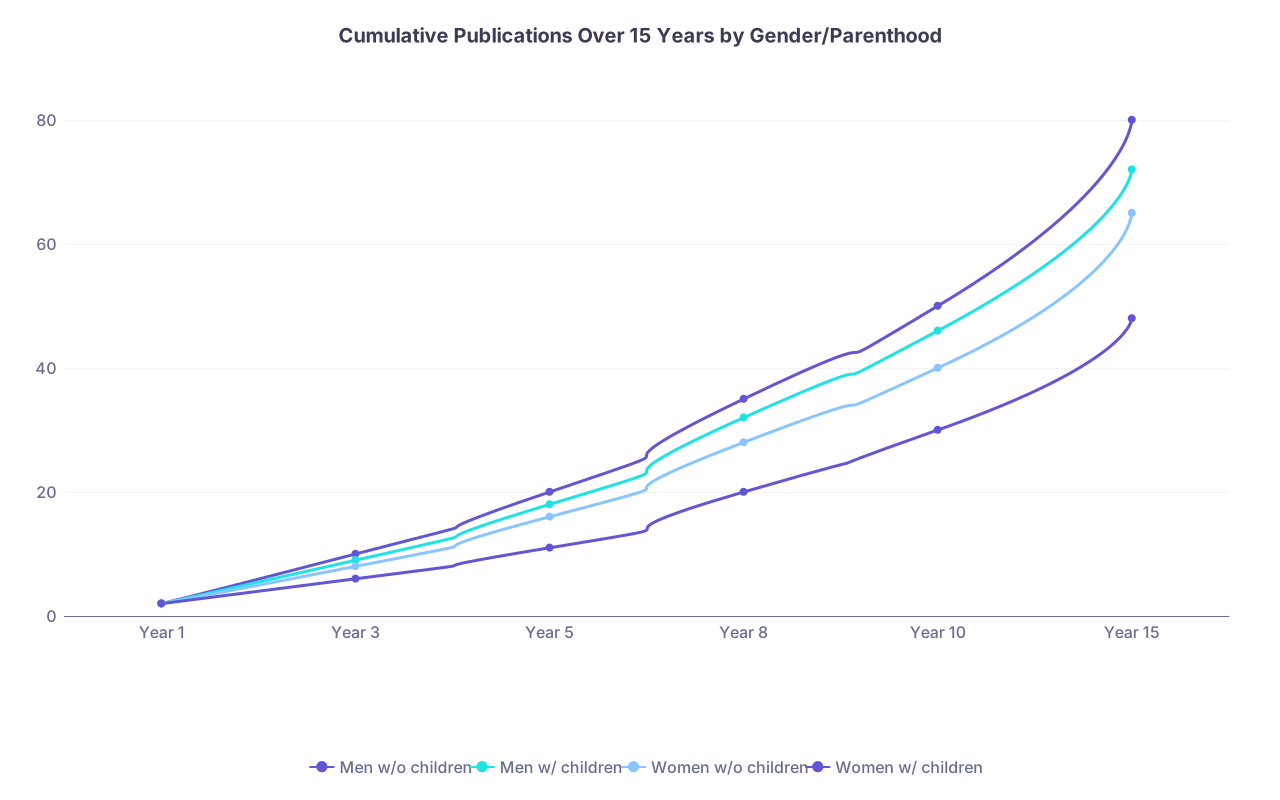
Look at publication curves by gender and parenthood and you see a “dip” around childbearing years that is much deeper and longer for women.
Studies that track 10-year trajectories show patterns like:
- Men’s annual publication counts may plateau slightly around early family years but rebound within 2–3 years.
- Women’s publication counts drop more sharply and often stay lower for 5+ years, especially if they have more than one child or inadequate institutional support.
If you model academic output across early-career years (0–15 years after residency), you often see something approximating this:
| Category | Men w/o children | Men w/ children | Women w/o children | Women w/ children |
|---|---|---|---|---|
| Year 1 | 2 | 2 | 2 | 2 |
| Year 3 | 10 | 9 | 8 | 6 |
| Year 5 | 20 | 18 | 16 | 11 |
| Year 8 | 35 | 32 | 28 | 20 |
| Year 10 | 50 | 46 | 40 | 30 |
| Year 15 | 80 | 72 | 65 | 48 |
You could argue about the exact shape, but the exposure is clear. By the time promotion is on the table:
- Men with kids might have 40–70% more publications than women with kids who started at the same time.
- Leadership roles, invited talks, and grant PI roles follow the same skew because they piggyback on output and visibility.
Committees are then “just following the metrics,” while quietly avoiding the obvious: those metrics are downstream of gendered caregiving patterns and biased institutional support.
Hidden Mechanisms: Bias, Culture, and Policy Gaps
You cannot explain a consistent 2–5 year promotion delay solely with hours and childcare. There is more under the hood.
The Pregnancy and Early Parenthood Penalty
The period from pregnancy planning through the first year postpartum is a structural minefield.
Real conversations I have heard in promotion and hiring spaces:
- “She just had a baby. Let’s see how committed she is over the next few years.”
- “He just had a baby, good for him. He seems even more focused now.”
Same life event. Opposite inference.
What the data show:
- Women physicians often face reduced opportunities at exactly the time when momentum matters—fewer invitations to join grants, fewer leadership roles on committees, fewer speaking invitations.
- Men physicians frequently see no penalty and sometimes a subtle halo: being viewed as “stable,” “family-oriented,” and “reliable.”
That is why even when CVs are closely matched, motherhood still predicts slower promotion.
Tenure Clock Extensions: The Math Problem
Many institutions offer “stopping the clock” or tenure clock extensions for childbirth or adoption. On paper, that sounds like equity. In practice it often fails for women and disproportionately benefits men.
Here is how it plays out:
- Men take the formal extension, but do not substantially reduce their work. Their CV grows for an extra year under a “junior” label.
- Women take the extension and genuinely reduce their hours for caregiving. Their relative output per year actually goes down, and the extra time does not fully close the gap.
You end up with a quiet asymmetry: same formal policy, unequal realized benefit. The net effect on promotion timelines is frequently neutral or even negative for women.
Financial and Career Consequences of Delayed Promotion
Let me be blunt: a 3–5 year delay to promotion is not just a title problem. It is a lifetime earnings and influence problem.
Salary Trajectory Impact
Promotion is usually tied to salary bands. If associate and full professor roles carry higher base pay and better bonus structures, then each year of delay compounds.
A stylized example for an academic clinician (numbers intentionally approximate):
| Year of Career | Scenario A: On-time Promotion | Scenario B: 4-year Delay |
|---|---|---|
| 5 | $210k | $210k |
| 8 | $240k (associate) | $215k (still assistant) |
| 12 | $270k | $240k (associate) |
| 20 | $310k | $290k |
Over 20+ years, that 4-year delay easily adds up to:
- $300k–$700k less in cumulative earnings, depending on institution and specialty
- Lower retirement contributions and compounding
- Less eligibility for leadership stipends, endowed roles, or external consultative work
All because the promotion decision shifted later.
Leadership and Influence
Promotions unlock:
- Division chief and program director roles
- Chair searches
- National committee eligibility
- Guideline-writing panels, specialty board roles
If you reach associate at 10 years vs 14 years, your window for leadership shrinks. The probability that you are in the running during your peak energy and productivity drops. Not because you were less capable, but because the institutional clock was not aligned with your childbearing years.
And do not ignore this: the lack of mothers in leadership then trickles back and reinforces the system that penalizes the next cohort. Vicious feedback loop.
Institutional Levers That Actually Change Promotion Trajectories
I am not going to pretend that individual “time management tips” fix a structural gap this large. The data say otherwise. The only changes that move promotion curves in a measurable way are institutional and policy-level.
Structural Supports with Measurable Effects
The promising data points cluster around a few types of interventions:
- Guaranteed, adequately long paid parental leave, not just disability pay.
- On-site, extended-hours childcare with priority for clinical staff.
- Automatic scheduling protections in pregnancy and postpartum (reduced nights, no last-minute schedule changes).
- Realistic RVU adjustments during and after leave, with no downstream penalty on bonus eligibility or evaluations.
- Protected academic time that is not quietly eroded when a physician becomes a parent.
Institutions that implement multiple of these in a coherent way show:
- Smaller gender gaps in time to promotion
- Higher retention of women faculty, especially after childbirth
- Better representation of women in leadership over a decade
But you have to measure it properly, not just advertise policies.

| Step | Description |
|---|---|
| Step 1 | Measure Current Promotion Gaps |
| Step 2 | Implement Parental Leave Policy |
| Step 3 | Adjust RVU and Promotion Criteria |
| Step 4 | Provide Childcare and Schedule Support |
| Step 5 | Track Promotion Outcomes by Gender and Parenthood |
| Step 6 | Refine Policies Based on Data |
If your institution cannot show you a chart of promotion timelines broken down by gender and parenthood status, they are flying blind. Or worse, avoiding the analysis because they suspect the results.
What Individual Women Physicians Can Control (Within a Biased System)
You cannot “optimize” your way out of structural inequity, but you are not powerless either. The question is: where do your choices generate the highest leverage given how promotions are actually decided?
Treat Promotion Criteria as a Data Problem
Before you accept a role or map your next 5 years, you need the real criteria, not the brochure version. That means hard numbers:
- Median time to promotion for your department, by track and gender (if you can get it).
- Expected annual RVUs, publication counts, teaching evaluations, committee work.
- Actual outcomes: how many women with children in the last 10–15 years at your institution reached associate/full? How long did it take?
If a chair cannot answer those questions with at least approximate numbers, that is your first data point. Either they do not track it, or they do not want to tell you.
Make Early, Aggressive Choices About Protected Time
You get the most leverage by front-loading certain decisions:
- Choosing a track that actually aligns with your goals. If you want promotion and leadership, a “pure clinical” track with soft criteria is often a trap.
- Negotiating explicitly for protected time that survives pregnancy and early childcare years. It should be written, not verbal.
- Locking in at least one substantial project (study, curriculum, quality initiative) with clear credit and visibility within your first 2–4 years as faculty.
Because once you are in the thick of early parenthood, your bandwidth to renegotiate everything drops. You are in execution mode. Good or bad, the initial conditions will drive the trajectory.

Be Strategic About When and How You Say Yes
Promotion dossiers are not a raw count of tasks completed. They are pattern recognition problems: do committee members see you as a leader, a scholar, a teacher?
You do not get there by saying yes to everything. You get there by:
- Prioritizing work that results in something citable: papers, guidelines, toolkits, major reports.
- Selecting committees that control resources and visibility (promotion committees, curriculum committees, quality leadership), not feel-good “women’s task forces” with no budget or authority.
- Aligning each “yes” with a line on your CV that moves the needle for the track you are on.
Women physicians with children are more likely to be asked to do unpaid “office housework”: mentoring everyone, DEI talks, endless panels. If you say yes to all of it, you will pay for it in promotion delay.
Ethics: Calling This What It Is
Let us drop the euphemisms. A system where becoming a parent, specifically a mother, reliably delays career advancement and reduces lifetime earnings is not neutral. It is discriminatory, even if nobody says the quiet part out loud.
From an ethical standpoint:
- Patients lose because a large share of high-skill, high-empathy physicians are pushed out of leadership and high-impact academic roles precisely when they could be shaping care systems.
- Institutions lose because they effectively pay to train and recruit excellent women physicians, then underutilize them for decades.
- Colleagues lose because the burden of caregiving is silently offloaded in ways that distort team functioning and burnout risk.
The gap in promotion timelines is not a side effect. It is a readout of how seriously an institution takes gender equity.

If your medical center proudly posts photos of women with stethoscopes and toddlers on their website but has a 5-year motherhood promotion gap, that is not “family-friendly.” That is branding over substance.
The Bottom Line
For women physicians, the impact of parenthood on promotion timelines is not vague or anecdotal. The data show:
- Motherhood is associated with a clear, quantifiable delay in promotion, often 2–5 years per step, and a lower probability of reaching associate and full professor at all.
- The drivers are structural, not individual: unequal caregiving burdens, misaligned clinical vs academic expectations, biased opportunities around pregnancy and early parenthood, and promotion metrics that ignore “time available.”
- Institutional choices either widen or narrow the gap: serious parental leave, childcare support, protected time, and transparent metrics measurably shrink disparities; cosmetic policies do not.
If you are a woman physician planning or living parenthood, you are not overreacting. You are reading the trend lines correctly. The challenge now is to use that data—hard, unromantic, uncomfortable data—to force institutions to redesign the system instead of asking you to absorb all the cost.