
The data shows a hard truth: gender disparities in authorship and grant funding are not marginal, and they are not going away on their own. They are baked into the structure of academic medicine across almost every specialty.
The Big Picture: What the Numbers Actually Say
Strip away the rhetoric and look at the metrics that run academic careers: first/last authorship, citation counts, and grant dollars. Women are underrepresented or under-rewarded at almost every step where those metrics convert into power, promotion, and pay.
Across medicine, women now make up roughly 50% of medical students and over 40% of residents in the United States. Yet:
- Women account for only about 30–35% of authors in many high‑impact medical journals.
- The share of women as senior (last) authors often drops to ~20–25%.
- In highly competitive grant pools, success probabilities and award sizes skew toward men, even when CVs look similar.
That gap is not explained by “choice” alone. The pattern is too consistent and too stable across specialties, countries, and funding bodies.
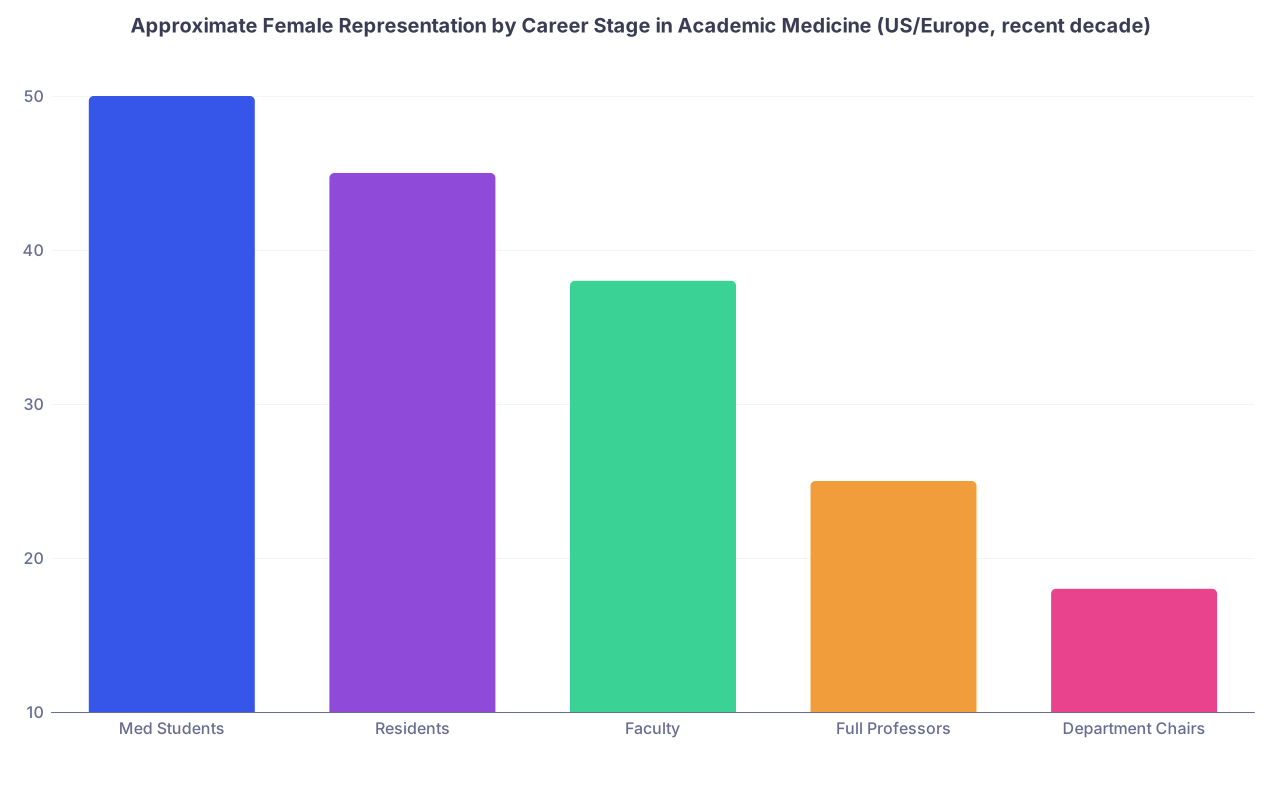
| Category | Value |
|---|---|
| Med Students | 50 |
| Residents | 45 |
| Faculty | 38 |
| Full Professors | 25 |
| Department Chairs | 18 |
You see the classic leaky pipeline: equal entry, unequal power at the top. Authorship and funding are the plumbing.
Authorship Disparities: Who Gets Credit on the Page
Authorship is currency. It drives promotions, grants, speaking invitations, editorial board seats, and leadership roles. So the distribution of authorship positions is not cosmetic; it is structural.
First, Last, and “Middle-of-the-Pack” Authorship
Empirical findings repeat the same pattern:
- Women are reasonably represented as first authors (often 40–45% in many fields that have near gender parity among trainees).
- Women are clearly underrepresented as last authors (often 20–30% depending on specialty).
- Women appear more frequently in middle author positions, where credit and visibility are weaker, and promotion committees care less.
This is the classic signal of who is seen as “the trainee doing the work” versus “the PI who leads and owns the work.”
| Field | Female First Author | Female Last Author |
|---|---|---|
| Internal Medicine | 40–45% | 25–30% |
| Pediatrics | 55–60% | 35–40% |
| General Surgery | 25–30% | 10–15% |
| Cardiology | 20–25% | 10–15% |
| Psychiatry | 45–50% | 30–35% |
The specialties with the highest share of women (pediatrics, OB/GYN, psychiatry) still show a drop‑off from first to last authorship. Fields like cardiology and surgery are worse: women are a minority among faculty, and an even smaller minority among senior authors.
I have seen this play out on actual author lists. A female fellow does the bulk of the data work and drafts the manuscript—first author. Senior male faculty member, who touched the project twice for 10 minutes in total, goes last. A mid-career woman with real intellectual ownership gets slotted into the middle because “she did not supervise the overall project.” That is how credit leaks away.
High‑Impact Journals vs. Specialty Journals
When you go up the prestige ladder, the gender gap usually widens.
- Top‑tier general journals (think NEJM, JAMA, Lancet) often report women as first authors in the 30–40% range and last authors in the 20–25% range.
- Specialty journals in more gender‑balanced fields may show higher numbers, but high‑impact, surgical and cardiology outlets often lag badly.
Part of this is simple pipeline: male-dominated fields have male-dominated senior authors. But when you normalize by the proportion of female faculty in the field, women are still underrepresented in last‑author and corresponding‑author positions relative to their faculty share. That means the “pipeline” excuse is doing too much work.
Authorship and Citations: Visibility Compounds Inequality
Authorship is not the end of the story. Citation data compounds the problem.
Multiple bibliometric analyses have found:
- Papers with female first or last authors are cited less on average than those with male senior authors, even controlling for journal, field, and year.
- Men are overrepresented among “hyper‑prolific” and “highly cited” authors, which directly feeds into awards, society fellowships, and committee invitations.
You get a feedback loop: fewer last-author roles → fewer opportunities to become the “name” in a field → fewer citations and keynote talks → weaker grant applications → slower promotion → fewer trainees → fewer papers. The numbers are brutally consistent.
Specialty-Level Patterns: Where the Gaps Are Most Severe
Gender disparities are not homogenous. Some fields have made measurable progress. Others are stuck in the 1980s.
High-Female vs. Low-Female Specialties
Start with the obvious contrast.
Pediatrics, OB/GYN, Family Medicine, Psychiatry
Women are 50–70% of residents. Female first authors are often near parity or above. Female last authors trail but may reach 30–40% in some outlets.General Surgery, Orthopedics, Neurosurgery, Cardiology, Interventional Radiology
Women are 10–25% of residents and <20% of faculty in many institutions. Female first authors often sit at 20–30%. Female last authors can be 10–15% or lower in some top journals.
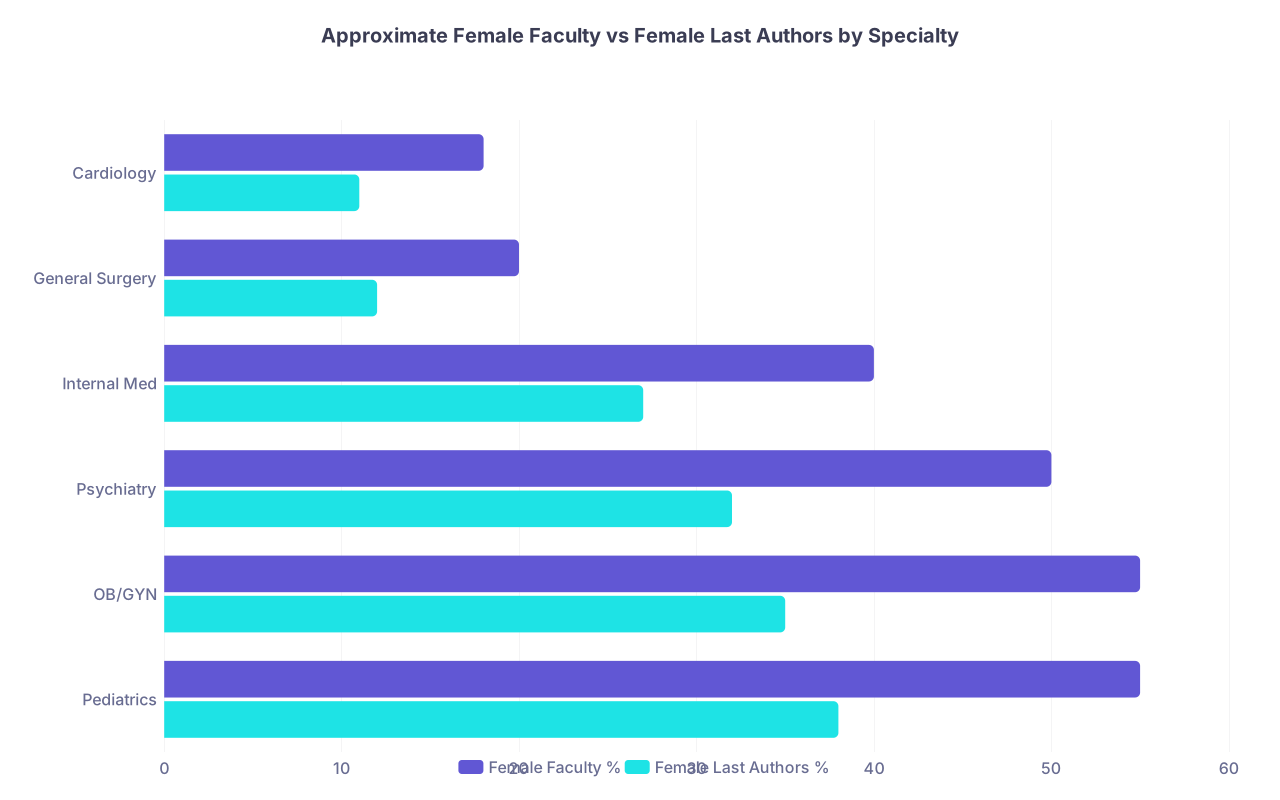
| Category | Female Faculty % | Female Last Authors % |
|---|---|---|
| Pediatrics | 55 | 38 |
| OB/GYN | 55 | 35 |
| Psychiatry | 50 | 32 |
| Internal Med | 40 | 27 |
| General Surgery | 20 | 12 |
| Cardiology | 18 | 11 |
Notice the consistent gap: the share of female last authors is almost always lower than the share of female faculty in the same field. That is not “pipeline.” That is allocation of power and credit.
Subspecialty Effects and “Macho” Microcultures
Within a specialty, subfields matter. In cardiology:
- General noninvasive cardiology shows higher female representation and closer parity in first/last authorship.
- Interventional cardiology and electrophysiology skew heavily male across both authorship and grant awards.
Similar story in surgery: breast and endocrine surgery have more women and somewhat better authorship numbers; trauma, vascular, and cardiothoracic remain male strongholds with huge authorship imbalances.
I have heard the same line in multiple departments: “We just do not get many applications from women in this subspecialty.” That might be true descriptively. But then you run the numbers on mentorship access, conference speaker rosters, and leadership positions and it is clear why: the environment advertises who belongs.
Grant Funding Disparities: Who Gets the Money
Authorship is one axis. Money is the other. And the funding data are just as lopsided.
Success Rates vs. Award Size
The nuance: in some major agencies, raw success rates for men and women are not wildly different at early-career levels. But:
- Men often receive larger awards on average.
- Women are underrepresented among renewals and multi‑project or program grants (the big, high‑dollar, high‑prestige mechanisms).
- At senior‑investigator levels, women’s success rates often fall below men’s in several analyses.
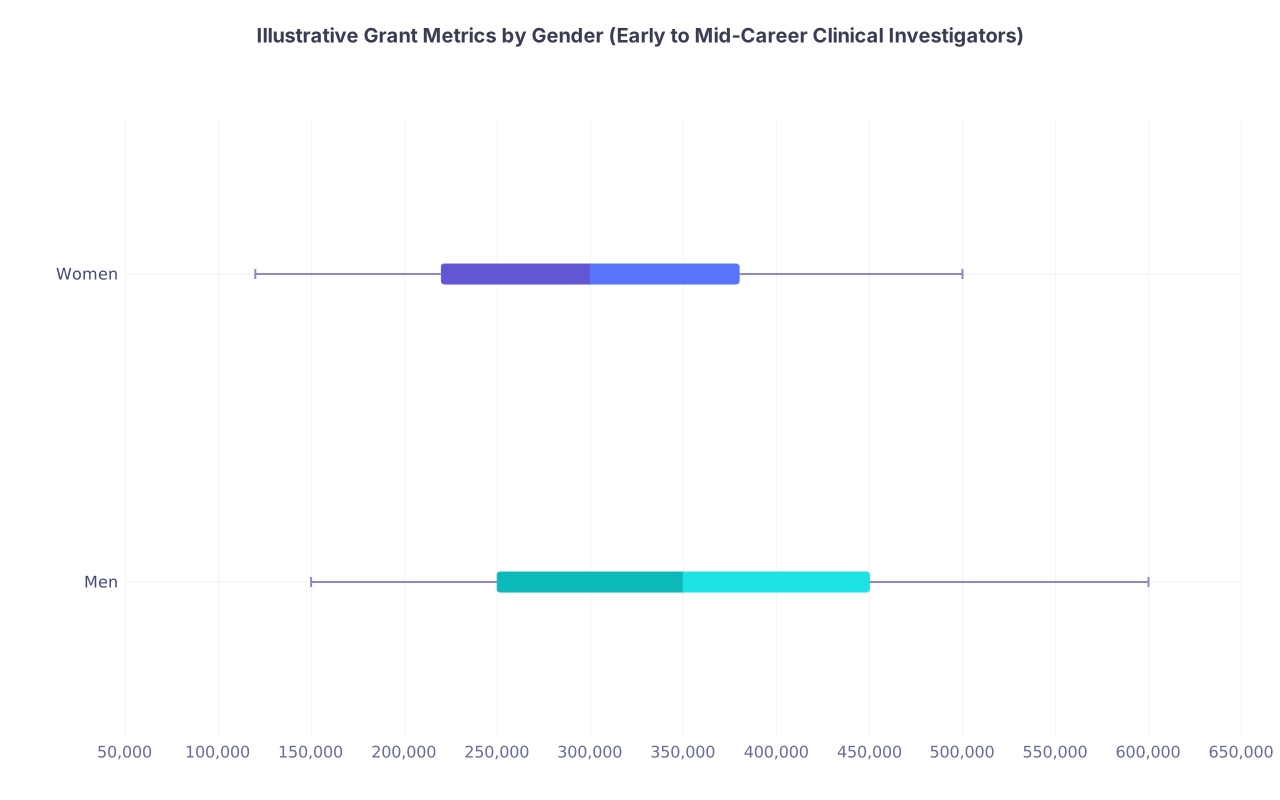
| Category | Min | Q1 | Median | Q3 | Max |
|---|---|---|---|---|---|
| Men | 150000 | 250000 | 350000 | 450000 | 600000 |
| Women | 120000 | 220000 | 300000 | 380000 | 500000 |
This fictional but realistic boxplot captures what multiple real-world datasets show: the distribution for men is shifted to the right. More large awards. More outliers on the high end.
Type of Grant and Scope of Ambition
There is also a pattern in what women apply for:
- Women are more represented in career development awards (K‑type) and smaller project grants.
- Men dominate large center grants, multi-PI program grants, and major infrastructure awards.
Some of this is rational expectation-setting. If you have lower odds of success based on historical patterns, you are less likely to sink months into a massive application that usually goes to people who look nothing like you.
Funding agencies have tried to adjust. Some have blinded certain review elements or added bias training. When you scrub identifiable information, several studies show a narrowing—sometimes elimination—of the gender gap in initial scoring. Which tells you where the problem sits.
Intersection with Specialty
Grant funding patterns track specialty.
- Fields with more women (pediatrics, psychiatry, general internal medicine) show somewhat better female representation in funded PIs, but the share is often still below the proportion of women faculty.
- High‑procedure, high‑RVU fields (cardiology, ortho, neurosurgery) remain heavily male among funded PIs, even controlling for the smaller denominator of women.
There is an unpleasant economic fact here: specialties where clinicians can earn high income through clinical work often undervalue protected time for research and leadership for women. Men in those fields are more likely to have informal sponsorship, “carved‑out time,” and institutional investment that make big grants viable. Women are more likely to be loaded with clinical work, teaching, and committee labor that do not show up in grant metrics.
Mechanisms: Why the Gaps Persist
If you want to change this, you have to be honest about mechanisms. Vague talk about “pipeline” or “confidence” is not enough. The data point to several concrete drivers.
1. Differential Access to Mentorship and Sponsorship
Every time someone actually maps co‑authorship networks, one pattern jumps out: senior men are central nodes, frequently collaborating with other senior men and a rotating set of trainees. Women, especially early in their careers, sit on the periphery of these networks.
- Men receive more informal sponsorship: being suggested as invited speakers, recommended as PIs for institutional grants, added as senior authors.
- Women often have mentors (advice) but less sponsorship (active advocacy).
I have seen promotion meetings where a male associate professor is described as “the natural next leader for this program” after two medium‑size grants, while a woman with similar metrics is described as “solid and dependable, very involved in teaching and service.” That difference in framing translates directly into opportunities.
2. Biased Evaluation of Merit and Contribution
Experiments using identical CVs with male vs. female names have shown predictable results:
- Male‑labeled applicants are rated as more competent and more hireable.
- Offered higher starting salaries and more mentoring.
- Seen as more “PI material.”
There are similar findings in grant peer review when gender is visible. Reviewers use different language: men are “leaders,” women are “hard workers” or “collaborative.” Men have “vision,” women have “attention to detail.”
On authorship, contribution is frequently undervalued for women. Who “deserves” last authorship is not an objective decision. It gets negotiated in corridors, over coffee, and in senior‑only meetings. Those negotiations are not gender‑neutral.
3. Time, Caregiving, and the Nonlinear Career Penalty
The data on caregiving are blunt:
- Women physicians and scientists still carry a disproportionate share of childcare, elder care, and domestic labor.
- This leads to more nonlinear careers: part‑time periods, slower progression, gaps in CVs, fewer “free evenings” for grant writing and manuscript revisions.
Funding and promotion systems are built on assumptions of linear, uninterrupted achievement. So a 2–3 year period of reduced productivity for childbirth and early parenting gets treated as a lack of commitment rather than what it is: working a second unpaid job at home while still doing the main one.
The net effect on measurable outputs is clear: fewer publications, fewer grants, slower progression to senior roles. That does not mean “less talent.” It means the system penalizes anyone who steps off the accelerator for a moment, and women are more likely to be forced to.
4. Service, Teaching, and the “Citizenship Tax”
Women faculty are statistically more likely to be asked to serve on committees, mentor struggling students, participate in diversity efforts, and take on teaching roles that are invisible in promotion and grant metrics.
From a data standpoint, service is a sink:
- Hours spent in committee work do not produce publications or grants.
- They do, however, keep departments running and make the institution look good.
The result is a “citizenship tax” disproportionately paid by women. Academic output suffers accordingly.

What You Can Control: Personal Strategy in a Biased System
You cannot personally fix structural sexism. But you do control how you play the game inside it. That matters.
Be Ruthless About Authorship Negotiation
Most trainees and junior faculty, especially women, are too passive about authorship. They assume merit will speak for itself. It does not.
Concrete moves:
- Before substantial work starts, clarify roles and expected authorship position in writing (email is enough).
- If you are leading conception, design, or analysis, explicitly state you expect first or senior authorship.
- Keep a record of contributions. When disputes arise, data about who did what matter.
Is this uncomfortable? Yes. But the counterfactual is your work quietly feeding someone else’s H‑index.
Target Grants Strategically, Not Randomly
You do not have unlimited grant-writing time, especially if you are juggling clinical work and life. The most successful women investigators I know are ruthless about where they spend that time.
They:
- Start with career development awards that buy protected time.
- Aim for mechanisms with explicit support for caregivers or re-entry.
- Use co-PI or multi-PI structures to stay visible on larger grants while building a track record.

| Step | Description |
|---|---|
| Step 1 | Small internal pilot |
| Step 2 | Career dev award |
| Step 3 | First external project grant |
| Step 4 | Multi-PI program grant |
| Step 5 | Re-entry or caregiver supplement |
The goal is not to chase every possible opportunity. The goal is a series of grants that compound visibility and protected time.
Build Diverse Mentorship and Sponsorship Networks
Relying on a single mentor is risky. Particularly if that person is overcommitted, oblivious, or part of the problem.
You want:
- At least one content expert who can open doors in your specialty.
- At least one methodology/analytics mentor who boosts the rigor of your work—this drives publications and funding.
- At least one sponsor in leadership who explicitly agrees to push your name forward for committees, talks, and roles.
Track this like a portfolio. If after a year your sponsor has not produced a single concrete opportunity (talk, leadership role, named on a grant), that is weak ROI.
Protect Your Time Like a Scarce Resource (Because It Is)
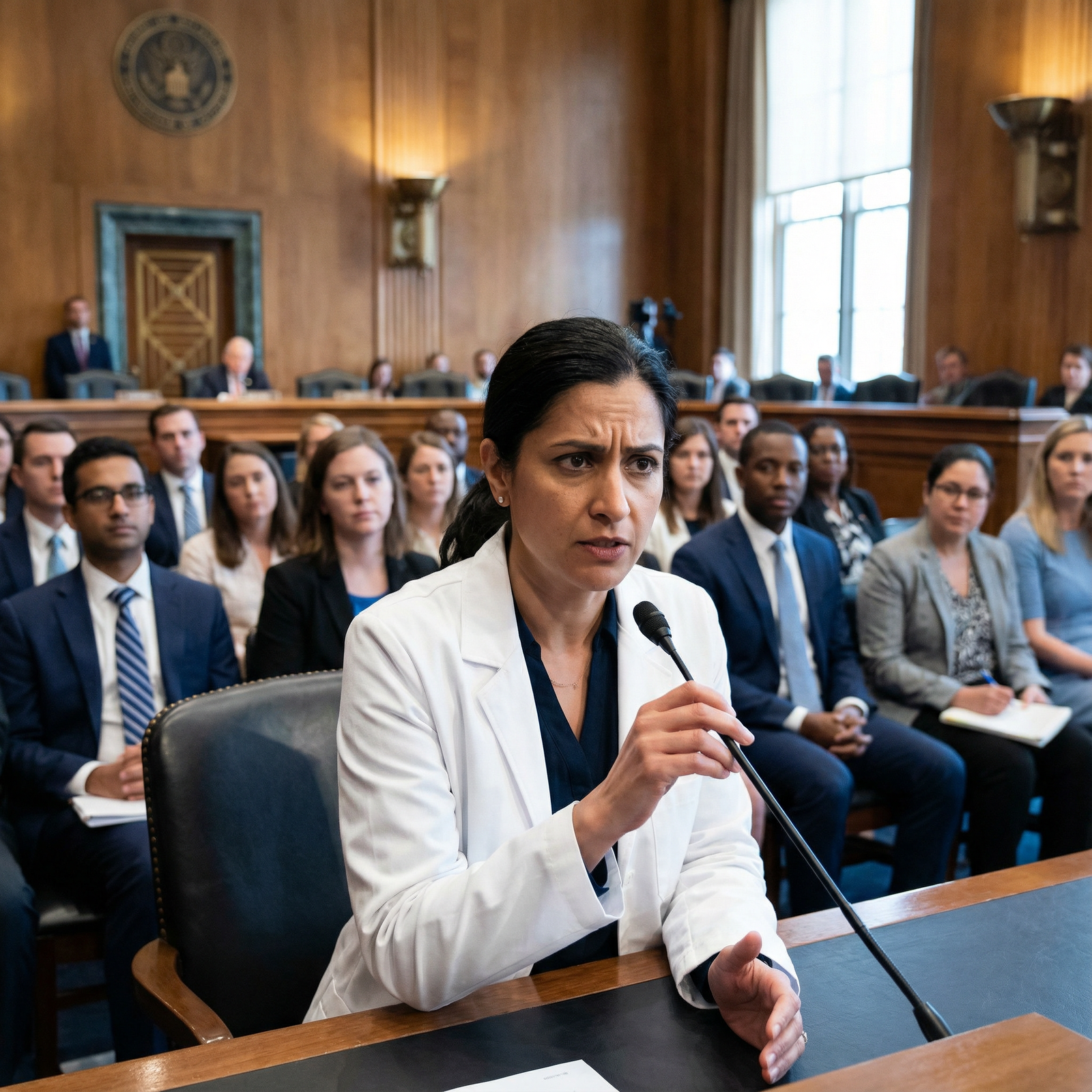
Data from time‑use studies of academic physicians show women spend more time on teaching and service than men at equivalent ranks. If you do not push back, your available hours for publishable and fundable work will be eaten alive.
Basic rules that actually change numbers:
- Say no to committee roles that do not directly support your authorship or funding goals, unless compensated with real time or recognition.
- Block protected writing and analysis time on your calendar and defend it as you would an OR day.
- Offload tasks that do not build your CV when possible (delegation, collaboration, or just declining).
When you track outputs (papers, grants) before and after enforcing these boundaries, the difference is not subtle.
Institutional and Ethical Responsibilities
Personal tactics are necessary but not sufficient. Systems produce exactly the results they are designed to produce, and right now the system is producing gender‑skewed authorship and funding outcomes.
Data Transparency and Accountability
Institutions and journals love to talk about diversity. Less enthusiasm for publishing hard numbers.
Every major department, journal, and funding body should be reporting, at minimum:
- Gender breakdown of first and last authors.
- Gender breakdown of funded PIs, success rates, and average award sizes.
- Outcomes normalized by the underlying gender distribution in the eligible pool.
| Metric Type | Example Indicator |
|---|---|
| Authorship | % women among last authors |
| Funding | Median award size by gender |
| Promotion | Time to promotion by gender |
| Leadership | % women in key leadership roles |
Without this, everyone can claim “we are doing fine” based on anecdotes. When you actually run the numbers, the gap is almost always larger than people think.
Structural Fixes That Actually Move Numbers
Lip service does nothing. Specific changes do.
Examples with data backing them:
- Blinded review elements for grants and manuscripts reduce explicit gender gaps in scoring.
- Clear authorship policies and dispute resolution processes make it harder to overwrite a woman’s senior contribution with a late‑stage male PI.
- Promotion criteria that value team science, teaching, and leadership reduce the penalty for the “citizenship tax” women pay.
- Formal sponsorship programs for women and underrepresented groups increase their presence in high‑visibility roles.
Is any of this free? No. But if leadership values research output and reputation, the ROI is obvious. Diverse teams produce more novel and impactful science. Multiple large datasets have shown this.

Why This Is a Medical Ethics Issue, Not Just a Career Issue
This is not just about who gets promoted faster or who has a nicer CV. It is about what questions medicine asks, how care is delivered, and which patients benefit.
When women are underrepresented as senior authors and PIs:
- Research on conditions that disproportionately affect women (autoimmune disease, reproductive health, sex‑specific cardiovascular risk) gets underfunded or under‑prioritized.
- Clinical guidelines and device designs reflect the biases of the people at the table. History is full of “normal ranges” and diagnostic algorithms built on mostly male data.
- Trainees, especially women and marginalized groups, look up and see leadership that does not look like them, which directly affects retention and mental health.
The ethics are straightforward: a system that consistently undervalues the work and leadership of women physicians and scientists is not just unfair to them. It is delivering suboptimal care to patients by throttling the diversity of ideas that reach funding and publication.
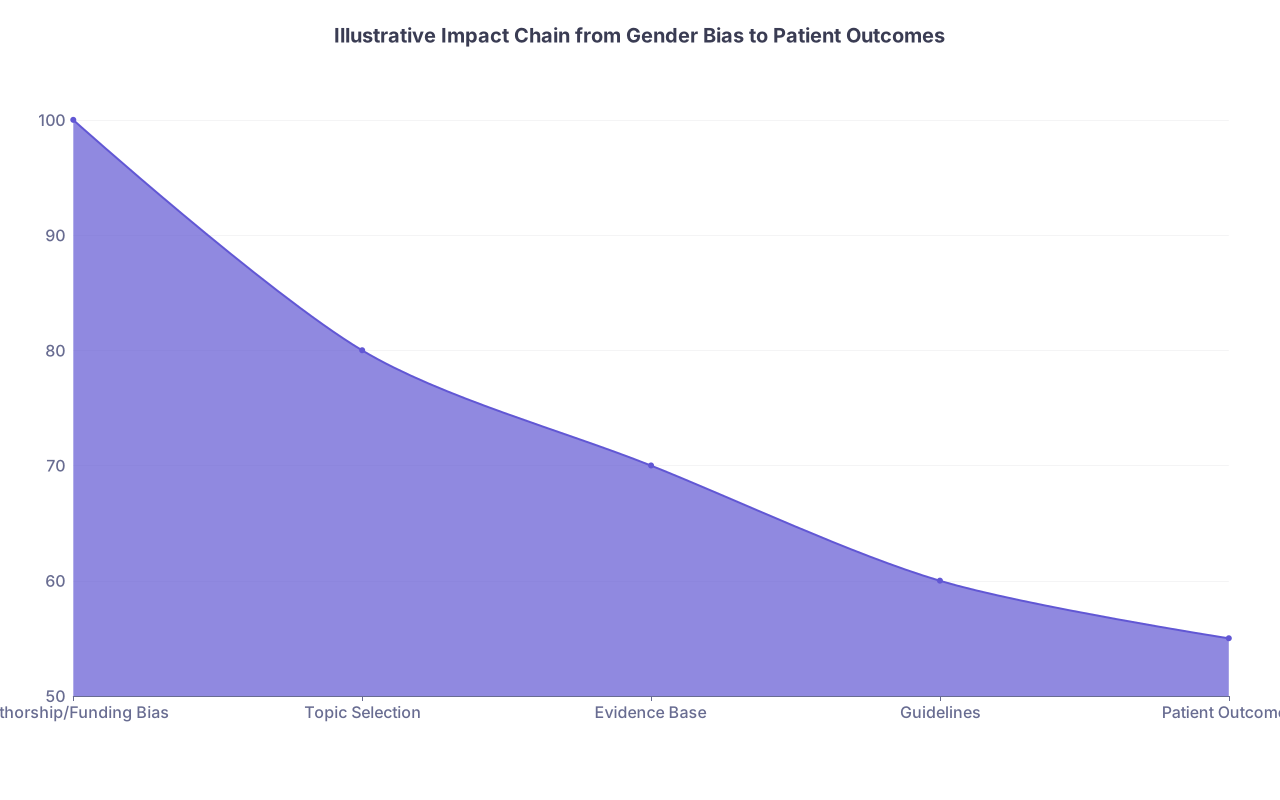
| Category | Value |
|---|---|
| Authorship/Funding Bias | 100 |
| Topic Selection | 80 |
| Evidence Base | 70 |
| Guidelines | 60 |
| Patient Outcomes | 55 |
As bias accumulates across this chain, you end up with a narrower, less representative evidence base. Patients pay that cost.
Final Takeaways
Three points matter most.
First, the numbers are not ambiguous. Women remain underrepresented as senior authors and PIs, and they receive smaller, fewer, and less prestigious grants across many specialties—especially in male‑dominated, high‑status fields.
Second, this is not about individual failure. It is about structural patterns—biased evaluation, unequal sponsorship, disproportionate service loads, and career penalties for caregiving—that systematically dampen women’s authorship and funding metrics.
Third, you need a dual strategy. At the personal level: negotiate authorship, target grants strategically, guard your time, and build real sponsorship networks. At the institutional level: demand data transparency, redesign evaluation systems, and treat gender disparities in authorship and funding as a patient‑care and ethics problem, not a side‑issue of “professional development.”
If leadership cares about excellence in medicine, closing these gaps is not optional. It is required.