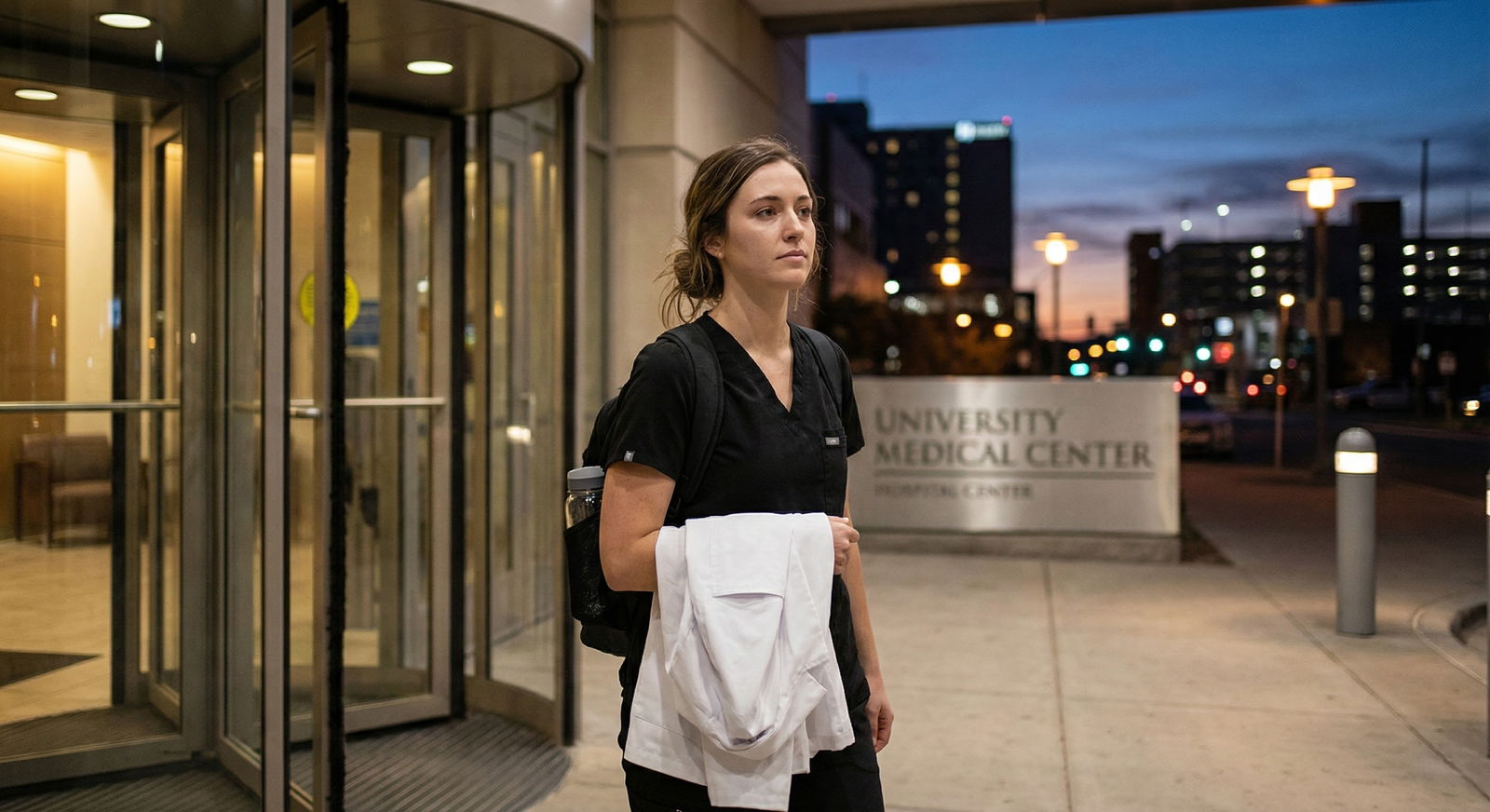
What do you actually do when it’s 11:45 p.m., you’re leaving the hospital alone, and your gut suddenly says, “This doesn’t feel safe”?
That’s the real question. Not abstract “women in medicine” safety discourse. The actual, concrete: You. Your bag. Your badge. A half-lit parking garage. Maybe a drunk family member still pacing by the ED entrance. And zero desire to be a headline.
This is the playbook for that situation.
First: Accept That Your Safety Is Not “Overreacting”
You’re not being dramatic. You’re not being “that resident.” You’re not weak because you’re thinking about safety instead of pretending to be fearless.
Here’s the reality I’ve seen over and over:
- Hospital lots are often poorly lit and half-empty at night.
- You’re an easy-to-identify professional (badge, scrubs, white coat, laptop bag).
- People assume you have money, prescriptions, or both.
- Security coverage at 2 a.m. is usually thinner than leadership admits.
So the baseline mindset: you are responsible for taking your own safety seriously, and the hospital is responsible for providing a reasonably safe environment. Those are not mutually exclusive.
We’ll deal with both: what you can control tonight, and what you should push your institution to change long term.
Your Personal Safety Plan: What To Do Tonight, Alone, Leaving Late
Think of this like a protocol. Not a vibe.
Before You Even Walk Out The Door
Do a 60–90 second safety check before you leave the unit. Make it part of your “signing out” ritual.
What are you carrying?
Bad idea:
- Two tote bags, a purse, a lunch box, a backpack, an open coffee, and your phone in your hand.
Better:
- One main bag you can zipper closed and wear cross-body or as a backpack.
- Keys and badge accessible without digging.
- Phone in a pocket, not in your hand broadcasting distraction.
What are you wearing?
You are not dressing for combat, but be realistic:
- Closed-toe shoes you can move quickly in.
- Avoid dangling things you need to clutch (scarf, loose items).
- Jacket that doesn’t completely obstruct your arms.
What’s your route and timing?
Ask yourself:
- Am I taking the same path every single night? (Predictable is bad.)
- Is there a 24/7 entrance/exit with staff nearby instead of the back door?
- Where is security at this hour? Static desk? Roving?
If you don’t know where security is, ask charge nurse, ED clerk, or call the hospital operator: “Where is security stationed overnight?” You should not be guessing.
As You Leave: Specific Behaviors That Actually Matter
This isn’t about paranoia. It’s about being a harder target.
Head up, phone away
- Don’t leave scrolling. Don’t walk to your car finishing a note on Epic mobile.
- Phone in your pocket, volume on high, emergency contacts one tap away.
- Eyes moving: doorways, corners, parked cars, people.
Key-in-hand technique
- Car key or fob in your hand before you step outside.
- Not the “key as a weapon between fingers” movie trick. Just ready to unlock and go.
- If your car has remote unlock or panic button, know exactly where that button is.
Use people and light—ruthlessly
- Choose the brightest route, not the shortest.
- Walk near building entrances, ED bay, ambulance bay, any staffed areas.
- If a group of nurses/RTs is leaving, leave with them. “Mind if I walk down with you?” is normal.
Your internal threat screen
Quick mental checklist:
- Is anyone loitering near entrances, stairwells, or isolated areas?
- Any vehicle running with person inside near your car’s path?
- Anyone whose behavior has already pinged your radar inside the hospital?
If your gut says “nope,” listen. That’s not drama. That’s data you can’t fully articulate yet.
Parking Lot and Garage: High-Risk Zone, High-Discipline Behavior
This is where most of the ugliness happens. Treat it like a short, focused operation.
Scan before committing
At the door to the lot/garage:
- Stop. Look over the area you’re about to enter.
- Look for: isolated people, groups clustered, someone leaning on rails, people sitting in cars with engines off.
- If you don’t like what you see, don’t just hope for the best. Step back inside and call security or wait for another employee to walk with.
Straight-line, purposeful walking
- Walk directly to your car. No wandering, no stopping to check messages.
- Head up, shoulders back, like you are going somewhere specific (because you are). Predators prefer confused or distracted targets.
The 10-second car rule
When you get near your car:
- Look under it casually as you approach.
- Look through the windows before unlocking. Back seat, passenger side.
- If anything looks wrong (window cracked, door ajar, items moved), do not get in. Back away, go back toward light/people, call security from there.
Once you reach your car:
- Get in, lock doors immediately.
- Start engine, leave. Adjust mirrors, find podcasts, and answer texts after you are out of the lot.
Using Security Without Feeling Like You’re “Bothering” People
I have heard this exact sentence from residents:
“I didn’t want to call security for an escort. I didn’t want to be a pain.”
That mentality is how institutions avoid fixing things. Stop doing their job for them.
Here’s how to use security like a professional:
Know the number and the script
Put hospital security in your phone. Tonight. Use a simple script:
- “Hi, I’m Dr. ____ on [unit]. I’m leaving now and I’d like an escort to the [garage/lot]. I’m parked on level [x], spot [x if you know]. Where should I meet the officer?”
When to call, non-negotiable
Always call if:
- You’ve had a conflict with a patient or family member that escalated.
- You’re being followed or repeatedly approached on your way out.
- You see someone suspicious hovering near your usual path.
- The lot is almost empty and you’re leaving after midnight.
If security seems annoyed
Some officers are great. Some are lazy. Some are openly dismissive.
If they say anything like:
- “It’s probably fine.”
- “We’re really busy, can you just be quick?”
- “No one else asks for this.”
Your response:
- “I understand you’re busy. I’m requesting an escort for safety. I will wait here. Thank you.”
And then—later, when you’re safe—you document the interaction and escalate (we’ll get to how).
Dealing With Specific Situations You Will Actually Encounter
Generic advice is useless if it doesn’t match reality. These are scenarios I’ve seen repeatedly.

Scenario 1: Aggressive Family Member Hanging Around ED Entrance
You just had a tense conversation with a patient’s family. They yelled. Maybe security was called. Two hours later, you’re leaving, and you see that same person pacing near the ED doors, glaring intermittently at staff.
What you do:
- Don’t walk past them alone “to show you’re not scared.” That’s ego, not strategy.
- Go back inside if you’ve already stepped out.
- Tell the charge nurse or ED clerk: “That’s the family member from room X earlier. I’m concerned about leaving alone. I need security to escort me to my car.”
- Wait somewhere visible with staff around (nurses’ station, triage area) until security comes.
If they’re gone by the time security arrives? Fine. You still did the right thing. Your brain is not overreacting; it’s correlating risk.
Scenario 2: You Notice Someone Following You to the Garage
Maybe it’s another staff member. Maybe it’s not. You notice the same person behind you through two turns.
Here’s the move:
- Do not head to your car. That’s home base you do not want to reveal if you can avoid it.
- Turn toward a bright, staffed, or public area instead—back to ED, into main lobby, toward security desk, or into the nearest unit.
- If they follow you into that area, tell the nearest staff person loudly enough to be heard:
“Hey, can you call security? I think someone might be following me to the garage.” - Look at the person’s face and clothing—commit those details. If they bolt, good. If they stay, security can address it.
You are not “making a scene.” You’re doing threat interruption.
Scenario 3: You Feel Unsafe Because of a Colleague
This is trickier, and more common than people admit.
Maybe a male colleague “jokes” about walking you to your car… repeatedly. Or he comments on how late you leave, asks where you park, appears in the garage “by coincidence” too often.
Short term:
- Stop giving location details: where you park, when you rotate, which exit you use.
- If he offers again, say: “No thanks, I’m all set. Security can walk me if I need it.” Neutral, firm.
- If he’s actually waiting for you, go back inside. Get another colleague or charge nurse and say directly, “I’m uncomfortable leaving alone right now. Can someone walk with me or can we get security?”
Long term:
- Document dates, comments, and any pattern of showing up.
- Bring it to GME, HR, or your program director, depending on who’s safer. Not as “I’m overthinking this,” but as “This is a pattern and I’m concerned about boundaries and safety.”
Scenario 4: The Walk Home or Public Transit
Not everyone drives. Some of you are in big cities, walking or taking the subway home after late shifts.
On foot:
- Vary your route within a small set of options. Don’t be robotic.
- Use main streets with late-night traffic and businesses, not empty side streets.
- AirPods: one ear only, or transparency mode. You need situational awareness.
- Have a “safe stop” spot identified every few blocks (24/7 pharmacy, hotel lobby, busy bodega) where you could duck in if someone is following.
Transit:
- Sit near the driver or in the car with the most people.
- Do not fall asleep. I know you’re exhausted. This is non-negotiable.
- If someone is harassing you: move cars at the next stop, make eye contact with another woman or group, and stand near them. People will often help if you signal clearly.
Tools and Tech: What Actually Helps and What’s Theater
Let’s separate useful from performative.
Useful
Phone sharing + check-in
Share location with a trusted person on late shifts. Text when you leave and when you get home: “Leaving now.” “Home.” If you miss a check-in, they know to call.Personal safety apps
Apps that let you trigger an alarm or send GPS + audio to contacts with a single press can be worth it. Only if you set them up and practice once.Small, legal defensive tools
Depending on your local laws and comfort:- Loud personal alarm on your keychain. These are underrated.
- Pepper spray where legal, only if you’re willing to actually use it and have practiced deploying it quickly. Don’t carry something you’re secretly afraid to use.
Mostly Theater
- Key between the fingers as a “weapon.” You’ll hurt your own hand first.
- Giant, heavy bags of “just in case” items you can’t deploy quickly.
- Relying fully on “I’ll scream” as your only plan, when you’re walking through isolated concrete structures at 1 a.m.
The real “tool” is your behavior: awareness, choosing light and people, and being willing to call for help early instead of waiting until it’s undeniably bad.
Pushing Your Hospital To Fix Structural Safety Problems
You can be personally careful and still be working in an objectively unsafe system. Both can be true.
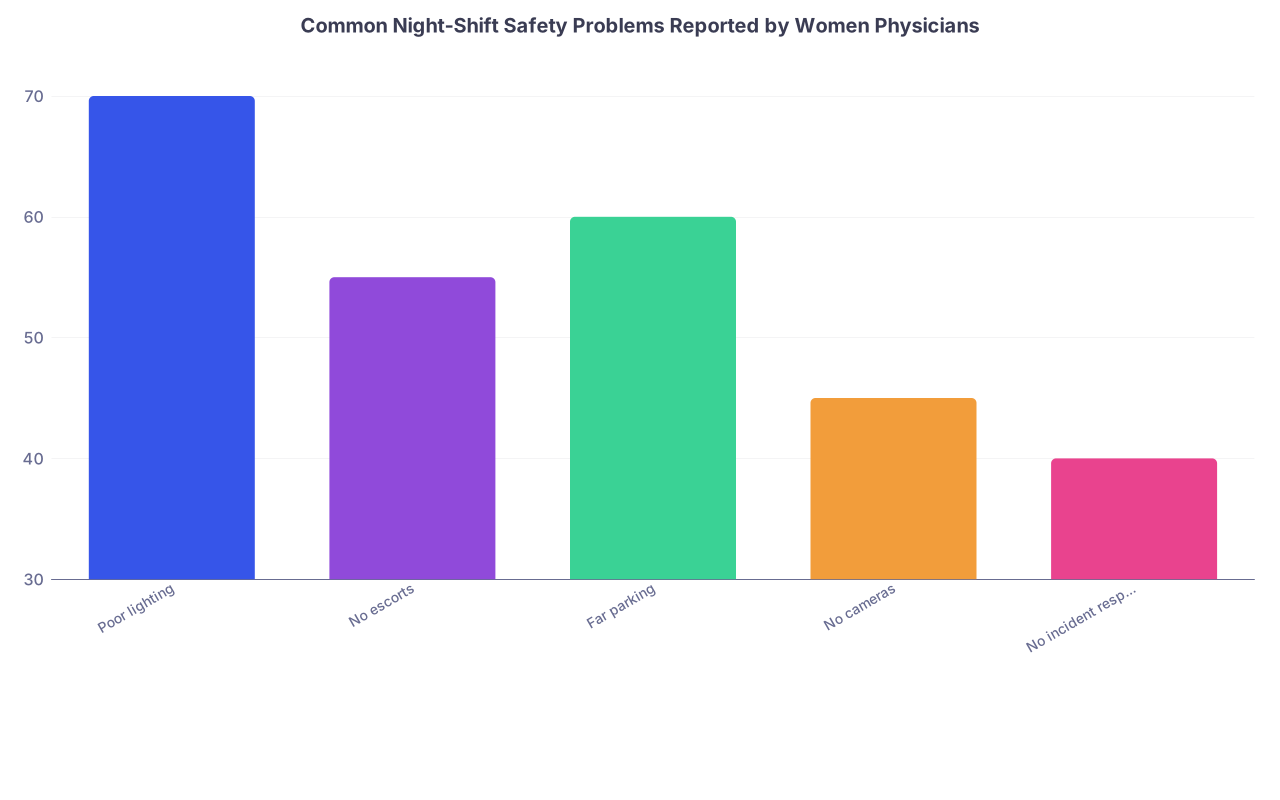
| Category | Value |
|---|---|
| Poor lighting | 70 |
| No escorts | 55 |
| Far parking | 60 |
| No cameras | 45 |
| No incident response | 40 |
Numbers like these are common in internal surveys. Here’s how you push back strategically.
Step 1: Document Specific Issues
Instead of vague “the garage feels unsafe,” track:
- Date, time, and location.
- What exactly happened (e.g., “Lights out on level 3,” “Door to stairwell propped open,” “Non-staff person sleeping near elevator,” “No security seen between 11 pm–1 am”).
- Who you reported it to, and when.
Patterns are harder for leadership to ignore than feelings.
Step 2: Find Allies
Do not do this solo if you can help it.
- Ask other women residents/attendings: “Are you comfortable leaving here at night?”
- Nursing staff and techs—especially those who work nights—often have horror stories. They will back you.
- Bring 3–5 names minimum when you raise concerns. You are not a “single anxious complainer”; you are representing a group of clinicians.
Step 3: Know What To Request
Be concrete. Suggestions that actually move the needle:
- Dedicated close-in parking for night-shift staff, especially women and smaller staff who might be easier targets.
- Mandatory escorts on request with a maximum response time.
- Improved lighting in all staff lots and garages.
- Badged access only to staff areas at night, including stairwells and back entrances.
- Regular security patrols of garage and walking routes during shift changes.
Put it in writing—email to program leadership, GME, and facility or security director. “These are specific changes that would materially improve safety for women leaving late shifts.”
Step 4: Use Medical Ethics If They Ignore You
You’re in the Personal Development and Medical Ethics lane? Here’s your angle:
- Physician and staff safety is an ethical issue. You cannot provide safe care if you’re at significant risk of harm on your way to and from work.
- Institutions have an ethical duty to create reasonably safe working environments, not just within the walls of patient care areas but including ingress and egress for staff.
- If women are disproportionately at risk and leadership ignores it, that’s a gender equity issue. Also ethics.
Frame your complaint as a patient safety and equity problem. Administration understands those words.
Mental Load: Managing Fear Without Becoming Numb or Hypervigilant
You’re tired of always having to think about this. You want to just walk to your car like your male co-resident does, headphones in, oblivious. I get it.
You have three bad options and one decent one.
Bad options:
- Ignore your fear, force yourself to “toughen up,” and hope you’re lucky.
- Spiral into constant hypervigilance that eats your mental health.
- Outsource your safety entirely to the system and then feel betrayed when it fails.
Better option:
- Build a clear, simple routine so you don’t have to think about it from scratch every night.
For example:
- Pack bag for easy carry before shift ends.
- Text “leaving now” to your person.
- Walk out via ED, scan lot, straight to car, in and out.
- If anything is off, call security. No debate. Just the rule.
Routine shrinks the cognitive burden. You’re not negotiating with yourself each time. You’re just running protocol.
Quick Reference Table: Night Shift Safety Moves That Actually Help
| Situation | Best Move |
|---|---|
| Leaving alone after midnight | Use brightest exit, call security if uneasy |
| Aggressive family still around | Ask staff to page security, wait inside |
| Being followed toward garage | Divert to staffed area, ask loudly for security |
| Garage feels deserted or dark | Don’t enter, call for escort or wait for coworkers |
| Long-term systemic problems | Document issues, gather allies, escalate in writing |
FAQ (Exactly 5 Questions)
1. Am I overreacting if I ask for a security escort every time I leave after 11 p.m.?
No. You’re responding to a predictable risk at a predictable time. If your hospital is understaffed on security to the point that routine escorts are “too much,” that’s their operational failure, not your character flaw. Use the service. If they complain, document it and escalate.
2. Is it unprofessional to say I don’t feel safe walking to my car with a specific colleague?
It’s not unprofessional. It’s boundary setting. You’re not obligated to accept help, especially if the helper is part of the problem. You can politely decline and lean on security or other staff. If the colleague pressures you, document and report the pattern as harassment or boundary violation.
3. Should I carry a weapon, like a knife or taser, leaving the hospital at night?
You should not carry anything you’re not trained, willing, and legally allowed to use. A poorly handled weapon can be taken from you and used against you. Focus first on awareness, environment (lighting, routes, escorts), and simple tools like alarms or legal pepper spray if you’re prepared. If you’re seriously considering a weapon, get proper training and check local laws.
4. How do I bring up safety issues without being labeled “difficult”?
You frame it as a shared, systemic issue, not a personal complaint. “Several of us have concerns about the garage lighting and escorts for night staff. Here’s a list of incidents and specific changes that would improve things.” Attach other names when possible. Professionals who care about safety are not “difficult”; they’re responsible. If leadership treats you otherwise, that’s a red flag about them, not you.
5. What if my program director dismisses my concerns and tells me to ‘be careful’ and move on?
Then you go around them. GME office, hospital safety committee, HR, or even your institution’s ombuds or Title IX office if there’s a gender component. Put it in writing: dates, what you brought up, what response you got. You’re not obligated to accept “just be careful” as the entire institutional safety plan.
Key points:
- Your safety walking out of the hospital at night is not negotiable and not “overreacting.”
- Use simple, repeatable behaviors: awareness, direct routes, allies, and security without apology.
- Don’t quietly absorb systemic failures—document, get allies, and push your institution to fix the infrastructure you’re forced to walk through every single shift.