
It’s 2:30 a.m. You’re in the call room after a brutal night. Your co-resident (or attending… or PA… or nurse you work with all the time) stops by. You’ve always gotten along. Joked. Venting partners. You’re both exhausted.
You’re scrolling through labs, and suddenly their hand is on your shoulder. Then your back. Then your waist. Maybe they move in for a hug you did not ask for. Maybe they corner you at the workstation and lean in too close. Maybe it’s a “jokey” back rub.
You freeze for half a second. You don’t want to “make it weird.” You’re thinking:
- Did that just happen?
- Am I overreacting?
- I still have to work with this person for the rest of the year.
- If I say something, is this going to blow up my career?
You’re not overreacting. And there actually is a way to handle this that protects your safety, your boundaries, and your future.
Let’s walk through what to do—step by step—depending on where you are in this mess.
Step 1: In the Moment – When It’s Happening Right Now
If you’re reading this before anything happens, good. Bank this language now. If you’re reading it after, still useful—you can use the same structure for your next interaction or your report.
First priority: Your immediate safety
You do not need to be “polite” when someone crosses your physical boundaries. Does that mean you have to scream at them in the team room? No. But you are absolutely entitled to get yourself out of the situation, fast.
You have three tools in the moment:
- Body movement
- Clear verbal statement
- Exit
Put them together like this.
If it’s unwanted touch that isn’t trapping you (hand on shoulder, lower back, “jokey” hug):
Move your body away. Step sideways, stand up, roll your chair back—anything that physically creates space.
Say something short and direct:
- “Please don’t touch me.”
- “Nope, I’m not okay with that.”
- “I don’t like being touched at work.”
Then go right back to work or leave:
- Turn back to the screen: “We need to finish admitting 402.”
- Or: “I’m going to check on my patient.” And walk out.
You’re not negotiating. You’re drawing a line.
If they’re blocking your exit or you feel trapped:
Here you prioritize getting out—words can be minimal.
Stand up if you’re sitting, with your chair between you.
Use a firm, louder tone:
- “Move, I’m leaving.”
- “I said no. Move.”
Walk out toward a more public space: nurses’ station, workroom with others, anywhere with people.
You are allowed to be blunt and even “rude” if you feel unsafe. I’ve seen women try to be nice about this and get stuck for longer than they needed. Do not manage their feelings; manage your safety.
If you’re too shocked to say anything
This happens all the time. Your brain goes offline, you half-laugh, you minimize in real time. Then it hits you like a truck on your drive home.
If that was you, don’t beat yourself up. Shock is a normal response. You still have options after.
Step 2: Immediately After – The First Hours
Once you’re out of the room and you can breathe, your next moves are about protecting both your memory and your future self.
1. Write it down. Immediately.
Not in the EMR. Not in your personal WhatsApp. Somewhere you control, that you can produce later if needed.
Include:
- Date and time (approximate is OK)
- Location (on-call room A, resident workroom, CT holding, etc.)
- Who was there (full name, role, level: “John Smith, PGY-3 surgery resident”)
- What they did, in concrete terms
- “He put his hand on my lower back and kept it there even when I moved away.”
- “She hugged me from behind while I was sitting charting and pressed her body into mine.”
- Your response (even if it was no response)
- Any witnesses or people nearby who might have seen/heard something
Do not soften the language in your own notes. Don’t write “maybe accidentally” if you know it wasn’t. Document like you’d document a bad fall: objective, detailed, no editorializing.
2. Capture any supporting evidence
If there’s anything else, secure it now:
- Texts from them later (“Sorry if I was too friendly earlier”)
- Messages to a friend you sent right after (“He just did X on call, I’m shaking”)
- Email to yourself with the description (time-stamped)
You’re not required to use any of this. But future you will be very mad at present you if you have to report this in six months and you’ve got nothing.
3. Do a quick gut-check: isolated weirdness vs pattern
One-off boundary crossing from someone who seems embarrassed when you rebuff them is one situation. Repeated comments, escalating touch, or drunk behavior at every call night event—that’s another.
You don’t need to fully decide anything yet. Just ask yourself honestly:
Was this surprising and out of character? Or has this been building?
The more “pattern,” the more urgent it is to loop in others.
Step 3: Decide Your Immediate Goal
You don’t have to decide your whole career strategy in one night. But you do need to be clear on your next move.
Your immediate goals could be:
- Stop it from ever happening again
- Get support so you don’t go insane holding this alone
- Make a formal report so there’s a record and potential consequences
- Get out of future one-on-one situations with this person
Different goals, slightly different paths. Let’s walk through them.
Step 4: Low-Conflict Boundary Reset (If You Feel Safe Doing It)
This is appropriate when:
- The behavior was boundary-crossing but not overtly predatory (e.g., overly familiar hug, hand on shoulder/back, lingering too close)
- You believe they might actually respond to direct feedback
- You’re not worried about retaliation from this person
You’re not obligated to do this. But some women choose it, especially if it’s a peer.
You pick a later time when you’re both calm, and say something like:
“About the other night on call—when you put your hand on my back / hugged me—I was not ok with that. I want our relationship at work to stay professional, so physical stuff like that can’t happen again.”
Then shut up. Let them respond.
If they say something like:
- “I’m so sorry, I didn’t realize. It won’t happen again.” and then they actually stop—fine. You still document this conversation in your private notes.
- If they minimize: “Relax, I was just being friendly,” you cut that off:
- “Friendly or not, it crossed a line for me. I’m serious—do not do it again.”
If they get angry or retaliatory even in that conversation, that’s data. You now move this out of “low-conflict” territory and toward formal support/reporting.
Step 5: When It’s More Serious – or You Don’t Feel Safe Talking to Them
If any of the following are true:
- They are your attending, PD, or someone who controls your evaluations
- There was clearly sexual intent (groping, forced hugging, pressing their body against you, kissing attempts)
- They ignored a “no” or a clear physical move away
- There’s a history of comments, texts, or other boundary-pushing
- You feel scared, trapped, or sick thinking about being alone with them again
You skip the solo feedback talk. You go to support and reporting pathways.
1. Identify your safe support person
You need at least one real human in the system who knows what happened.
Options (you don’t need all; you pick your best fit):
- A trusted co-resident (ideally senior)
- A chief resident you trust
- A faculty mentor not in the same direct chain as the offender
- A female attending who has been candid with you before
- GME office ombudsperson
- Title IX or institutional Office of Equity/Compliance
Your first conversation can be “informal” in your mind: “This happened. I’m not sure yet what I want to do, but I need to say it out loud and figure out my options.”
Be specific. Use real words, not euphemisms:
- Say “He put his hand on my thigh and didn’t move it when I shifted away,” not “He was kind of flirty.”
- Say “She hugged me from behind and pressed her chest into me,” not “She’s a little too touchy.”
2. Understand your reporting options
Most institutions will have at least these:
| Option | Typical Role / Use Case |
|---|---|
| Chief Resident | First-line support, schedule changes |
| Program Director | Formal response within department |
| GME Office | Institution-level trainee protection |
| Title IX / Compliance | Formal investigation of harassment |
| Anonymous hotline | Report patterns, start paper trail |
You can ask:
“I want to understand my options. What happens if I tell you this formally vs informally? What are the possible outcomes? Will he/she know I reported? How will my rotations or evaluations be protected?”
A good support person will walk you through likely scenarios, not just parrot policy.
Step 6: Protecting Yourself at Work While This Plays Out
This is the part most people don’t talk about when they say “You should report.” You still have to show up to work. You still have to take call.
Here’s the practical side.
1. Limit one-on-one time
You do not need to justify this to anyone.
- Ask the chiefs for schedule changes:
- “I’m having a personal issue with Dr. X and need to avoid one-on-one calls with him for now. I’ve spoken with [mentor/PD/GME] about this.”
- When you must work the same shift, station yourself near others: nurses’ desk, main workroom, reading room with other staff.
- Leave doors open. You don’t need to be dramatic; just don’t close yourself in with them.
If anyone pushes back on “why,” you can say: “It’s a professional boundary situation. I’ve addressed it with leadership.”
2. Prepare scripts for future interactions
You don’t want to be improvising at 3 a.m. again. Have go-to lines:
If they try to touch you again (even lightly):
- “Do not touch me.”
- “We’ve already talked about this. Back up.”
If they act like nothing happened and try to chat casually:
- “I’m keeping things strictly professional between us from now on.”
- “I’m not comfortable with informal conversations. Let’s keep it work-only.”
If they hint you’re “overreacting”:
- “My boundaries are not negotiable.”
- “You crossed a line. I’m done discussing whether that was ‘a big deal.’”
You’ll probably feel harsh saying this. That’s because women get trained to pad everything in apology and soft language. Ignore that reflex. You’re not in a social setting. You’re at your job.
3. Keep documenting
Every interaction that feels off goes in your private log:
- Date, time, place
- What was said/done
- Who was nearby
If you eventually file a formal complaint, this pattern matters. One “incident” gets dismissed a lot. Ten documented moments tell a different story.
Step 7: Formal Reporting – When and How to Pull That Trigger
I’m blunt about this: Formal reporting is emotionally brutal, often slow, and not magically protective. But sometimes it’s absolutely the right—and only—move.
It’s most clearly necessary when:
- There was clear sexual assault (e.g., forced kissing, groping of breasts/genitals, pinning you down)
- They’ve done this or similar things to others (you’re hearing stories)
- They have significant power over trainees and are using it
- Your own career is being threatened (“If you tell anyone…”, bad evals out of nowhere, being pulled from cases)
Where to start
If you’re in training:
- Consider talking to GME or Title IX before going to your PD if the PD is close with the offender.
- You can say: “I need to report sexual harassment/assault from a colleague. I’m worried about retaliation and my evaluations. I want to understand your process and protections before I formally file.”
Expect:
- A written or recorded statement
- Questions about prior incidents, witnesses, documentation
- Possible interim measures: no-contact orders, schedule changes, different supervision structures
You should ask directly:
- “How will you protect me from retaliation on evaluations and recommendations?”
- “What happens if he/she denies everything?”
- “How long do these investigations usually take?”
Retaliation – and how to spot it
Retaliation can be blatant (threats, yelling) or quiet:
- Sudden negative evals after years of solid feedback
- Being excluded from teaching cases / opportunities
- Being labeled “difficult” or “not a team player”
If you’ve filed a report, you document this too and flag it to GME/Title IX:
“I reported harassment by Dr. X on [date]. Since then: [list what’s happened]. This feels like retaliation.”
Hospitals are much more legally nervous about retaliation claims than about the initial harassment. Use that.
Step 8: Emotional Fallout – You’re Not a Robot
Does this affect your trust at work? Yes. Your sleep? Probably. Your confidence? Almost certainly.
No, you’re not “weak” for being shaken by this. You’re a human being whose body was put in a situation it did not consent to, in a place where you are supposed to be able to focus on saving lives, not defending your own boundaries.
Minimum support you should line up:
- One person in the hospital system you trust who gets it (not the “he didn’t mean it, he’s just awkward” crowd)
- One person outside medicine (friend/partner/family) who can remind you your whole value is not tied to this job
- If you can access it, therapy—ideally someone familiar with workplace harassment / medical culture. You don’t need to be “falling apart” to justify this. Think of it like PT after an injury: you treat before you limp permanently.
If you’re noticing:
- Panic when assigned to the same shift
- Avoiding certain parts of the hospital
- Dissociation, intrusive memories, or feeling physically ill when you see them
That’s not you being dramatic. That’s your nervous system reacting to a real violation. Get help early; it does not get “fixed” just by ignoring it.
Step 9: If You’re Watching This Happen to Someone Else
You might not be the one being touched. You might be the person in the neighboring workstation hearing the “jokes,” seeing the hand linger a little too long.
If you care about women in medicine, this is where you prove it.
In the moment, you can:
- Interrupt physically: Walk over and join the conversation, pull them away: “Hey, can you help me with this admission?”
- Name what you see if you’ve got the power to:
- To the offender (attending to attending, resident to co-resident): “Knock it off, that’s not appropriate.”
After, you can:
- Check in privately with the person targeted:
- “I saw what happened with Dr. X. Are you okay? That did not look professional to me.”
- Offer to be a witness if they ever decide to report:
- “If you choose to tell someone, you can put my name down. I saw/heard it.”
Do not decide for them that “it’s not a big deal.” Your job is to support, not to minimize.
Step 10: Long Game – Rebuilding Your Sense of Safety and Power
You’re in medicine. You signed up for hard calls, dying patients, moral distress. You did not sign up for colleagues who can’t keep their hands to themselves.
Over the long run, you want three things:
Clear internal boundaries
You know what’s okay for you and what’s not. You stop explaining or apologizing for those lines.External skills to enforce them
You have language ready. You’ve practiced it enough that you can say “Do not touch me” without your voice shaking. (It will shake at first. That’s fine. Say it anyway.)A professional network that doesn’t tolerate this garbage
You slowly identify: Who are the people who “get it,” who intervene, who support? Those people become your mentors, collaborators, friends. The others fade out of your circle.
And quietly, here’s something I’ve seen over and over: The women who learn to hold firm boundaries early in training end up being the ones their students and juniors run to years later when they need help. You will not only be protecting yourself; you’ll be changing the culture for the people coming up behind you.
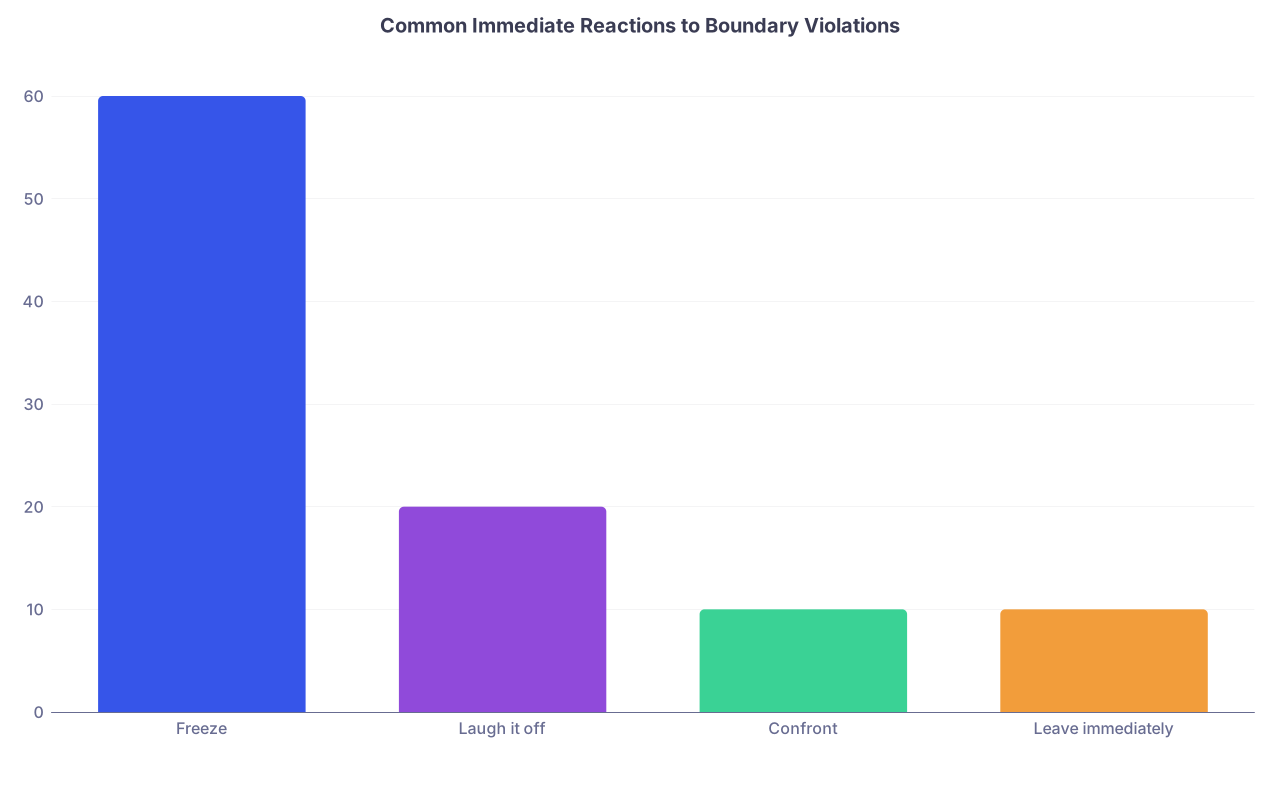
| Category | Value |
|---|---|
| Freeze | 60 |
| Laugh it off | 20 |
| Confront | 10 |
| Leave immediately | 10 |

| Step | Description |
|---|---|
| Step 1 | Boundary crossed on call |
| Step 2 | Get to safety |
| Step 3 | Document incident |
| Step 4 | Consider direct feedback |
| Step 5 | Seek support person |
| Step 6 | Formal report |
| Step 7 | Monitor and document |
| Step 8 | Level of threat |
| Step 9 | Need protection or pattern? |

Key Takeaways
- You are allowed to have firm physical boundaries at work. “Please don’t touch me” is a complete sentence, even at 3 a.m. on call.
- Document everything, get at least one trusted support person, and do not dismiss your own discomfort as “overreacting.”
- Formal reporting is hard but sometimes necessary, and you’re not obligated to handle this alone or to sacrifice your safety to protect someone else’s comfort or reputation.