
It is July 1st. New academic year.
You just received your faculty renewal letter, and it hits you: you have no real five‑year plan. Promotion criteria feel vague. Mentorship is… inconsistent. You are pulled in twelve directions—clinical duties, teaching, research, maybe kids, maybe aging parents—and somehow you are also supposed to “build your brand,” “advance DEI,” and “avoid burnout.”
This is where a five‑year career grid stops being a nice idea and becomes survival.
I am going to walk you through a structured, time‑bound, unapologetically practical five‑year plan designed for women in academic medicine. Month by month in Year 1. Then year by year for Years 2–5. With explicit checkpoints for:
- Promotion (and avoiding the “stuck associate” trap)
- Scholarship you actually can produce
- Leadership that is strategic, not just thankless committee work
- Pay, recognition, and boundaries
- Ethics: staying aligned with your values in a system that often is not
Think of this as the skeleton. You will fill in the organs, muscle, and bruises.
Step 0: Build Your Five‑Year Grid (Week 1–2)
Before any timeline, you need the actual grid. One page. Visible.
Set up a simple 5×5 grid: years across the top, domains down the left.
| Domain / Year | Year 1 | Year 2 | Year 3 | Year 4 | Year 5 |
|---|---|---|---|---|---|
| Clinical | |||||
| Teaching / Education | |||||
| Research / Scholarship | |||||
| Leadership / Service | |||||
| Personal / Ethics |
At this point you should:
Pick your clock
- Are you on a 5–7 year promotion clock from assistant to associate? Or already associate eyeing full?
- Write your expected promotion review year at the top of the grid. If you do not know it, that is your first problem.
Choose your priority domains (top 2)
Most women in academic medicine try to be “strong in all areas” and end up exhausted and mediocre in all. Pick two primary pillars:- Clinician‑educator
- Clinician‑investigator
- Education leader
- Quality / safety / operations leader If everything is “top priority,” nothing is.
Define your five‑year endpoint (20 minutes, not days)
Be specific:- “Promoted to Associate Professor on clinician‑educator track.”
- “Section chief for X.”
- “NIH K award funded and running my own research line.”
- “0.8 FTE, with protected day for writing, no weekend call.”
Write one sentence in the Year 5 column of each domain. Rough, not perfect.
Year 1: Assessment, Alignment, and Saying No (Quarter by Quarter)
Your first year is not about doing more. It is about aim.
Quarter 1 (Months 1–3): Information and Reality Check
At this point you should stop guessing and get data.
Month 1: Promotion and track clarity
- Download your institution’s promotion guidelines. Highlight:
- Required number and type of publications
- Teaching expectations (evaluations, roles)
- “Excellence” vs “strength” criteria in your track
- Meet with:
- Your division chief or chair
- Your assigned (or chosen) mentor
And ask directly: - “If I keep doing what I am doing, where will I be in 5 years?”
- “What track and promotion timeline do you realistically see for me?”
Take notes. People will reveal their expectations and their biases.
Month 2: Time and workload audit
For four weeks, track your time. Honestly. Include:
- Clinical hours (scheduled vs actual)
- Teaching (prep + delivery)
- Admin and email
- Research / writing
- Home / caregiving spillover
Then categorize:
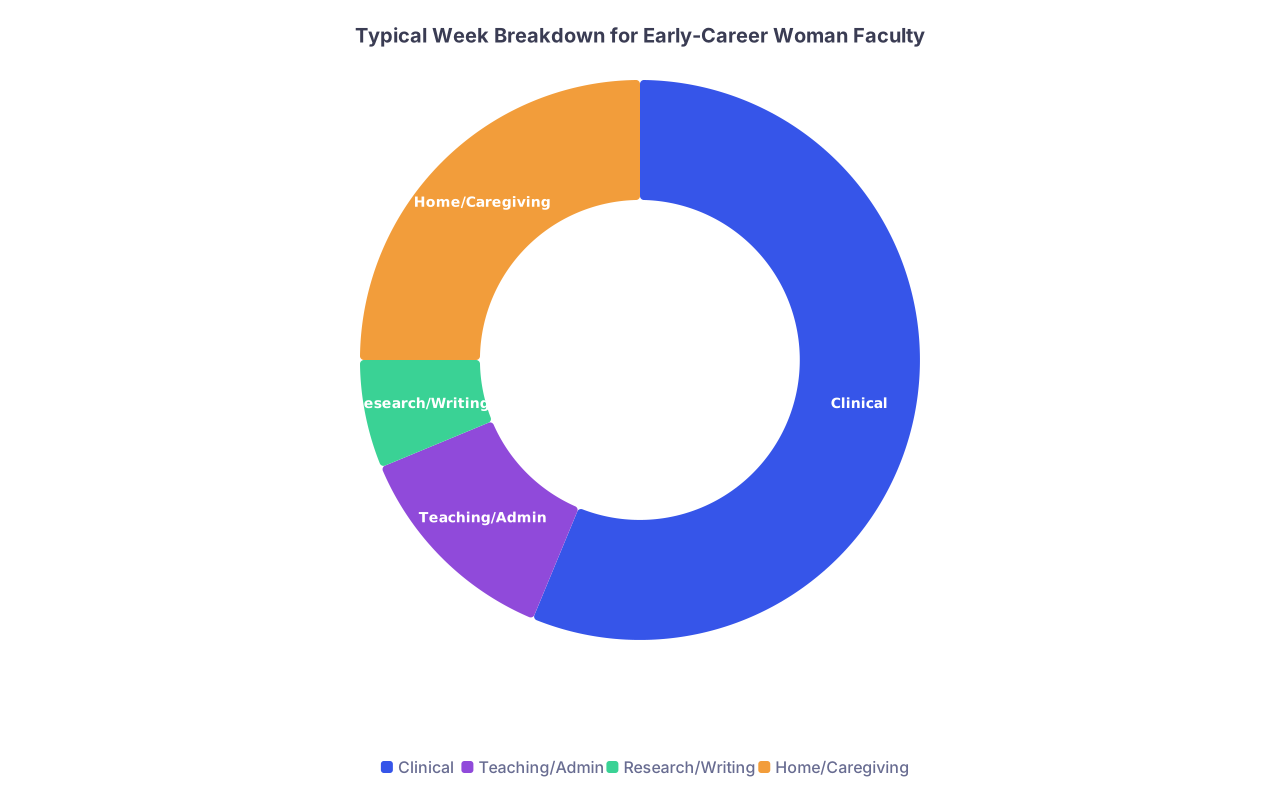
| Category | Value |
|---|---|
| Clinical | 45 |
| Teaching/Admin | 10 |
| Research/Writing | 5 |
| Home/Caregiving | 20 |
If your research time is under 20% but your promotion track assumes “productive scholarship,” that is a mismatch. Not your failure. A structural problem to fix.
Month 3: Boundaries and non‑promotable work
Women in academic medicine get buried in non‑promotable tasks: “Can you just chair this wellness task force?” “Can you coordinate this student elective?” It sounds flattering. It is career‑killing if unchecked.
At this point you should:
- List every committee, task force, side role
- Mark each as:
- P = promotable (directly counts toward promotion metrics)
- NP = non‑promotable
- Decide one NP role to exit this year. Yes, one. You are not that irreplaceable.
Script for stepping down:
“I have reviewed my promotion plan and need to align my activities with my track. I am stepping down from [role] at the end of this term so I can focus on [X], which is part of my agreed‑upon goals with my chair.”
Use it. You will not be the first.
Quarter 2 (Months 4–6): Design Your Scholarly and Teaching Niche
You cannot be “interested in everything.” Pick a lane.
Month 4: Define your academic niche
Examples:
- “Simulation‑based resident education in OB emergencies.”
- “Outcomes of telehealth in rural oncology.”
- “Implementation of quality measures in sepsis care.”
One sentence. Clinical + scholarly angle. Put it at the top of your grid.
Month 5: Build a minimum viable scholarship plan
At this point you should sketch a 3‑year scholarship arc:
- Year 1–2: 2–3 first‑ or senior‑author papers in your niche
- Year 3–4: One institutional or foundation grant; multi‑site collaboration
- Year 5: Larger grant or recognized expertise (invited talks, guideline committee)
Block one half‑day per week for writing / analysis. Guard it like an OR block.
Month 6: Teaching with receipts
Teaching “a lot” is useless without documentation.
- Ensure you have:
- Scheduled teaching roles that occur every year
- Mechanism for written evaluations (residents, students)
- One or two visible education projects (curriculum design, OSCE, course directorship)
Start a “teaching evidence” folder: PDF evaluations, syllabi, emails praising your teaching. You will not remember later.
Quarter 3 (Months 7–9): Mentorship, Sponsorship, and Money
Month 7: Build your mentorship constellation
At this point you should stop relying on a single “assigned mentor.”
You need:
- 1 content mentor (your niche area)
- 1 career / promotion mentor (knows the politics)
- 1 peer mentor (same level, reality check)
- 1 sponsor (senior person who says your name in rooms you are not in)
Have explicit meetings. Say: “I am building a five‑year plan and would like to meet twice a year to review progress. Is that feasible for you?”
If they waffle, they are not your mentor. Move on.
Month 8: Pay transparency and equity check
Women are underpaid in academic medicine. Consistently.
At this point you should:
- Quietly collect data:
- Department salary ranges
- RVU targets and bonuses
- Protected time norms for people like you
- Compare:
- Are you doing more clinical for the same (or less) pay?
- Did your male colleagues get start‑up packages you did not?
If the gap is clear, you bring it up during your annual review with data and your five‑year plan in hand.
Month 9: Ethics and non‑negotiables
Write down:
- Your top 3 professional values. Examples:
- Intellectual honesty
- Equity in patient care
- Presence for your family
- Your 2–3 non‑negotiables:
- “I will not work more than X weekends per year.”
- “I will not sign my name on data I did not see myself.”
- “I will not accept leadership roles without written protected time.”
These become filters for opportunities that will appear in Years 2–5.
Quarter 4 (Months 10–12): Concrete Deliverables
By the end of Year 1 you should have outputs, not just plans.
At this point you should:
- Submit at least:
- 1–2 manuscripts (case series, curriculum description, QI project)
- 1 abstract to a national meeting in your niche
- Document:
- All teaching with evaluations and titles
- All committees and roles (with dates)
- Conduct:
- A formal “Year 1 review” with your career mentor:
- Pull up your grid
- Mark what was completed
- Adjust Year 2 goals based on reality, not fantasy
- A formal “Year 1 review” with your career mentor:
Years 2–3: Execution, Visibility, and Strategic Leadership
Now we zoom out from month‑by‑month to annual priorities. You have the foundation. Years 2–3 are for building recognizable value.
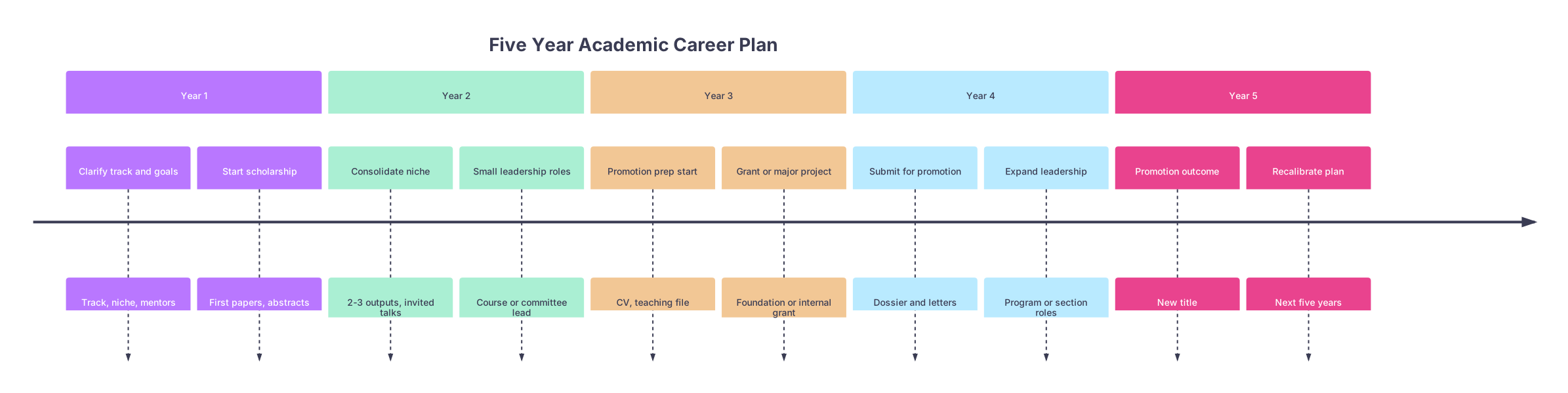
| Period | Event |
|---|---|
| Year 1 - Clarify track and goals | Track, niche, mentors |
| Year 1 - Start scholarship | First papers, abstracts |
| Year 2 - Consolidate niche | 2-3 outputs, invited talks |
| Year 2 - Small leadership roles | Course or committee lead |
| Year 3 - Promotion prep start | CV, teaching file |
| Year 3 - Grant or major project | Foundation or internal grant |
| Year 4 - Submit for promotion | Dossier and letters |
| Year 4 - Expand leadership | Program or section roles |
| Year 5 - Promotion outcome | New title |
| Year 5 - Recalibrate plan | Next five years |
Year 2: Consolidation and Saying a Better “Yes”
At this point you should start filtering invitations against your grid.
Clinical
- Align your clinical portfolio with your niche:
- If your niche is geriatric oncology, stop taking extra random ED shifts that do not support that.
- Negotiate:
- Slightly less clinical in exchange for measurable scholarly output.
Put this explicitly in your annual goals with your chief.
- Slightly less clinical in exchange for measurable scholarly output.
Teaching
- Aim to:
- Secure 1 stable teaching role with a title (e.g., “Associate Program Director,” “Clerkship Site Director,” “Simulation Director”)
- Start 1 education project you can publish:
- New curriculum with pre–post data
- Simulation module with evaluation data
Research / Scholarship
Target for Year 2:
- Total of 3–5 peer‑reviewed products in your niche (over Years 1–2)
- At least one as first or senior author
- Submit 1 small grant:
- Internal pilot funding
- Foundation grant
- Society grant
Do not chase 5 different topics. That CV reads scattered. Commit to your niche.
Leadership / Service
You want visible, not random.
Take on:
- 1–2 leadership roles that:
- Are on your promotion CV template as leadership
- Give you face time with decision‑makers
- Align with your values (e.g., DEI committee in your department, not six hospital‑wide task forces that meet at 7 p.m.)
And say no to the rest.
Year 3: Promotion Prep Starts Earlier Than You Think
Year 3 is not early. It is when you avoid the “surprised at review” disaster.
Mid‑Year 3: Mock promotion review
At this point you should:
- Pull the promotion checklist from your institution
- Build:
- An updated CV in institutional format
- A draft teaching portfolio:
- Teaching philosophy (1–2 pages)
- Evidence (evaluations, roles, awards)
- A brief personal statement about your niche and trajectory
Ask your career mentor or a former promotions committee member to do a mock review and answer bluntly:
- “If I came up in 2 years, would I be ready?”
- “Where are my obvious holes?”
Expect to hear things like:
- “You need more first‑author work.”
- “You have done a lot of teaching but little leadership in education.”
- “Your roles are impressive but undocumented.”
Good. Now you know.
Research / Grants
Year 3 is when you:
- Either:
- Submit a serious grant (K award, R03, major foundation), or
- Cement your status as a clinician‑educator or QI leader with:
- Multi‑institution projects
- National presentations
- Co‑authorship on consensus statements or guidelines
Do not try to become an NIH‑funded PI and an associate program director and a service line chief unless you have superhuman bandwidth and support. Pick.
Visibility
You should have by now:
- 1–2 invited talks outside your home institution in your niche
- Network with 3–5 peers at other places doing similar work
If not, ask your sponsor directly:
“Where can you suggest I present this work nationally? Would you be willing to connect me with X?”
Years 4–5: Promotion, Power, and Protection
Here is where women often get stuck: doing a ton of work but not converting it into promotion, pay, or power. Years 4–5 are about that conversion.
Year 4: Formal Promotion Submission and Protective Negotiation
Early Year 4: Decide on your promotion year
At this point you should sit down with your chair and ask:
- “Assuming continued productivity, is Year 5 the right year for my promotion dossier?”
If they hesitate without concrete reasons, push for specifics:
- “What exact metrics are missing and by when would I need them?”
Document this conversation in an email summary.
Mid Year 4: Build the dossier
You will need:
- CV in perfect institutional format
- Teaching portfolio with:
- Clear statement of your education philosophy
- Documented roles, learner levels, contact hours
- Selected evaluations and outcomes data
- Personal statement:
- Your niche, impact, and future direction
- Evidence of:
- Leadership roles
- Service contributions (department, school, profession)
- National / regional reputation (talks, committees, societies)
Start early. This is not a one‑week project.
Leadership and ethics
Year 4 is when people start offering you bigger things:
- Fellowship director
- Section chief
- Vice chair of something
At this point you should apply the “Three Ps” test before you accept:

- Power – Will this role give you decision‑making authority, or just more work?
- Protection – Is there written protected time, admin support, and recognition in promotion criteria?
- Pay – Is there salary or bonus attached, or is it “for the good of the department”?
If a role fails all three, decline. That is not you being difficult. That is you refusing to subsidize the system with your unpaid labor.
Year 5: Outcome and Reset
By Year 5, one of two things is happening:
- You are submitting or have submitted your promotion dossier.
- You have identified a structural mismatch and are considering a pivot (different track, different institution, or out of academia).
Early Year 5: Final polish and external reputation
At this point you should:
- Ensure:
- 1–2 new publications since your dossier prep started
- Continued teaching and leadership activity (no sudden gaps)
- Secure:
- Strong external letters (your department should help, but you can suggest names—people who genuinely know your work)
Your national reputation does not need to be superstar level, but it does need to exist. Society committees, conference workshops, guideline working groups—these count.
Mid to Late Year 5: Decision point and recalibration
Once promotion results arrive (or your path becomes clear), do a brutal, honest review.
Ask yourself:
- Did this environment support my growth or fight it?
- Were my boundaries respected or constantly tested?
- Did my five‑year outcomes match the effort I put in?
If the answer is consistently “no,” your next five‑year grid may involve:
- Switching departments or institutions
- Moving to a different track (e.g., pure clinician‑educator vs research‑heavy)
- Negotiating a different FTE split (e.g., 0.7 clinical / 0.3 admin)
- Or leaving academic medicine. Which is not failure. Sometimes it is the most ethical choice you can make for yourself.
A Sample Filled‑In Five‑Year Grid (Clinician‑Educator Path)
To make this concrete, here is what a realistic grid might look like for a woman hospitalist aiming for Associate Professor as a clinician‑educator in 5 years.
| Domain / Year | Year 1 | Year 2 | Year 3 | Year 4 | Year 5 |
|---|---|---|---|---|---|
| Clinical | 0.8 FTE, hospitalist shifts | 0.7 FTE, add dedicated teaching weeks | 0.7 FTE, mentor junior hospitalists | 0.6 FTE, protected admin time | 0.6 FTE, stable schedule aligned with roles |
| Teaching / Education | Regular ward teaching, eval collection | Co-direct resident inpatient rotation | Associate Program Director | APD plus lead new simulation curriculum | Recognized education leader, institutional award |
| Research / Scholarship | 1–2 education/QI papers, 1 abstract | 2 more papers, national meeting workshop | Internal education grant, multi-site project | Publish grant outcomes, invited talks | Education portfolio strong for promotion |
| Leadership / Service | One department committee (aligned niche) | Lead small QI committee | Chair education subcommittee | Program-level leadership role | Consider associate program director or equivalent |
| Personal / Ethics | Define values, drop 1 non-promotable task | Solidify no-weekend rule, regular therapy | Attend women-in-medicine leadership course | Negotiate fair pay and written protected time | Decide next 5-year plan with boundaries intact |
Ethics Threaded Through the Five Years
I want to call this out explicitly. Career planning for women in academic medicine without an ethics lens is incomplete.
Across the five years, you should keep circling back to three ethical questions:
- Self‑respect – Are you treating your own time, body, and mind as worth protecting? Or are you sacrificing yourself for an institution that would replace you in a month?
- Equity – Are you reinforcing inequities (gender, race, disability, socioeconomic) in how you allocate your talent, or are you intentionally bending some of your work toward justice?
- Integrity – Are you taking on roles and projects you can stand behind, or are you slapping your name on things for promotion points?
Your five‑year grid is not purely a productivity tool. It is a shield. It lets you say:
- “This opportunity is great, but it does not fit my five‑year plan.”
- “That expectation is inconsistent with my agreed‑upon track.”
- “No, I will not take on unpaid labor under the guise of ‘team player.’”
Your Next Step Today
Do not go buy another notebook or read three more articles.
Open a blank document or grab a sheet of paper and:
- Draw the 5×5 grid
- Label the rows: Clinical, Teaching, Research, Leadership, Personal/Ethics
- Label the columns: Year 1–Year 5
- In the Year 5 column, write one specific outcome for each row
Then schedule a 30‑minute meeting with your most trusted mentor and send them your rough grid in advance. Subject line: “Five‑year plan draft—need a reality check.”
That is how this stops being theory and becomes your actual career.