
The worst mistake a woman doctor in a toxic workplace can make is leaving without a plan. Not staying. Leaving chaotically.
This is your exit strategy timeline. Stepwise. Ordered. Ruthless.
You are not just quitting a job. You are protecting your license, your money, your reputation, and your sanity. At each point, you will have specific tasks—no vague “self‑care,” no airy “know your worth.” Concrete moves.
Big Picture: Your 6–12 Month Exit Horizon
Before we zoom into months and weeks, you need the frame.
If your workplace is:
- Gaslighting you about patient safety.
- Undermining your authority in front of patients.
- Overloading you with RVUs or call that others do not carry.
- Retaliating when you speak up.
…then you are already on the exit timeline. Whether you admit it or not.
Ideal timeline: 6–12 months from decision to final day.
Less than 3 months is possible, but it is a controlled skid, not a smooth landing. More than 18 months in a known toxic environment is usually procrastination disguised as “loyalty” or “I owe my patients.”
Here is how the time breaks down at a high level:
| Phase | Timeframe | Primary Focus |
|---|---|---|
| Phase 1 | Month 0–1 | Assessment, documentation, quiet prep |
| Phase 2 | Month 1–3 | Financial + legal positioning |
| Phase 3 | Month 2–6 | Job search + reputation protection |
| Phase 4 | Month 4–8 | Offer negotiation + resignation plan |
| Phase 5 | Final 4–6 weeks | Handover, boundaries, clean exit |
Now we go granular.
Month 0–1: Silent Assessment and Evidence Gathering
At this point you should stop calling this “a rough patch.” You are running a structured assessment.
Week 1: Name the Problem and Protect Your Headspace
Day 1–3:
- Write down exactly what is toxic.
Not “bad culture.” Specifics:- Example: “Supervisor told me in front of patient, ‘You’re too emotional to manage this case.’”
- Example: “Given 18 patients in half‑day when male peers have 10–12.”
- Separate:
- Uncomfortable but normal training stress.
- Truly unsafe, discriminatory, or abusive patterns.
Day 3–7:
- Start a private log on a personal device (not on the hospital computer, not email):
- Date, time.
- Who was present.
- What was said or done.
- Objective impact (patient safety issue, extra hours, pay discrepancy, etc.).
- Take photos/scans (on your personal device) of:
- Your contract and all amendments.
- Compensation statements / RVU reports.
- Any written feedback or emails that feel off.
You are not being paranoid. You are building the record you will wish you had if this escalates.
Week 2: Contract + Policy Recon
At this point you should know what you signed.
Read your contract start to finish:
- Notice period (30, 60, 90, 120 days?).
- Restrictive covenants:
- Non‑compete: radius, duration, scope (e.g., outpatient only? all practice?).
- Non‑solicitation: can you contact former patients? Staff?
- Tail coverage:
- Who pays for malpractice tail if you leave voluntarily vs terminated.
- “For cause” vs “without cause” termination:
- How can they fire you.
- How you can leave.
Pull organizational policies:
- Harassment / discrimination.
- Grievance or reporting process.
- Professional conduct / disruptive physician policy (yes, the one often used against women who speak up).
Do not start complaining formally yet. First you need position, not just emotion.
Week 3–4: Reality Check with Trusted Outsiders
At this point you should test whether the problem is them or “just medicine.”
- Quietly talk to:
- One trusted colleague not in your direct supervisory chain.
- One mentor outside your institution.
- If possible, another woman physician in your specialty who has left a bad job before.
Ask directly:
- “If I described this to a lawyer, would it sound like normal friction or harassment/retaliation?”
- “What happened to people who left here before me?”
You are looking for patterns:
- Are women / URiM physicians treated differently?
- Do they attack people who resign?
- Do they threaten references?
By the end of Month 1 you should have:
- A running evidence log.
- A clear understanding of your contract.
- A rough decision: stay and fight vs leave with precision. This article assumes you are leaving.
Month 1–3: Positioning Your Finances and Legal Risk
Toxic workplaces weaponize two things against doctors: fear for your license and fear you cannot afford to leave. You will blunt both.
Month 1 (Late) – Month 2: Financial Buffer and Exit Budget
At this point you should know how long you can go without a paycheck. Not guess. Know.
Map your baseline:
- Pull 3 months of bank / credit card statements.
- Calculate:
- Fixed costs (mortgage/rent, student loans, childcare, car, insurance).
- Variable but critical (food, gas, basic utilities).
- Ignore lifestyle extras for now.
Build a bare‑bones monthly number:
- Example: $8,000 / month all‑in.
- Target 3–6 months of runway if possible.
Adjust in real time:
- Pause aggressive loan paydown temporarily.
- Cut obvious luxuries for 3–6 months. You are buying freedom.
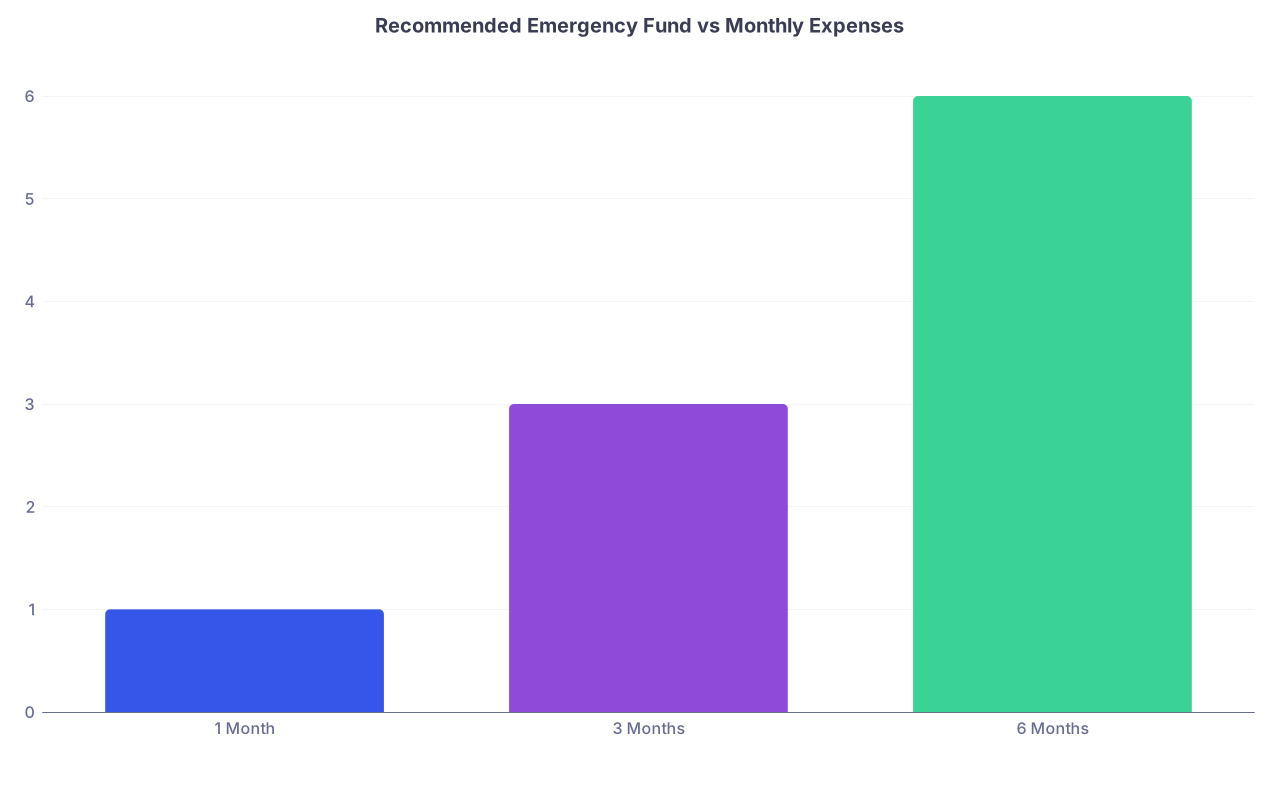
| Category | Value |
|---|---|
| 1 Month | 1 |
| 3 Months | 3 |
| 6 Months | 6 |
If you already have 3–6 months in cash equivalents, you are ahead. If not, start:
- Moving any bonuses or extra shifts into a separate “Exit Fund.”
- Planning to stay at least until you hit a minimal buffer (e.g., 2–3 months), unless the situation is acutely unsafe.
Month 2: Legal Triage
At this point you should understand your legal exposure and your leverage.
- Quietly schedule a 30–60 minute consult with:
- An employment lawyer with health care / physician contract experience.
- Bring:
- Your contract.
- Any policy documents.
- A summary (1–2 pages) of your issues and the worst incidents.
Ask them:
- “If I resign ‘without cause’ tomorrow, what are my risks?”
- “How enforceable is this non‑compete in our state?”
- “What documentation should I keep if they try to claim I am a ‘disruptive physician’?”
- “Should I report anything to internal compliance or outside bodies now, later, or never?”
You are not threatening litigation. You are mapping the battlefield.
Month 2–6: Job Search, Network, and Reputation Guard
If you wait to start your job search until you give notice, you have already lost leverage. At this point you should be quietly building your next step while still employed.
Month 2: Clarify What You Refuse to Repeat
Write two short lists:
Non‑negotiables for the next job:
- Protected time for documentation.
- Reasonable patient load caps.
- Transparent pay structure.
- Clearly defined reporting structure (so you are not supervised by the same type of person who abused you before).
Red flags you ignored last time:
- No women in leadership.
- Everyone “just left” and you are the replacement.
- Vague answers about workload: “We all just pitch in.”
Those become your filter for every conversation.
Month 2–3: Update Your Professional Story
At this point you should be visible as a strong physician, not “the one trying to escape a dumpster fire.”
Update:
- CV (clean, accomplishment‑focused, not trauma‑focused).
- LinkedIn profile.
- Any professional bios.
Start low‑risk networking:
- Conferences (even local).
- Specialty listservs.
- Alumni networks.
- Physician‑only groups with job postings.
Prepare your story now:
- “I am looking for a practice that aligns better with my values: safe staffing ratios, collaborative culture, and room for growth in X area.”
Not:
- “My current place is toxic.”
You can be honest later with trusted people. Job interviews are not the place for full catharsis.
Month 3–5: Applications and Interviews While Still Employed
At this point you should be actively exploring options, not waiting for the perfect unicorn.
Send targeted applications:
- Prioritize roles that:
- Fit your non‑negotiables.
- Are geographically and non‑compete compatible.
- Apply more broadly than your pride prefers. Options equal power.
- Prioritize roles that:
During interviews, test for toxicity:
- Ask:
- “Tell me about a time a physician raised concerns about safety. How was it handled?”
- “What is your turnover in the last 2–3 years for my specialty?”
- “How do you support physicians who are parents / caregivers?”
- Watch:
- Do they talk over the women in the room?
- Do they joke about “resilience” or “thick skin” when you bring up culture?
- Ask:

Plan for reference issues:
- Identify safe references:
- Prior attendings.
- Faculty from training.
- Colleagues who respect you but are not drinking the current Kool‑Aid.
- Avoid:
- Toxic supervisors as primary references unless absolutely unavoidable.
- If a prospective employer insists on your current supervisor:
- Time this for late in the process, close to offer.
- Coordinate with your lawyer if you expect retaliation.
Month 4–8: Offers, Negotiation, and Exit Mechanics
Once one or more offers are in motion, the timeline shifts. You move from “survival and search” to “precision exit.”
Month 4–6: Evaluate and Negotiate Offers
At this point you should approach each offer like a contract, not like a lifeboat. Desperation leads to new toxicity.
Compare offers on:
- Clinical load (patients/day, call expectations).
- Support (APPs, scribes, MA ratios).
- Compensation structure (RVU, salary, hybrid).
- Culture proxies:
- Percentage women in leadership.
- Retention of junior attendings.
- Known reputation in your specialty community.
Negotiate:
- Non‑compete scope and radius.
- Tail coverage—push for employer‑paid.
- Clear language around schedule and duties.
- Any “citizenship” duties (committees, teaching) spelled out.
If you can, sync the start date to:
- Give you enough notice time for your current contract.
- Allow for 2–4 weeks off in between for decompression.
Month 5–7: Finalize Start Date and Plan Resignation
At this point you should align three clocks:
- Current contract notice period.
- New job start date.
- Your financial runway.
Example:
- Current contract: 90‑day notice.
- New job: can start in ~120 days.
- You decide:
- Give notice 4 months before start.
- Use unused PTO strategically.
- Build a 1–2 week buffer between jobs.
Talk to your lawyer before you resign:
- Review the exact wording of your resignation letter.
- Confirm:
- You are complying with notice requirements.
- You are not accidentally admitting fault.
- You know how to discuss restrictive covenants if asked.
Final 4–6 Weeks: Resignation, Handover, and Clean Exit
This is where toxic workplaces often show their teeth. At this point you should act boringly professional and clinically excellent. No extra drama for them to weaponize.
Step 1: Formal Resignation (Day 0 of the Final Phase)
- Send a short, neutral resignation letter/email to:
- Your immediate supervisor.
- HR as required by policy.
- Example structure:
- Statement of resignation.
- Effective last day (per contract).
- Appreciation for professional opportunities (optional, minimal).
- Offer to assist with transition (vague, not over‑promising).
Do not:
- Detail all the toxic events.
- Threaten legal action in the letter.
- “Tell them off.” That is for private therapy, not official documents.
If you are reporting misconduct or safety issues, coordinate:
- Separate communication to compliance / legal (possibly already done earlier).
- Keep this distinct from your resignation letter.
Step 2: Tighten Professionalism and Documentation (Weeks 1–3 after notice)
At this point you are under the microscope.
Clinical work:
- Double‑check documentation.
- Avoid gray‑zone decisions—practice by‑the‑book.
- Keep your own daily note (personal log) of any odd interactions post‑notice.
Interactions:
- Keep all responses calm, short, and written when possible.
- If someone tries to bait you in a meeting:
- “I disagree; I will follow up in writing.” Then email the summary.
- Decline new long‑term projects:
- “Given my upcoming departure, it would be better for continuity if someone staying long‑term leads this.”
If they retaliate:
- Sudden performance reviews.
- Accusations of being “disruptive” or “checked out.”
You:
- Immediately document:
- Who said what, when, in what context.
- Notify your lawyer if it escalates.
- Stay relentlessly calm in writing. Jurors and boards read emails, not your internal monologue.
Step 3: Patient Care and Handover (Final 2–4 Weeks)
At this point you should focus on leaving your patients as safe and supported as possible—without martyring yourself.
Handover:
- Prepare concise summaries for complex patients.
- Flag high‑risk cases in the EMR for the covering physician.
- Avoid taking on new high‑complexity patients whose care you cannot reasonably transition.
Communications:
- Follow institutional policy about notifying patients (you often cannot solicit them, but you can state you are leaving).
- If allowed:
- “I will be leaving this practice as of [date]. You will continue to receive care here from Dr. X / team. If you have questions about your ongoing care, here is how to reach the clinic.”
- Avoid:
- “Follow me to my new place” unless your contract and lawyer explicitly clear this.
Step 4: Final Week Checklist
In the last 5–7 days:
Logistics:
- Return badges, keys, devices with a receipt or written confirmation.
- Clean your office. Do not leave personal items behind.
- Save only what you are contractually allowed to keep:
- Teaching materials that are clearly yours.
- No patient data. No screenshots. No databases.
References and relationships:
- Quietly say goodbye to the people you actually respect.
- Ask 2–3 of them if you can contact them in the future for references or collaboration.
- Get personal email / phone numbers.
Mental transition:
- Expect last‑minute guilt trips:
- “You are abandoning your patients.”
- “We thought you were a team player.”
- Your internal script:
- “I am protecting my capacity to practice for decades, not burning out for this one institution.”
- Expect last‑minute guilt trips:
Post‑Exit: First 30–90 Days in the New Role
Your exit is not finished on your last day. At this point you should deliberately not recreate the same patterns.
First 30 Days
- Observe before you fix:
- Watch how nurses talk about physicians.
- See how leadership responds to concerns in meetings.
- Set early boundaries:
- Define your work hours and stick to them.
- Say no to “just this one extra committee” until you understand the politics.
30–90 Days
If the old place tries anything:
- Negative reference.
- Threatening letters about non‑compete.
Loop back to your lawyer with evidence.
Personally:
- Debrief with a therapist or coach who understands physician workplaces.
- Write down:
- What you learned.
- What you will never tolerate again.
- How you will spot red flags sooner next time.
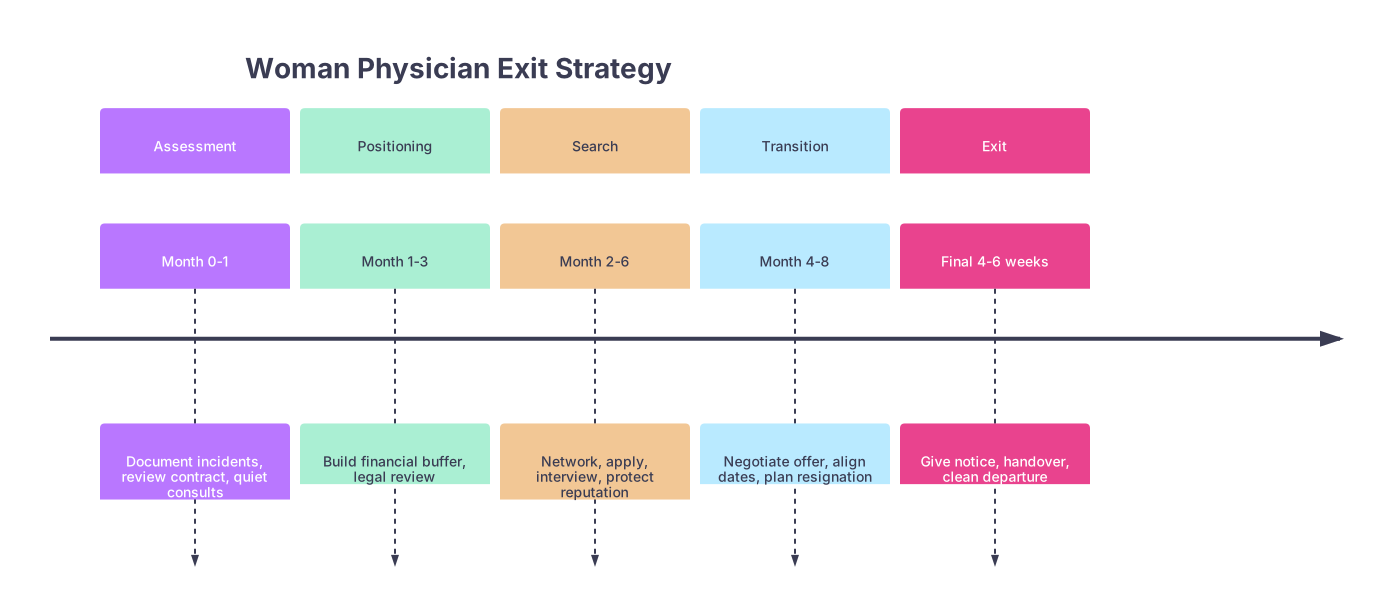
| Period | Event |
|---|---|
| Assessment - Month 0-1 | Document incidents, review contract, quiet consults |
| Positioning - Month 1-3 | Build financial buffer, legal review |
| Search - Month 2-6 | Network, apply, interview, protect reputation |
| Transition - Month 4-8 | Negotiate offer, align dates, plan resignation |
| Exit - Final 4-6 weeks | Give notice, handover, clean departure |
Three Things to Keep Front and Center
- Leaving a toxic workplace is not a failure of resilience. It is a professional decision to protect your license, your health, and your future patients.
- The order matters: document → secure finances → get legal clarity → line up the next role → resign cleanly.
- At every point, act as if your emails and notes will be read aloud in a courtroom or a credentialing committee. Because in the worst scenarios, they will be.