
It’s late September of your second year of med school. You’ve just walked out of a small‑group session where a male classmate got praised for being “assertive” and you got called “a bit intense” for saying the exact same thing. You’re not imagining the double standard. And you’re starting to realize: going through medicine as a woman without real mentors is a bad plan.
This is where most people finally say, “I need a mentor.”
They’re already behind.
Let’s walk it back and do this correctly—from pre‑med to M4—with specific checkpoints: what to do, when to do it, and what not to waste time on.
Big Picture: Your Mentorship Timeline At a Glance
At each major phase, your goal changes. You’re not collecting “mentors” like Pokémon; you’re building a small, evolving bench of people who actually help.
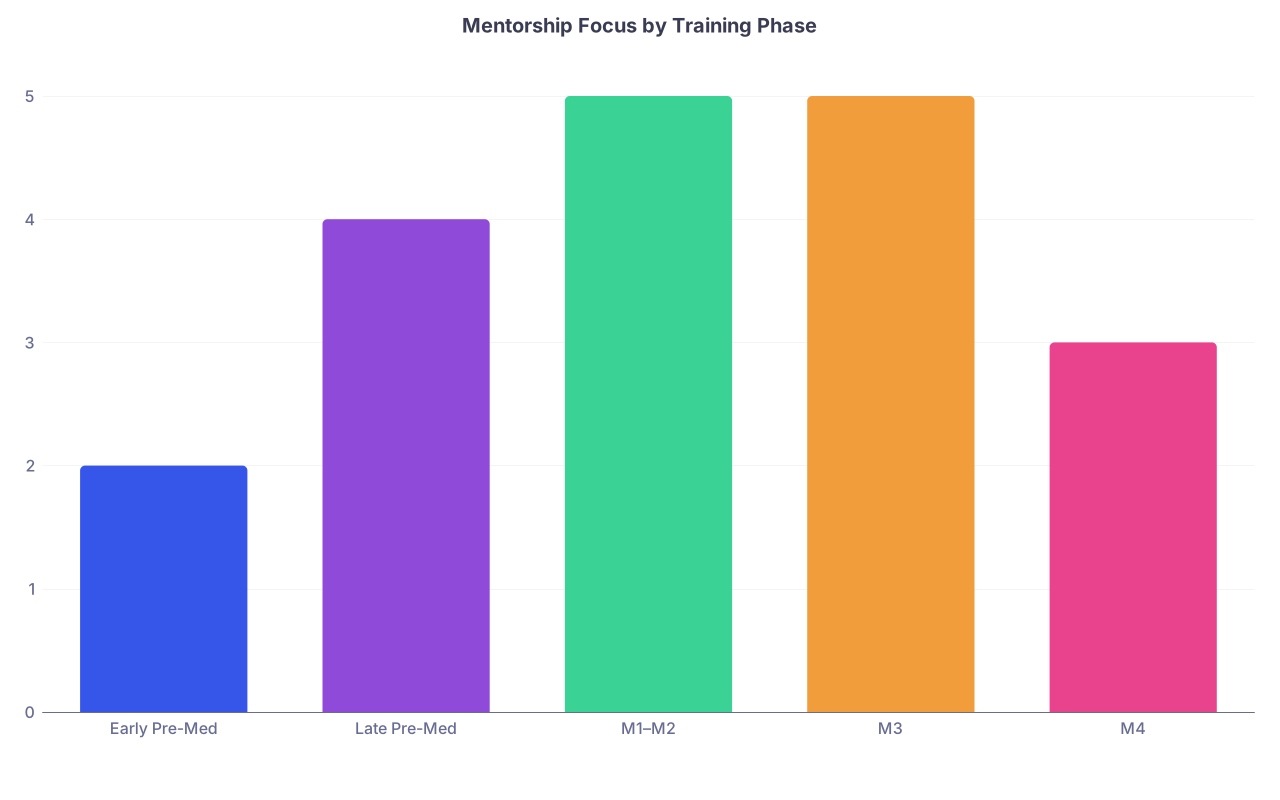
| Category | Value |
|---|---|
| Early Pre-Med | 2 |
| Late Pre-Med | 4 |
| M1–M2 | 5 |
| M3 | 5 |
| M4 | 3 |
Think of the numbers as intensity of focus on mentorship (1 = minimal, 5 = heavy):
- Early pre‑med: Exposure and role models
- Late pre‑med: Application strategy and letters
- M1–M2: Identity, resilience, early career direction
- M3: Clinical skills, specialty choice, sponsorship
- M4: Transition, advocacy, and long‑term alignment
Now let’s go chronologically.
Phase 1: Early Pre‑Med (High School → Early College)
At this point you should stop waiting for some future “more serious” version of you to deserve mentorship. You’re early, but not too early.
Goals for this phase
- See real women in medicine up close
- Learn what their lives actually look like
- Build comfort talking to physicians, not worshipping them
What to do, year by year
Senior year of high school / Freshman year of college
Focus: Exposure, not career‑defining mentorship.
- Attend:
- Premed club events
- Local “Women in Science/Medicine” panels
- Hospital community talks or open houses
- Ask short, specific questions after events:
- “What surprised you most about med school as a woman?”
- “If you were starting college again, what would you do differently?”
- Start a simple “mentor log” (Google doc is fine):
- Name, role, where you met them
- 1–2 lines about what they said that stuck with you
You’re not asking anyone to “be your mentor” yet. You’re learning who sounds grounded vs burned out vs delusional.
Sophomore year college
Now you should test one or two slightly deeper relationships.
Your moves this year:
Pick 1–2 women in medicine (or close—NPs, PA‑Cs, PhDs in biomedical fields) who:
- Responded kindly to you
- Seem to have a life you’d consider tolerable, not just “impressive”
Send an email that isn’t cringe:
- Subject: “Quick question from a sophomore premed”
- Body: 3 sentences:
- Who you are
- One specific thing you appreciated about their talk / interaction
- Ask: “Would you be open to a 20–30 minute call so I can ask 3–4 questions about your path?”
During that call, ask about:
- How they chose medicine
- What they’d tell their younger self as a woman in medicine
- One mistake they made you should avoid
At this point you should meet (remotely or in person) with at least 1 woman in medicine before the end of sophomore year. If you haven’t, you’re behind schedule. Fix it this semester.
Phase 2: Late Pre‑Med (Junior/Senior Year, Application Cycle)
This is where mentorship stops being nice‑to‑have and becomes strategic. You need people who can:
- Give application feedback
- Tell you honestly if your school list is trash
- Write letters
- Name the gender dynamics you’re about to walk into
Junior Year: Build Your Core Pre‑Med Mentorship Team
At this point you should have:
- 1 academic mentor (professor / PI, ideally aware of your career plans)
- 1 clinical mentor (physician or advanced practice provider you’ve shadowed/volunteered with)
- 1 peer/near‑peer (M1–M3 who remembers the process)
Not all need to be women. But at least one should be a woman physician or senior trainee who will say the quiet parts out loud about bias, pregnancy, harassment, etc.
Timeline
Fall junior year
- Solidify a research or longitudinal volunteering role
- Intentionally choose supervisors who seem to respect women. Red flag if:
- They interrupt women constantly
- All their “strong” trainees they brag about are men
- Tell them directly you’re considering medicine. People help what they know about.
Spring junior year
- Schedule a 30–45 minute “trajectory” meeting with each core mentor:
- “I’m planning to apply to med school in [year]. Could I get your advice on my readiness and how to strengthen my application?”
- Ask explicitly:
- “From what you’ve seen, would you feel comfortable writing a strong letter for me when the time comes?”
- Pay close attention to tone. Anything less than “absolutely” is a “no.”
- Schedule a 30–45 minute “trajectory” meeting with each core mentor:

Senior Year / Application Year
At this point you should use mentorship, not just collect contacts.
- Meet with your key mentors:
- Before submitting your primary
- Before finalizing your school list
- Before the bulk of interviews
- With at least one woman mentor, explicitly ask:
- “Are there particular schools or regions you’ve seen be more supportive of women?”
- “Are there red flags for women you’d look for on interview day?”
Do not skip this. I’ve seen women pick programs with zero female leadership, then be shocked by the culture.
Phase 3: M1–M2 (Pre‑Clinical Years) – Identity and Protection
You show up to M1 thinking you’re starting fresh. You’re not. Gender dynamics didn’t evaporate at the medical school door. They intensified.
At this point you should ditch the idea that one “super mentor” will meet all your needs. You need a small constellation:
- 1–2 faculty mentors (at least one woman)
- 1–2 residents/fellows
- 1–3 peer/near‑peer mentors (M2–M4)
Early M1: First 3–4 Months
Your main job: pay attention.
Who:
- Treats staff and students well?
- Has a life you’d actually want?
- Seems honest about systemic issues?
By December of M1 you should:
- Have attended at least one Women in Medicine or similar event
- Introduced yourself after to at least one speaker
- Joined at least one relevant interest group:
- Women in Surgery, Women in EM, AMWA, SNMA/LMSA if that’s your identity, etc.
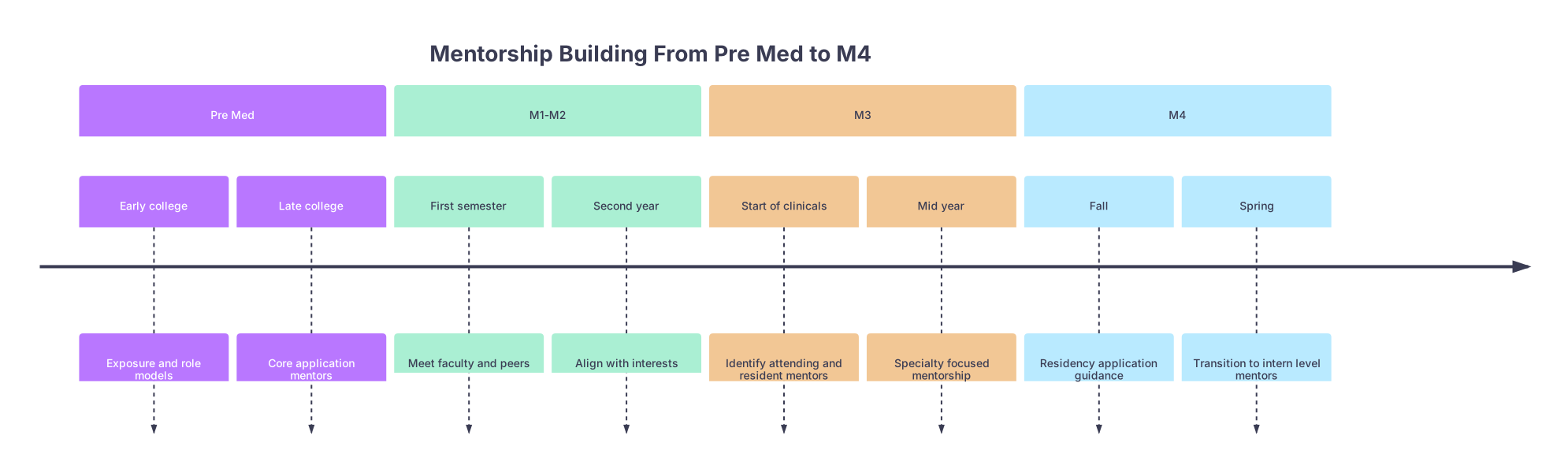
| Period | Event |
|---|---|
| Pre Med - Early college | Exposure and role models |
| Pre Med - Late college | Core application mentors |
| M1-M2 - First semester | Meet faculty and peers |
| M1-M2 - Second year | Align with interests |
| M3 - Start of clinicals | Identify attending and resident mentors |
| M3 - Mid year | Specialty focused mentorship |
| M4 - Fall | Residency application guidance |
| M4 - Spring | Transition to intern level mentors |
Late M1–M2: Intentional Mentor Matching
Around spring of M1 or early M2, most schools start some formal “advisory college” or mentorship structure. Don’t assume the assigned person is enough.
At this point you should:
Identify 1–2 women in fields you might be interested in.
Don’t wait until you’re sure. You’ll never be “sure” early enough.Reach out like this:
- Mention a specific lecture/clinic activity where you saw them
- State your current level: “I’m an M1 still exploring, but I’m especially curious about [field].”
- Ask for a 20–30 minute meeting to hear about their path and what they’d suggest for someone at your stage.
Use those meetings to ask:
- “As a woman in [field], what do you wish students actually knew?”
- “What would you do differently in M1–M2 if you could redo them?”
- “How do women tend to be evaluated differently on the wards?”
One ugly truth: you need at least one mentor who will be blunt about evaluations and bias. I’ve watched too many M3s stunned by comments like “too aggressive” or “not confident enough” on the same rotation. A good mentor will pre‑warn you and debrief those.
Phase 4: M3 (Clerkships) – This Is Where Mentorship Really Matters
M3 is where the wheels come off if you’re unsupported. Grades suddenly subjective. Comments coded. “Team player” means one thing for him, another for you.
At this point you should have:
- 1 primary faculty mentor who knows you reasonably well
- 1–2 residents/fellows you can text with “this happened, is this normal?”
- 1–2 M4s as near‑peers who just survived this
Before M3 Starts (Spring M2 → Summer)
Meet with:
- A woman faculty mentor
- A resident or senior student
Ask directly:
- “What are the common gendered pitfalls on clerkships?”
- “How does feedback typically get delivered here?”
- “If I encounter something that feels sexist or unsafe, who should I talk to first?”
Have a plan before day one of your first clerkship.

During M3: Rotation by Rotation Strategy
At the start of each rotation you should:
Identify one attending and one resident who seem:
- Fair
- Not dismissive of women
- Actually notice students
Ways to test this early:
- Do they learn your name?
- Do they ask what you want to get out of the rotation?
- Do they give any feedback before the last day?
Around week 2–3 of a 4–6 week rotation:
- Ask your chosen person for formative feedback:
- “I’m aiming to grow on this rotation. How am I doing so far? Anything I should adjust now?”
- For attendings you vibe with, add:
- “I’d appreciate your perspective as a woman in [field], if there are things you’ve seen women get dinged for more often.”
- Ask your chosen person for formative feedback:
Do not wait until the end of a rotation to talk about your performance. That’s how you get blindsided shelf week with “quiet, not very engaged” on your eval.
By mid‑M3 you should also:
- Decide which 2–3 faculty you’d consider for future letters
- Explicitly say:
- “I’m leaning toward [field] and would appreciate any guidance on how to position myself as a strong applicant.”
Phase 5: M4 – From Mentorship to Sponsorship
M4 is short and brutal. ERAS, interviews, away rotations, rank list drama, and the vague dread of being an intern.
At this point you should be using mentors as strategists and door‑openers, not just comfort providers.
Early M4 (May–August): Application Building
You need:
- 1–2 strong letter writers in your chosen field
- 1 “global” mentor (often in primary care, med ed, or dean’s office) who:
- Reads your personal statement
- Reviews your program list for sanity
- Knows your full context (strengths, vulnerabilities, life constraints)
Meet with your mentors and cover:
- Geography and family planning questions:
- “I’m not having kids in residency” vs “I might. What programs handle pregnancy badly?”
- Program culture:
- “Have you seen women advance to leadership from this program?”
- “Any places you’d avoid if you were a woman trainee?”
| Phase | Faculty Mentor | Resident/Fellow | Near-Peer (M2–M4) |
|---|---|---|---|
| Late Pre-Med | 1 | 0 | 1 |
| M1–M2 | 1–2 | 1 | 1–2 |
| M3 | 2–3 | 2–3 | 1–2 |
| M4 | 2–3 | 1–2 | 1 |
Numbers are guidelines, not quotas. Quality over quantity. Always.
Late M4 (Interview Season → Match)
Now you shift from “help me decide” to “help me interpret.”
Use your mentors to:
- Sanity‑check red flags from interview days:
- All‑male panels
- “We don’t really track parental leave”
- Jokes about work‑life balance at women’s expense
- Help craft post‑interview communications that are assertive but not obsequious
- Discuss your rank list honestly:
- “If you were me, would you rank X over Y given my goals and the fact that I’m a woman who may/may not want kids during training?”
You also start flipping roles here. At this point you should be:
- Taking one pre‑med or M1 under your wing, even lightly
- Answering the DM from the sophomore at your undergrad who says, “Can I ask you about med school?”
That’s how the pipeline actually changes: not just senior women in power, but women two steps ahead reaching back.
How to Tell if a Mentor is Actually Supportive of Women
Let me be blunt. A female mentor is not automatically a good mentor for women. Some of the harshest “I suffered so you should too” attitudes I’ve seen came from women.
You want mentors who:
- Name bias without blaming you for it
- Believe you should have a life, not just a CV
- Don’t make every conversation about “back in my day we just worked harder”
Watch for:
- Do they celebrate other women’s success?
- Do they talk about junior women with respect?
- Have they actually helped someone get promoted, matched, or protected?
If a “mentor” constantly undermines your confidence, dismisses your concerns, or tells you “this is just how it is, deal with it,” that’s not mentorship. That’s hazing dressed up as toughness.
Concrete Checkpoints: If You’re Here, Do This Now
Quick self‑audit:
- Early college:
- Have you spoken to at least one woman in medicine about her path? If no, schedule something this month.
- Late pre‑med:
- Do you have at least one potential strong letter writer who knows you as a person, not just a grade? If no, deepen one relationship this semester.
- M1–M2:
- Can you name one faculty member and one resident you’d feel safe emailing about gendered issues? If not, prioritize those meetings in the next 2–3 months.
- M3:
- Do you have someone to text when your eval feels unfair or sexist? If no, you are exposed. Fix that before the next rotation.
- M4:
- Do 2–3 mentors know your full story and have opinions on your rank list? If not, you’re making high‑stakes decisions in a vacuum.
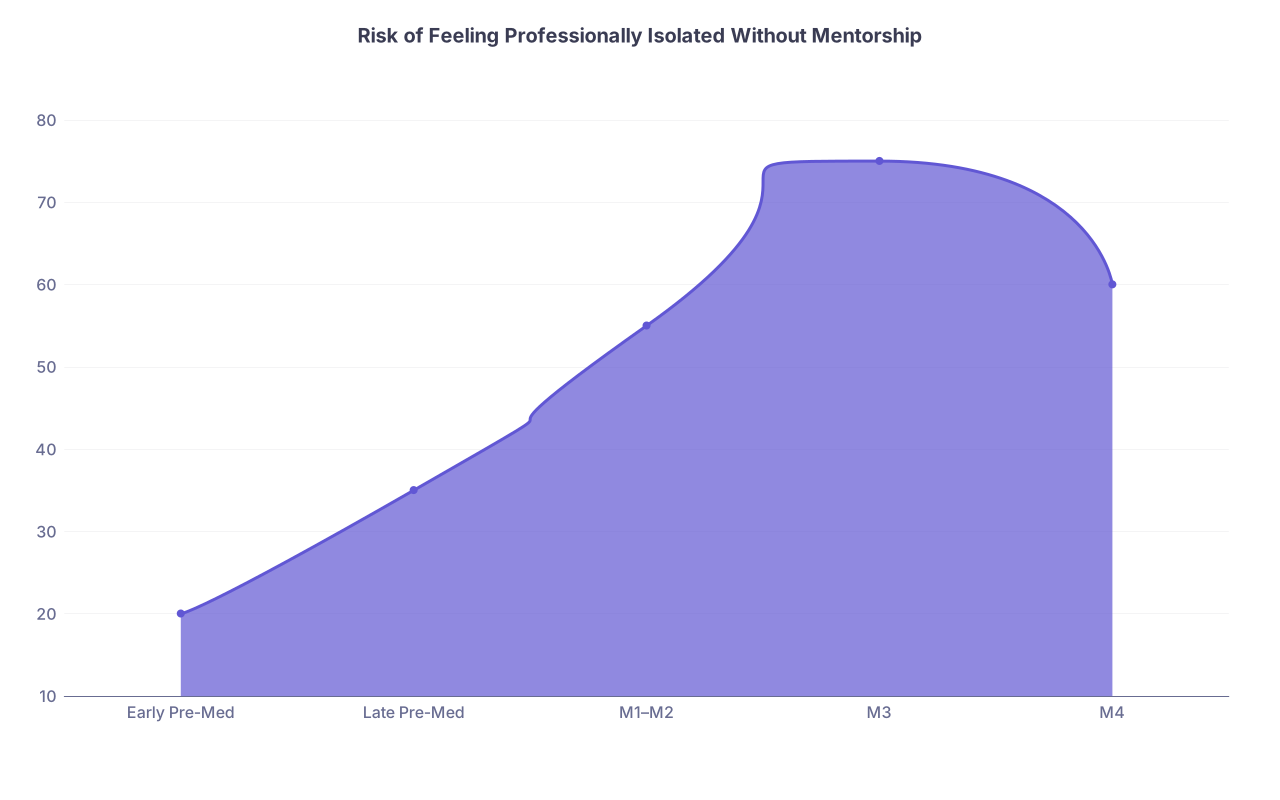
| Category | Value |
|---|---|
| Early Pre-Med | 20 |
| Late Pre-Med | 35 |
| M1–M2 | 55 |
| M3 | 75 |
| M4 | 60 |
The curve goes up fast in M3. That’s not accidental. That’s what the clinical environment does if you’re on your own.
FAQ (Exactly 4 Questions)
1. Is it “too much” to ask someone early on if they’ll be my mentor?
Yes, usually. Early on, ask for a single, concrete thing: a 20–30 minute meeting, feedback on a CV, advice on class selection. Let the relationship prove itself over several interactions. After a few good meetings, you can say, “I’ve really valued your guidance—would you be open to continuing to meet a few times a year as more of a formal mentor?”
2. Do all my mentors need to be women?
No. You want some men who “get it” and use their position to amplify you. But you need at least one woman physician who will be honest about what you’re facing as a woman in medicine. A mentorship team that’s all men usually means you’re not getting the full story on gendered experiences.
3. What if my school’s formal mentor assignment is a bad fit?
You’re not stuck. Be polite, but don’t treat that person as your only option. Continue to meet them occasionally if it’s politically wise, but quietly build your own team: residents you click with, attendings who seem fair, faculty from interest groups. Most strong mentorships happen outside the official system.
4. How do I end a mentorship that isn’t helpful or feels toxic?
You don’t need a dramatic breakup. Just stop deepening it. Space out meetings, redirect your energy to others, and keep interactions cordial but minimal. If they actively undermine you or others, document specific behaviors and—if safe—discuss with a trusted faculty ally, ombudsperson, or dean. You’re allowed to protect your career and your sanity.
Key points to carry with you:
- Start earlier than feels comfortable. If you’re waiting to be “impressive enough,” you’re already late.
- Build a team, not a hero. Different mentors for different roles, across each phase from pre‑med to M4.
- Audit regularly. If no one knows you well enough to advocate for you at each stage, that’s your next task.