
You just matched. The email has been reread twelve times. Group chats are blowing up with screenshots and emojis. But once the adrenaline fades, a quieter question shows up:
“Okay… now what?”
You have ninety days between Match Day and your first day as an intern. Those ninety days can be the difference between starting residency barely holding on, and walking in with systems, boundaries, and a clear ethical compass.
This is the 90‑day plan I wish more women interns would follow. Chronological. No fluff. At each stage: what you handle, what you ignore, and where the ethical landmines hide.
Big Picture: Your 90‑Day Map
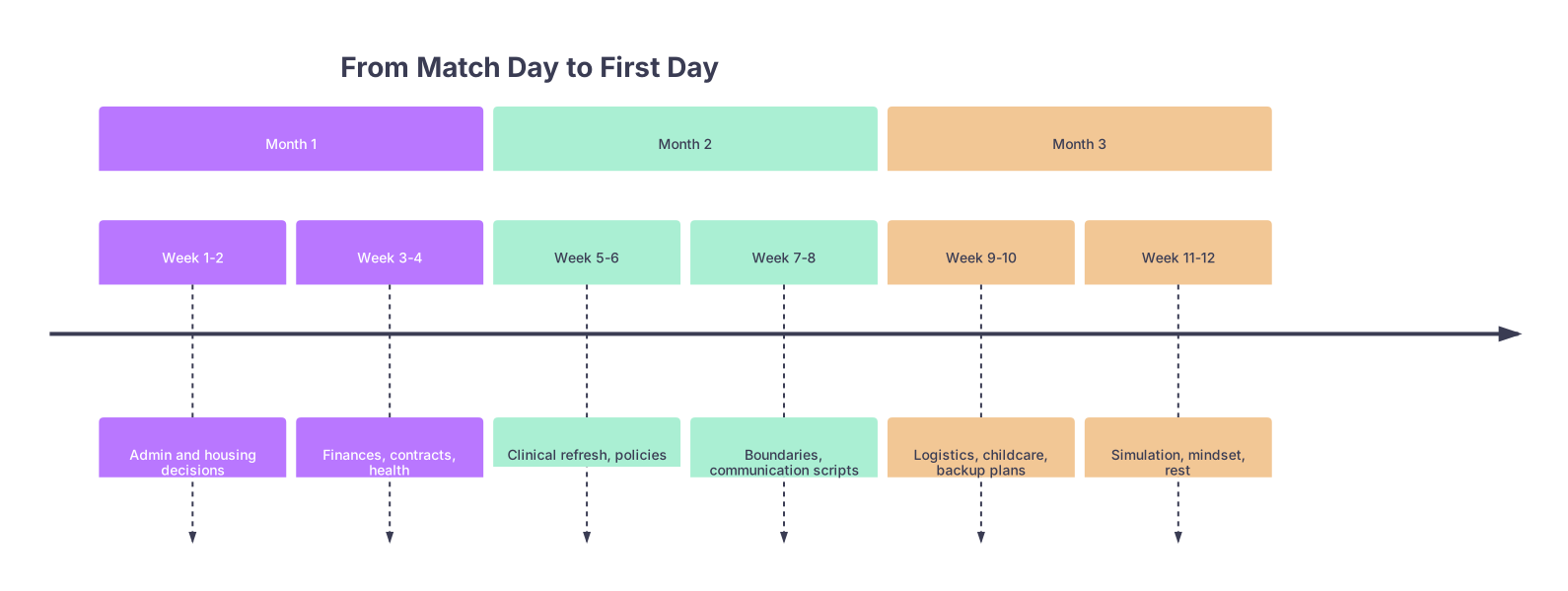
| Period | Event |
|---|---|
| Month 1 - Week 1-2 | Admin and housing decisions |
| Month 1 - Week 3-4 | Finances, contracts, health |
| Month 2 - Week 5-6 | Clinical refresh, policies |
| Month 2 - Week 7-8 | Boundaries, communication scripts |
| Month 3 - Week 9-10 | Logistics, childcare, backup plans |
| Month 3 - Week 11-12 | Simulation, mindset, rest |
At this point you should see three phases:
- Month 1 (Days 0‑30): Secure your life foundation.
- Month 2 (Days 31‑60): Build your professional and ethical foundation.
- Month 3 (Days 61‑90): Tighten systems, rehearse, then protect your energy.
We go month by month, then week by week.
Month 1 (Days 0–30): Secure Your Life Foundation
Goal: By the end of Month 1, you have: housing, basic finances set, medical clearance in process, and a clear picture of what your first year actually looks like.
Week 1–2: Reality Check and Commitments
At this point you should:
Read your offer letter like a contract lawyer, not like a fan.
Do not just skim for salary.Focus on:
- Salary and pay schedule (monthly vs biweekly; exact start date)
- Benefit start dates (health insurance gap issues)
- Vacation days and how they are scheduled
- Moonlighting policies (if allowed at all as an intern)
- Parental leave, lactation policies, part‑time / accommodation language
Red flags I have seen:
- “Vacation assigned by program only, no switching” buried in a paragraph.
- Vague “leave at program discretion” with zero specifics.
Map your year on a single page.
Pull whatever schedule the program gave you (even a rough rotation list) and scribble it onto a 12‑month calendar.Mark:
- ICU / night float / call-heavy rotations
- Lighter blocks (outpatient, elective)
- Known conferences or program retreats
- Personal non‑negotiables (weddings you will attend, religious holidays, etc.)
This is not perfection. It is orientation. You need to see which months are “survival mode” and which are “recovery and growth.”
Decide if you are moving alone or with support.
Partner, friend, or family nearby changes everything. So decide quickly:- Are you living alone, with partner, or with roommate?
- Does anyone realistically help with:
- Moving
- Childcare
- Emergency backup (middle-of-the-night car issue, for instance)
Be honest. Empty offers from distant relatives do not count as a support system.
Start the housing search with three hard criteria.
Women interns get this wrong a lot: chasing “cute” or “cheap” over safe and practical.Your non‑negotiables:
- Commute under 25–30 minutes door to door on your worst rotation.
- Safe area for late returns (lighting, parking, building security).
- In‑unit or same‑floor laundry if you can afford it. Night shifts + laundromat = misery.
Then add nice‑to‑haves:
- Quiet enough to sleep daytime (check: proximity to trains/bars/schools)
- Grocery options accessible without a 40‑minute odyssey
You are not building your forever home. You are building a functional bunker.
Week 3–4: Money, Health, and Admin
At this point you should shift from “high” to “systems.”
- Build a brutally honest first‑year budget.
Use realistic numbers. Not fantasy.
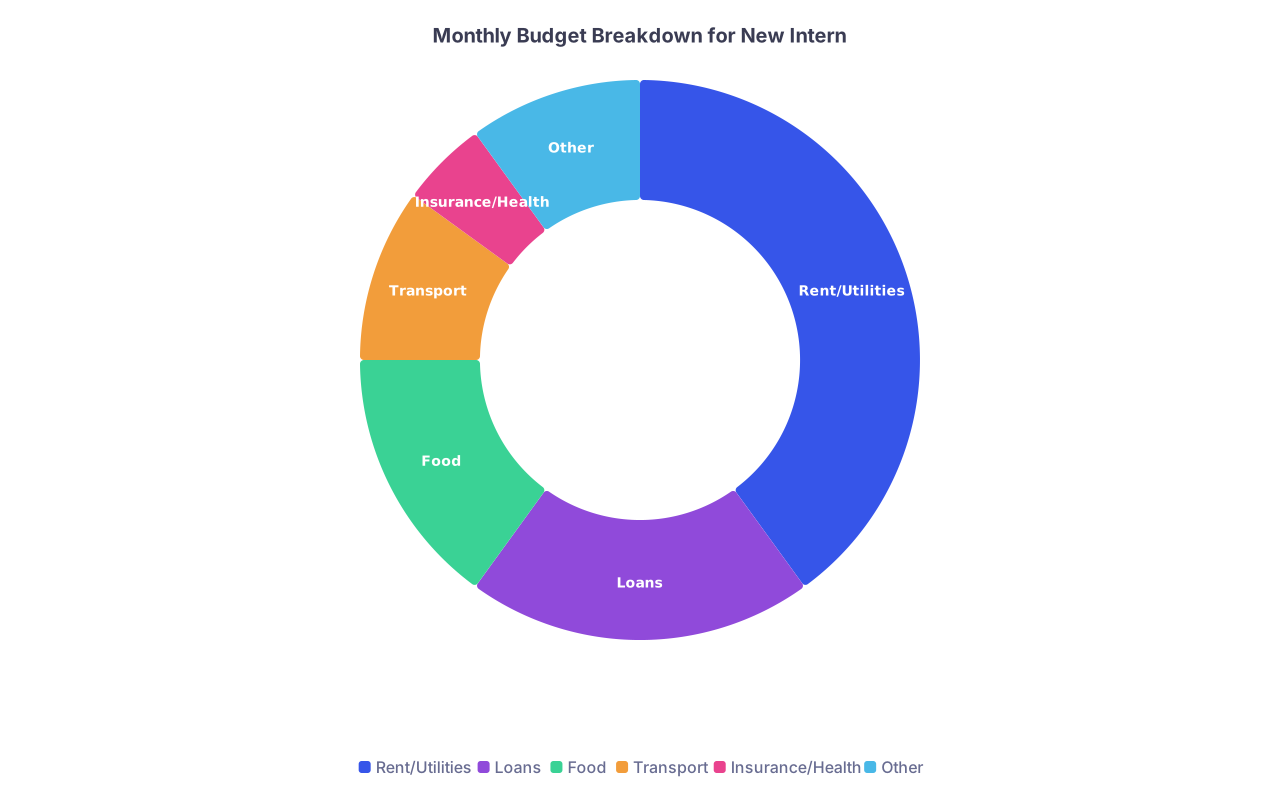
| Category | Value |
|---|---|
| Rent/Utilities | 40 |
| Loans | 20 |
| Food | 15 |
| Transport | 10 |
| Insurance/Health | 5 |
| Other | 10 |
Walk through:
- Post‑tax monthly income from your specific program (do the math, not guesses).
- Fixed costs: rent, utilities, internet, phone, minimum loan payments.
- Food: assign a number, then add 20% because of nights and DoorDash reality.
- Transport: gas/parking or transit passes.
- Health: copays, therapy, medications.
- “Intern tax”: scrubs, comfortable shoes, white coat tailoring, parking permits.
If the numbers do not work:
- Increase roommates / cheaper housing before cutting mental health or safety.
- Set an auto‑transfer of small amount to savings on payday, even if symbolic.
- Lock in your own healthcare before you are the one writing orders.
You will counsel patients on preventive care while ignoring your own. Fix that now.
Make appointments for the next 90 days:
- PCP visit: baseline labs if needed, chronic issues addressed.
- Gynecologic care: Pap up to date, contraception sorted, fertility questions asked now–not mid‑ICU block.
- Mental health:
- If you already have a therapist → book out into early intern year now.
- If you do not → start intake now; waiting lists are ugly.
Understand employee health and documentation deadlines.
Hospital onboarding is not optional. Or flexible.At this point you should:
- Read every single HR / GME email.
- Create a one‑page checklist with due dates: immunizations, drug screen, background check, BLS/ACLS, NPI number, license/permit paperwork.
Core Onboarding Requirements for Interns Item Typical Deadline Before Start Employee health visit 30–45 days Drug screen 30 days Background check 30 days BLS/ACLS 30–60 days House staff license / permit 45–60 days NPI number 30–45 days Missing one of these can literally delay your start. I have seen interns pulled from orientation over a “forgotten” drug screen.
Start a low‑friction documentation system.
You will be drowning in:
- Policies
- Didactic materials
- Lecture links
- Evaluation forms
Set up now:
- One cloud folder: “Intern Year”
- Subfolders: HR, Policies, Rotation Guides, Evaluations, Personal Docs.
- One note system (Notion, OneNote, Apple Notes, whatever) with:
- “Questions to ask PD / chief”
- “Cases that bothered me ethically” (more on this later)
- “Feedback log”
This will matter when things get ethically messy and your memory is foggy from nights.
Month 2 (Days 31–60): Build Your Professional and Ethical Foundation
By now housing should be decided or close, HR is moving, and the adrenaline has cooled. This month is about who you are as a physician and as a woman in a system that was not built for you.
Week 5–6: Clinical Refresh and Policy Reality
At this point you should:
Do a targeted, not global, clinical review.
Review what you will actually see in month one.- If you start in medicine wards:
- Chest pain, shortness of breath, sepsis, DKA, GI bleed, acute kidney injury.
- If OB/GYN:
- Labor triage basics, postpartum hemorrhage algorithms, preeclampsia.
- If surgery:
- Post‑op fever, pain control, fluids/electrolytes, basic wound issues.
60–90 minutes, 3–4 times per week, max. Do not pretend you are studying for Step again.
- If you start in medicine wards:
Read your institution’s core policies like an ethicist, not like a bored intern.
Focus on:
- Duty hours and reporting mechanisms.
- Harassment and discrimination policy.
- Lactation and parental leave policy.
- Reporting unsafe care or impairment.
- Social media and confidentiality rules.
Ask yourself:
- How do I report something without getting buried?
- Who are the actual people named (titles) in these pathways?
You are building a mental map for: “When something feels wrong, what door do I knock on?”
- Learn your electronic health record in advance if possible.
Many programs offer EHR training modules or sandbox access. Use it for:
- Order sets for common scenarios (chest pain, sepsis, stroke alert).
- Admit/transfer/discharge workflows.
- Where to find critical lab / imaging results.
Because nothing makes you feel more incompetent—and more ethically vulnerable—than not being able to place a simple order while a sick patient waits.
Week 7–8: Boundaries, Identity, and Scripts
This is the part most people skip. It is also the part that keeps women from burning out or becoming someone they do not recognize in 9 months.
At this point you should:
- Decide who you want to be under pressure.
Not aspirational adjectives. Concrete behaviors.
Write down:
- “When I am exhausted, I still will not…”
- Falsify any documentation.
- Ignore a patient’s report of harm or abuse.
- Bully a student because I was humiliated by someone above me.
- “When I am exhausted, I still commit to…”
- Double‑checking critical orders (chemo, insulin, heparin).
- Speaking up if I think harm is happening—at least once—no matter who is in the room.
You will have nights where this list is the only thing between you and a compromise you will regret.
- Plan your boundaries with your own body.
Women get socialized to ignore their body needs in training. That becomes an ethics issue when your impairment risks patients.
Set three physical non‑negotiables:
- Minimum sleep hours target and hard limit (e.g., never drive home if I have been awake >24 hours straight; call a ride or nap).
- Hydration/food: when in a 12‑hour shift, at least 1 real meal and 1 snack, and ask co‑residents to cover for 10 minutes rather than quietly starving.
- Menstrual, pregnancy, or chronic condition planning:
- Have what you need (meds, supplies) in your work bag.
- Know who you would tell first if a health issue started affecting performance.
This is professionalism, not selfishness.
- Prepare gender‑specific response scripts.
You will be:
- Called “nurse” repeatedly.
- Asked if you are “old enough to be a doctor.”
- Talked over by male colleagues.
- Hit with inappropriate comments from patients, staff, sometimes attendings.
You are not brainstorming these comebacks in the moment at 3 a.m.
Write and practice 3–4 phrases in each category:
- When a patient misidentifies you:
- “I am the doctor taking care of you today.”
- “Your nurse is excellent; I am your physician.”
- When a colleague talks over or dismisses you:
- “I would like to finish my thought.”
- “I just said that. Let me clarify why I am concerned.”
- When a comment crosses a line:
- “That comment is not appropriate.”
- “I am not comfortable with that. Let’s keep this professional.”
You do not need to be clever. You need to be clear.
- Clarify your social media and confidentiality boundaries.
Decide now:
- No clinical stories with identifying details. Ever.
- No mocking or demeaning patients, staff, or colleagues, even “anonymized.”
- No posting about shift details that could identify specific patients or events.
If you are on TikTok/IG:
- Separate personal vs “med” accounts.
- Decide what is off‑limits: relationship content, family, political commentary during training.
Interns have been disciplined—and fired—over careless posts. Do not be one of them.
Month 3 (Days 61–90): Tighten Systems, Rehearse, Protect Energy
Now the start line is visible. Anxiety usually spikes here. The move, the goodbyes, the packing of your white coat.
At this point you should focus on practical rehearsals and final decisions.
Week 9–10: Logistics, Safety, and Backup Plans
- Lock in your living setup—no more “I’ll figure it out later.”
- Lease signed or housing confirmed.
- Move date chosen that gives you at least 7–10 days in town before orientation.
- Utilities set to start before you arrive.
You want time to:
- Test your commute at rush hour.
- Find the parking, badge office, employee entrance.
- Locate a 24‑hour pharmacy and a grocery store you like.
- Design your “intern bag” and physical systems.
This sounds trivial until it is not.
Your daily carry:
- Reliable pens, small notebook, reference cards or app.
- Protein bar or snack, small water bottle.
- Phone charger + extra cable; small portable battery.
- Minimal wallet: ID, hospital badge, credit/debit card, small cash.
- For many women: hair ties, sanitary products, small hand cream because alcohol gel will wreck your hands.
Have two versions:
- “Day shift bag”
- “Night shift bag” (more snacks, hoodie, maybe blue‑light glasses)
- Set up your safety plan for nights.
Women walking to parking garages at 11 p.m. or 7 a.m. after nights: this is not abstract.
Decide now:
- Parking spot: well‑lit, not cheaper but unsafe.
- Hospital security escort phone number saved in your contacts.
- Who gets your location shared by default on nights (partner, friend, family).
- Rule for yourself: if you feel unsafe walking to your car, you call security. No apologizing.
- Build redundancy for life emergencies.
At this point you should identify:
One person local you can call if:
- Your car dies.
- You lock yourself out.
- You get sick but need help with errands / pharmacy.
For childcare (if applicable):
- Primary plan (partner, daycare, family).
- Backup (trusted sitter, backup daycare, neighbor).
- Urgent backup (drop‑in center, nanny agency).
Ethically, you cannot miss every other shift due to preventable logistics. Design the net now.
Week 11–12: Simulation, Communication, and Rest
These final weeks are about rehearsal and restraint. Not cramming.
- Run mental simulations of hard scenarios.
Pick 5–10 realistic situations:
- You think your attending is making a dangerous call.
- A senior makes a sexist joke about a nurse.
- A patient refuses care “because I want a male doctor.”
- A co‑resident falls asleep driving home.
- A nurse says, “This does not feel right,” and the senior dismisses it.
For each:
- What is your first sentence?
- Who else would you involve?
- Where is the line where you escalate above your immediate supervisor?
You are pre‑programming your ethical responses so your future exhausted self has a script.
- Plan your “check‑ins” for your first three months.
Structure here matters.
- Personal:
- One friend or family member designated as your “reality check.” Schedule a 20‑minute call weekly for the first month, then every other week.
- Professional:
- Schedule a brief meeting with your program director or associate director at 4–6 weeks in (if not formal, ask for it). Come with:
- 2 things going well.
- 2 things you are struggling with.
- 1 ethical concern you have noticed (even if not dramatic).
- Schedule a brief meeting with your program director or associate director at 4–6 weeks in (if not formal, ask for it). Come with:
- Protect a real rest window.
Do not spend the last ten days speed‑reading UpToDate. That anxious cramming never fixes what you think it does.
At this point you should:
- Have 3–4 days with:
- Limited social obligation.
- No major travel.
- Enough sleep that you feel bored at least once.
Do:
- Light review: skim your own notes, look at common order sets.
- Gentle physical activity: walking, yoga, whatever does not drain you.
- Actual joy: see the people you will miss, in small groups, not 10 goodbye parties.
Skip:
- Last‑minute huge trips with red‑eye flights two days before orientation.
- Massive home projects you “finally have time for now.”
You need to arrive with something in your tank.
- Write yourself a one‑page “Intern Year Compass.”
Final step.
On one sheet, handwritten:
- Why you chose this specialty.
- The kind of physician you refuse to become.
- Three values you commit to when things get ugly (for example: honesty, respect for patients, humility).
- One sentence you will read after a bad shift. Something that sounds like you, not Instagram.
Fold it. Put it in your work bag or a locked note on your phone.
You will need it.
Quick Recap: What Actually Matters
If you remember nothing else from this 90‑day plan:
Month 1 – Build your base.
Lock down housing, money, and health. You cannot be an ethical physician if your own life is chaos.Month 2 – Decide who you are as a doctor.
Read policies, set boundaries, and script your responses to discrimination, harassment, and unsafe care before they happen.Month 3 – Tighten and rest.
Finalize logistics, rehearse hard scenarios, and then protect a real rest window. You are not cramming for a test; you are preparing a human being to do hard work without losing herself.
That is the job for these ninety days. Not perfection. Just a clear, deliberate runway into the hardest, most defining year of your career so far.