
Timeline for Reporting and Following Up on Gender Harassment Complaints
It’s 10:47 pm. You just got out of a case where a senior surgeon “joked” about women not belonging in the OR. Again. Third time this month. The scrub tech caught your eye and gave you that half-sympathetic, half-resigned look that says, “He’s like this with all the women. Nothing ever happens.”
You’re in the workroom now, scrolling through your institution’s “Respectful Workplace” policy, wondering if it’s even worth it to report. You’re tired. You’re worried about retaliation. You also know, deep down, that if you say nothing, it will continue—for you and for the intern who just rotated onto the service.
This guide is for the next hours, days, weeks, and months. What to actually do. When. And how to follow up so your complaint does not just disappear into an anonymous “we take this very seriously” black hole.
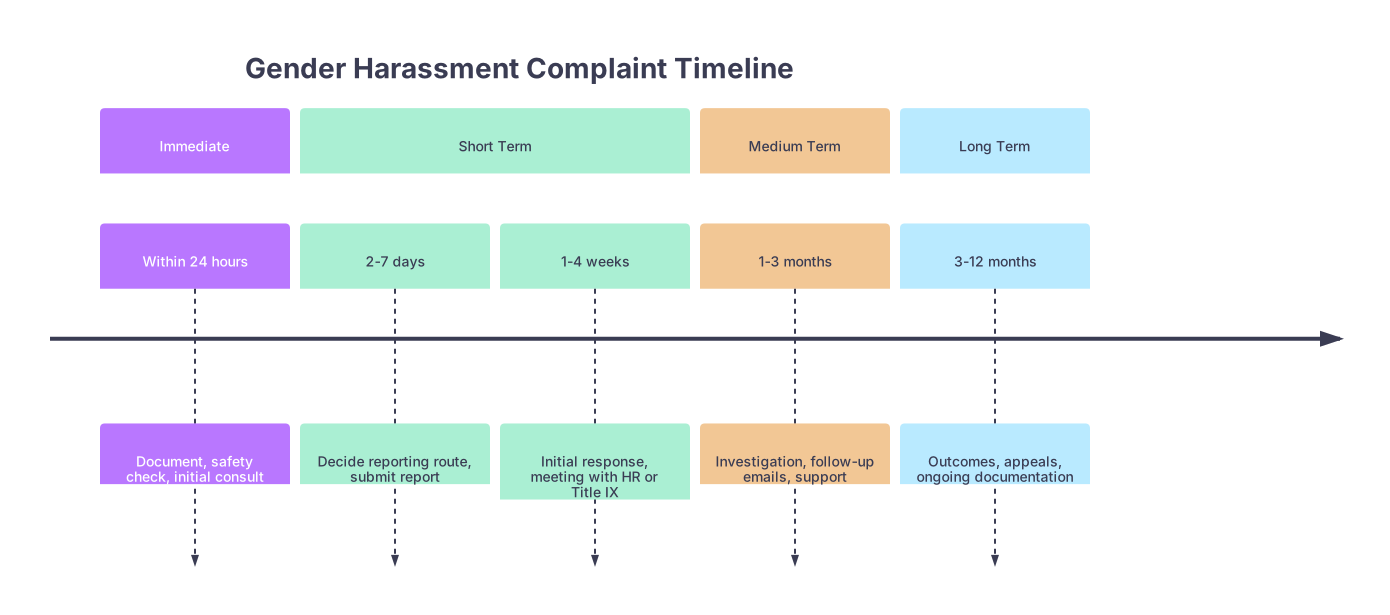
| Period | Event |
|---|---|
| Immediate - Within 24 hours | Document, safety check, initial consult |
| Short Term - 2-7 days | Decide reporting route, submit report |
| Short Term - 1-4 weeks | Initial response, meeting with HR or Title IX |
| Medium Term - 1-3 months | Investigation, follow-up emails, support |
| Long Term - 3-12 months | Outcomes, appeals, ongoing documentation |
First 24 Hours: Capture the Facts and Stabilize Yourself
At this point you should not be writing a polished complaint. You should be preserving evidence and protecting yourself.
Within the first 1–2 hours
If you’re safe and not actively on a critical patient task:
Write a raw account
- Open Notes on your phone, an email draft to yourself, or a paper notebook.
- Capture:
- Date and exact time (or best estimate)
- Location
- Who was present (names + roles)
- Exact words used, as close to verbatim as you can remember
- Body language, tone, gestures
- Your response and immediate emotional/physical reaction
- Do not sanitize it. Leave your anger in. You can edit later. What you need now is accuracy.
Secure any hard evidence
- Screenshots of:
- Group chats (“the boys” thread that excludes you, sexist memes, comments)
- Emails or messages with gender-based comments, jokes, or “advice”
- Photos, if relevant (e.g., offensive signs, drawings on whiteboards).
- Save to:
- A personal, non-institutional device or encrypted storage if allowed by your policies.
- Name files with date and short descriptor:
2026-01-08_OR_comment_DrX.png.
- Screenshots of:
Quick safety check
- Ask yourself:
- Do I feel safe finishing this shift?
- Is this person alone with me in call rooms, parking garage, etc.?
- If you do not feel safe:
- Swap tasks with a trusted colleague.
- Tell the chief resident, attending you trust, or nurse manager: “I had an inappropriate encounter with Dr X and I do not feel safe being alone with him. I need to adjust assignments tonight.” You do not owe graphic details in that moment.
- Ask yourself:
Before you go to sleep
You’re still within the first 24 hours. At this point you should:
Create a running log
- Start a simple document (on your own device) titled something like “Gender Harassment Log.”
- Add:
- Incident #1: Date, time, location, people present, detailed description.
- How it affected your work (e.g., you left the OR, you avoided asking questions, you skipped a teaching opportunity).
- This becomes your backbone for any formal complaint.
Tell at least one trusted person
- Not for gossip. For witness backup.
- Options:
- Co-resident who was present
- Nurse who heard it
- Faculty ally
- Script: “I’m writing things down because I’m considering reporting. Can I list you as someone who witnessed/heard this if it comes to that?”
Decide what absolutely must wait until you’ve slept
- Do NOT:
- Email the harasser directly in the heat of the moment.
- CC half the department on a late-night rant.
- Do:
- Keep your documentation safe.
- Mark one calendar reminder for 48 hours: “Decide next step on harassment incident.”
- Do NOT:
Days 2–7: Decide How You’ll Report and Build Your Support Network
You’ve slept. Maybe you’re still nauseated thinking about going back on that service. This is the week you move from “this happened” to “how do I handle it strategically.”
Day 2–3: Information gathering
At this point you should understand your options. Not vaguely. Specifically.
Find the actual policies
- Go to:
- GME or Office for Faculty Affairs webpage
- Title IX or Office of Institutional Equity page
- Employee handbook
- Look for:
- “Sexual harassment”
- “Gender harassment”
- “Hostile work environment”
- “Anti-retaliation”
- Save PDFs or screenshots. Highlight sections that mention:
- Reporting pathways
- Anonymous vs confidential options
- Timelines for institutional response (sometimes hidden in the fine print)
- Go to:
Clarify definitions in your mind
- Gender harassment often looks like:
- Repeated sexist jokes
- Comments about “women being too emotional for surgery”
- Excluding women from opportunities because of gendered assumptions
- This matters because HR sometimes tries to minimize, “Well, that was just one comment.” Your log will show pattern and impact.
- Gender harassment often looks like:
Quietly ask, “Has this happened before?”
- Without launching an investigation in the hallway, you can say to trusted people:
- “Have you ever heard Dr X make comments about women in the OR?”
- If you start to hear, “Oh, that’s just how he is,” log that. It suggests a pattern. Patterns are powerful.
- Without launching an investigation in the hallway, you can say to trusted people:
Day 3–4: Choose your initial reporting pathway
Most institutions give you at least these options:
| Pathway | Typical Use Case |
|---|---|
| Program leadership | Resident or trainee issues |
| HR / Employee Relations | Faculty–staff, staff–staff issues |
| Title IX / Equity Office | Sex/gender-based discrimination |
| Ombuds Office | Confidential, exploratory |
| Anonymous hotline | High-risk, fear of retaliation |
At this point you should pick one primary and maybe one backup.
Program leadership (PD, APD, chief residents)
- Pros: They know you, they can adjust schedules quickly, they see patterns across trainees.
- Cons: Conflicts of interest, fear of retaliation in evaluations, social pressure.
- Good starting point if:
- The harasser is within your department.
- You need immediate practical changes (switching teams, avoiding direct supervision).
Title IX / Institutional Equity
- Pros: Specializes in sex/gender discrimination; often required to investigate; clearer processes.
- Cons: More formal, can feel adversarial; systems vary wildly in quality.
- Good if:
- Comments are clearly gender-based.
- There’s a pattern across trainees.
- Your leadership previously shrugged things off.
HR / Employee Relations
- Pros: Handles employment law risk for the institution; may act faster when liability is obvious.
- Cons: Their priority is risk management, not your emotional safety.
- Good if:
- The harasser is a staff member, non-physician, or someone outside your training hierarchy.
- There are pay or promotion consequences.
Ombuds office
- Pros: Typically confidential, off-the-record; you can reality-check your options.
- Cons: They usually do not take direct action; more like a coach.
- Good as:
- A first conversation when you’re unsure if you want to file yet.
Anonymous hotlines
- Pros: Zero immediate visibility of your name.
- Cons: Very limited ability to follow up; often triggers “general reminders” instead of specific accountability.
- Use if:
- You’re in a very small department with extreme power imbalance.
- You’re documenting pattern in an especially toxic environment.
Day 4–7: Start quiet support and prepare your report
At this point you should not be alone in this.
Loop in 1–2 strategic allies
- Examples:
- Female faculty member known as an advocate.
- Male ally who’s publicly shut down sexist comments before.
- Your residency ombudsperson if you have one.
- Ask directly:
- “Can I run a situation by you and get your honest sense of how it plays out here?”
- “If I decide to file, could I list you as support or a witness to the culture on this service?”
- Examples:
Draft your formal report text
- Format it like a short, focused incident summary:
- Who (names, titles)
- What (exact statements/actions)
- When (date/time)
- Where (location/setting)
- Impact on your work and training
- Any witnesses
- Example frame:
- “On January 8, 2026, at approximately 9:30 am in OR 4, Dr X (Attending Surgeon) stated, ‘Women are too emotional for surgery; that is why I do not like having female residents on my cases.’ This was said in front of [names]. I felt targeted based on my gender and subsequently avoided asking intraoperative questions, which impacted my learning and participation. This comment is part of a pattern of similar statements over the last 3 months, detailed in the attached log.”
- Format it like a short, focused incident summary:
Decide your visibility preference
- Non-anonymous report with your name: More powerful, higher risk.
- “Confidential” report (where possible): Your identity is limited to certain offices.
- Anonymous: Sometimes necessary, but weaker.
- Write it down: “I am comfortable / not comfortable being identified to the accused at this time.” This guides your choices.
Weeks 2–4: File the Complaint and Track the Institutional Response
You’re now in the “paper trail” phase. This is where things often get lost unless you stay organized.
Week 2: Submit the report
At this point you should actually file. Not just talk about maybe filing.
Submit through an official channel
- Email, online portal, or in-person form.
- Attach:
- Your incident summary
- Relevant screenshots (redacted only if necessary)
- Your incident log (or at least the sections related to this person)
- Subject line example:
- “Formal report of gender-based harassment by Dr X – Resident [Your Role/Program]”
CC intentionally
- Consider CC’ing:
- Program Director or APD (if not the accused)
- GME office
- Don’t CC the whole world. Wide blasts backfire.
- Consider CC’ing:
Request acknowledgment and a timeline
- One sentence in the body:
- “Please confirm receipt and provide the expected timeline and process for review of this complaint.”
- One sentence in the body:
Save everything
- Create a folder (on your personal device if allowed):
Harassment_Report_2026. - Save:
- Original complaint
- Auto-replies
- Meeting invites
- Policy documents
- Create a folder (on your personal device if allowed):
Week 3–4: Follow up and prepare for meetings
Institutions love to say “we are looking into it” and then go silent. At this point you should politely but firmly keep them on the clock.
If you don’t get acknowledgment within 5 business days
- Send a short follow-up:
- “Following up on my formal report of gender-based harassment submitted on [date]. Could you confirm receipt and share next steps and an anticipated timeline for the review process?”
- If still nothing after another 5 days:
- Escalate: CC GME Dean or Faculty Affairs depending on your position.
- Send a short follow-up:
Prepare for your first interview/meeting
- Expect questions like:
- “What exactly was said?”
- “Have you told anyone else?”
- “What outcome are you seeking?”
- Before the meeting, write out:
- 3–5 key incidents (with dates) you want documented.
- Your desired immediate outcomes:
- Not being scheduled 1:1 with the harasser
- Having an alternate faculty member for evaluations
- Safety measures if you anticipate retaliation
- Decide if you want a support person present:
- Another faculty member
- Union rep (if applicable)
- Ombuds or advocate
- Expect questions like:
Right after each meeting
- Send a recap email. Critical step.
- Example:
- “Thank you for meeting with me on [date] regarding my report of gender-based harassment by Dr X. As I understand it, next steps include: (1) you will interview [names], (2) you will review prior complaints, and (3) you will follow up with me by [time frame] with an update. Please let me know if I’ve misunderstood anything.”
- This locks their commitments into the record.
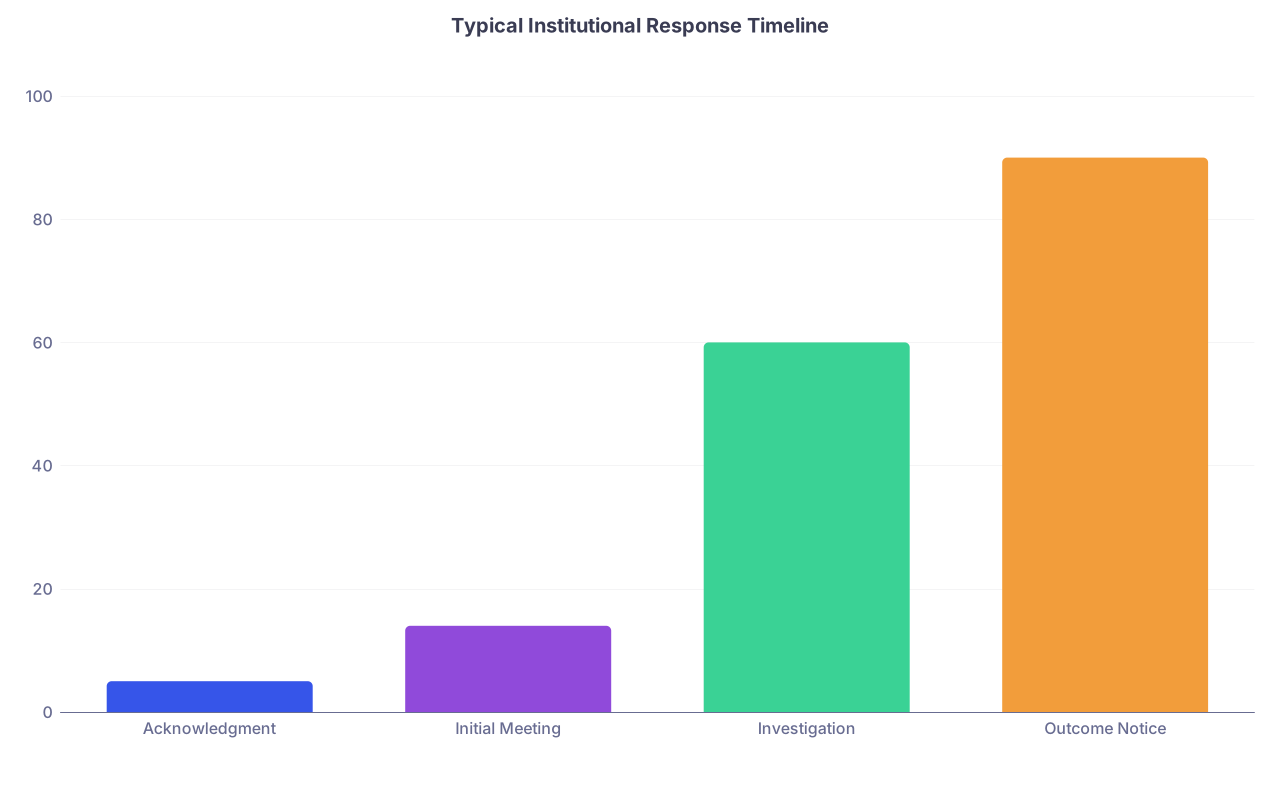
| Category | Value |
|---|---|
| Acknowledgment | 5 |
| Initial Meeting | 14 |
| Investigation | 60 |
| Outcome Notice | 90 |
Months 2–3: During the Investigation – Protect Yourself and Keep Records
This is the drag phase. The emails slow down. The whispers pick up. This is where people either give up or quietly get pushed out.
At this point you should shift into “long game” mode.
Ongoing: Document retaliation or further incidents
Update your log weekly
- New entries:
- Any new comments or incidents by the same person.
- Changes in:
- Evaluations right after you reported.
- Schedule changes that isolate you or cut your opportunities.
- Social exclusion from teaching or cases.
- New entries:
Flag potential retaliation
- Examples:
- Sudden drop from “outstanding” to “needs improvement” evaluations with vague feedback.
- Being removed from key rotations without clear educational rationale.
- Harasser telling others you’re “not a team player.”
- When you notice something:
- Email the investigator or HR:
- “I want to document a concern about potential retaliation following my harassment complaint. On [date], [specific action]. This is a change from my prior evaluations/assignments, which have been [brief history].”
- Email the investigator or HR:
- Examples:
Keep your clinical performance solid and documented
- Not fair, but real: people will scrutinize your performance.
- Save:
- Positive emails from attendings and patients.
- Evaluations predating your complaint that show you were doing well.
- This protects you if anyone tries the “she’s just a problem resident” narrative.
Mid-investigation: Request status updates
If the promised timeline passes with no word, at this point you should press—politely, in writing.
- Sample email at 60–90 days:
- “I’m writing to request an update on the status of the investigation into my report of gender-based harassment filed on [date]. When we spoke on [date], you indicated an anticipated timeline of [X]. Could you please share where things stand and the next steps?”
If they respond with generic language (“we are still reviewing”), respond once:
- “Thank you. I understand these processes take time. I remain concerned about ongoing contact with Dr X in my clinical duties and would appreciate any interim measures that can be taken to ensure a safe and equitable learning environment.”
Months 3–12: Outcomes, Appeals, and Long-Term Strategy
Eventually, you’ll get some kind of outcome. It may be satisfying. It may be infuriatingly vague: “appropriate action has been taken.”
At this point you should think on two tracks: immediate outcome and long-term career.
When you receive the outcome
Get it in writing
- If they tell you verbally, respond via email:
- “To summarize what I heard in today’s meeting regarding the outcome of my complaint: [summary]. Please correct me if I’ve misunderstood anything.”
- If they tell you verbally, respond via email:
Ask explicitly (if they don’t volunteer)
- “Were any findings of policy violation made?”
- “What protections are in place against retaliation moving forward?”
- “What should I do if I experience further harassment or retaliation?”
Decide whether to appeal
- Check the policy: there’s often a short deadline (10–30 days).
- Grounds for appeal typically include:
- New evidence
- Procedural error
- Clear mismatch between findings and evidence
- If you’re considering appealing:
- Draft a concise, factual appeal.
- Get input from:
- Trusted faculty
- Legal counsel (if involved)
- Professional organizations (AMA, specialty societies, sometimes have resources)
Long-term: Career and culture strategy
Harassment complaints sit in a bigger career arc.
Reassess your environment
- Be honest:
- Did leadership support you or subtly punish you?
- Did colleagues close ranks around the harasser?
- If the environment is clearly toxic and unchangeable:
- Start a 6–12 month exit plan:
- Fellowship applications
- Lateral move to another institution
- Shifting to a different division with better culture
- Start a 6–12 month exit plan:
- Be honest:
Use your experience strategically (if you feel safe)
- Options:
- Participate in GME or faculty development trainings.
- Help revise policies (“We need explicit gender harassment language, not just ‘sexual favors’ language.”)
- Mentor junior women: share what you learned about timelines and leverage.
- Options:
Protect your mental health
- This whole process is draining. I’ve watched solid, high-performing residents start doubting their sanity.
- Timeline here:
- Within the first month of filing: consider therapy or peer support, even if you “feel fine.”
- Every 1–2 months: quick self-check—sleep, anxiety, dread going to work?
- If symptoms persist: treat this like any other occupational injury. Get help.
Three Anchors to Keep in Mind
Document early, thoroughly, and consistently. Your log and emails are your spine when memories blur and institutions get amnesic.
Push for timelines and put every commitment in writing. Verbal promises evaporate; emails do not.
Think beyond the complaint. You’re not just surviving this week’s comment. You’re shaping your long-term career and the environment for the women coming after you.