
It is July 1st. You are pulling on a short white coat that does not quite feel like it belongs to you yet. Your name badge says “MS3.” Your stomach is tight, half from excitement, half from the knowledge that from today forward, other people’s words about you — in Epic comments, on evaluation forms, in offhand hallway remarks — will shape your career.
You are also a woman in medicine. Which means you are walking into a system where evaluation bias is real, often subtle, and sometimes weaponized. Your goal this year is two-fold: learn medicine and protect your evaluations. Not by playing politics all day. By being deliberate, time-specific, and strategic.
Here is your roadmap.
Big-Picture Timeline: What You Are Protecting, and When
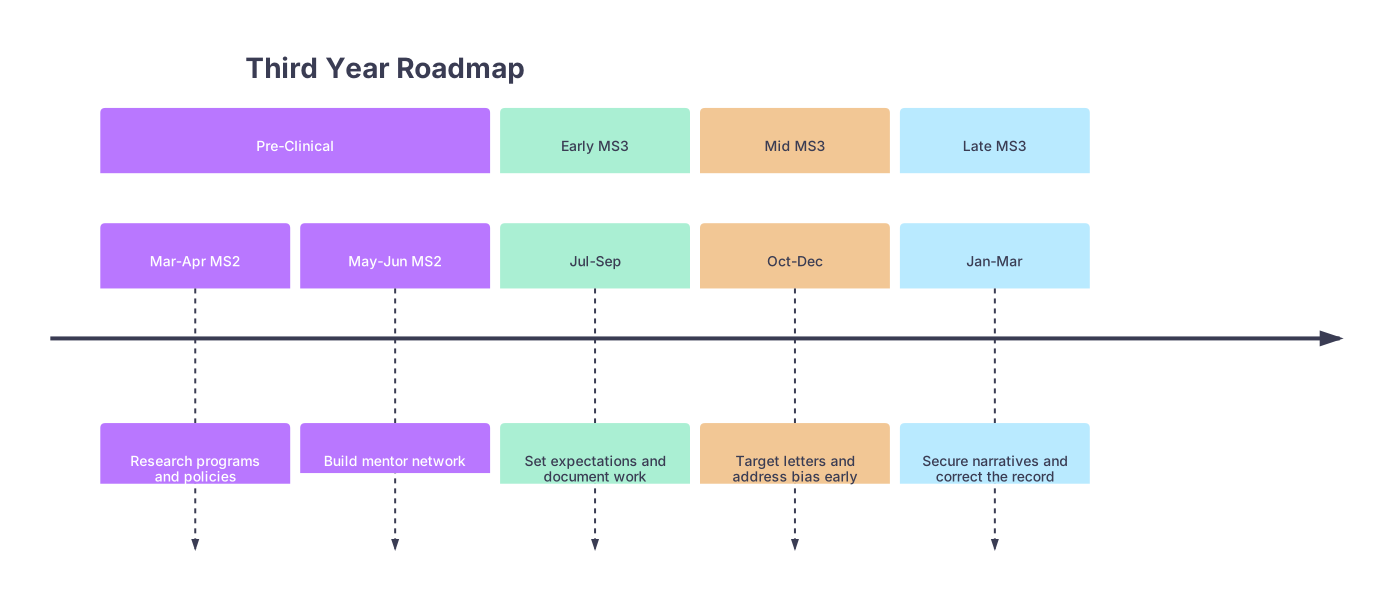
| Period | Event |
|---|---|
| Pre-Clinical - Mar-Apr MS2 | Research programs and policies |
| Pre-Clinical - May-Jun MS2 | Build mentor network |
| Early MS3 - Jul-Sep | Set expectations and document work |
| Mid MS3 - Oct-Dec | Target letters and address bias early |
| Late MS3 - Jan-Mar | Secure narratives and correct the record |
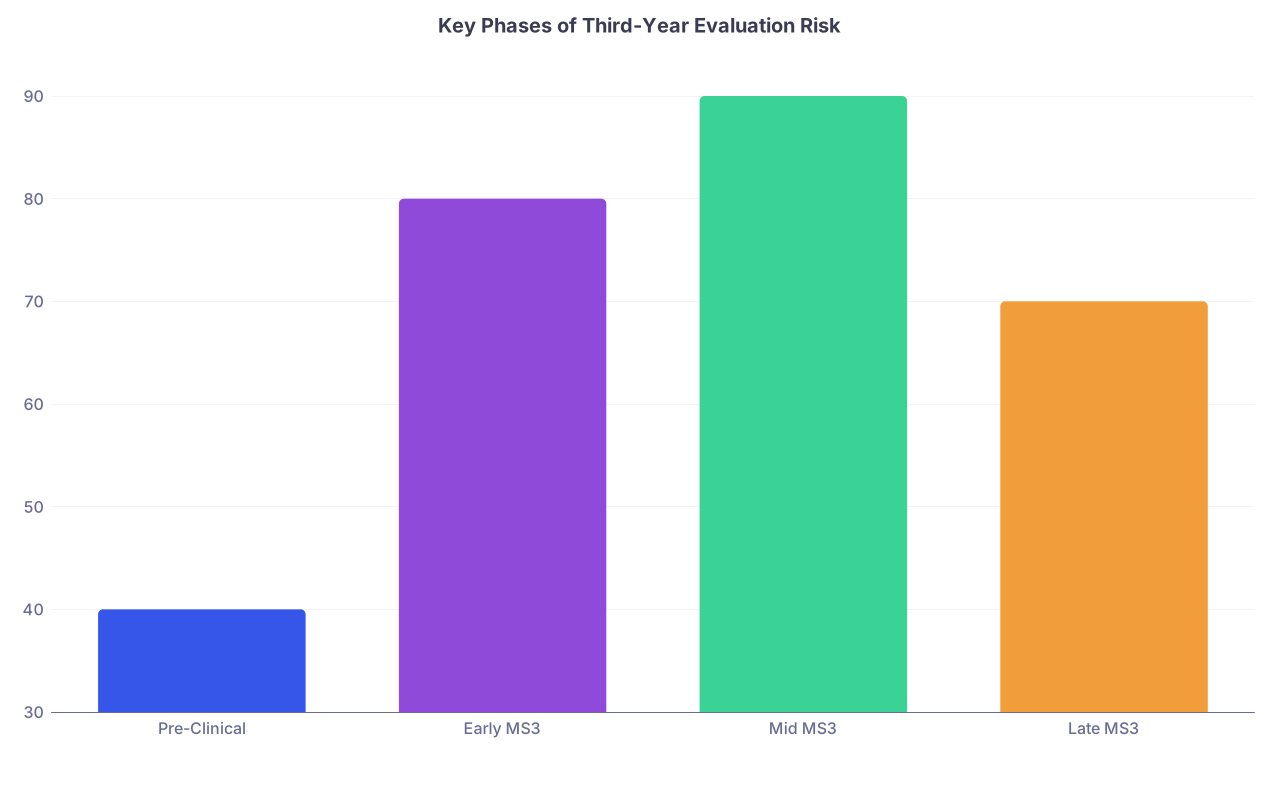
| Category | Value |
|---|---|
| Pre-Clinical | 40 |
| Early MS3 | 80 |
| Mid MS3 | 90 |
| Late MS3 | 70 |
The risk to your evaluations is not constant. It spikes around:
- The first 2–3 weeks of every rotation (reputation gets set early).
- The midpoint feedback session (or when it is supposed to happen).
- The last week of the rotation (who is actually writing your eval).
- The months when departments decide who gets honors and who gets letters.
We will walk this chronologically, but keep this principle in mind the whole year:
Do not let your story be written by the laziest or most biased person in the room.
You cannot control everyone. But you can influence who sees your work, what they see, and how it gets recorded.
2–3 Months Before Third Year: Quiet Prep That Pays Off
You are still MS2, probably somewhere between pharm flashcards and Step studying. This is when you build the scaffolding that will protect you later.
Step 1: Know Your School’s Rules (And Loopholes)
By this point you should:
- Pull your school’s clinical grading and evaluation policy. Actually read it.
- Identify:
- How many evaluators per rotation.
- Who can complete evaluations (attendings only? fellows? residents?).
- How “honors” is decided (percentile? committee? single attending’s whim?).
- Whether students can review narrative comments before they are locked.
Create a one-page summary for yourself. Yes, literally one page.
Red flags I have seen:
- Rotations where “primary attending” is assigned on paper but barely works with you.
- Services where residents write everything but only attendings’ names show up.
- Honor cutoffs based on vague “professionalism” scores with no rubric.
When you know where decisions are soft, you know where bias can creep in.
Step 2: Map Out High-Stakes Rotations
At this point you should:
- List the core rotations where narratives and grades matter most for residency: usually Internal Medicine, Surgery, OB/GYN, Pediatrics, Family, Psych, EM (depending on your school).
- Star the ones likely to generate letters of recommendation for your target specialty.
You want to be especially protective on:
- Rotations early in the year (they set your class reputation).
- Rotations in your intended specialty.
- Rotations with known “difficult” or old-school faculty.
Ask classmates or residents by name: “If you had to avoid getting your main eval from one attending on medicine, who would it be?” People will tell you.
Step 3: Build a Minimal Mentor Net
Not a networking spree. Just a minimal safety net.
By this point you should have:
- 1–2 faculty who know you from pre-clinical courses, research, or student groups.
- 1 resident or senior student you trust enough to text “something weird just happened on rounds, what do I do?”
Send a simple email:
“Hi Dr. X, I am starting clinical rotations in July and I value your judgment. Would it be okay if I occasionally reached out for brief advice if I run into questions about evaluations or professional dynamics?”
Most will say yes. That pre-consent matters when something actually goes sideways.
First Month of Third Year: How You Start Each Rotation
You are on Day 1 of your first core rotation. This is where your evaluation protection becomes visible.
Day 1–2 of Each Rotation: Set the Frame
At this point you should:
Identify who will likely evaluate you.
- Ask the coordinator or chief: “Who usually completes the student evaluations on this service?”
- Write those names in a notes app. This is your evaluation target list.
Have a 3-minute expectations conversation with the attending or senior resident:
- “I really want to grow on this rotation and earn a strong evaluation. What specific behaviors do you look for in students who typically receive top marks?”
Phrase it bluntly. I have watched faculty snap into “teacher mode” the moment a student says “earn a strong evaluation” out loud.
- Subtly counter gendered expectations from Day 1:
- Avoid drifting into default helper roles: constantly volunteering for scut, organizing snacks, or doing emotional labor that male students skip. Do your share, not everyone’s.
- Use your full professional voice when presenting and answering questions. No trailing off, no apologizing for existing. “I am not sure, but I would look up…” is better than “Sorry, I have no idea.”
Week 1: Visible, Trackable Work
Bias thrives in vagueness. Your job in Week 1 is to make your contributions obvious and documentable.
At this point you should:
- Take ownership of a reasonable number of patients, and say it clearly:
- “I can follow Ms. J and Mr. L today, write their notes, call the family, and present.”
- Send one weekly summary email to your attending or senior (if culturally appropriate at your site):
“Dr. Y, for your awareness, this week I followed 3 primary patients, wrote X notes daily, called 4 families, and read about A/B/C topics. Any feedback on where I should focus next week would be very helpful.”
Short. Professional. You are seeding objective facts. Later, when someone’s memory is fuzzy, they have this.
- Start a private log (not on hospital computers) of:
- Who you worked with each day.
- Concrete things you did (presented at noon conference, closed 3 notes, did 2 pelvics under supervision, called 2 consults).
- Any problematic comments or interactions, word-for-word.
You may never need that log. When you do, you will be very grateful it exists.

Week 2–3 of Each Rotation: Midpoint Feedback as a Shield
This is where many women get quietly derailed. Vague “you are doing fine” masking implicit criticism that shows up later in the written eval as “less confident than peers” or “quiet presence.”
Force a Real Midpoint Conversation
At this point (day 7–10) you should:
- Ask explicitly: “Could we do a brief midpoint feedback this week? I want to be sure I am on track for your highest evaluation category.”
During that meeting, you:
Ask for specific strengths and weaknesses.
- “What have you seen me do that reflects a top-performing student?”
- “What concrete things would I need to change in the next 2 weeks to be in your top group?”
Translate gendered feedback in real time.
- If you hear: “You are very nice and easy to work with,” answer:
“Thank you. For your evaluation, are there specific clinical or reasoning skills you want me to demonstrate more clearly?” - If you hear: “You could be more confident,” answer:
“Can you give an example of a moment where my behavior came across as less confident, and how you would have preferred I approach it?”
- If you hear: “You are very nice and easy to work with,” answer:
Do not leave the room with adjectives. Walk out with behaviors.
- Restate and document.
- After the meeting, send a short thank-you email summarizing the actionable points:
“Thank you for the midpoint feedback today. I will focus on: 1) speaking up earlier on rounds with my plans, 2) independently reading on my patients’ conditions nightly, and 3) taking first pass on more notes. I appreciate your guidance.”
You just created a paper trail. If the final evaluation later says you were “uninvested” or “did not take ownership,” you have high ground.
Weeks 3–4: End-of-Rotation Positioning
This is where you make it very easy for the right people to write the right things.
Identify and Cultivate Your Primary Evaluator
By this point you should:
- Know which attending (or two) saw your work the most.
- Spend your last 3–5 days making your effort extremely visible to that person.
Concrete moves:
- Ask to present a brief, well-prepared topic at the end of rounds or in a spare moment. Something like: “I prepared a short 5-minute overview on the workup of new ascites if that would be helpful.”
- Volunteer for one extra, high-yield task per day:
- Call a consultant and present succinctly.
- Lead the family meeting with supervision.
- Admit the new patient with a resident double-check.
At this point you should also request the evaluation directly:
“Dr. Z, I believe you have seen the most of my work on this rotation. If you feel comfortable, I would be very grateful if you could be the primary person completing my evaluation.”
Faculty are busy. This direct ask often determines whose narrative becomes “official.”
The Last Day: Close the Loop
On the final day, do three things:
Ask again for feedback:
- “Based on where I started and where I am now, how would you describe my growth on this rotation?”
Gently shape the language:
- If they say: “You are very conscientious and kind,” respond:
- “Thank you. I hope that also came across in how I followed through on my patients, like with Ms. R’s repeated labs and the family calls. I would like programs to see me as someone who takes ownership.”
- If they say: “You are very conscientious and kind,” respond:
You are feeding them phrases they can use in the eval.
- Send a same-day thank-you email with a snapshot of your work:
“Thank you again for the teaching this month. For your evaluation, just as a reminder, I primarily followed 4–5 patients daily, wrote notes on X, led Y family discussions, and read on topics including Z. I appreciated the chance to grow in clinical reasoning and ownership on this service.”
It is not bragging. It is reminding a very busy person what you did.
Specialty-Specific Landmines for Women — And Time-Linked Tactics
| Rotation | Typical Biased Comment | Preemptive Strategy |
|---|---|---|
| Surgery | "Too quiet in the OR" | Script concise intra-op questions |
| IM | "Pleasant but reserved" | Speak early with plans on rounds |
| OB/GYN | "Great with patients, less assertive with team" | Ask directly for leadership tasks |
| EM | "Slower to make decisions" | State your plan out loud before asking for help |
| Psych | "Very empathetic, unclear diagnostic thinking" | Document and verbalize diagnostic formulations |
Surgery (Especially Early Year)
Timeline moves:
- Week 1: Tell the chief or attending:
- “My goal is to be actively involved in the OR and on the floor. Please let me know if I am not speaking up enough or missing opportunities.”
- Every OR day: Prepare 2–3 targeted questions per case. Ask them when the room is calm, not during a tense dissection.
- “For this patient’s cholecystitis, what made you choose laparoscopy instead of open?”
- Last week: Ask specifically:
- “Students who receive your highest evaluations on surgery — what do they usually do that stands out?”
You want “engaged, asks good questions, takes initiative” in your narrative, not “quiet but hardworking.”
OB/GYN
Common pattern: women students get loaded with “patient comfort” and emotional labor, then written off as less assertive.
Time-linked protection:
- Early in the rotation:
- “I am very comfortable with patient communication. I also want to develop procedural and decision-making skills. Please involve me in those whenever possible.”
- Weekly: Track and, when needed, remind:
- “I have assisted in X vaginal deliveries, done Y pelvic exams, and participated in Z triage evaluations. I would appreciate any additional opportunities you see.”
When Something Biased or Inappropriate Happens
It will. Maybe subtle (“You’re so caring, you’d be great in pediatrics, not surgery”). Maybe worse.
Your response depends on timing.
In the Moment (Day-of)
At this point you should:
- Decide: safe to address now, or later / through someone else.
- For low-grade but clear bias, try a clean redirect:
- “I appreciate the compliment. I am committed to pursuing [specialty] and developing the full skill set it requires, including procedural and leadership skills.”
For something more egregious or sexualized, your priority is document, then decide:
- Right after:
- Write down exactly what was said, where, who was present, time.
- Within 24 hours:
- Tell one person in your mentor net: a trusted resident, faculty, or dean.
Within the Rotation (Days 2–10 After)
If the issue is affecting your evaluation (being excluded from cases, dismissed in rounds, consistently undermined), you cannot wait until grades are posted.
At this point you should:
- Request a brief meeting with the clerkship director or site director:
- “I wanted to touch base early in the rotation. I am concerned that I am not getting equitable learning opportunities. For example, in the past week…”
Bring your log. Stick to facts. Resist the urge to over-apologize.
I have seen students do this early and still walk out with honors because they were proactive and documented. I have seen others stay quiet and then cry in my office in March with three “Passes” and a poisonous comment about being “too emotional.”
Late Third Year: Letters, Narratives, and Repairing Damage
It is January–February. You are pivoting toward residency applications. This is not just about grades anymore. It is about narrative.
Month 9–10: Choose Letter Writers Strategically
By this point you should:
- List all attendings who:
- Saw you for at least 2 consistent weeks.
- Gave you concrete feedback.
- Do not make you feel small.
From that list, pick letter writers who:
- Know you as more than “pleasant and hardworking.”
- Have actually seen you struggle and improve — those letters carry more weight.
When you ask for a letter:
“I am applying to [specialty] and I am seeking strong, detailed letters. Do you feel you know my clinical work well enough to write me a supportive letter that comments on my reasoning, independence, and professionalism?”
If they hesitate, withdraw gracefully. A lukewarm letter can be worse than none.
Month 11–12: Correcting a Bad Evaluation
Sometimes you did everything right and you still get a toxic or biased comment in your record.
Timeline to respond:
- Within 1 week of seeing the eval:
- Email the clerkship director:
“I reviewed my evaluation from [rotation]. I am concerned that one comment does not accurately reflect my performance, particularly given [midpoint feedback/email trail]. Could we meet briefly to discuss?”
- Bring:
- Your weekly emails.
- Your midpoint summary.
- Any corroborating comments from other evaluators on the same rotation.
Your goals:
- Have the comment contextualized in your Dean’s letter.
- In some schools, get an addendum or correction appended.
- Ensure someone on the promotions or MSPE committee hears your version.
Ethical Backbone: Protecting Yourself Without Selling Out
You are in a gray zone all year. Balancing self-advocacy with team culture. There are a few lines I advise students not to cross:
- Do not lie or exaggerate your contributions in emails or logs. Ever.
- Do not undercut other students to look better; that usually backfires and it is unethical.
- Do not tolerate harassment because “I need the grade.” If the situation is unsafe or discriminatory, your long-term career is better served by reporting, even if it costs you a short-term evaluation.
Self-protection is not selfishness. It is ethical. You are safeguarding your ability to continue in this profession and to advocate for patients later.

Quick Rotation Checklist: Week-by-Week
| Timepoint | Key Actions |
|---|---|
| Day 1–2 | Identify evaluators, set expectations, start log |
| Week 1 | Weekly summary email, visible patient ownership |
| Week 2 | Request midpoint feedback, document specifics |
| Week 3 | Increase visibility to primary evaluator |
| Final Days | Ask directly for eval, send closing summary email |
](https://cdn.residencyadvisor.com/images/articles_svg/chart-relative-impact-of-actions-on-evaluation-quality-7319.svg "Relative Impact of Actions on Evaluation Quality")
| Category | Value |
|---|---|
| Setting expectations Day 1 | 70 |
| Midpoint feedback documentation | 90 |
| End-of-rotation summary email | 80 |
| Speaking up on rounds | 85 |
| [Reporting serious bias](https://residencyadvisor.com/resources/women-in-medicine/timeline-for-reporting-and-following-up-on-gender-harassment-complaints) | 60 |
FAQ (Exactly 3 Questions)
1. What if I feel like I am being punished for being “too assertive” when I try to speak up more?
You calibrate, you do not retreat. Use your midpoint feedback meeting to ask: “I am working on speaking up more. Are there times my communication has felt abrupt or poorly timed?” Then adjust how you assert yourself (tone, timing, brevity), not whether you do it at all. Also, watch the men at your level. If they get away with a certain level of directness, you probably can too; if they are getting snapped at for it, that is a service culture issue, not a you issue.
2. How do I handle a resident who clearly likes my male co-student more and gives him better opportunities?
Treat it as a structural, not personal, problem. Early in the rotation, say to the resident: “I want to be sure I am getting comparable opportunities. Could we plan for me to do the next [admission/procedure/presentation]?” If it continues, escalate quietly to the chief or attending with concrete examples: “In the last week, my co-student has done X and Y; I have not been given similar chances despite asking.” You are not whining; you are asking for equitable education.
3. Is all of this too much “politics”? Shouldn’t my work speak for itself?
In a perfect world, yes. In the real one, your work speaks, but people mis-hear it through their own bias and busyness. The strategies here are not games; they are translation. You are turning your effort into visible, memorable facts at predictable timepoints. That is not politics. That is survival in a system that was not originally built with you in mind.
Today, take one concrete step: pull up your school’s clinical grading policy and draft a one-page summary, then start a simple log template for your first rotation. Those two documents will quietly change how the rest of your third year unfolds.