
The biggest mistake women premeds make is not what they do, but when they do it. The right experiences in the wrong order can quietly sink an otherwise strong application.
You are not just collecting checkboxes. You are building a narrative over time: identity → exposure → commitment → leadership → readiness. If you get that sequence right, adcoms stop asking “Can she handle medical school?” and start asking “How high will she fly?”
Let’s walk it chronologically.
Big Picture: Your 8–10 Year Arc
At this point you should stop thinking in semesters and start thinking in phases. From early college through application year, your experiences should roughly stack like this:
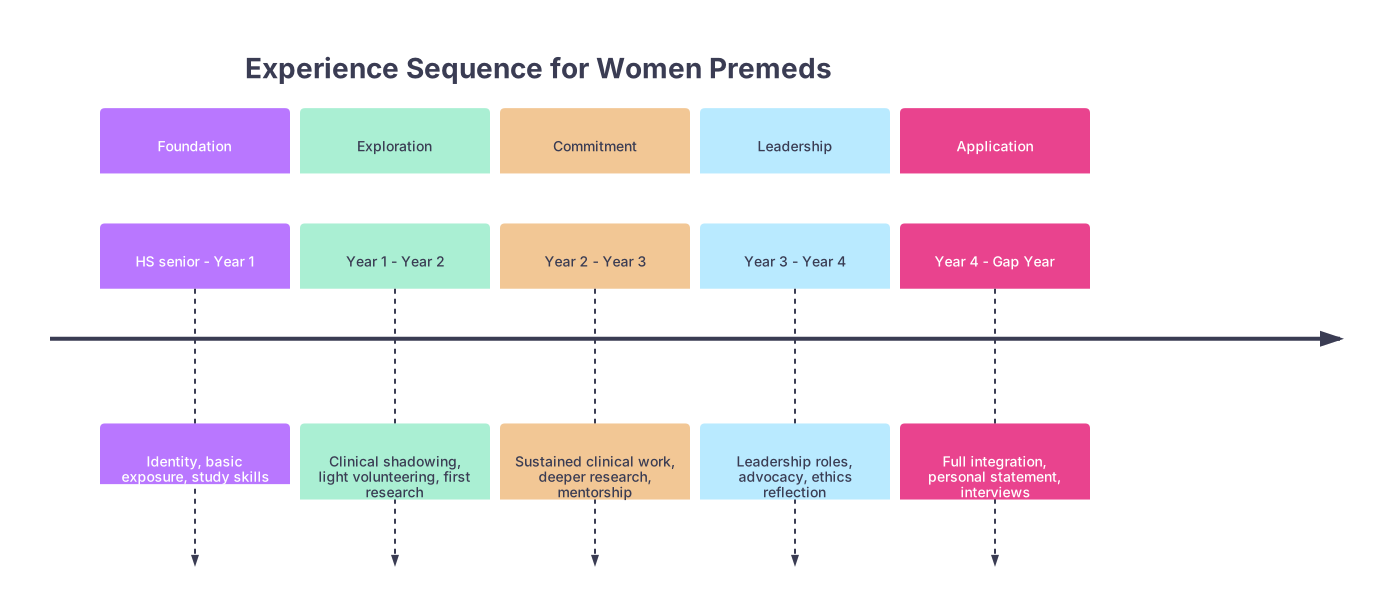
| Period | Event |
|---|---|
| Foundation - HS senior - Year 1 | Identity, basic exposure, study skills |
| Exploration - Year 1 - Year 2 | Clinical shadowing, light volunteering, first research |
| Commitment - Year 2 - Year 3 | Sustained clinical work, deeper research, mentorship |
| Leadership - Year 3 - Year 4 | Leadership roles, advocacy, ethics reflection |
| Application - Year 4 - Gap Year | Full integration, personal statement, interviews |
You’ll recycle the same core categories over and over, but with increasing depth:
- Academics and study discipline
- Clinical exposure and patient contact
- Research and inquiry
- Service and community engagement
- Identity, gender, and ethics reflection
- Leadership and advocacy
The key is not to cram everything into junior year or a random gap year. You want a visible ramp of responsibility and insight, not a sudden spike.
High School Senior / Pre-College Summer: Set Your Direction, Not Your Résumé
At this point you should stop scrambling for “prestige” and focus on setting your trajectory.
Your goals for this phase:
- Confirm you actually like health care, not just the idea of medicine.
- Build basic work and time-management habits.
- Start noticing gender dynamics in real-world settings (quietly, like an anthropologist).
Concrete moves:
One light clinical exposure
- A short hospital volunteer stint, hospice volunteer, or shadowing a family friend physician/PA/NP.
- Do not overthink the specialty. You’re there to see:
- How staff talk about patients.
- How women clinicians are treated by patients and colleagues.
- Who leaves the room to “help with family stuff” when calls come in.
A real job of any kind
- Retail, food service, babysitting, lifeguard.
- Med schools respect work. Especially when you’re supporting yourself or your family.
- Start a log of:
- Difficult customers
- Ethical gray areas (cutting corners, safety, fairness)
- Gendered expectations (“Can you smile more?” “We need a woman for this client.”)
Set up your “experience log” system
- A simple Google Doc or Notion page with:
- Date / Role / Location
- 2–3 sentence description
- “What I saw about power, vulnerability, or fairness today”
- A simple Google Doc or Notion page with:
You are not “behind” if you have zero formal clinical hours when college starts. You are ahead if you already know how to observe and reflect.
Year 1 (Freshman): Identity and Gentle Exposure
At this point you should protect your GPA first and sprinkle low-pressure experiences around it. Your primary job is to prove you can think, read, and pass STEM.
Your priorities:
Fall Semester: Lay the foundation
- Master college-level studying.
- Join one premed-adjacent club, not five.
- Women in Science/Women in Medicine groups
- AMSA or campus pre-health club
- Start going to meetings and listening.
- Notice: Who talks? Who gets interrupted? Who organizes the emotional labor?
Spring Semester: Add light clinical and service
- 2–4 hours/week of:
- Hospital volunteer (friendly but structured)
- Free clinic greeter/runner
- Crisis hotline training (if offered)
- You want just enough contact to confirm:
- You can function in a medical setting
- You’re not secretly averse to blood, grief, or chaos
- 2–4 hours/week of:
Summer After Year 1: Short project + more exposure
- Choose one primary lane, not four:
- A 6–8 week research assistant gig
- Full-time clinical job (CNA, MA, scribe if you can get trained that fast)
- An organized service program with health angle
- Pair it with:
- At least 10–20 hours of shadowing one physician you can keep long-term (bonus if she’s a woman in your possible specialty).
- Choose one primary lane, not four:
At this stage, don’t push for leadership. You have nothing to lead yet.
Year 2 (Sophomore): Depth and First Commitments
Now you start choosing. Not everything. But something.
At this point you should have:
- A stable GPA trend
- 20–40 hours of shadowing or clinical volunteering
- Membership (not leadership) in at least one org that matters to you
Your Year 2 sequence should look like this.
Fall Sophomore: Commit to 2–3 “anchors”
Pick two or three roles you’ll hold for at least a full academic year:
Anchor 1 – Clinical contact
- Options:
- Hospital volunteer with more responsibility (ED, inpatient floors)
- MA/CNA/EMT/scribe if you’re certified
- Free clinic role with recurring patient interaction
- Aim: 3–6 hours/week, every week.
- Options:
Anchor 2 – Service/advocacy with a gender or equity angle
- Domestic violence shelter
- Reproductive health clinic (PP, student-run sexual health org)
- Mentoring girls in STEM
- Campus organization addressing harassment, consent, or pay equity
- This gives you content for “women in medicine” and ethics questions later.
Optional Anchor 3 – Intro research
- Preferably with a long runway: a lab you can stay in 2–3 years.
- You don’t need a big-name PI. You need continuity.
Spring Sophomore: Add structure and reflection
Now you start doing two higher-order things:
Seek a mentor who is a woman in medicine
- Find:
- A female attending or resident you shadowed
- A woman PI in your department
- An advisor from Women in Science group
- Ask for:
- One 30–45 min meeting
- Her story about training, bias, family vs career decisions
- Start a “mentor file” with notes and questions.
- Find:
Formal ethics exposure
- Take an intro bioethics/medical humanities course if you can.
- Or:
- Join an ethics discussion group
- Attend hospital ethics committee open sessions or grand rounds if possible
- Log specific cases you hear about:
- Reproductive autonomy
- End-of-life care
- Gender bias in pain treatment or diagnosis
Summer After Year 2: Serious Experience Choice Point
This is a big summer. At this point, you should choose a primary track that fits your narrative:
Track A – Clinical-heavy
- Full-time EMT, CNA, patient care tech, MA, or scribe
- Goal: 30–40 hrs/week for 8–12 weeks
- Emphasis: Volume of patient stories, communication under pressure, interprofessional teamwork
Track B – Research-heavy
- 8–10 week research program (SURP, REU, institutional program)
- Goal: poster, abstract, or real contribution
- Emphasis: Asking questions about women’s health, disparities, or systems
Track C – Service + advocacy
- Full-time role in:
- Women’s shelter
- International health program (ethically structured, non-savior complex)
- Policy or nonprofit internship focused on health equity
You can’t do all three well. Commit. You’ll build the others in smaller doses later.
Year 3 (Junior): Leadership and Coherent Story
This is the year where scattered experiences either cohere… or stay random. At this point you should:
- Be known somewhere (clinic, lab, org) as “reliable and good”
- Have at least one mentor who’d write you a specific LOR
- FEEL the tension of your own ethics questions
Fall Junior: Step into leadership where you already belong
No parachute leadership.
You take leadership in the spaces you already served:
- Volunteer → shift lead or coordinator
- Club member → committee head or officer
- Research assistant → train new students or own a small project
This is where a lot of women stumble: they underclaim. I’ve seen smart women premeds “help out” with logistics for everything and then list zero leadership on AMCAS.
Leadership you can count:
- Scheduling and training new volunteers
- Running a support group or workshop series
- Coordinating a campus campaign on consent, mental health, or equity
- Creating a new patient-education project in your clinic
Ethics and Gender: Go deeper, not wider
At this point you should build at least one sustained ethics or gender-related project, not sprinkle a dozen one-offs.
Examples:
- Develop a peer workshop series on:
- Bias in clinical decision-making
- Microaggressions toward women in medicine
- Consent and power in patient interactions
- Participate regularly in:
- Hospital or campus ethics committee student liaison role
- Med humanities reading group with clinicians
Keep track of cases where gender, power, and medicine intersect:
| Date | Setting | Issue | Your Question |
|---|---|---|---|
| Oct 3 | ED volunteer | Pain med bias | Why were women patients doubted first? |
| Nov 12 | Shelter | Confidentiality | When is it right to break confidence? |
| Dec 5 | Clinic | Repro care | How do personal beliefs fit in? |
Those lines become concrete interview stories later.
Spring Junior: Position for Application Year
Now you start planning your application year like a project manager.
Decide your application year and gap year plan
- If applying straight through:
- MCAT by spring/summer
- Letters lined up by May
- If taking a gap year:
- Start locking in what you’ll do (research, full-time clinical, fellowship)
- If applying straight through:
Secure letter writers You want:
- 2 science faculty (ideally one who’s seen you struggle and improve)
- 1–2 from:
- A PI
- A long-term clinical supervisor
- A leader from your advocacy/service work
Elevate one role into “flagship” leadership
- President of Women in STEM org
- Lead coordinator at a free clinic
- Project lead on a research project about women’s health or disparities
- Founding a new initiative only if it’s realistic and sustained
Summer After Year 3: Application + Capstone Work
At this point, if you’re applying without a gap year, your time is split:
- Roughly half application logistics
- Half continued high-yield experience
Use your summer like this:
- 15–20 hrs/week continuing your flagship role
- 10–15 hrs/week of:
- MCAT (if not done)
- Secondaries and application writing
- Keep a weekly reflection: “What from this week shows I’m ready now to train as a physician?”
If you’re planning a gap year, this summer is where you transition in to that full-time role.
Gap Year (Optional but Powerful): Show Full-Time Adult Capacity
For many women premeds, the gap year is where the story clicks. You get full-time responsibility without juggling 5 classes.
At this point you should:
- Be working 35–40 hours/week in something clearly preparatory for medicine
- Have one clear through-line: clinical, research, service, or policy
Good gap year structures:
| Track | Main Role | What It Shows |
|---|---|---|
| Clinical-heavy | MA, scribe, EMT, CNA | Patient care stamina, team skills |
| Research | Coordinator, full-time RA | Data rigor, long-term focus |
| Service/Policy | Nonprofit, public health dept | Systems view, advocacy |
| Combo | 0.6 FTE clinical + 0.4 FTE research | Integration of care and inquiry |
As a woman premed, gap year is also where you can test your boundaries:
- Advocate for yourself at work (schedule, pay, respect).
- Observe gender dynamics on rounds, in staff meetings, with attendings.
- Try saying “Actually, I can’t take on that extra task” and watch what happens.
Those are not side notes. They’re rehearsal for residency.
Application Year: Sequence Your Story, Not Just Your Forms
Now you’ve done the work. The question becomes: In what order do you present it?
At this point you should be ruthless: your application must read like a coherent story of a woman who:
- Entered medicine with clear eyes about its human and ethical messiness
- Grew steadily in responsibility and scope
- Thought about gender, power, and care in a serious way
- Can handle the grind without losing her values
AMCAS Experiences: Order by Narrative, Not Ego
Don’t just sort activities by hours or prestige. Sequence them so an adcom can read top-to-bottom and see:
- Early exposure and curiosity
- Growing clinical responsibility
- Increasingly sophisticated ethical reflection
- Leadership that actually impacted people
Your 3 “most meaningful” should usually be:
- One deep clinical role (with concrete stories of patients and teams)
- One service/advocacy/ethics role with a gender or equity lens
- One academic/research or leadership role showing intellectual maturity
Interviews: Use Time Sequence to Your Advantage
Most women fumble interviews by answering as if everything is happening now. You have a timeline. Use it.
When asked “Why medicine?” or “Tell me about a challenge,” answer in phases:
- “Early on, I thought medicine was about X…”
- “Then sophomore year, working at the shelter, I saw Y…”
- “By my gap year, as a scribe in the ED, I realized Z…”
Adcoms love visible growth. Especially when you connect it to:
- Real ethical tension (not sanitized scenarios)
- Awareness of gender bias without making it your only identity
- Concrete steps you’ve taken to build resilience and boundaries
Quick Reality Check: Common Bad Sequences to Avoid
If you recognize yourself here, adjust now.
All clinical dumped into gap year, nothing prior
Reads as: “Decided late, untested in patient settings.”Heavy research first, no people contact until junior year
Reads as: “Great scientist, maybe not actually into messy human work.”Spread-thin club involvement, no deep advocacy
Reads as: “Does everything, owns nothing.”Strong women’s advocacy with zero tie to medicine
Reads as: “Great activist, unclear on why physician specifically.”
You can fix almost all of these by adding 6–12 months of sustained, weekly clinical or service work and then actually writing about what changed you.
A Visual of How Time Should Tilt
By the end, your hours per category should roughly tilt from “exploration” to “leadership and deep work”:
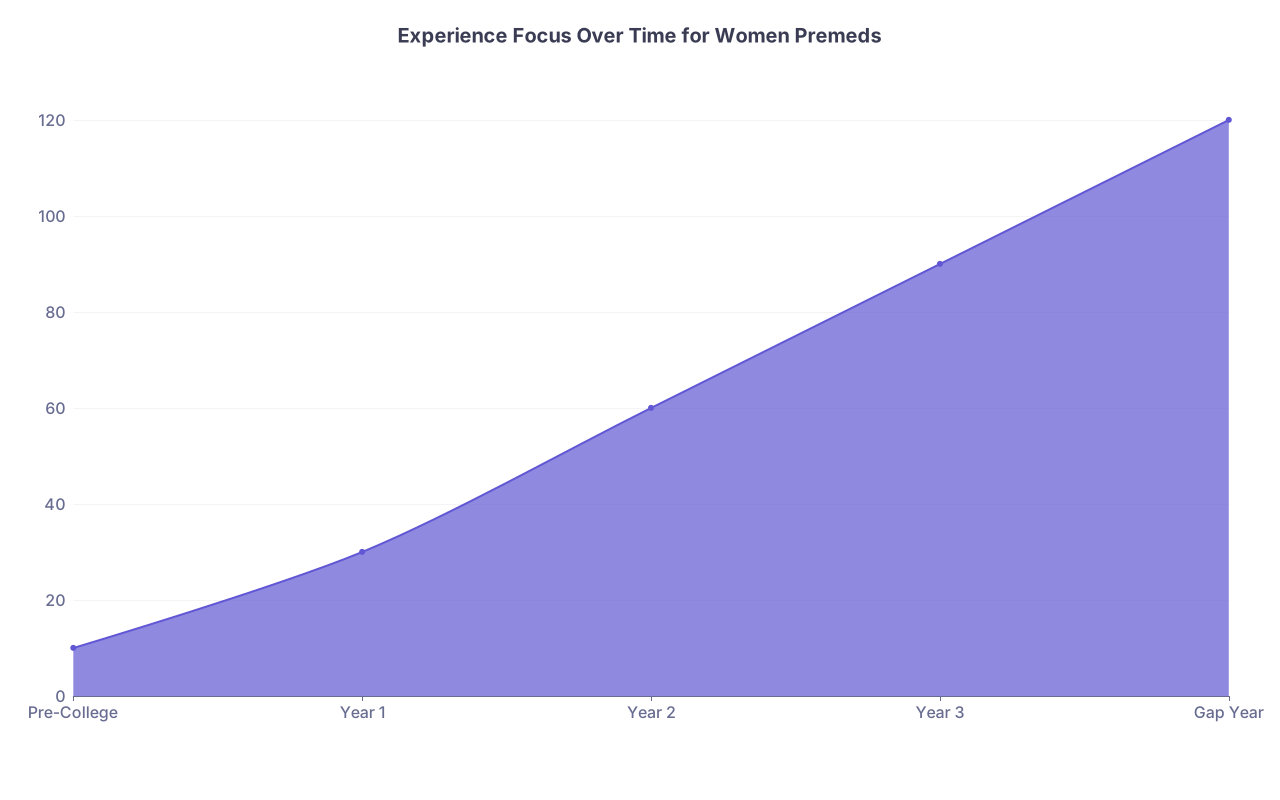
| Category | Value |
|---|---|
| Pre-College | 10 |
| Year 1 | 30 |
| Year 2 | 60 |
| Year 3 | 90 |
| Gap Year | 120 |
And leadership intensity ramps later:
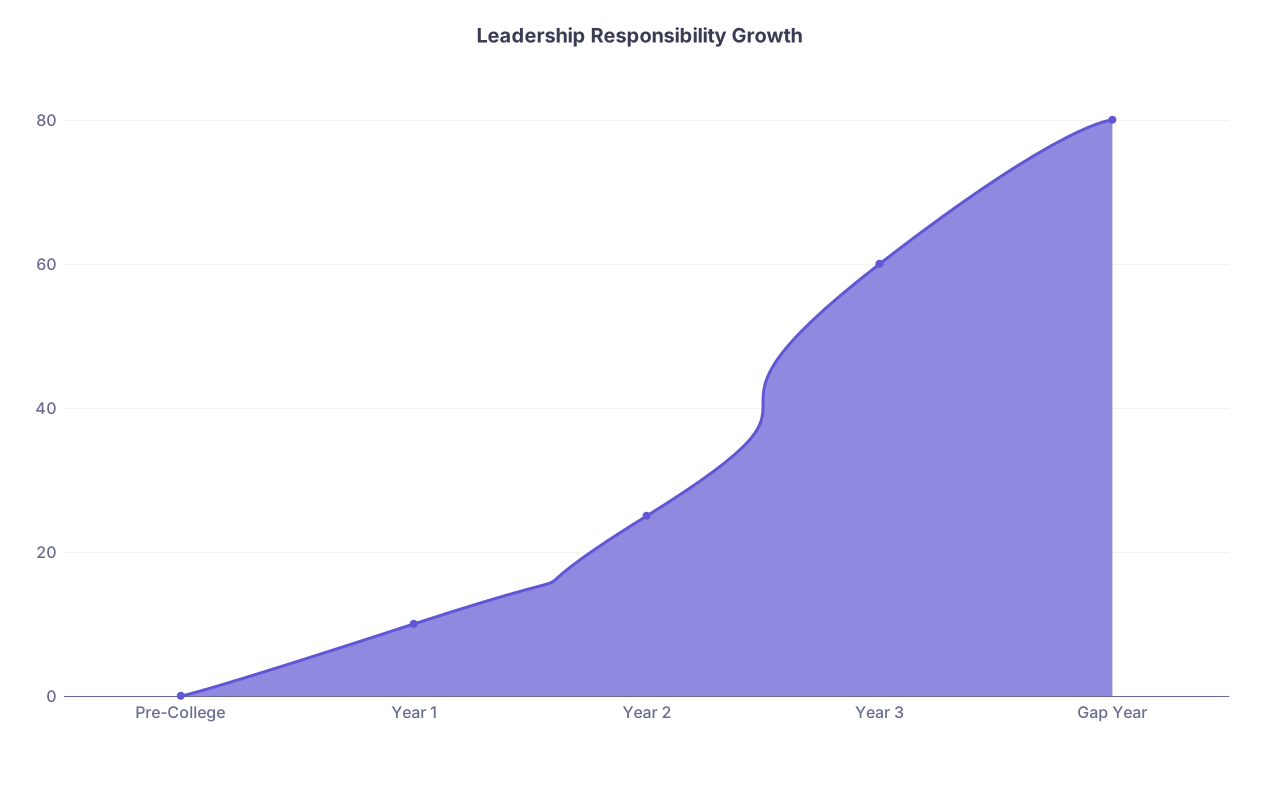
| Category | Value |
|---|---|
| Pre-College | 0 |
| Year 1 | 10 |
| Year 2 | 25 |
| Year 3 | 60 |
| Gap Year | 80 |
You start light. You finish heavy. That’s the point.
Gender, Power, and Ethics: Don’t Bolt It On at the End
One last thing: do not tack “women in medicine” onto your personal statement like a sticker. It needs to be threaded throughout your actual experience sequence.
You should be able to map:
- A freshman or sophomore moment when you first noticed gender bias
- A middle-college period when you tested how to respond (or not)
- A later role where you acted—through mentoring, policy, or boundary-setting
That’s an arc. That’s growth. That’s what they want to see.
Your Action Step for Today
Open a blank page and make four columns: Year/Phase, Clinical, Service/Advocacy, Research/Academics, Leadership/Ethics. Map what you’ve already done into those boxes by semester.
Then mark the biggest empty stretch. That’s the gap you need to fill next—not with any random activity, but with a 6–12 month, weekly commitment that fits where you are on the timeline. Fill that gap on paper today, even if it’s just “clinic volunteer, 4 hrs/wk starting September,” and you’ve already started fixing your sequence.