
The biggest mistake future women physicians make in M1–M2 is waiting for research and leadership to “appear.” They rarely do. You build them, step by step, on a timeline.
You are not “just a first‑year.” You are 24 months away from ERAS asking:
- Where is your sustained research?
- Where is your leadership and advocacy?
- Where is your story as a future woman MD?
I am going to walk you month by month through M1–M2 with one lens: at this point, you should be doing this for research and this for leadership. If you follow this, you will not be the person in spring of M2 saying, “I need research now; what do I do?”
Big Picture: Your 2‑Year Research & Leadership Arc
At this point (before M1 starts or in the first few weeks), you need a frame:
- M1 Fall: Exploration and positioning
- M1 Spring: Commitments and early output
- M1 Summer: Deep work (research block and leadership build)
- M2 Fall: Consolidation and visible roles
- M2 Spring: Outcomes, mentoring others, and shaping your narrative
Here is what a healthy balance actually looks like across M1–M2:
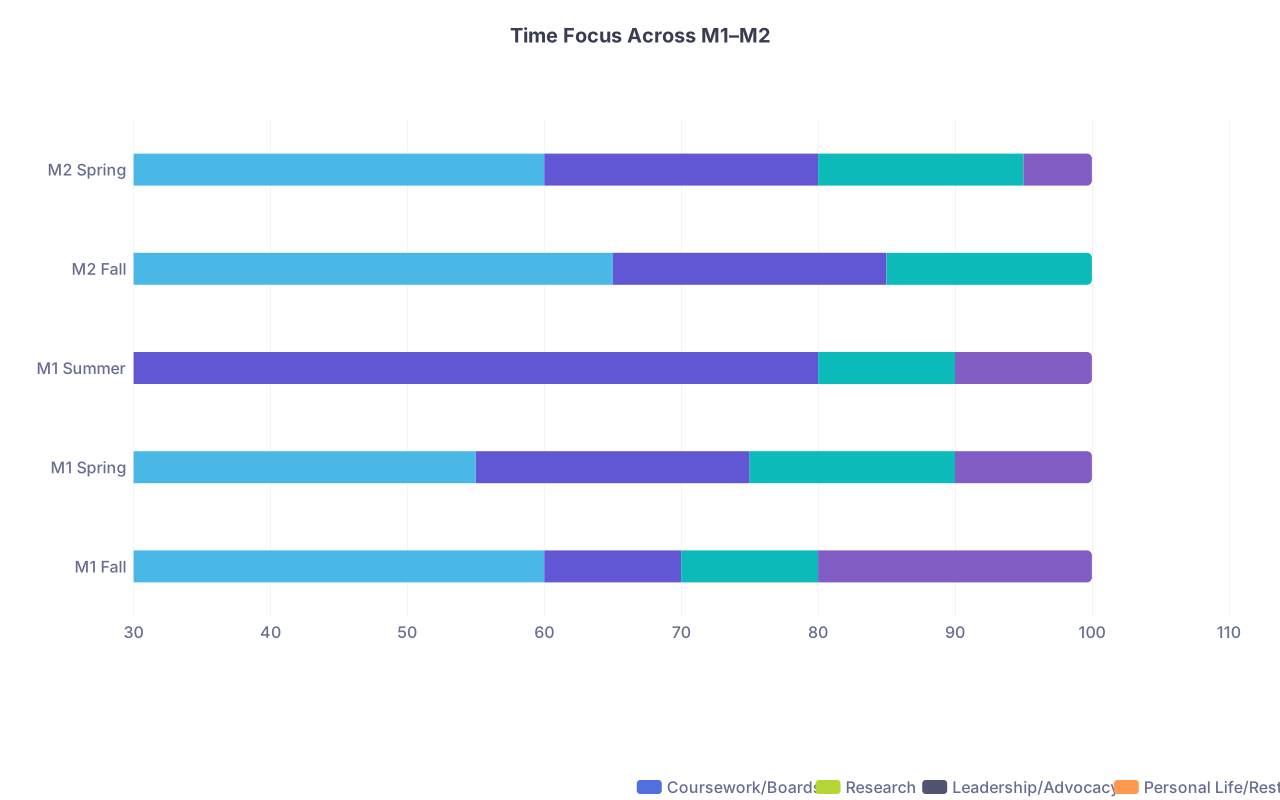
| Category | Coursework/Boards | Research | Leadership/Advocacy | Personal Life/Rest |
|---|---|---|---|---|
| M1 Fall | 60 | 10 | 10 | 20 |
| M1 Spring | 55 | 20 | 15 | 10 |
| M1 Summer | 30 | 50 | 10 | 10 |
| M2 Fall | 65 | 20 | 15 | 0 |
| M2 Spring | 60 | 20 | 15 | 5 |
Those numbers are not precise, but the shape is right: high school load during the year, aggressive research in the M1 summer, then refinement and visibility in M2.
Your goals as a future woman MD are not just “have research” and “hold leadership.” They are:
- Demonstrate you can contribute to scholarly work.
- Show you can lead and advocate, especially on issues affecting women in medicine and women’s health.
- Build real relationships with mentors who will sponsor you, not just write generic letters.
Now we go chronologically.
M1: Month‑by‑Month Research and Leadership Plan
August–September (M1 Months 1–2): Orientation and Targeting
At this point you should not be committing to 3 projects and 5 organizations. Your job is positioning.
Research (6–8 hours total over the month):
Map your school’s research landscape.
- Scan departmental pages: OB/GYN, Internal Medicine, Pediatrics, EM, Surgery.
- Look for women faculty with active publications in the last 2–3 years.
- Note projects related to:
- Women’s health
- Health equity
- Medical education
- Ethics / professionalism
Build a short “research target list” (10–15 people).
Include:- Name and department
- Area of work
- Recent paper title
- Whether they have trainees on their author list
Draft a single, clean outreach email template you can customize.
- 2–3 sentences about you (M1, interests, any prior research or skills like statistics, coding, or writing).
- 1–2 sentences referencing a specific paper of theirs.
- Clear ask: “I would be grateful for a brief 15–20 minute meeting to learn whether there might be a way to contribute to your work.”
Leadership (2–3 hours total over the month):
At this point you should just show up and observe.
- Attend interest group fairs:
- Women in Medicine / American Medical Women’s Association (AMWA)
- OB/GYN, Internal Medicine, Surgery, EM, Family Med
- Ethics or humanities in medicine
- Go to 2–3 meetings, keep your camera on (if virtual), ask at least one question.
- Note which groups:
- Actually do things (events, mentoring, advocacy).
- Have competent, organized leadership versus chaos.
You are evaluating where you might credibly hold a leadership role in M2. Not signing up for everything.
October–November (M1 Months 3–4): Initial Commitments
The exam schedule is real now. So you move carefully.
Research (start 1 project):
By the end of November, you should:
- Have sent 8–12 targeted emails from your list.
- Secured at least one meeting that ends with:
- A concrete project you can join or
- A plan to start something in the spring / summer.
If you have options, prioritize projects that:
- Have a defined product: abstract, poster, manuscript, QI project with a deadline.
- Fit into your schedule in 2–4 hours per week.
- Involve a mentor with a track record of publishing with students.
Set expectations explicitly:
- “Given my M1 schedule, I can commit 2–3 hours weekly now and 20–30 hours weekly in the M1–M2 summer. I would like to aim for [X: abstract, manuscript] by [Y: date]. Does that seem realistic?”
If a mentor hesitates or is vague, that is a red flag. You do not want a 3‑year data cleaning limbo.
Leadership (dip a toe, do not overcommit):
By late fall you should:
- Pick 1–2 core organizations to be an active member in:
- e.g., Women in Medicine / AMWA + one specialty interest group.
- Take on small, visible tasks:
- Help organize a panel on women in surgery.
- Coordinate a book club reading on gender bias in medicine.
- Assist with a mentorship mixer between M1s and women residents.
You are building credibility. When elections come in spring, people remember “she got things done” not “she was on the email list.”
December–January (End of Fall / Start of Spring): Reflection and Reset
You will hit your first big exam blocks. Use the quieter pockets around winter break strategically.
Research:
At this point you should:
- Have a clear, written role on your project:
- “I am extracting data from charts for X cohort”
- “I am conducting a literature review”
- “I am drafting the introduction section”
During winter break (if you get 2–3 weeks off):
- Plan 10–20 hours of focused research work:
- Push a draft forward.
- Finish a lit review.
- Learn a needed skill (basic R for statistics, REDCap navigation, etc.).
Schedule a January check‑in with your mentor:
- Confirm goals for:
- Abstract deadlines (local, regional, national conferences).
- Manuscript timelines.
- Summer expectations (full‑time involvement, funding applications).
Leadership:
You should:
- Decide now: which group(s) will you consider running for leadership in?
- Talk to the current woman president / leader:
- Ask what the role really entails (hours per week, emotional labor, admin tasks).
- Ask specifically about how she has handled gender bias, being talked over in meetings, etc. This is your reality check.
Make a short plan:
- “If I run, I will aim for X role (e.g., Vice President, Advocacy Chair, Mentorship Chair) with Y concrete goals (e.g., launching a women-in-surgery visiting surgeon series, starting a women’s health elective journal club).”
M1 Spring: Building Real Traction
February–March (M1 Months 7–8): Output and Applications
Now you shift from “I joined something” to “I am producing things.”
Research:
At this point you should:
- Be doing 2–4 hours per week of steady work on your project.
- Identify at least one concrete deliverable with a date:
- Local research day abstract (often March–May).
- Regional / national conference that accepts student work (APSA, ACOG, ACP, SAEM, etc.).
If your current project is dead in the water (no meetings, no progress, no data access):
- Cut your losses now and re‑engage your target list.
- It is better to pivot in February than to realize in May you have nothing.
Leadership:
Most schools hold club elections this time of year.
By the end of March, you should:
Run for one meaningful leadership role, not five tiny ones.
Good choices for a future woman MD:- President / Co‑President of Women in Medicine / AMWA
- Advocacy Chair in a specialty group
- DEI / Wellness / Mentorship Chair with a clear agenda
Use your platform explicitly:
- “I want to focus on supporting women students facing microaggressions on the wards in M3–M4.”
- “I plan to create a structured mentoring network between women faculty and students.”
You are not just collecting titles. You are selecting a role that supports your values and your future narrative.
April–May (M1 Months 9–10): Locking in the M1–M2 Summer
The M1–M2 summer is where you can massively accelerate your research trajectory. Do not walk into May without a plan.
Research:
By the end of April you should have:
- A formal summer plan for 6–10 weeks:
- Who is your main mentor?
- What exactly are you doing each week?
- Will there be a product by August?
If your school has summer research funding, deadlines are usually between January and March. If you missed those, fine. Not fatal. You can still:
- Do unfunded research (while working a side job if needed).
- Apply to external programs (some women’s health / health equity research programs exist, like at major academic centers).
Aim for a project with:
- Clear data to work with by June.
- A strong chance of:
- Abstract submission by fall of M2.
- Manuscript draft within 12 months.
Leadership:
At this point:
- If elected, you start shadowing the outgoing officer(s).
- Have a simple 3‑bullet plan for your term:
- One anchor project (e.g., annual women in specialties symposium).
- One advocacy effort (e.g., lactation room access audit, curriculum changes around gender bias).
- One mentorship structure (e.g., pairing M1–M2 women with residents / faculty).
Document everything. You will need specifics for future personal statements and interviews.
M1–M2 Summer: Deep Work Phase (June–August)
This summer can differentiate you. Or it can disappear into vague “lab experience.”
Weeks 1–2: Onboarding and Scope
At this point you should:
Have a kickoff meeting with your mentor and any co‑mentors:
- Clarify goals, timelines, authorship expectations.
- Lay out a weekly schedule (e.g., 25–30 hours research, 5 hours leadership/admin, rest/board prep as needed).
Complete all logistics:
- IRB training, HIPAA modules, data access, study protocol review.

Weeks 3–6: Maximum Productivity Window
This 4‑week window is where you should make 70–80% of your research progress.
Your weekly goals:
20–30 hours / week on:
- Data collection and cleaning
- Analysis (with guidance)
- Drafting sections of an abstract or manuscript
Meet with your mentor or research team weekly:
- Present 1–2 slides or a brief written update.
- Ask for feedback and next steps.
By the end of Week 6 you should ideally have:
- A complete or near‑complete data set or analysis plan.
- A working draft of an abstract or at least a structured outline.
If you are getting nothing but “We will see when the data comes in,” your project was not scoped correctly. That is painful, but better to know early.
Leadership During Summer:
You will likely not have heavy leadership duties yet, but you can:
- Do planning work for your term:
- Draft an event calendar.
- Reach out to women faculty and residents to confirm fall events.
- Start one small, high‑impact project:
- A brief survey of women students’ experiences with mistreatment, bias, or safety concerns.
- An anonymous story collection for a future panel on gender and ethics in clinical training.
M2: Tightening the Story and Making It Visible
M2 is when board prep and harder coursework hit. You do not start new massive commitments. You refine and finish.
August–October (M2 Early Fall): Products and Presence
At this point you should be aiming for visible outputs.
Research:
By the end of October, target:
1–2 abstract submissions:
- Your school’s research day
- A regional/national conference
A clear plan and timeline for:
- Manuscript submission (even if it is after Step 1/Level 1).
If you have enough momentum, you can add:
- A small secondary project (case report, small chart review) with a short turnaround.
- Only if your main project is stable.
| Timepoint | Minimum Goal | Strong Goal |
|---|---|---|
| End of M1 Summer | Project in progress | Abstract draft ready |
| Fall of M2 | 1 abstract submitted | 2+ abstracts, poster |
| End of M2 | 1 submitted manuscript | 1 accepted, 1 in draft |
Leadership:
This is your main leadership year. By September you should:
Launch your anchor project:
- Example: A “Women in Medicine Leadership Evening” with a panel of women faculty across specialties, speaking honestly about career, family, bias, and ethics.
Start 1 ethics‑adjacent initiative:
- Reflection sessions on gender and moral distress in clinical training.
- Collaboration with your ethics department on a case discussion series about reproductive rights, consent, or gender‑based violence in clinical care.
Document outcomes: attendance numbers, qualitative feedback, any policy changes sparked.
November–February (M2 Late Fall–Winter): Synthesis and Mentorship
This is where you turn activity into a coherent narrative as a future woman MD.
Research:
At this point you should:
Be polishing and presenting:
- Posters at your institutional research day.
- Presentations at small conferences or student symposia.
Push your manuscript(s):
- Schedule co‑author meetings to finalize drafts.
- Set a real submission deadline (preferably before dedicated board study, but not at the cost of failing an exam).
Leadership and Ethics:
Your leadership should now be:
- Less about starting things, more about:
- Sustaining your main projects.
- Delegating tasks to M1s and early M2s.
- Handing off pieces to successors.
Mentorship is non‑optional here:
- Take on at least 1–2 M1 women as mentees:
- Meet once every 1–2 months.
- Talk frankly about burnout, microaggressions, and boundary‑setting in leadership.
You are modeling ethical leadership: not martyrdom, not performative overwork.
March–May (End of M2): Hand‑Off and Narrative Building
You are close to clinical rotations and eventually residency applications. Now you consolidate.
At this point you should:
Hand off leadership roles with:
- A written transition document listing:
- Contacts
- Annual events
- Budgets
- Lessons learned (what worked, what failed, what resistance you saw especially around women‑focused initiatives).
- A written transition document listing:
Request letters of recommendation from:
- Your main research mentor.
- A faculty member who saw your leadership (Women in Medicine advisor, ethics faculty collaborator, etc.).
Have an explicit conversation with them:
- “I hope to apply in [X specialty] as someone committed to women’s health / gender equity / ethical leadership. Could you speak to my work in [specific project] and how I functioned on the team?”
You also need to articulate your own story:
- Spend a few hours drafting a paragraph that answers:
- “How have my research and leadership experiences as a woman in medicine shaped the kind of physician I want to be?”
This will echo through your personal statement, activity descriptions, and interviews.
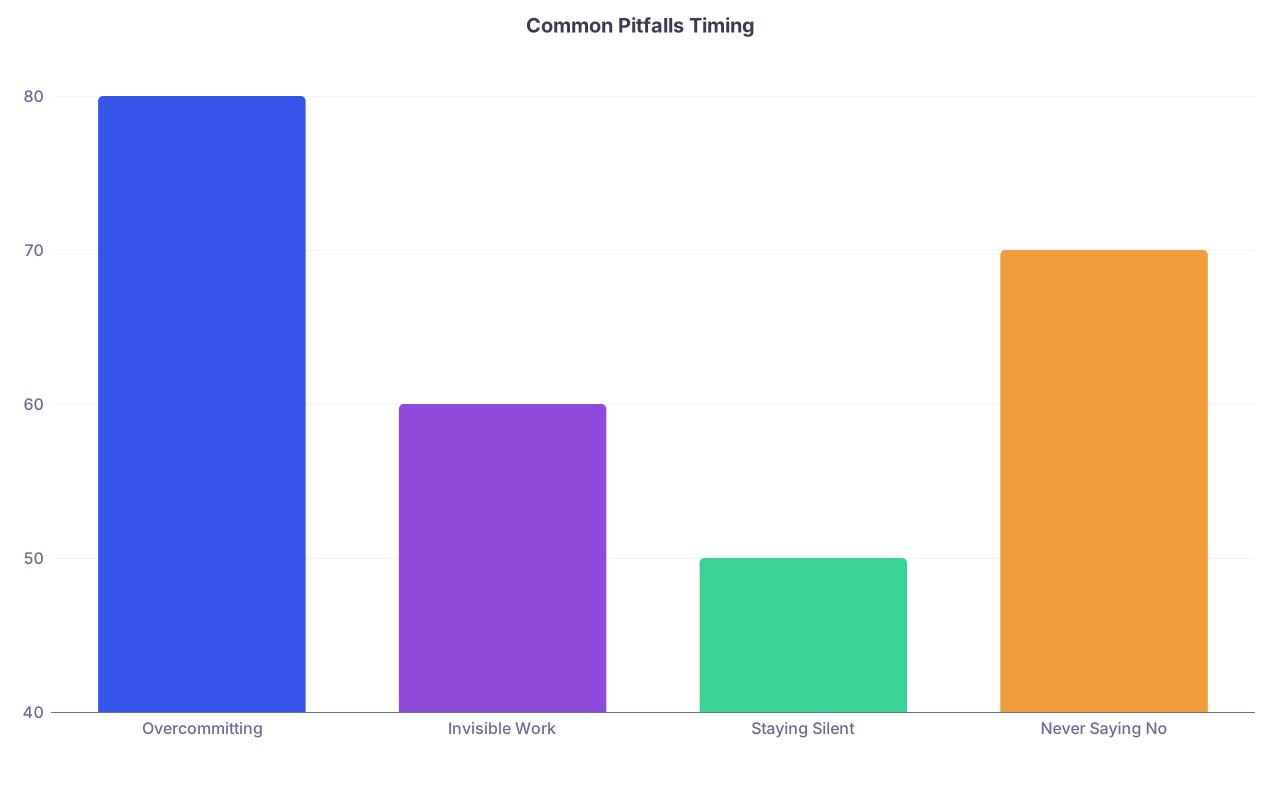
Common Pitfalls for Women in M1–M2 (and When They Show Up)
Let me be blunt about traps I see over and over.
| Category | Value |
|---|---|
| Overcommitting | 80 |
| Invisible Work | 60 |
| Staying Silent | 50 |
| Never Saying No | 70 |
Overcommitting (M1 Fall–Spring):
4 research projects + 5 clubs = shallow impact + burnout. Pick 1–2 that matter and go deep.Invisible work (all year):
Women disproportionately do admin grunt work in student groups. If all you do is take notes, send emails, and set up Zoom links, your “leadership” will vanish from your CV and your memory. You need ownership of a project.Staying silent in meetings (M1–M2 leadership):
You will be interrupted. Talked over. Ignored. Decide your default: “I will calmly repeat, ‘As I was saying…’ and back myself up,” and ally with other women to echo each other.Never saying no (especially M2):
You are not morally obligated to join every diversity initiative because you are a woman. Say yes where you can have impact and say no to guilt‑driven asks that drain you.
Putting It All Together: Your Practical Checklist
Here is a compact, time‑based reference.
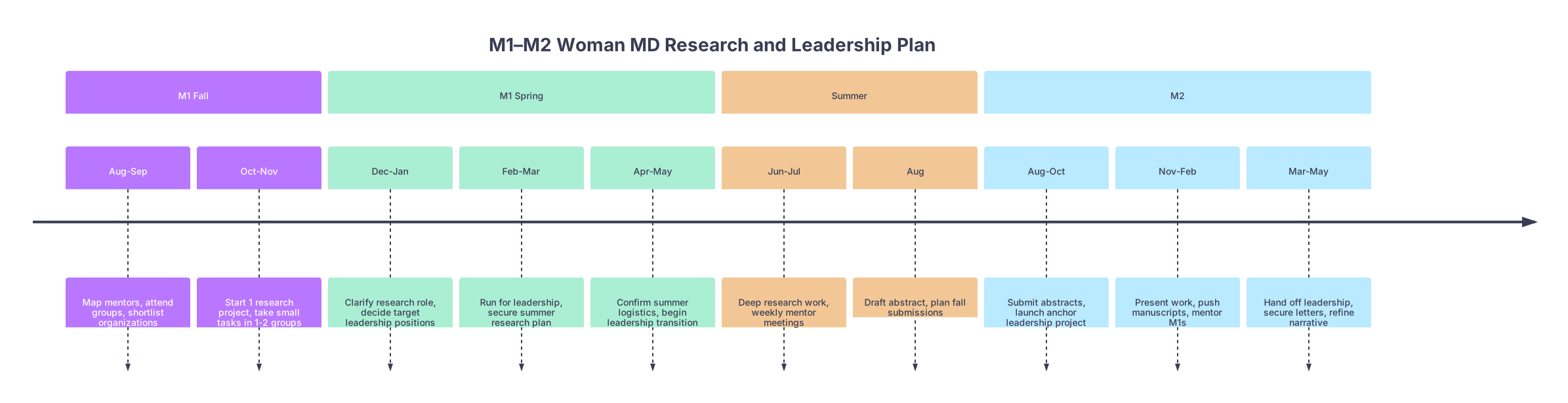
| Period | Event |
|---|---|
| M1 Fall - Aug-Sep | Map mentors, attend groups, shortlist organizations |
| M1 Fall - Oct-Nov | Start 1 research project, take small tasks in 1-2 groups |
| M1 Spring - Dec-Jan | Clarify research role, decide target leadership positions |
| M1 Spring - Feb-Mar | Run for leadership, secure summer research plan |
| M1 Spring - Apr-May | Confirm summer logistics, begin leadership transition |
| Summer - Jun-Jul | Deep research work, weekly mentor meetings |
| Summer - Aug | Draft abstract, plan fall submissions |
| M2 - Aug-Oct | Submit abstracts, launch anchor leadership project |
| M2 - Nov-Feb | Present work, push manuscripts, mentor M1s |
| M2 - Mar-May | Hand off leadership, secure letters, refine narrative |
Today, not next month, take one concrete step:
Open your school’s faculty directory and identify three women faculty whose work interests you. Write a short, specific email to the first one asking for a 15–20 minute meeting about potential research or mentorship. Do not overthink it. Send it.