
The way search committees talk about female faculty candidates behind closed doors is not what’s in the DEI brochure. Not even close.
I’m going to walk you through what actually gets said in those rooms, what it really means, and how women in medicine can prepare without gaslighting themselves into thinking they’re imagining the bias. I’ve sat in those meetings, heard the side comments, watched the “objective” scoring quietly bend as soon as a strong woman’s CV hit the table.
Let me pull back the curtain.
What Really Happens When Your CV Enters the Room
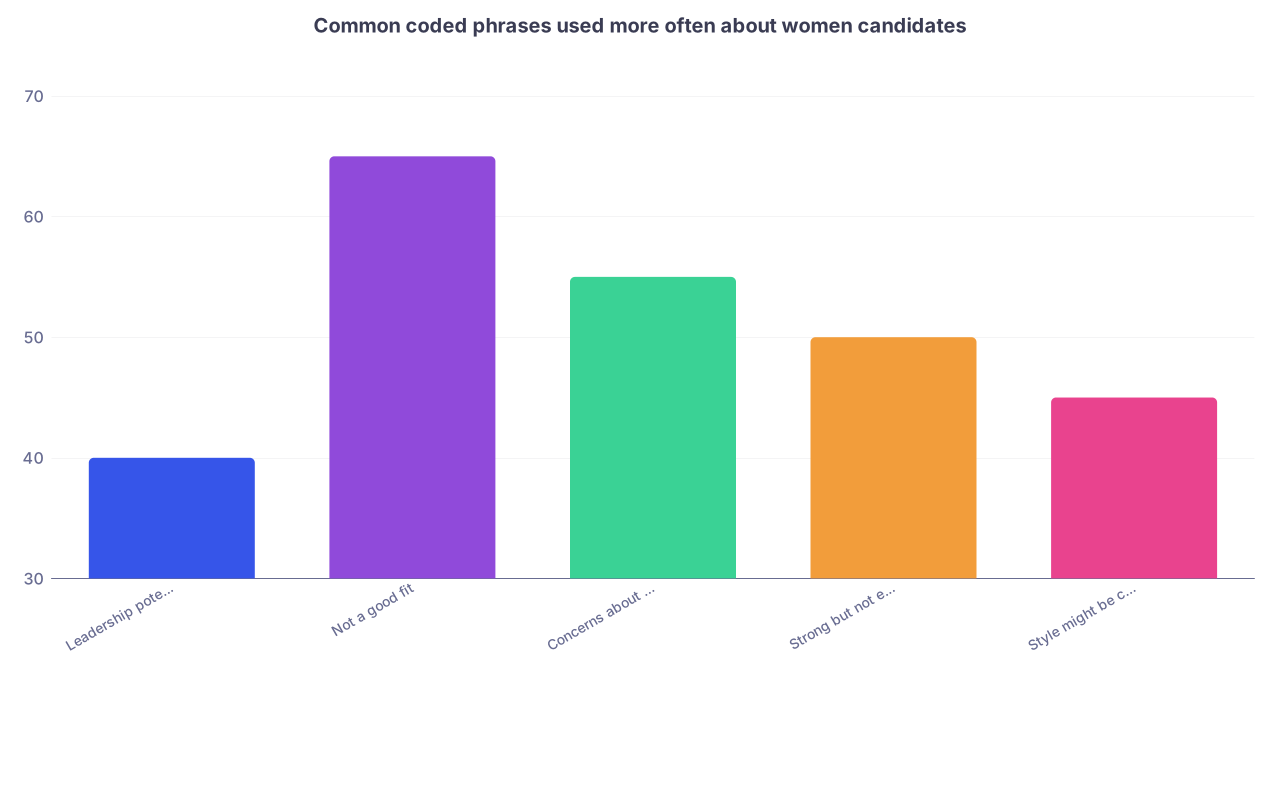
| Category | Value |
|---|---|
| Leadership potential | 40 |
| Not a good fit | 65 |
| Concerns about commitment | 55 |
| Strong but not exceptional | 50 |
| Style might be challenging | 45 |
Here’s the first lie you’ve probably been told: “We just follow the rubric.”
No. The rubric is theater. The real decisions happen in how people talk about you.
The process usually looks something like this: everyone pretends to score independently, then they walk into a room (or Zoom) and start “calibrating.” Calibration is where bias walks in wearing a blazer and holding a latte.
The chair might start: “Let’s go through our top 10 candidates.” On paper, you look fantastic. Strong publications. Solid funding trajectory. Good letters. Teaching. Service. All of it.
Then the language starts.
“She's very impressive, but…”
That "but" is where female candidates live or die.
The shift is subtle. For a male candidate: “He’s clearly on the rise, I think we can support his development here.” For a female candidate with the same metrics: “She’s done well, but I’m not sure we’ve seen enough independent leadership yet.”
Same CV. Different lens.
And everyone in the room feels comfortable, because nobody said “we don’t want a woman.” They just said “fit” and “style” and “leadership potential.” It sounds professional. It isn’t.
The Coded Language: What They Say vs What They Mean

Here’s where I’m going to be blunt. If you’re a woman in medicine, you need to learn to translate search committee code. Because it’s the same script at Harvard, at a midwestern community program, at a big public system. Different accents, same content.
Let’s decode the greatest hits.
“I have some concerns about her fit with the culture.”
Meaning: she has boundaries, opinions, or a backbone; we’re not sure we want to deal with that.
Reality: Committees use “fit” to maintain familiarity. Men who look/act like existing faculty are “great fit.” Women who are assertive, especially women of color, are “possibly disruptive.”
“Her style might be challenging.”
Meaning: she speaks directly, doesn’t soften everything with apologies, and doesn’t perform “likability” at the expected level.
Compare to how they talk about men: “He’s a strong personality, but that could be an asset in this division.”
“I’m not sure she’s ‘ready’ for this level yet.”
Meaning: her CV looks exactly like the male candidate we just got excited about. But our default is skepticism instead of presumption of excellence.
You see this a lot at promotion-level hires (associate/full). Men get promoted on potential. Women get promoted on proof.
“I worry about her bandwidth / other commitments.”
This one is ugly.
Meaning: She has young kids. She mentioned caregiving. Someone stalked her social media and saw family photos. They will call it “concern for her well-being” when it’s actually concern about her availability to serve the institution.
“I just didn’t get a sense of her vision.”
Meaning: she did not sell herself aggressively enough, or she did but they weren’t listening because they’d already decided she was “nice but not star material.”
And then the nuclear option:
“She’s excellent, but I’m not convinced she’s the superstar we need for this role.”
This is how you lose to a man with similar or slightly worse metrics. Women must often be undeniably, completely overqualified to overcome that one sentence.
The Double Standard on “Likeability” and “Leadership”
| Behavior | About Male Candidate | About Female Candidate |
|---|---|---|
| Direct and blunt | “Strong leader, decisive” | “Abrupt, might be hard to work with” |
| Negotiates hard | “Knows his worth” | “High maintenance, demanding” |
| Confident in achievements | “Impressive, clear sense of impact” | “Self-promoting, a bit full of herself” |
| Sets boundaries | “Focused, good prioritization” | “Not a team player, limited availability” |
| Ambitious career goals | “High potential, we want him on our team” | “Might not stay, concerned about retention” |
Here’s the thing I wish more women understood: committees are not primarily judging your CV. They’re judging your narrative and your palatability.
I’ve watched this happen in real time:
- A male candidate says, “I want to build a nationally recognized program here.” Committee: “We need this kind of bold vision.”
- A female candidate says the exact same line. Committee: “She might be a bit unrealistic. Do we have the resources for that? Will she be disappointed?”
Female leadership is treated as risky until proven safe. Male leadership is treated as default until proven problematic.
There’s also the tightrope of “confident but not too confident.” A man who’s 70% qualified but selling at 110%? “He’ll grow into it.” A woman who is 120% qualified and answers questions with precision? “She seems a little stiff. Not sure she’ll connect with people.”
And then there’s the question I’ve literally heard in more than one meeting:
“Do you think she’ll ‘play well’ with Dr. X?”
Translation: Will she tolerate the difficult senior male faculty we’re afraid to confront?
If the answer is “she’ll probably push back,” your stock drops.
How Family, Age, and “Stability” Get Weaponized
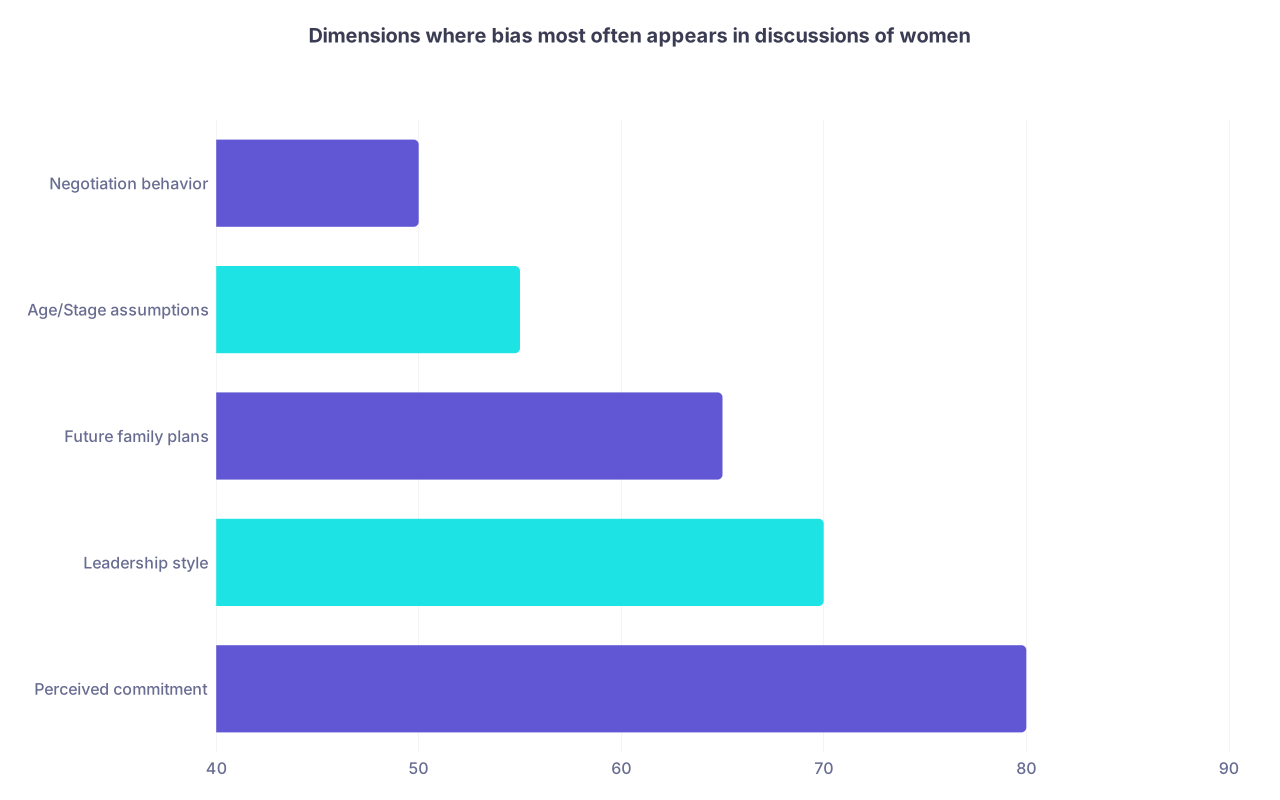
| Category | Value |
|---|---|
| Perceived commitment | 80 |
| Leadership style | 70 |
| Future family plans | 65 |
| Age/Stage assumptions | 55 |
| Negotiation behavior | 50 |
Nobody writes “two kids” on the rubric. They just talk around it.
I’ve heard it done every way:
“She’s got three kids under 10, right? I just worry we’re setting her up for burnout if we expect her to take this on.”
Sounds caring. Completely inappropriate. Because here’s the truth: they don’t say the same thing about the guy with three kids. For him: “He seems really grounded with his family; that stability is a plus.”
You’ll see versions of this:
- “I’m not sure how long she’ll stay; her partner is in another city.”
- “She mentioned her parents are aging; I wonder if she’ll need to move closer eventually.”
- “She took a couple of years part-time earlier; any concerns about long-term commitment?”
It’s always framed as institutional concern. It’s actually risk-avoidance, based on gendered assumptions about who will sacrifice for family.
Age plays in too.
Younger women: “She’s great, but will she start a family soon? That might slow her down.”
Older women: “I’m not sure how many big years she has left in her. Maybe we should hire someone earlier in their trajectory.”
Men, by contrast, get the “prime of his career” framing at almost any age between 35 and 60.
The Politics of “Fit”: Who Gets Protected

Let me be honest: a lot of what happens in search committees is about protecting existing power structures. “Fit” is the excuse.
When a senior male faculty member has a reputation (everyone knows he talks over women, derails meetings, makes “jokes” that aren’t funny), the unspoken question in the room is: “Will this female candidate tolerate him without creating headaches for us?”
So:
- An outspoken woman is “high risk for interpersonal conflict.”
- A very qualified but soft-spoken woman is “not sure she’ll have the gravitas to manage strong personalities.”
- A woman who politely but clearly negotiates for resources is “might be difficult down the line.”
You notice the pattern. They’re not trying to build an equitable environment. They’re trying to insert you into a broken one without making anyone uncomfortable.
I’ve watched excellent female candidates get downgraded because someone said, “She asked some tough questions about mentorship. I worry she’ll need a lot of support,” while a male candidate who grilled the committee about startup funds was called “strategic” and “savvy.”
The Rubric vs The Reality
Let’s talk about the “objective scoring” fantasy.
Search committees love their matrices. Teaching: 1–5. Research: 1–5. Clinical: 1–5. Leadership: 1–5. DEI: 1–5. It looks clean. It isn’t.
Here’s what actually happens:
Someone who has informal influence (often older, often male, often not the most objective person in the room) says something early in the discussion. “She’s good, but I’m not sure she stands out.” Or, “He really impressed me.”
After that, the scores move. Quietly.
The committee recalibrates their numbers to match the emerging narrative. A female candidate who was a “4” in leadership on paper becomes a “3” in discussion because “I guess I didn’t see that come through in the interview.” A male candidate who was a “3” in research suddenly becomes a “4” because “with our support, he’ll get there.”
Yes, there are exceptions. There are some departments that fight this actively, and some chairs who shut down biased comments on the spot. But the baseline culture in many institutions still allows this nonsense to breathe.
How Strong Female Candidates Can Strategically Respond

| Step | Description |
|---|---|
| Step 1 | CV and Cover Letter |
| Step 2 | Interview Content |
| Step 3 | Interview Demeanor |
| Step 4 | References and Backchannel |
| Step 5 | Post Interview Communication |
You’re not going to fix systemic bias single-handedly. That’s not your job. But you can walk into this game without being blindfolded.
Here’s what tends to help, based on what I’ve seen actually change minds in the room:
Over-clarify your ambition and stability in concrete terms.
Do not assume they’ll connect the dots. Spell out your 3–5 year plan. Name specific projects, collaborations, and institutional resources you want to engage. Then state clearly: “This is the kind of place I want to build my long-term career.” They need to hear “long-term” out of your mouth, or someone will invent a story about you leaving.Preempt the “bandwidth” and “family” story without justifying your life.
Not with apologies. With structure.
Example: “I’ve been clinical 0.8 with protected research time, and I’ve hit X publications and Y grants in the last 3 years. I know how to manage my time and commitments effectively.”
You’re not explaining your kids or your parents. You’re demonstrating output and systems.Own your leadership narrative explicitly.
Do not let them default to seeing you as “worker bee” instead of leader. Come in with 2–3 crisp leadership stories: starting a program, fixing a broken process, driving a team through a change. Frame them as leadership, not “helping out.”Be deliberate in how you show warmth vs authority.
This is the unfair part. You need both. If you lean too hard on authority, they call you “difficult.” Too much warmth, “not leadership material.” So yes, you consciously land in the “firm but collegial” lane. No, it’s not fair. It’s survival in a rigged system.Choose references who will explicitly counter the usual doubts.
Tell your references what’s at stake. Ask them to name your leadership strengths, your reliability, your long-term commitment, your ability to work with “strong personalities.” The backchannel conversations about you matter as much as the formal ones.
What Ethical Search Committees Actually Look Like

Let me not be completely cynical. There are committees that try to do this right. Here’s how you know you’re dealing with one that at least cares about fairness:
- Someone immediately shuts down coded language. “Can we be specific about what you mean by ‘not a good fit’?”
- They insist on concrete examples when “style” or “personality” come up.
- They compare candidates against the rubric first before open discussion.
- They track demographic patterns: who keeps getting called “not ready,” “too aggressive,” “too quiet,” and they question it.
- They have women in the room who are not tokenized, and those women are actually listened to.
If you’re on a search committee yourself, this is where your ethics get tested. It’s not theoretical. It’s whether you let “I’m not sure about her family situation” slide by unchallenged. Or you stop the conversation and say, “That’s not relevant and we’d never say that about a man.”
For Women in Medicine: Internal Work That Is Not Selling Out
This is the personal development part people usually sanitize. I won’t.
You are not going to thrive by pretending gender bias doesn’t exist. But you also can’t walk into every interview radiating justified anger; committees smell that and label it “chip on her shoulder” before you’ve even sat down.
The tightrope is this: clear-eyed realism with strategic self-respect.
A few things that actually help:
- You separate their bias from your worth. When you don’t get an offer, you ask, “What narrative did they choose to tell about me?” instead of “What’s wrong with me?”
- You practice talking about your accomplishments in clean, declarative language without undercutting yourself. No “I was just lucky,” no ten qualifiers.
- You stop oversharing personal life details in professional spaces that have not earned your trust. Your story is not their data.
- You build your own internal committee: mentors (especially women a few steps ahead) who will translate feedback honestly and help you decide when a place is simply not worth your time.
Because here’s the deepest secret: sometimes the most ethical decision you can make for yourself is to walk away from a place that reveals, in the interview process, exactly how they’d treat you once you’re inside.
FAQs
1. Should I avoid mentioning my family entirely during interviews?
You do not have to erase your life to get a job. But be intentional. Casual mentions (“my partner is also in healthcare”) are fine. Long narratives about childcare struggles? Not for this audience. When family comes up, keep it neutral and stable: “My support system is solid, and I’ve consistently met my professional goals.” If someone keeps probing into family in ways that feel off, that’s a red flag about the culture, not a test you need to pass.
2. How can I tell if coded language is being used against me in a search process?
You won’t hear the closed-door conversation, but you’ll catch echoes. Feedback like “they weren’t sure about fit” without specifics, or “they had questions about your readiness for leadership” despite your track record, are classic signs. If multiple places use the exact same vague language, have a trusted mentor do a brutal review of your materials and interview style. Sometimes you need tactical tweaks; sometimes you’re just hitting the bias wall.
3. Is it worth serving on search committees myself, or is that just extra unpaid labor?
If you can afford the time, yes, it’s worth it—once you’re far enough along that your voice actually carries weight. You’ll learn how decisions truly get made, build influence, and sometimes you’ll be the only person in the room catching the subtle sexism. But walk in with boundaries: you’re not there to be the “diversity representative” who fixes a broken system by herself.
4. How do I know if I’m coming across as “too aggressive” or if that’s just sexism talking?
Ask very carefully selected people who have shown they can handle nuance—ideally, senior women and men you trust. Have them watch you in a mock chalk talk or negotiation. If they say, “You’re clear and firm; the rest is bias,” believe them and stop shrinking. If they point out specific habits (cutting people off, not listening, dismissive tone), that’s data you can refine without erasing your strength. The goal is not to be smaller; it’s to be so grounded in your presence that their flimsy stereotypes have less to grab onto.
With this lens, you’re no longer walking blind into those committee rooms—even if you’re not physically inside them. You know the script, the subtext, and the levers you do control. How you use that knowledge in your next career step? That’s the next move in your story.