
How Committees Quietly Police Women Doctors’ “Tone” and “Fit”
It’s 4:45 pm on a Wednesday. You just finished clinic, you’re behind on notes, and your co-resident texts you: “We’re being discussed at CCC today. Wish me luck lol.”
You know exactly what that means. Clinical Competency Committee. Promotions committee. Whatever label your institution uses, you understand the subtext: people who outrank you are about to sit in a room and decide what they really think of you. On paper and out loud.
If you’re a woman in medicine, especially if you’re not white, there’s another layer you’ve already felt—maybe you can’t quite name it, but it’s there. You’re not only being judged on performance. You’re being judged on tone. On “fit.” On whether the way you speak, stand, push back, or advocate makes them…uncomfortable.
Let me tell you how that actually works behind closed doors. Because nobody will ever put this in the handbook.
, Strong leader, Quiet](https://cdn.residencyadvisor.com/images/articles_svg/chart-common-phrases-used-about-women-vs-men-in-evaluati-3678.svg "Common Phrases Used About Women vs Men in Evaluations")
| Category | Value |
|---|---|
| Emotional | 70 |
| Aggressive | 60 |
| [Not a team player](https://residencyadvisor.com/resources/women-in-medicine/subtle-behaviors-that-get-women-residents-unfairly-labeled-unprofessional) | 55 |
| Strong leader | 30 |
| Quiet | 65 |
What Really Happens in Those Rooms
I’ve sat in those meetings. I’ve heard the same code words repeated for years. Different institutions, same script.
Here’s the structure. A group of faculty and program leadership sit around a table with a spreadsheet or a software dashboard open. For each trainee, they cycle through:
- Numeric ratings (mostly ignored unless really bad or really stellar)
- A few cherry-picked written comments
- Whoever in the room “knows” the person best gives a quick narrative
Then the real decision is made in about 90 seconds.
For men, the narrative usually centers on competence, reliability, trajectory.
For women, the narrative very often drifts—quietly, almost casually—into tone and fit.
You’ll hear things like:
- “She’s very direct.”
- “She can come off a bit strong.”
- “She’s a little intense; might need to soften a bit with staff.”
- “I just don’t know if she fits our culture.”
- “Patients seem to like her, but nurses have expressed concerns about her communication style.”
That last one? That line is the nuclear weapon. “Nurses have concerns.” It’s vague. It’s rarely traceable to a specific, documented incident. But it lands hard in a room of attendings who are already primed to avoid anything that looks like “trouble.”
And what does “trouble” look like for women? Speaking up. Setting boundaries. Not performing constant likability.
For men who act similarly? The words shift.
- “Confident.”
- “Strong personality.”
- “Maybe a little rough around the edges, but he’ll be a good surgeon.”
- “He doesn’t suffer fools.”
Same behavior. Different label. Different downstream consequences.

The Two Unwritten Rubrics: Clinical vs. Social
Officially, you’re evaluated on milestones, ACGME competencies, patient care metrics, exam scores, procedural numbers. That part is real.
But there’s a second, completely unwritten rubric running in parallel. Call it the social rubric. This one has categories like:
- “Makes us comfortable”
- “Does not make waves”
- “Plays the game”
- “Not too loud, not too quiet”
- “Reflects well on us in front of leadership and patients”
For men, that social rubric is looser. They get more range. A male resident can be brash, sarcastic, even occasionally rude, and still be cast as “a character.” Faculty joke about him. “He’ll mellow out when he’s an attending.”
For women, especially women of color, that same behavior is flagged as a problem. And the language used to describe that problem is centuries old: shrill, emotional, abrasive, difficult, not a team player.
Committees will never say, “We are worried that she’s not sufficiently deferential when she disagrees.” Instead they say, “We’re concerned about her tone in difficult conversations.”
Same message. Sanitized.
How “Tone” Gets Manufactured
Here’s a pattern I’ve watched play out more times than I can count:
- A woman resident pushes back appropriately on an unsafe order, a poor handoff, or a demeaning comment.
- The person she challenges (often a senior, occasionally nursing, sometimes a consultant) doesn’t enjoy being challenged by her.
- They describe the interaction later as: “She was upset” or “Her tone was off” or “She was aggressive.”
- That version makes it into an email, a hallway conversation, or a line in an evaluation.
- The committee sees only the end product: “Concerns have been raised about her professionalism and communication style.”
At no point does anyone ask: Was she actually wrong? Was the underlying clinical issue legitimate? Did she actually raise her voice? Or did she simply stop smiling while disagreeing?
I’ve seen residents get dinged for “tone” for sending a concise, polite, but non-apologetic email: “For patient safety, I will not discharge this patient until X is completed.”
A male resident using identical language? He’s “appropriately firm about safety.”
The “Fit” Trap
“Fit” is the other catch-all that quietly polices women’s behavior.
When committees say:
- “I’m not sure she fits our culture.”
- “I just don’t see her as one of our chiefs.”
- “She may do better at a different type of program.”
What they often mean is: she doesn’t conform enough to the unspoken personality template they like. Friendly but not too opinionated. Assertive but always smiling. Available, accommodating, endlessly flexible.
I once heard a faculty member say, about a top-performing woman resident: “She’s great, but I don’t think she fits the ‘X Hospital’ brand. She’s a bit…intense.”
Translation: she expects people to do their job. She doesn’t sugarcoat feedback. She doesn’t perform small talk as a tax for being allowed to lead.
For male residents, “fit” gets used differently. “He’s a bit of an oddball, but he’s brilliant” still ends with: “We should support him for fellowship.” For women, “odd” or “different” becomes: “She might struggle to find a place where she belongs.”
| Behavior Scenario | Typical Phrase for Men | Typical Phrase for Women |
|---|---|---|
| Correcting a colleague publicly | Confident | Aggressive |
| Challenging an attending on a plan | Strong advocate | Difficult to work with |
| Quiet, reserved on rounds | Thoughtful | Lacks confidence / too quiet |
| Setting firm boundaries on hours / coverage | Values wellness | Not a team player |
| Direct feedback to staff or peers | Clear leader | Has issues with tone |
How This Shows Up in your File (And Follows You)
The policing of tone and fit doesn’t just sting in the moment. It gets baked into your record and shadows you.
Let me walk you through how it travels.
Step 1: Vague Comments in Evaluations
You’ll see phrases like:
- “Can be perceived as harsh at times.”
- “Needs to work on diplomacy.”
- “Some staff have reported discomfort with her communication style.”
- “Should continue to develop emotional regulation during stressful situations.”
Notice how none of this is actionable. There’s rarely a date, a specific instance, or a clear behavior. Just vibes.
But when a committee scrolls through evaluations and sees even two or three of those scattered among fifty normal ones, those vague lines carry disproportionate weight. They stick in people’s brains.
Step 2: Committee Narratives
In the closed-door discussion, no one reads your whole file. They skim the summary and then rely on the “story” about you. Those vague comments become the spine of your story.
Someone will say, “There have been some concerns about her tone with staff, but she’s improved.”
Another will chime in, “Yeah, I’ve heard something about that too,” despite never actually witnessing anything. The concern multiplies without new data. Classic committee groupthink.
Suddenly your identity in that room is “the tone issue resident,” even if you’re one of the top clinicians in your class.
Step 3: Letters and Endorsements
Fast forward to fellowship applications, job searches, chief resident selection.
The same faculty who sat in those meetings are now writing your letters. Do they explicitly say “tone” in a letter? Usually not. But the subtext leaks:
- “She is very passionate and can be quite intense about patient care.”
- “She has grown considerably in her interpersonal interactions.”
- “With continued mentorship, she will be an excellent colleague.”
Translation: we had reservations. Proceed with mild caution.
Meanwhile, the guy who routinely disappears post-call and has three chart-deficiency emails per week? “A pleasure to work with, brings great energy, and is an asset to any team.”
You think I’m exaggerating. I’m not.
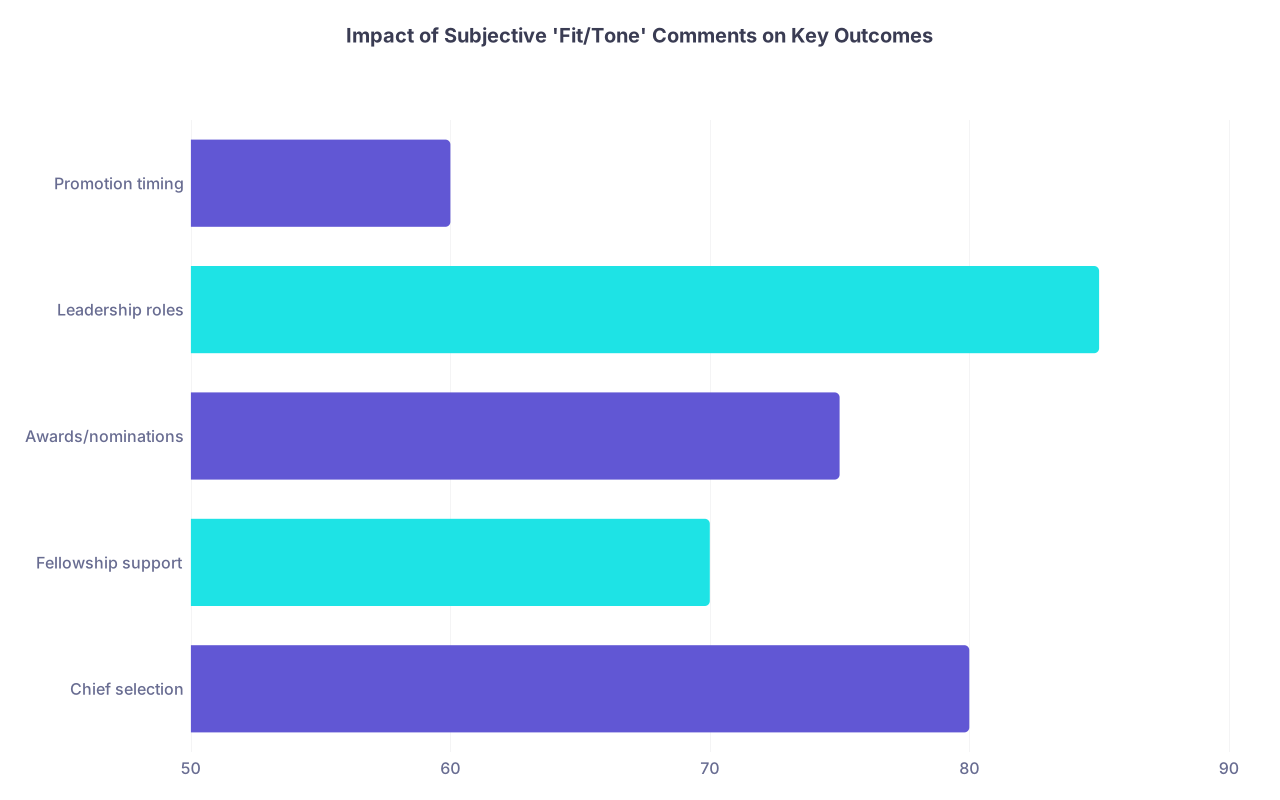
| Category | Value |
|---|---|
| Chief selection | 80 |
| Fellowship support | 70 |
| Awards/nominations | 75 |
| Leadership roles | 85 |
| Promotion timing | 60 |
How Women Start Policing Themselves
Here’s the worst part: the system trains you to censor yourself before anyone else has to.
After the third time you’re told to “watch your tone,” you start editing every email three times. You add smiley faces or extra “Thanks so much!!” lines so no one thinks you’re upset.
You speak up in rounds, but then immediately backpedal: “Sorry, just thinking out loud, I might be wrong.” You sand down every sharp edge. You apologize for existing with an opinion.
I’ve watched incredibly capable women residents do emotional gymnastics in front of attendings and nurses:
- Smiling while advocating for patient safety.
- Laughing off microaggressions because they don’t want to be “the problem.”
- Softening language: “I wonder if maybe we could consider…” instead of “We need to do X because Y.”
Men sometimes learn to polish their communication too, sure. But for women, it’s not polish. It’s self-protection.
You know if you get labeled as “difficult” once, it can take years to scrub that off. So you overcorrect. And then somebody calls you “too quiet” or “not confident enough.” You literally cannot win.

| Step | Description |
|---|---|
| Step 1 | Normal advocacy or disagreement |
| Step 2 | Person feels challenged |
| Step 3 | Describes you as harsh or aggressive |
| Step 4 | Vague eval comments about tone |
| Step 5 | CCC hears repeated concerns |
| Step 6 | Identity resident |
| Step 7 | Weaker support for roles and opportunities |
What You Can Do Without Selling Your Soul
Let me be blunt: you are not going to single-handedly fix a culture your attendings have been steeped in for 30 years. So the question shifts: how do you survive and advance without erasing yourself?
1. Make Behavior, Not Vibes, the Story
You will not stop people from having feelings about you. You can make it harder for them to translate a mood into a permanent label.
For emails or written communication, lean on clarity and structure. Avoid unnecessary fluff, but use one or two neutral softeners. Not apology—precision.
Instead of:
“Like I said before, I won’t discharge until X is done.”
Try:
“For patient safety, I’ll plan to discharge once X is completed. Let me know if you’d like to discuss another approach.”
Same stance. One extra sentence offering collaboration. Committees love that line—“She’s firm but open to discussion.”
2. Separate Content From Delivery in Feedback Sessions
When a supervisor hits you with “People have concerns about your tone,” do not just nod and leave. That’s how vague poison lingers in your file.
Say clearly: “I want to improve, and I also want to understand. Can you give me a specific example of something I said or did, the exact words or behavior, and how it was received?”
You’re doing two things:
- Forcing them to move from “vibe” to anecdote.
- Signaling that you’re responsive to feedback, which committees love.
If they cannot give a specific example, that’s telling. You don’t need to win that argument, but you’ve at least planted doubt in their future retelling.
3. Build Your Own Counter-Narrative
You cannot rely solely on “the system” to capture who you are.
Quietly cultivate attendings and nurses who really see your work and your intent. Not just people you like socially—people who have actual influence: respected clinicians, key committee members, program leadership.
Be explicit with at least one mentor:
“I’ve been told to watch my tone in a few situations. I care about communication and also about being able to advocate strongly for patients. If you ever see me cross a line, I want you to tell me directly. And if you don’t see that problem, I’d appreciate you speaking to my professionalism if it ever comes up.”
That’s how you insert a different story into the room when you are not there.

The Ethics No One Wants to Talk About
Let’s talk ethics, since that’s supposedly the spine of medical education.
Does a committee have a duty to call out biased language in evaluation? Yes. Do most do it? Rarely.
I’ve watched program directors skim right past obviously gendered comments like:
- “Sometimes comes across as emotional.”
- “Needs to smile more with patients.”
- “She gets flustered when challenged.”
And then in the next file, for a man exhibiting the same behavior: “Shows great passion,” “Strong sense of ownership,” “Can be intense when advocating for patients.”
That is an ethical failure. Full stop.
What should happen—and almost never does:
- Committees should flag and discard vague, non-specific, or clearly biased comments.
- Program directors should train faculty and staff on how bias shows up in language.
- There should be standardized ways to separate legitimate professionalism issues from discomfort with women who lead.
But here’s the reality: many committee members do not see the pattern. They truly believe they’re just “calling it like they see it.” Others see it and don’t want the conflict of calling out their colleagues.
So the work falls—again—on women to navigate a crooked playing field.
You should not have to do that. But pretending the field is straight does not help you either.
Bottom Line: What You Need to Remember
Keep three things in your head as you move through training:
First, you are being judged on two rubrics—clinical and social. Men get more leeway on the social rubric. Women get narrower lanes and harsher penalties for stepping outside them.
Second, “tone” and “fit” are often code for discomfort with women who do not perform the exact version of agreeable, deferential professionalism older faculty unconsciously expect. That’s their conditioning, not your deficiency.
Third, your job is not to become smaller. Your job is to be strategic: get specific examples when “tone” comes up, build allies who know your actual behavior, and craft communication that’s clear and firm without giving anyone cheap ammunition.
You do not need to be less. You need to stop letting other people’s vague discomfort become the headline story of your career.
FAQ
1. How can I tell if feedback about my ‘tone’ is legitimate or biased?
Ask for specifics. If they can point to concrete, replayable moments—exact words, timing, setting—that multiple people independently experienced as disrespectful or demeaning, that’s worth examining. If all you hear is “people feel” or “it seems like” without dates, quotes, or clear examples, you’re probably dealing more with bias and vibes than true professionalism concerns.
2. What do I do if I think my program director is repeating biased narratives about me?
You do not go in guns blazing. You schedule a calm meeting, bring notes of your own evaluations, and say something like: “I’ve heard that there are concerns about my tone. I’d like to understand specific incidents so I can improve, and I’d also like you to know that I care deeply about patient advocacy and collegial communication. Can we review together where you’re seeing patterns?” You are inviting collaboration, not accusation—while signaling that you’re paying attention.
3. Should I actually change how I speak and write, or is that just selling out to bias?
You adjust how you package your advocacy so it cannot be easily dismissed as “tone,” but you don’t surrender the content. This is not about becoming smaller; it’s about being precise and tactical. You can learn to add one sentence of collaborative framing or a neutral opener to an email without diluting your stance. That’s not selling out—that’s learning to operate effectively in a flawed system while you build enough power to change it.