
Last spring, I sat in a windowless conference room while a female resident with stellar evaluations was picked apart for being “a bit intense,” “not universally loved,” and “maybe too assertive for this group.” Ten minutes later, a male resident with noticeably weaker feedback was praised for “taking charge,” “having presence,” and “being the kind of guy people follow.” Both were candidates for chief. You already know how that vote went.
You see the announcement emails. You hear the speeches about “merit” and “leadership potential.” What you never see is the brutal, biased, and sometimes blatantly gendered conversation that happens behind that closed door.
What Chief Selection Meetings Actually Look Like
Let me walk you into that room.
It’s usually a cramped conference room or the program director’s office. Coffee that’s been reheated twice. Printed evaluation packets. A whiteboard with names. Maybe a Zoom screen if faculty are off-site. Chief selection happens in late winter or early spring for most programs, though some do it obnoxiously early.
Who’s in the room varies, but the power structure is almost always the same: program director(s), associate PDs, a few core faculty, sometimes chief residents or senior residents, maybe an admin. The vibe? Half performance, half bare-knuckle politics.

| Step | Description |
|---|---|
| Step 1 | Collect evaluations |
| Step 2 | Shortlist candidates |
| Step 3 | Faculty discussion |
| Step 4 | Program director deliberation |
| Step 5 | Rank candidates |
| Step 6 | Offer chief role |
| Step 7 | Vote or consensus |
The official criteria sound clean:
- Clinical excellence
- Professionalism
- Teaching ability
- Leadership skills
- Reliability
- Peer respect
On paper it looks fair. But in that room, those bullet points get twisted through a gendered lens. The same behavior is “decisive” in one candidate and “abrasive” in another, depending on who’s doing it and what they look like.
And do not kid yourself: people come in with favorites already picked. The “discussion” is often just retrofitting reasons around a decision someone has quietly made weeks before.
How Gender Quietly Warps the Discussion
You probably suspect bias. You don’t see how blatant it gets when people think no trainees are listening.
I’ve sat in multiple chief selection meetings where these exact patterns repeated with nauseating consistency. Let’s walk through a few.
1. The “Likeability Tax” on Women
Men are evaluated on effectiveness. Women are evaluated on effectiveness plus likeability. That second part is where they get burned.
Here are phrases I’ve actually heard about female candidates:
- “She’s excellent but rubs some people the wrong way.”
- “I just do not know how the interns will respond to her tone.”
- “She can be a little sharp on rounds.”
- “She seems stressed a lot—chief will be even more demanding.”
Now compare that to what I’ve heard about male candidates with the same exact behavior:
- “He sets high standards.”
- “He does not suffer fools.”
- “He’s intense, but that’s why things get done.”
- “He’ll grow into the softer skills.”
Same behavior. Completely different framing.
| Behavior | Male Candidate Label | Female Candidate Label |
|---|---|---|
| Direct feedback | Decisive leader | Abrasive, harsh |
| High expectations | Demanding, effective | Difficult, rigid |
| Expresses frustration | Stressed but committed | Emotional, overwhelmed |
| Delegates tasks | Good manager | Bossy, controlling |
| Advocates for residents | Strong advocate | Complains, pushes too hard |
If a woman is not “nice enough,” it gets weaponized. If she is nice, suddenly she’s “not authoritative enough” or “does not command the room.” That’s the double bind: be warm and get dinged as weak, or be strong and get dinged as unlikeable.
I have seen outstanding women essentially disqualified on a single comment like “the nurses do not always find her approachable,” while a man with several negative peer comments sailed through because “he’ll mellow out as chief.”
2. “Potential” vs “Track Record”
Here’s another quiet trick.
Men are very often chosen on potential. Women are expected to show a fully formed track record.
For male candidates:
- “He’s still growing, but with mentorship he’ll be fantastic.”
- “He has raw leadership talent we can shape.”
- “Yeah, he’s had some professionalism flags, but look how far he’s come.”
For female candidates:
- “She’s strong now, but I’m not sure how she’d handle conflict as chief.”
- “I wish we had seen her in more formal leadership roles before this.”
- “She’s excellent clinically, but chief is a political role.”
Translation: We forgive his gaps. We magnify hers.
I watched a meeting where a male candidate with multiple late notes, a few professionalism comments, and lukewarm peer feedback was chosen over a woman with pristine evaluations because, quote, “we see him stepping into a big leadership path long-term.” Hers? “She’s already there; she doesn’t need the title.”
That last phrase is a classic sabotage line. “She doesn’t need it.” As if chief is a charity and not a career accelerator.
3. The Quiet Penalty for Saying “No”
Another bias you almost never hear talked about publicly.
Women who protect their time or set boundaries—especially around childcare, family, or wellness—get framed as “less committed.” Men who do the same are “balancing life” or “family men.”
Real comments I’ve heard:
About a woman:
- “She turned down the extra QI project—chief needs someone fully available.”
- “She’s made it clear her weekends are precious with her kids.”
About a man with kids:
- “He’s really grown up since becoming a dad.”
- “Impressive that he balances so much. That will resonate with residents.”
And then, the dagger: “We don’t want to overburden her.”
That sounds protective. It’s not. It’s a mechanism to keep women out of roles that lead to power and promotion, “for their own good.”
If you’re a woman, especially a mother, you’re walking a razor edge. Say yes too much, and you’re “overextended, maybe not ready for more.” Say no, and you’re “not fully invested.”
Men simply are not policed this way at the same frequency or intensity.
4. The Myth of the “Neutral” Chief
Programs like to tell themselves they are picking “the best person for the job.” As if the job exists in a vacuum.
Reality: Some programs are explicitly looking for a “buffer” between residents and leadership. They want someone who will not push too hard, who will absorb resident frustration and deliver it in a digestible, non-threatening way.
Guess who gets idealized for that role? Women. Especially women who are conflict-averse or very relational.
Then the narrative becomes:
- “She’s a great bridge.”
- “The residents really open up to her, and she brings things to us in a way we can hear.”
That’s sometimes code for: she will soften and dilute complaints, not rock the boat too much, and be easier to “manage” than that outspoken guy who makes us uncomfortable.
On the flip side, if a woman is the outspoken one who is blunt with leadership, I’ve seen her described as “not politically savvy enough for chief.” The same behavior in a man gets labeled “courageous” or “principled.”
Where Intersectionality Makes It Harsher
Gender bias is not hitting everyone equally.
The chief selection process lands especially hard on:
- Women of color
- Immigrant women
- Women with accents
- Non-heteronormative women
- Women in surgical or male-dominated specialties
I’ve watched Black and Brown women be described as “intimidating” or “too strong a personality” for behaviors that would be applauded as “confident” in White men. I’ve heard comments about “communication style” that were clearly code for accent or cultural difference.
Bias stacks. Gender stereotypes plus racial stereotypes plus specialty stereotypes.
If you’re a Latina resident in surgery, for instance, you’re battling the stereotype that you’re “fiery” or “too much” on top of surgery’s baked-in glorification of abrasive male behavior. So when selection time comes and you advocate hard for your team, that can get twisted into “she escalates too much” or “she doesn’t know when to let things go.”
That’s the part nobody says at resident town halls. They just quietly “go another direction.”
How Data Is Used—and Twisted
Programs love to wave around “360 evaluations” and “anonymous feedback” like they’re objective. They’re not. They are soaked in the same gender bias as everything else.
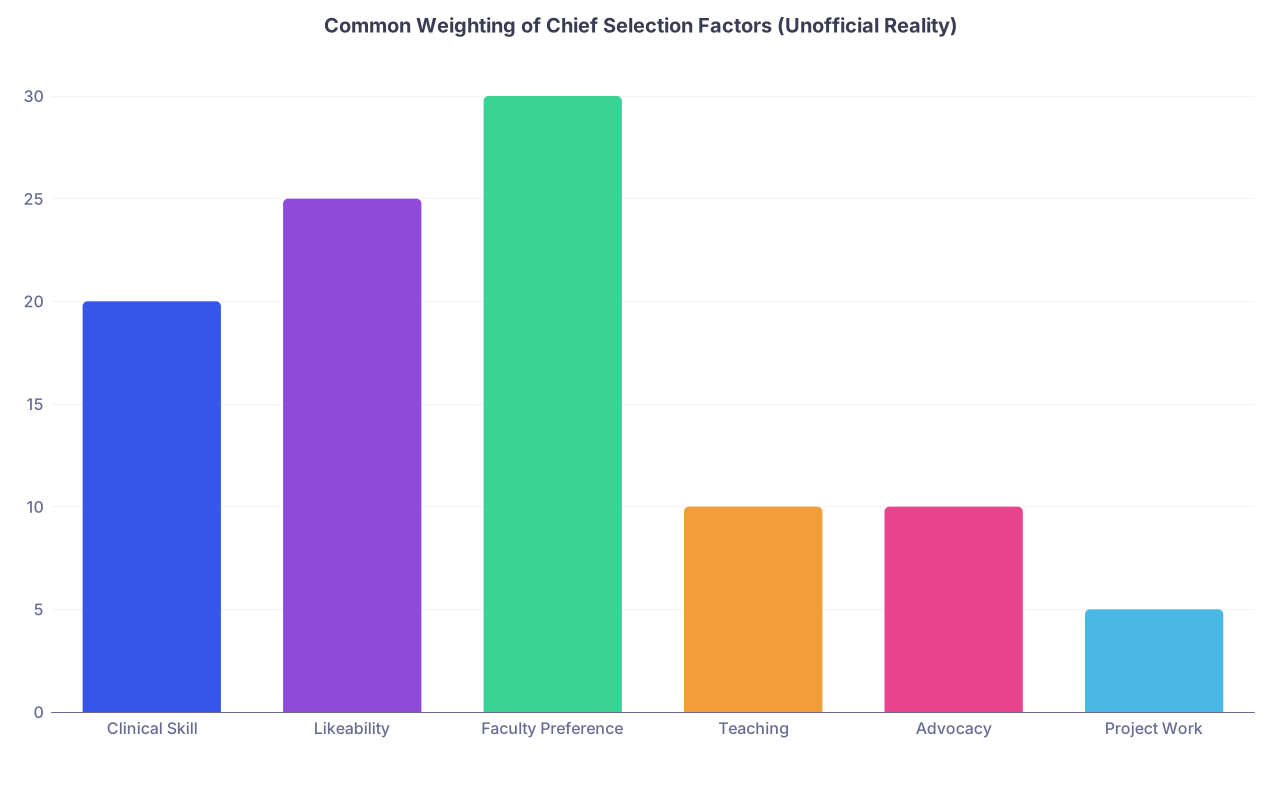
| Category | Value |
|---|---|
| Clinical Skill | 20 |
| Likeability | 25 |
| Faculty Preference | 30 |
| Teaching | 10 |
| Advocacy | 10 |
| Project Work | 5 |
Notice those middle bars. Likeability and faculty preference quietly outweigh actual leadership behaviors in many programs.
I’ve watched PDs skim right past multiple written comments about a woman’s strong bedside teaching, but pause and dig into a single “she was a bit harsh with me when I was late” complaint from an intern who, by the way, was chronically late.
Then, they’ll say, “We can’t ignore this pattern,” based on one or two negative comments that fit their pre-existing discomfort with a woman being firmly in charge.
Even the so-called “objective” things—like who gets invited to teach sessions, who gets nominated for awards, who gets put on high-visibility committees—are already downstream of gender bias. The same leaders picking chiefs decided those earlier opportunities.
So by the time you’re in that room, the deck is already stacked.
What You Can Do If You’re a Woman Aiming for Chief
You cannot fix the system alone. But you are not powerless either. I’m not going to tell you to “just work hard and be yourself.” That’s how people keep you naive and compliant.
Instead, here’s what actually moves the needle inside that room.
1. Manage Your Narrative Early
By PGY-2, people already have a story in their heads about you. You either shape it or they do.
You want faculty saying things like:
- “Residents go to her when things are on fire.”
- “She’s the one who gets stuff done quietly in the background.”
- “She’s firm but the interns still like her.”
This means being strategic about when you’re visible. Take charge on rounds occasionally. Run a teaching session that people talk about. Volunteer for one or two high-yield projects rather than scattering yourself across ten meaningless committees.
2. Build Allies in That Room—Not Just Friends Among Residents
Your co-residents do not vote in that meeting. The people who do:
- Program director
- Associate/assistant PDs
- A few core faculty
- Sometimes current chiefs
You need them to have concrete, positive stories about you. That doesn’t mean brown-nosing. It means:
- Seeking feedback early and implementing it visibly.
- Following up on things you promise to do.
- Showing up prepared when you present or lead anything in front of them.
And yes, this is politics. You can pretend medicine is above that, or you can acknowledge reality and play smart.
3. Anticipate the Gendered Attacks and Preempt Them
If you’re a strong, direct communicator, you already know what they’ll say: “abrasive,” “harsh,” “intimidating.”
So you build a visible track record of also being supportive, approachable, and fair. You do not need to water yourself down. You just make it harder for that caricature to stick.
Examples:
- After a tough feedback interaction with an intern, you follow up with brief check-ins that they appreciate.
- You’re consistent—what you demand from one intern, you demand from all.
- You’re seen advocating for residents in a way that is direct but solutions-focused, not just venting.
So when someone in that room tries to say, “She’s harsh,” someone else can say, “That’s not my experience—she’s the one people go to for help at 2 a.m.”
4. Document and Own Your Leadership Work
Women routinely underestimate and undersell what they’ve done. Then wonder why their “obvious” excellence doesn’t get recognized.
Keep a running list of:
- Projects you led
- Crises you managed
- Residents you coached out of trouble
- Initiatives you started or improved
When PDs ask about chief interest, you need to speak in specifics: “I led X change that improved Y,” not “I like supporting my co-residents.”
Because in that meeting, concrete wins are which shield you from vague character attacks.

If You’re Already Being Evaluated—or Passed Over
For some of you, this is not theoretical. You’ve already seen peers chosen over you in ways that made your stomach turn. So what now?
Have the Uncomfortable Conversation
Most residents never ask directly: “Can you walk me through how chief selection is made and what held me back this year?”
You should. Calmly. With a notebook. Not arguing point by point, but gathering data.
Then you translate the vague adjectives into actual behaviors you can choose to adopt or reject. If they say you’re “too direct,” ask, “Can you give me an example of a situation where that was a problem?” Sometimes they have nothing. Sometimes they have something real. Either way, you learn the terrain.
Protect Your Sense of Worth
I’ve seen brilliant women destroyed by being passed over for chief. They internalize it as a verdict on their future as leaders. It isn’t.
Here’s the thing nobody tells you: some of the best leaders I’ve watched in academic medicine were never chief. They were too disruptive, too unconventional, or simply not in favor with the right people at the right time. Residents knew who the real leaders were. So did the smart faculty.
Chief is a line on a CV. Valuable, yes. But not a divine calling. Don’t let a biased committee decide how big you’re allowed to think about yourself.
Find Roles That Actually Fit Your Strengths
If you’re the type who calls out unsafe systems, that will threaten some leadership teams. They might choose the smoother, more compliant candidate.
Fine. Then build the career where that exact trait becomes your advantage—quality improvement, patient safety, advocacy, education leadership. Institutions eventually realize they need people who do more than keep everyone comfortable.
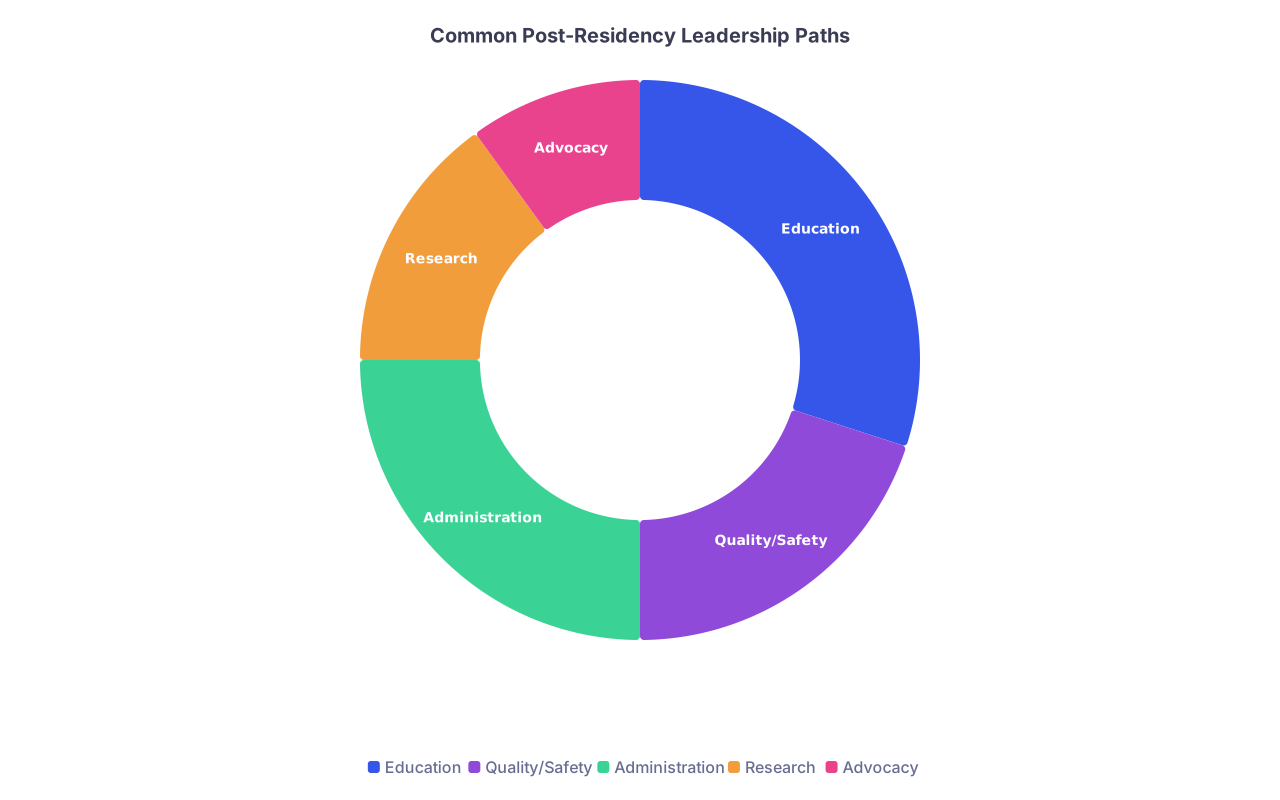
| Category | Value |
|---|---|
| Education | 30 |
| Quality/Safety | 20 |
| Administration | 25 |
| Research | 15 |
| Advocacy | 10 |
Chief can be a step toward those, but it is not the only route.
What Ethically Needs to Change (That You Won’t See on Brochures)
Let’s talk ethics. Because that’s what this really is—an ethical failure dressed up as “fit.”
If a program was serious about fairness in chief selection, they’d do at least some of the following:
- Publish clear, behavior-based criteria for chief resident selection.
- Educate faculty about gender and racial bias in evaluations and promotions.
- Blind certain parts of the process where possible (e.g., structured scoring rubrics before discussion).
- Track who they select as chiefs over 5–10 years and look at gender, race, and specialty breakdowns.
- Bring current residents into the process in a structured, meaningful way, not as window dressing.
Some programs are starting to do this. Most are not. Many PDs are still operating on vibe and familiarity: “Who do I feel comfortable texting at midnight?” Which, by the way, often translates to “Who looks and behaves like the people who’ve always held power here?”
If you ever sit on the selecting side in the future—and many of you will—you’ll remember this. You’ll catch yourself when you’re about to say, “She’s just not as likeable,” and instead ask, “What specific behaviors am I talking about, and would I describe them the same way in a man?”
That’s how the culture shifts. Slowly. One uncomfortable self-correction at a time.