
What do you do when you realize everyone at work thinks your time, your inbox, and even your evenings belong to them—but you trained them to?
Let’s talk about the boundaries mistakes female attendings regret when it’s already too late—when they’re burned out, resentful, and quietly Googling “non-clinical careers” between discharges.
I’ve watched this play out over and over:
- The “helpful” junior attending who becomes the dumping ground.
- The “approachable” female faculty whose office is the unofficial therapy clinic.
- The “team player” who ends up with every extra QI project and committee no one else wants.
None of that happens in a vacuum. It happens because boundaries were never clearly set. Or were set, then ignored “just this once.” And people—colleagues, residents, leadership—learned to expect that from you.
Let’s go through the big mistakes so you don’t end up five years in, staring at your schedule thinking, “How did I let this happen?”
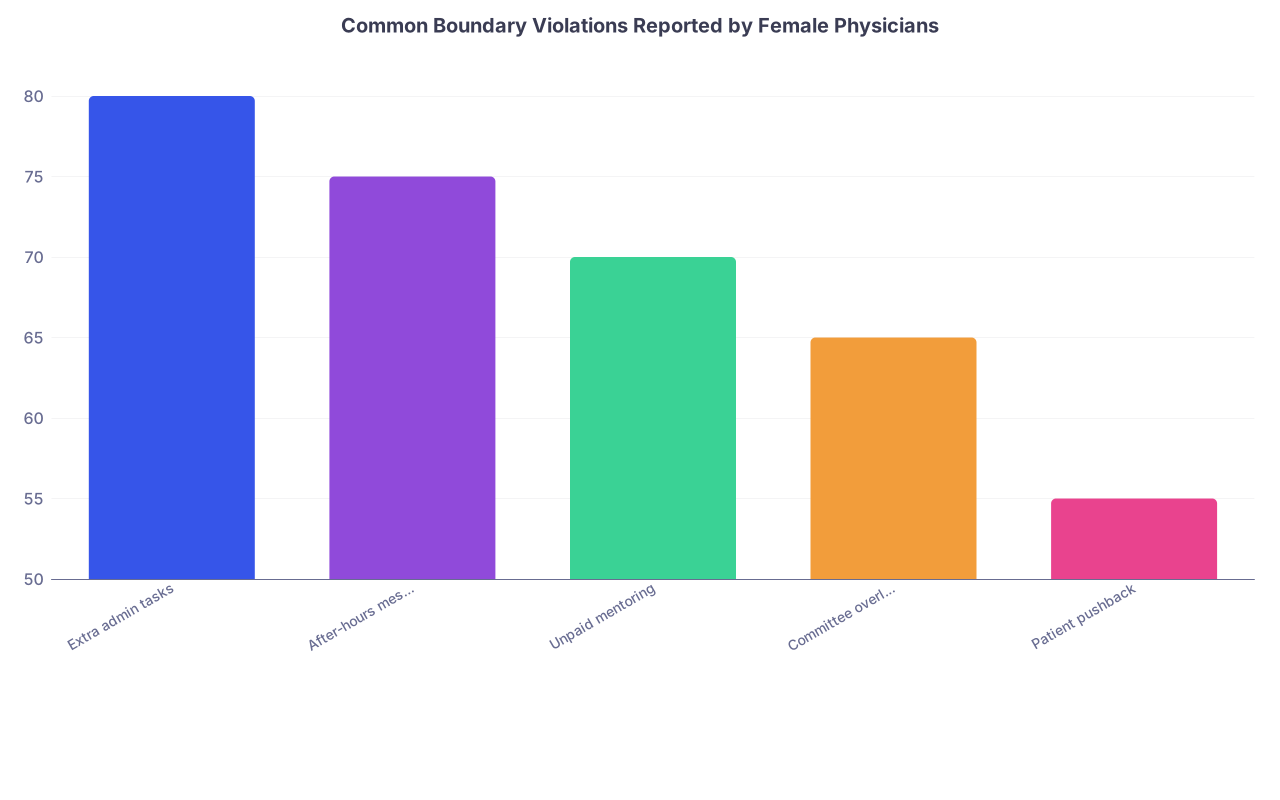
| Category | Value |
|---|---|
| Extra admin tasks | 80 |
| After-hours messages | 75 |
| Unpaid mentoring | 70 |
| Committee overload | 65 |
| Patient pushback | 55 |
1. Saying Yes to “Just This Once” (AKA: Teaching People You Have No Limits)
The most common regret I hear: “I didn’t set the tone early.”
Here’s how this boundary mistake usually starts:
- “Can you cover this shift? We’re desperate.”
- “Can you join this committee? It’s only a few meetings.”
- “Can you just quickly look at this? You’re so good with this stuff.”
You tell yourself:
- It’s good for my reputation.
- I should be a team player.
- I don’t want to be difficult, especially as a junior woman.
So you say yes. Then you say yes again. Then guess what? You’re now the Reliable Yes Person. And that reputation is far stickier than any “no” you try to introduce later.
Red flag patterns:
- You’re everyone’s first call for coverage.
- Your name mysteriously appears on extra QI projects, “ad hoc” tasks, or student teaching assignments.
- Your “protected” time gets treated as flexible.
The mistake isn’t any one “yes.” It’s the absence of guardrails around your yes.
What you need to do differently:
- Decide in advance:
- How many extra shifts per month you will ever take.
- How many committees you’ll sit on at once.
- What kinds of tasks you simply do not do (e.g., repeated “quick edits” on others’ work, endless “pick your brain” chats with no structure).
Then your script becomes:
- “I can take 1 extra shift this month. I’ve already committed it.”
- “I serve on two committees at a time. If something is higher priority than X or Y, I’m open to swapping, but I won’t just add a third.”
- “I’m not able to review this on short notice. Try sending it to [other appropriate channel].”
If you don’t decide your limits, someone else will. And they will not be as protective of your time as you should be.
2. Letting Your Inbox and Phone Be 24/7 Access Points
I’ve watched attendings answer Epic messages during dinner, patient portal messages on Sunday mornings, and resident texts at 11:30 pm that absolutely could’ve waited.
You might think, “It’s faster if I just respond,” or “I’ll look unhelpful if I don’t.” What you’re really doing is:
- Training staff and colleagues that you’re on-call to everyone, always.
- Erasing the line between your time and the hospital’s time.
- Setting yourself up for legal and ethical gray zones with patient communication.

The specific mistakes:
No stated communication boundaries
- Never telling staff: “I do not answer non-urgent messages outside X–Y hours.”
- Never clarifying to residents: “Text me at night for clinical issues only; all non-urgent questions go into email/EPIC for the next workday.”
Responding immediately to non-urgent stuff
- Those 8 pm portal messages about refill requests? When you answer right away, that becomes the expectation.
- Same with nurses messaging you for things they could handle with an order set or standing protocol.
Allowing “just one quick question” culture
- A constant stream of interruptions kills your focus and lengthens your day.
- Worse, it trains people not to think: why look it up if you’ll answer instantly?
Better boundaries to set early:
- To clinic staff:
- “I review non-urgent patient messages between X–Y daily. Please reassure patients it may take up to 2 business days for a response.”
- To residents/students:
- “For urgent clinical questions overnight, text or call. For learning questions or non-urgent things, email me and I’ll respond during work hours.”
- To yourself:
- No EPIC at home except during a scheduled block of time you choose—and preferably not every day.
- Turn off push notifications for EMR, work email, and hospital apps on your personal phone.
When you answer everything, anytime, you’re not being a hero. You’re slowly burning your future self.
3. Being the Emotional Sponge for Everyone (Without Any Limits)
This one hits women in medicine particularly hard.
Female attendings get:
- The crying resident after a bad outcome.
- The nurse venting about an attending.
- The med student struggling with imposter syndrome.
- The colleague mid-divorce or post-complaint needing “just someone to talk to.”
Some support is good. Being approachable is good. But here’s the quiet mistake: you become the default emotional labor provider—with zero protection for your own mental bandwidth.
I’ve watched amazing female attendings become:
- Unofficial therapists.
- The “mom” of the department.
- The one everyone goes to when something blows up—personally or professionally.
They rarely get formal credit for this. They almost never get time protected for it. But they pay for it with exhaustion.
Signs you’ve crossed from supportive to exploited:
- You’re consistently running behind because you’re “just closing the door for a minute” to talk to someone.
- Your schedule is chaos but you’re still the one people come to when there’s conflict.
- You feel guilty setting limits, so you don’t. Then you resent everyone.
Healthier ways to hold this boundary:
You can be compassionate and have limits. Example phrases:
- “I’ve got 5 minutes now, and if we need longer, let’s set up a time later this week.”
- “This sounds like something an actual therapist would be really helpful with. I’m glad you told me; let’s get you connected with real support.”
- “I care about this, but I can’t be the right person for all of it. Have you talked with [PD, chief, HR, wellness]?”
Also: protect your office. If your door is always open and people treat it like a drop-in zone, you’ll never get protected thinking time.
Try:
- Blocked time with door closed and “Do not disturb unless urgent” sign.
- Specific open-door times where you’re available for residents/trainees to pop in.
If you don’t set limits, your empathy will be consumed by everyone else and you’ll have none left for yourself.
| Situation | Common Mistake | Better Boundary |
|---|---|---|
| Extra shift request | Saying yes to every “urgent” ask | Pre-decided monthly cap on extra shifts |
| Resident texts | Responding instantly to all questions | Clinical after-hours only; others via email |
| Committee invites | Accepting “great opportunities” reflexively | Asking for role, time cost, and ability to say no |
| Emotional support | Long unstructured vent sessions | Time-limited talks and referral to formal resources |
| Patient portal | Answering nights and weekends | Clear 1–2 business day response policy |
4. Letting “Opportunities” Hijack Your Career Direction
Women get over-targeted for “opportunities” that are actually:
- Thankless committees
- Diversity token roles
- Low-visibility admin tasks
- “Could you help us with this student group? They’d love a female role model.”
Sounds flattering. Feels like you’ll look unsupportive if you decline. And the big mistake? You say yes before asking what it costs you.
Here’s what I’ve seen too many times:
- Female assistant professors doing 4 committees, 3 “mentorship” roles, and all the wellness tasks.
- Male colleagues quietly saying no, doing high-yield research or leadership work instead—and getting promoted faster.
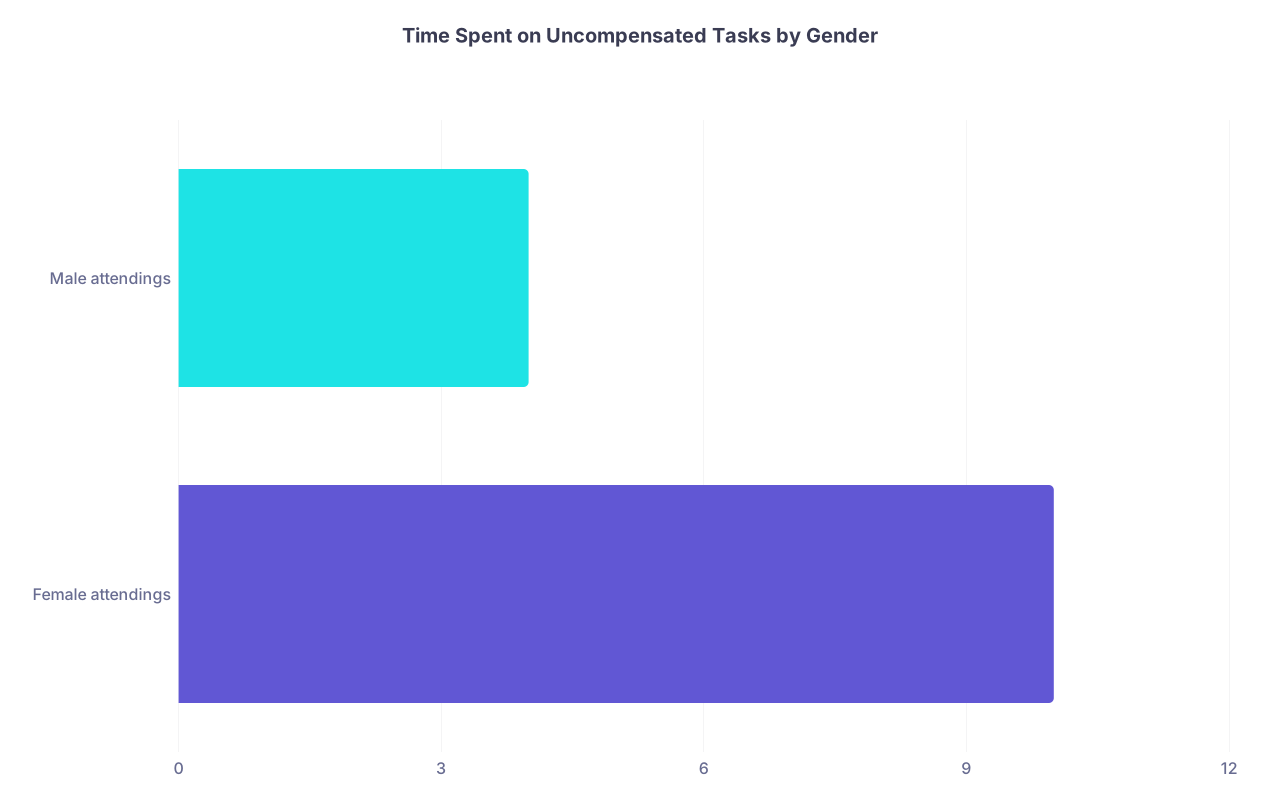
| Category | Value |
|---|---|
| Female attendings | 10 |
| Male attendings | 4 |
(That’s hours per week, by the way. I’ve seen worse.)
Boundary errors here:
- Not asking: “Is this compensated? Counted toward promotion? Recognized in any meaningful way?”
- Not tracking how much unpaid, invisible labor you’re doing.
- Saying yes to things misaligned with your long-term goals because you don’t want to upset someone senior.
You need a simple filter:
- Does this align with my 2–3 career priorities for the next 2 years?
- Is there formal recognition—title, FTE, stipend, promotion credit?
- If I say yes to this, what will I say no to?
If you’re not sure how to say no without burning relationships:
- “I appreciate you thinking of me. My current commitments are at capacity, and I want to make sure I do what I’ve already taken on well, so I’ll have to decline.”
- “This looks meaningful, but it doesn’t align with my current focus on [research/clinical program building/leadership development]. If there’s something in that area in the future, I’d be very interested.”
Do not let other people’s priorities become your career.
5. Failing to Set Boundaries With Patients Early—and Consistently
You know this one. The “nice” female attending gets:
- The patient who insists on only seeing her, even when panel is full.
- The chronic late-arriver expecting to still be seen “just this once.”
- The one sending multiple portal messages a day demanding instant responses.
- The patient who subtly (or not so subtly) tests physical or conversational boundaries.
The mistake isn’t that these people exist. It’s how you respond the first few times.
Classic missteps:
- Accommodating late arrivals “so they don’t get upset.”
- Answering every portal message as if it’s urgent.
- Keeping the visit going when the conversation drifts into inappropriate or overly personal territory.
- Letting ongoing minor boundary-pushing slide because “it’s awkward to confront it.”
You are not just being “nice.” You’re teaching them what you will allow.
Stronger early boundaries:
- Late patients:
- “Since you arrived late, we’ll have to focus on just your top concern today. For the rest, let’s schedule a follow-up.”
- Excess portal messaging:
- “I see you’re sending multiple messages per day. To make sure we address things properly, let’s group your concerns for your next appointment, and remember that responses can take up to 2 business days.”
- Inappropriate comments:
- “That comment is not appropriate for this setting. Let’s keep our focus on your health today.”
- If repeated: “If this continues, I won’t be able to keep caring for you in this clinic.”
And for the “you’re the only doctor who understands me, I can’t see anyone else” situation:
- “I’m glad you feel comfortable with me, but I work in a team-based system. Sometimes you’ll see my colleagues; they’re excellent and I trust them.”
This isn’t harsh. It’s professional. And it protects you from resentment—and sometimes from actual safety issues.

| Step | Description |
|---|---|
| Step 1 | Request or Demand |
| Step 2 | Say no clearly |
| Step 3 | Offer alternative or delay |
| Step 4 | Say yes with limits |
| Step 5 | Reinforce boundary if pushed |
| Step 6 | Monitor for creep |
| Step 7 | Aligned with priorities? |
| Step 8 | Within capacity? |
6. Never Correcting Boundary Violations Once They Start
Here’s an ugly truth: your first boundary setting will not always work. People will:
- “Forget.”
- Test you.
- Push to see if you’re serious.
The real mistake is not the first violation. It’s your silence after the first violation.
Examples I’ve seen:
- You said you don’t answer non-urgent texts at night. A resident still texts at 9 pm. You answer anyway. Now your “boundary” is a suggestion.
- You told your division chief you’re at max committees. They add you to a “short-term task force” anyway and you don’t push back.
- You told patients about 2-business-day message response time…and you still answer everything same day.
Every time you don’t enforce your boundary, you’re actually setting a new, worse boundary.
What enforcement looks like in real life:
- “I saw your text last night but as I’ve said, I don’t answer non-urgent messages outside work hours. Let’s talk about your question now.”
- “As I mentioned, I’m at full capacity for committees. I won’t be able to join this task force. If something needs to come off my plate to make room, I’m willing to discuss that.”
- “I understand you’d like an immediate answer. My standard is a response within 2 business days, and I’ll stick to that to stay fair to all patients.”
Yes, it will feel uncomfortable. Discomfort is not a sign you’re doing something wrong. It’s a sign you’re doing something different from what people expect.
The regret I hear years later is always the same: “I let it slide, and then it became impossible to claw back.”
7. Ignoring Structural Boundaries: Time, Money, and Credit
Everyone talks about “work-life balance” like it’s a vibes thing. It’s not. It’s structural.
Female attendings often:
- Work through unpaid lunches.
- Stay late charting nearly every day.
- Do unpaid prep/teaching at home.
- Say yes to “volunteer” roles that mysteriously come with a lot of work and zero compensation.
- Let others claim credit or be the front-facing name on projects they quietly drove.
These aren’t just personal sacrifices. They’re systemic boundary problems.
Specific structural boundaries you need:
Time
- Decide how many evenings per week you’re willing to give to work stuff. Stick to it.
- Block real, non-negotiable admin time on your schedule.
- Stop treating “I’ll just finish this at home” as normal.
Money/FTE
- Ask bluntly: “Is this role funded? How much FTE? Is there a stipend?”
- If the answer is no: “At this stage, I’m prioritizing compensated and promotion-relevant work.”
Credit
- Email documentation of your contributions.
- Speak your role out loud in meetings: “As the person who led the implementation of X…”
- When sidelined: “To accurately reflect the team’s work, my name should be listed as [role].”
If you don’t set and defend structural boundaries, the institution will take everything you offer and then ask for more. Not because people are evil. Because systems are greedy and female labor—especially emotional and administrative labor—is cheap and quietly expected.
8. Confusing Being Liked With Being Respected
Last one, and it’s brutal.
A lot of female attendings err on the side of being liked:
- They smooth over conflict.
- They avoid saying no strongly.
- They over-apologize for normal boundaries.
- They tolerate subtle disrespect to “keep the peace.”
Years later, the regret sounds like this:
- “People liked me, but they didn’t protect me.”
- “They came to me for favors, not for leadership.”
- “I worked myself sick to avoid being called ‘difficult.’”
Here’s the uncomfortable truth: you can be widely liked and quietly exploited.
Your job is not to be universally liked. Your job is to:
- Provide excellent patient care.
- Teach and mentor effectively.
- Maintain your own health and integrity.
- Build a sustainable, meaningful career.
Being respected often requires:
- Clear no’s.
- Enforcing boundaries when crossed.
- Allowing some people to be mildly annoyed that you’re not available on demand.
The mistake is sacrificing your long-term well-being to protect other people from the slightest discomfort.
Your Next Step (Do This Today)
Open your calendar and your messages right now.
Choose one of these to act on today:
- Block a recurring, protected admin block each week and mark it as busy. Door closed. No “quick questions.”
- Draft and send a short message to your clinic staff or trainees clarifying when and how you respond to non-urgent messages.
- Say no—clearly—to one non-essential committee, project, or “opportunity” that’s not aligned with your real goals.
- Identify one patient or colleague boundary that’s been bothering you and write the exact sentence you’ll use next time it comes up.
Do not wait until you’re burned out, resentful, or fantasizing about quitting medicine altogether.
The earlier you set boundaries, the less you’ll need to claw your life back later.