
How Women Residents Accidentally Volunteer for Invisible Work
Why are you staying two hours late “to help the team” while your male co-resident is already home, showered, and posting gym selfies?
Let me be blunt: women residents do not “end up” with invisible work by coincidence. There is a pattern. And if you do not see it early, you will pay for it with your time, your evaluations, and sometimes your career trajectory.
This is not about blaming you. It is about spotting the traps that quietly train you to say yes to everything that does not show up on your CV.
What “Invisible Work” Actually Looks Like in Residency

Do not kid yourself that invisible work is just “being nice.” It is a specific category of tasks:
- Necessary for the system to function
- Low-recognition, low-credit, low-ownership
- Easy to assign to “whoever is willing”
- Often gendered
Examples I have seen over and over:
- Calling families repeatedly because “they trust you more”
- Organizing birthday cakes, farewell gifts, wellness events, baby showers
- Fixing schedule problems: coverage swaps, finding someone for that random weekend cross-cover
- Pre-rounding on extra patients “to help the team start on time”
- Prepping all the discharge paperwork and follow-up calls because “you’re so thorough”
- Taking the “difficult” patient who yells, cries, or needs more emotional labor
- Being the unofficial interpreter when you share a language, instead of using professional services
- Mentoring every struggling intern because “they open up to you”
Careful: some of these are clinically important and ethically meaningful (family calls, difficult patients). The problem is not that you ever do them. The problem is that you do them disproportionately, automatically, and uncredited.
That is how you “…just suddenly always have more to do.”
The Gendered Script You Do Not Realize You Are Following
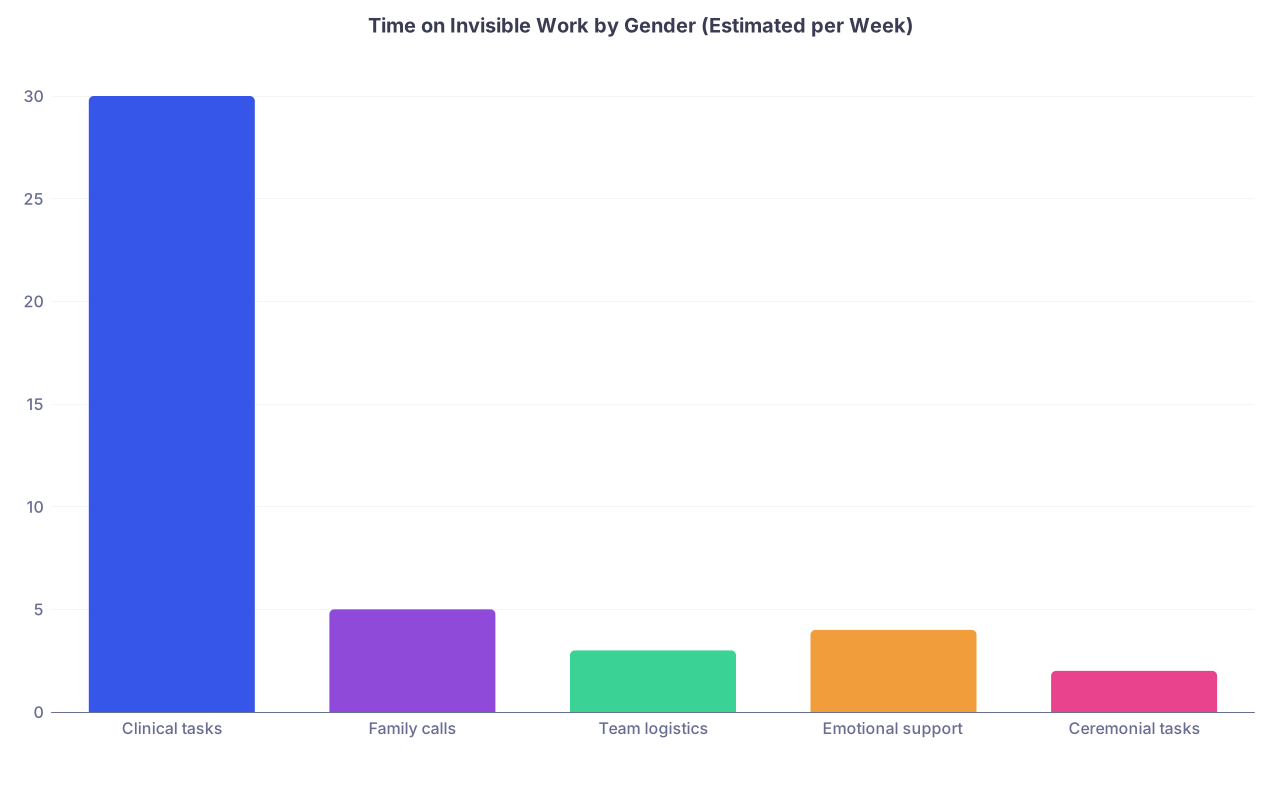
| Category | Value |
|---|---|
| Clinical tasks | 30 |
| Family calls | 5 |
| Team logistics | 3 |
| Emotional support | 4 |
| Ceremonial tasks | 2 |
You were trained long before residency started.
Girls praised for “being helpful” in group projects. Pre-meds applauded for “service orientation.” Women students called “mature,” “team players,” “great with families.” All of that gets imported directly into residency culture.
Here is what that script sounds like in real life:
- “You’re so good with the anxious families—can you call them?”
- “You’re really organized, can you coordinate the holiday potluck?”
- “Can you talk to Mr. X again? He responds better to you.”
- “I know you’re slammed, but you’re the only one he trusts.”
Notice the pattern. Compliment followed by request. Your desire to be seen as competent and kind is weaponized against your time.
The common mistakes women residents make here:
Treating every compliment as an obligation
“They think I’m good at this; I should do it.”
No. That is not how workload gets decided.Confusing being liked with being valued
Attendings may love that you smooth everything over. That does not mean they will protect your time, give you procedures, or write stronger letters.Underestimating the cumulative cost
Ten extra minutes for a family call, three times a day, over a month? That is hours and hours that came from somewhere—your sleep, your notes, your reading.
You are not just “nice.” You are being slowly typecast.
The Quiet Ways You Accidentally Volunteer

Most women do not walk into sign-out and say, “Please, give me all the low-visibility work.” They leak willingness through small behaviors.
Here are the subtle ways you accidentally put your hand up.
1. Filling Silence
Scenario: The team looks at each other after an attending says, “Someone needs to call all 4 families and update them tonight.”
Two seconds of silence. You break first.
“I can do it.”
You think you are just being efficient. What you are actually doing is:
- Training the team that you will fill every unclaimed gap
- Letting others learn that if they stay quiet, you will jump in
- Setting a precedent that is very hard to undo
Better response: wait. Let someone be assigned. Or ask:
“Can we split those calls up?”
“Who is primary on which patient? Should each of us call our own?”
Silence is not your enemy. It is where responsibility is supposed to get fairly distributed.
2. Over-explaining Your Boundaries
Men often say, “I can’t. I need to finish notes on my patients.”
Women often say, “I’m so sorry, I would love to, I’m just super behind and I still need to call a couple families and I have a discharge summary that’s overdue…”
The long explanation does two things:
- Signals guilt: “I owe you this, but I really can’t.”
- Invites negotiation: “Well, can you at least do this one?”
You do not need to justify protecting your core responsibilities. A simple:
“I need to finish my notes and orders. I can take X, but not Y.”
is enough.
3. Doing Preemptive Emotional Labor
You apologize before you ask for help. You soften every request. You check in on everyone else’s stress level before your own.
So when there is vaguely defined “wellness” or “team culture” work to be done—guess who feels like the right fit? The person who is already taking care of everyone’s feelings.
That looks like:
- You writing the “thank-you” card from the team
- You planning the resident retreat details
- You organizing gifts for your favorite nurse’s retirement
None of this is evil. But when it becomes your default, you become the residency program’s unpaid social coordinator.
The Real Risks: It Is Not “Just a Few Extra Tasks”
| Type of Work | Example Task | Who Notices | Helps Your Career? |
|---|---|---|---|
| Visible | Presenting on rounds | Attendings | Yes |
| Visible | Performing procedures | Attendings | Yes |
| Invisible | Organizing team celebrations | Peers | Rarely |
| Invisible | Extra family updates for others | Families | Sometimes |
| Invisible | Emotional support for interns | Interns | Not formally |
Do not romanticize this as “being a good team player.” There are concrete harms.
Performance dilution
Your note quality, presentations, and reading time suffer. Guess what attendings evaluate you on. Not the amount of cake you bought.Opportunity cost
Time spent fixing call-room logistics is time you are not scrubbing into an extra case, asking for a procedure, or preparing a teaching point.Reputation pigeonholing
You become “so nice” and “so helpful” instead of “technically excellent” or “outstanding clinician.” Those labels matter when people write your letters.Burnout with no badge
You feel exhausted but also weirdly ashamed of being exhausted because “I didn’t do anything special, I just helped.” That is how invisible work burns you out quietly.Ethics creep
When you are overloaded with uncounted work, your attention to detail, informed consent quality, and documentation can slip. Not because you are careless. Because you are spread too thin.
You are not only risking your well-being. You are risking the standard of care you can provide.
How to Say No Without Becoming “Difficult”

| Step | Description |
|---|---|
| Step 1 | Extra task appears |
| Step 2 | Do it or share fairly |
| Step 3 | Say no briefly |
| Step 4 | Say yes with limits |
| Step 5 | Core duty or add on |
| Step 6 | Time and energy available |
| Step 7 | Strategic benefit? |
Here is the mistake: women often think the options are
“say yes and be liked”
or
“say no and be labeled difficult.”
That is a false binary. You need more nuanced tactics.
1. Default to “Let me see how we can split this”
When someone drops a vague communal task on the table:
Wrong: “I can do it.”
Better: “OK, what needs to be done and how can we divide it?”
This:
- Signals leadership, not martyrdom
- Creates social expectation of shared responsibility
- Makes it harder for others to silently opt out
If they keep pushing it to you:
“I’m happy to take a piece of this. I can handle X. Who can take Y and Z?”
2. Use the “core responsibilities first” rule
There is a simple ethical hierarchy you should be using:
Patient safety > Learning/competence > Program requirements > Social / emotional labor
So when someone asks you to pick up invisible work, mentally check:
- Will this compromise my ability to get my core clinical work done safely and competently?
- Will this significantly cut into things that directly affect my training (procedures, teaching, studying)?
If the answer is yes to either, you owe it to yourself and to your patients to say no.
Sample phrasing that does not grovel:
- “I cannot take that on and still safely manage my list.”
- “I need to prioritize procedures / notes / prep for tomorrow’s case.”
- “I can help with a small part—what’s the most critical piece?”
3. Stop over-owning other people’s feelings
You are not responsible for whether someone is mildly disappointed you did not organize the potluck.
You are responsible for:
- Being collegial, not cruel
- Pulling your fair share of necessary work
- Protecting your ability to function and learn
So when guilt kicks in, ask yourself:
Is this actual wrongdoing or just violating someone else’s expectation that I will overfunction?
There is a big difference.
Turning Invisible Work into Visible Value (When You Choose It)

Sometimes you will choose to do work that looks “invisible” at first glance—but you do it strategically, visibly, and with boundaries.
The trick is converting random favors into documented skills.
Examples:
Family meetings:
Instead of quietly doing all family updates for the team, propose:
“I’d like to lead the structured family meeting for Ms. Y with you present so I can get feedback on my goals-of-care communication.”
Now you are not just “so nice with families.” You are demonstrating advanced communication skills under supervision.Mentoring interns:
Instead of informal vent sessions every night, ask to be the formal “peer mentor” for incoming interns, with occasional check-ins documented by chiefs or PD. That becomes a leadership role.Wellness projects:
If you design a call-schedule improvement or a handoff checklist that reduces errors and improves resident satisfaction, write it up. QI project, poster, maybe a paper.
The key questions before saying yes:
- Can I define the scope?
- Can I get my effort seen and documented by someone who writes evaluations?
- Can this be turned into a leadership, QI, or educational project?
If the answer is no across the board, think hard before you commit.
When the System Itself Is Biased (Because It Is)
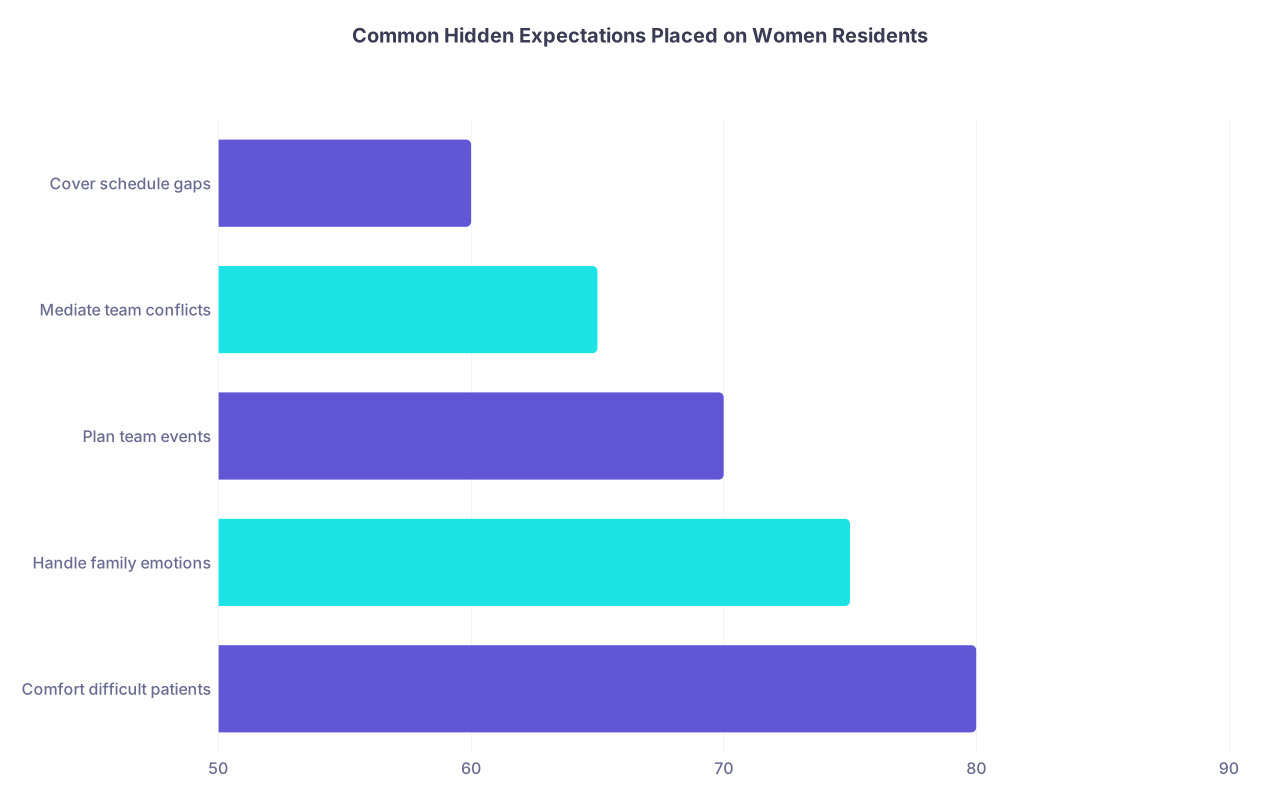
| Category | Value |
|---|---|
| Comfort difficult patients | 80 |
| Handle family emotions | 75 |
| Plan team events | 70 |
| Mediate team conflicts | 65 |
| Cover schedule gaps | 60 |
You are not imagining it. Many programs systematically lean on women for invisible work. That looks like:
- Female chiefs unofficially handling all the “resident drama”
- Women residents always asked to orient new nurses, students, or ancillary staff
- “You’re such a mom to the team” framed as a compliment
You cannot fix institutional sexism by individually working harder. But you can stop feeding it.
Practical ways to push back without torching the room:
Mirror back the pattern:
“I’ve noticed most of the emotional labor / event planning lands on the same people. Can we rotate who does what each month?”Shift from personality to role:
“Instead of one ‘go-to’ person, can we assign a resident-of-the-month for family meetings / wellness events / schedule issues?”Use allies strategically:
If there is a male colleague who gets it, ask him to sometimes be the first to volunteer for stereotypically “feminine” tasks. It breaks the expectation.
And if your program leadership is completely blind to this dynamic, document. Patterns. Extra duties. Impacts. This is what you take to a trusted faculty mentor, GME, or ombuds, if needed.
Scripts You Can Actually Use Tomorrow
Let me make this concrete. Here are some word-for-word options.
Task: “Can you call all these families? You’re so good at it.”
Response:
“I can call the families for the patients I’m following. For the others, it is better if their primary resident updates them so they hear a consistent plan.”
Task: “Can you organize the farewell party?”
Response:
“I cannot take on the planner role this month. I can contribute money / bring something, but someone else will need to coordinate.”
Task: “You’re so good with Ms. X, can you always be the one who talks to her?”
Response:
“I’m happy to talk with her today. Long term, it is important that the whole team can work with her. Let’s rotate who spends extra time with her each day.”
Task: Endless informal mentoring
Response:
“I care about how you’re doing, but I’m stretched pretty thin. Have you talked to [chief / faculty mentor]? I can do a short check-in once a week, but I can’t be your primary support.”
You are not being mean. You are refusing to be exploited.
FAQ (Exactly 5 Questions)
1. How do I know if I am doing “too much” invisible work versus just being a good colleague?
Track one week. List every task you do that is not clearly clinical, educational, or required by the program: family updates for other people’s patients, planning events, schedule fixes, emotional support, extra onboarding help. If that list is long and mostly falls on you compared with peers, you have a problem. Being a good colleague is about fairness and reciprocity, not martyrdom.
2. What if saying no hurts my evaluations because attendings expect me to be “helpful”?
You can be visibly helpful on high-value tasks and still set limits on low-value ones. Attendings mainly notice clinical performance, reliability, and attitude on rounds and in patient care. When you say no, tie it to patient care and core duties: “I need to make sure my notes and orders are accurate first.” That is hard to criticize without sounding reckless about safety.
3. How do I handle it when co-residents repeatedly dump invisible work on me?
Name the pattern calmly and suggest structure. “I’ve noticed I’ve coordinated the last three team events / taken most of the extra family calls. Going forward, can we rotate this weekly so it is shared?” If an individual keeps pushing tasks onto you, use a firm boundary: “I can’t take that on—what are you able to do here?” Put the responsibility back in their lap.
4. Can invisible work ever be an advantage for my career?
Yes, but only when you convert it into visible, bounded, and documented roles: formal mentorship, QI leadership, structured communication skills, committee work with defined titles. Random favors do not help you. Roles with names, emails from PDs, and bullets for your CV do. Choose selectively, and make sure at least some of that work aligns with your future goals.
5. What if my culture or upbringing makes it very hard to say no or not help?
Acknowledge that inner pressure, but also remember your ethical obligations: you must protect your capacity to provide safe care and complete your training. Start with small boundaries: delay your yes (“Let me think about it”), negotiate scope (“I can do X, not Y”), or propose shared solutions (“How can we divide this?”). You are not rejecting your values by setting limits. You are making sure you are still standing in 5–10 years.
Key points:
Women residents get trapped in invisible work by small, repeated “yes” decisions that others quickly learn to rely on.
Your job is not to prove you are endlessly helpful; it is to protect your clinical competence, well-being, and long-term career by saying yes strategically and no without guilt.