The way many women in medicine write emails and chart notes quietly sabotages their authority. Not because they are less competent—but because their communication keeps signaling that they’re unsure, apologetic, or subordinate when they’re not.
If you’re a woman in medicine and you haven’t taken a hard look at your email and charting habits, you’re almost certainly giving away power you need to keep.
Let’s walk through the most common patterns I see that undercut women’s authority—and exactly how to stop doing them.
The Subtle Email Habits That Make You Sound Junior When You’re Not
I’ve watched brilliant female attendings, chiefs, and fellows get treated like support staff—on the basis of email tone alone. Same credentials, same content; totally different reaction compared to their male colleagues.
Here are the big mistakes.
1. Over-apologizing: Turning Every Message Into an Apology Tour
You know the lines:
- “Sorry to bother you…”
- “Sorry for the long email…”
- “Sorry for the late response…”
- “I apologize if this is a silly question…”
Men send the same information with: “See below.” Or “Following up on this.”
You don’t need to begin every communication from a position of guilt.
Where this hurts you:
- You train people to see you as the one who’s “grateful to take up space,” not as a peer.
- You frame reasonable requests (like asking for labs to be drawn correctly) as personal imposition.
- You make it harder to assert yourself later; you’ve already put yourself in the one-down position.
Better patterns:
Instead of: “Sorry for the late response, my clinic was really busy but I wanted to get back to you about this.” Try: “Thank you for your patience. Clinic was full this afternoon. Here’s the plan moving forward: …”
Instead of: “Sorry to bother you, but could you help with…” Try: “Can you assist with… / Please help with…”
Reserve actual apologies for true mistakes that affect patient care, professionalism, or deadlines. Not for existing.
2. Hedging Everything: Sounding Like You Don’t Believe Yourself
Hedging language is probably the most common authority-killer I see in women physicians’ emails.
Phrases that dilute you:
- “I just wanted to check…”
- “I was wondering if maybe we could…”
- “I think perhaps we might want to consider…”
- “I’m not sure, but I feel like…”
- “I could be wrong, but…”
That’s fine if you’re casually texting a friend. In professional communication, stacked hedges read as: “I’m not confident and you shouldn’t be either.”
You can still be collaborative without sounding uncertain.
Instead of: “I was just wondering if maybe we could move this patient up on the schedule?” Try: “Can we move this patient up on the schedule? He is unstable and needs earlier evaluation.”
Instead of: “I’m not sure, but I feel like CT might be helpful?” Try: “A CT is indicated here; please proceed with ordering.”
You are allowed to be direct without being rude. Directness is not cruelty. Stop treating it like it is.
3. Softening Demands That Should Be Clear Orders
This is one that hurts you and your patients. I’ve seen female senior residents write:
“Hey team! If we could try to get the morning labs in by 7 that would be amazing. Thank you!!”
Their male co-resident, same level, same team:
“Please have morning labs drawn by 7 AM so results are back for rounds. Thank you.”
Guess whose labs are on time more consistently?
When expectations are phrased as vague hopes, people treat them as optional. You might think you’re being “nice.” What you’re actually being is unclear.
Key differences:
- “Can we try to…” vs. “Please do…”
- “It would be great if…” vs. “We need…”
- “I was hoping we might be able to…” vs. “The plan is…”
You’re not asking for a favor when you’re directing patient care. You’re doing your job.
4. Over-gratitude: Performing Niceness So People Won’t Get Mad
You don’t need three lines of gratitude for a standard response.
- “Thank you so much!! Really appreciate you taking the time!!”
- “Thanks again, I know everyone is busy!!!”
- “Really really grateful for your help!!!”
Overdoing it doesn’t make you more likable. It makes you look like you’re trying to compensate for existing.
Use normal professional gratitude:
- “Thank you for your help with this.”
- “Appreciate the quick response.”
- “Thanks for following up.”
One line. Period. Save the effusive thanks for when someone truly goes above and beyond.
5. Letting Others Take the Credit in Group Emails
Classic scenario: You lead a complex case, coordinate multiple services, put out six fires. The email recap to leadership goes out—from you—like this:
“Thanks everyone for all the hard work on this patient. The team really came together. Shout-out to [resident] and [nurse] for their great work.”
What’s missing? Any mention that you led it.
Men are generally better at claiming their role without shame. Women often erase themselves preemptively.
Instead of writing yourself out of your own work, try:
“I coordinated with cardiology and ICU to develop the following plan. [Resident] and [nurse] were instrumental in implementing the changes at the bedside.”
You’re not stealing credit. You’re accurately describing what happened.
6. Emotional Over-disclosure in Professional Threads
You’re tired. You’re burned out. The call schedule is garbage. All real. But dumping emotional processing into professional email chains weakens your perceived judgment, especially as a woman (because stereotypes are already locked and loaded).
Messy examples:
- “I’m honestly really overwhelmed right now, but I’ll try to get to this tonight.”
- “This month has been so brutal; I feel like I’m drowning!”
- “I’m so anxious about this patient, I haven’t slept.”
Those might be things you say to a trusted mentor or friend. They don’t belong in group emails, especially in mixed-power groups with people who already doubt women’s stability.
Better versions:
- “I’m on call this week; I’ll be able to complete this by Friday.”
- “This rotation is heavy, but I will get this done by end of day.”
- “I’m concerned about this patient’s status. Here are my specific concerns: …”
You can name workload and concern without framing yourself as falling apart.
Charting Choices That Quietly Undermine Your Clinical Authority
If email shows people how you think, the chart shows them how you think about patients. Women can be just as clinically sharp as men and still chart in ways that look tentative or deferential.
That matters. Notes affect how consultants respond, how risk is perceived, and how your decisions look in court.
7. Underselling Your Own Assessment
I’ve sat next to female residents writing assessments that read like this:
“A 65-year-old male with possible CHF exacerbation, maybe related to medication non-adherence. Will consider increasing diuretics and monitoring closely.”
They present the case out loud with complete confidence. The note? Sounds like a shrug.
Common undercutting phrases:
- “Possible … but unclear”
- “Suspect maybe …”
- “Will consider…”
- “Uncertain, but likely…”
- “Not sure if this is significant, but…”
Compare that to a more authoritative version:
“65-year-old male with acute decompensated heart failure, most likely precipitated by medication non-adherence. Plan to increase IV diuretics, monitor I/Os closely, and reassess volume status this afternoon.”
You can still express uncertainty where it matters. Just don’t smear uncertainty over every sentence by habit.
Use hedging when it’s clinically relevant:
- “Differential diagnosis includes X, Y, Z.”
- “Less likely causes include…”
- “Unclear trigger at this time; will pursue further workup with…”
Be precise, not vague.
8. Letting Others Own the Plan in Your Own Note
This one is subtle but pervasive.
Patterns that give away your role:
- “Per cardiology, will start heparin.”
- “Per attending, will obtain CT.”
- “Per overnight team, will continue current plan.”
If that’s literally all that happened, fine. But often you participated in the decision—or you’re the one carrying it out, making micro-adjustments all day.
Your note is where your reasoning should live. If every line is “per someone else,” your thinking disappears. In many institutions, I’ve seen women’s notes read like they are secretaries transcribing orders, while male colleagues’ notes read like they’re driving care.
You fix this by combining attribution with your assessment:
Instead of: “Per cardiology, will start heparin.” Write: “Agree with cardiology recommendation to start heparin for NSTEMI. Will monitor closely for bleeding given history of GI bleed.”
Instead of: “Per attending, will obtain CT.” Write: “Discussed with attending; will obtain CT abdomen to evaluate suspected SBO given ongoing vomiting and distension.”
You’re not stealing the attending’s authority. You’re documenting your shared reasoning and your role in executing it.

9. Over-documenting to Prove You Worked Hard (And Weakening the Key Message)
A lot of women in medicine overstuff their notes. Wall-of-text H&Ps and progress notes. Every conversation, every minor lab, every detail—because they’ve been challenged so many times they feel they need to prove they’ve thought of everything.
The problem: when everything is important, nothing is.
What gets lost?
- Your main assessment.
- Your actual medical decision-making.
- The concise rationale behind the plan.
Common red flags:
- A 3-page progress note with two lines of assessment.
- Paragraphs describing social context, but one sentence on differentials.
- Every consultant’s opinion carefully recorded, but your own conclusion buried.
Remember who’s reading: on busy services, people skim. If your key diagnosis and plan are buried in the fourth paragraph, you’ll be misinterpreted or ignored.
Structure that helps your authority:
- Clear, bold assessment section: “Assessment:”
- Numbered problems with a strong leading sentence each.
- Rationale stated in 1–3 crisp sentences per major issue, then details if needed.
Example:
“1. Sepsis likely secondary to pneumonia. Febrile, tachycardic, hypotensive with consolidations on CXR and elevated lactate. Started broad-spectrum antibiotics and fluids; will reevaluate clinical status and lactate in 4 hours.”
Concise doesn’t mean careless. It means you know how to prioritize.
10. Using Emotional or Minimizing Language in the Chart
Women are more frequently labeled “emotional,” then punished for it. When your documentation includes emotional or minimizing language, it feeds those biases.
Watch for:
- “Patient is very anxious, tearful, and difficult.”
- “Family seems upset and overreacting.”
- “Nurse was rude to me.”
- “Patient ‘claims’ to have severe pain.” (yes, those quotes matter)
You might be venting through your note. Don’t. Vent to a friend, mentor, or therapist. The chart is a legal document and a professional artifact. You will be judged on tone as much as content.
Better options:
- “Patient appears distressed, crying, stating concerns about prognosis.”
- “Family strongly expressed concern about possible delay in care; time was spent addressing questions.”
- “There was a disagreement regarding medication administration; will discuss with nursing leadership if issues persist.”
Objective. Descriptive. Not petty or dismissive.
The Gendered Double Standard You’re Up Against (And Why You Still Need to Change)
Let me be blunt: you’re playing on a tilted field.
Women who write direct, concise emails are more likely to be called “abrupt” or “cold.” Women who document decisively can be described as “overconfident.”
Meanwhile, men writing the exact same way are called “efficient” and “clear.”
You can’t fix that bias alone. But you can stop making it easier for people to underestimate you.
Think of authority in communication as a scale.
On one side: Systems bias against women’s authority. On the other: How much credibility, clarity, and grounded confidence you project.
You don’t need to become aggressive. You do need to stop pre-emptively shrinking.
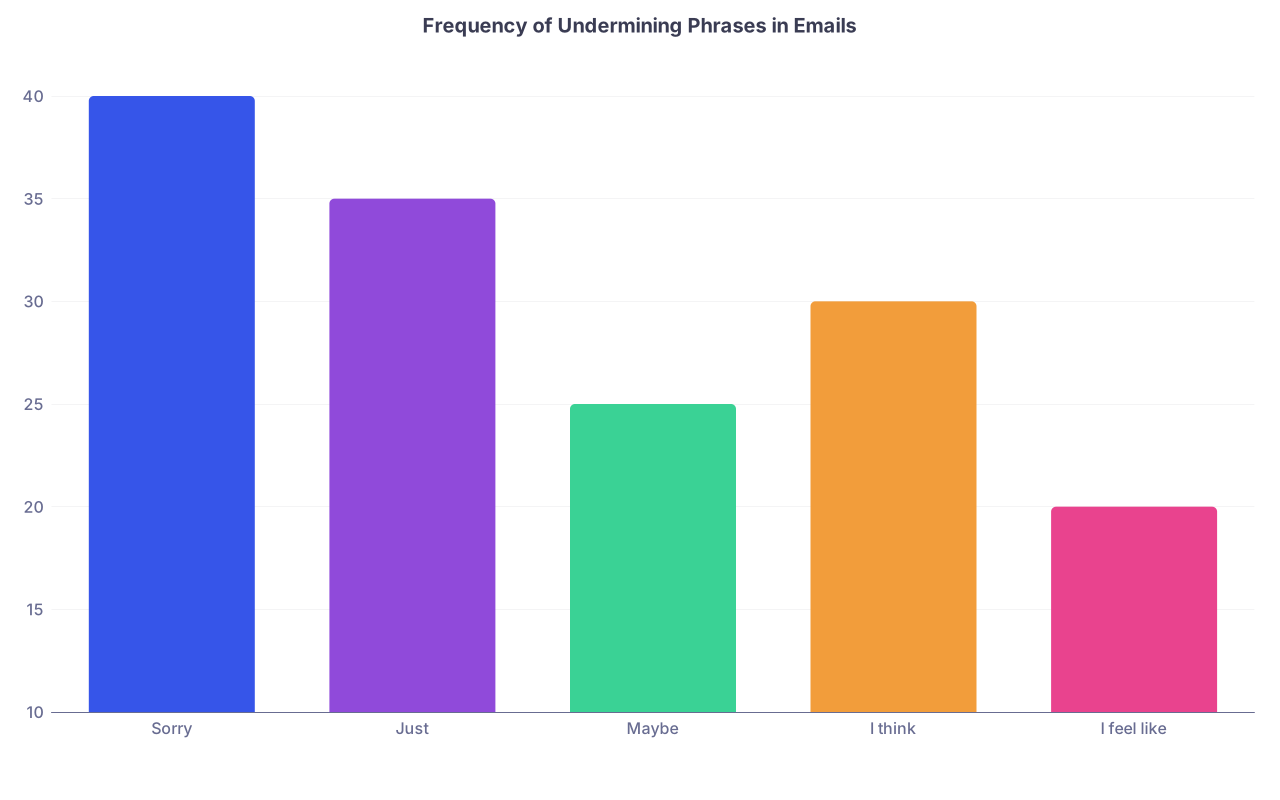
| Category | Value |
|---|---|
| Sorry | 40 |
| Just | 35 |
| Maybe | 25 |
| I think | 30 |
| I feel like | 20 |
Tactical Rewrites: Before and After
Let’s make this less theoretical. Here are real-world rewrites I’ve had women use that changed how they were treated almost immediately.
Case 1: Directing the Team
Before: “Hey guys, sorry for the late email, today was crazy. I was just wondering if we could try to get vitals in a little earlier tomorrow? It would be super helpful for rounds. Thanks so much!!”
After: “Tomorrow, please obtain vitals by 6:30 AM so they’re available for rounds at 7. Thank you.”
Result: Compliance improved. No one complained about tone. The only thing that changed was clarity and authority.
Case 2: Consultant Request
Before: “Hi, I’m not sure if this is something your team would usually see, but I was wondering if maybe you could take a look at this patient? She’s been having some weird symptoms and I’m feeling a bit uncertain. Totally understand if not.”
After: “Hi, I’m requesting a consult for Ms. X, a 54-year-old with [key problem]. She has [brief summary]. My primary questions are: 1) Could this represent [X]? 2) Do you recommend [Y] at this time? Thank you.”
Result: Faster consult, clearer recommendations, zero drama.
Case 3: Chart Assessment
Before: “Patient may possibly have early sepsis, but picture is somewhat unclear. Will consider starting antibiotics and continue to monitor closely.”
After: “Patient meets criteria for possible early sepsis (tachycardia, fever, suspected infection). Will start empiric antibiotics now and monitor vitals and lactate closely; will reassess antibiotic choice when cultures result.”
Result: Your reasoning is obvious. If something goes wrong legally, your note shows active decision-making, not passivity.
| Situation | Undermining Phrase | Authoritative Phrase |
|---|---|---|
| Starting an email | "Sorry to bother you..." | "Following up on..." |
| Making a request | "I was wondering if we could..." | "Please do..." |
| Expressing uncertainty | "I feel like maybe..." | "Differential includes..." |
| Referencing others | "Per attending..." | "Agree with attending that..." |
| Setting expectations | "It would be great if..." | "We need..." |
How to Start Fixing This Without Feeling Fake
You might worry that if you cut the hedges and apologies, you’ll sound harsh. Especially if you’ve been trained since childhood to soften yourself to make others comfortable.
Here’s how to transition without whiplash.
- Pick one channel to change first. For example: only your emails to peers and staff this month. Then expand to consultants. Then leadership.
- Choose 2–3 phrases you will intentionally eliminate for 30 days: “Just,” “Sorry to bother,” “I was wondering if maybe.”
- Create replacement templates you can copy-paste or mentally plug in. For instance:
- “I’m writing to request…”
- “The plan is…”
- “We will…”
- Tell one trusted colleague what you’re doing so you’re less tempted to backslide when feedback gets weird. And yes, some people will react. That doesn’t mean you’re wrong.
You’re not obligated to sound small to protect other people’s comfort.
The Ethical Piece You’re Probably Ignoring
This isn’t just about your career. It’s about patient care and professional ethics.
When your emails and charting undermine your authority:
- Nurses and staff may not prioritize your orders.
- Consultants may take your concerns less seriously.
- Leadership may not recognize safety issues you raise.
- Families may doubt your recommendations and delay necessary care.
You have an ethical obligation to communicate in a way that supports safe, clear, decisive patient care. That means not only being competent but sounding competent in the record.
You are not lying by sounding confident when your assessment is well founded. You’re telling the truth about your clinical judgment.
If You Remember Nothing Else
Keep these three points:
- Stop pre-apologizing and over-hedging in emails—your default tone should be clear, concise, and direct, not guilty or tentative.
- Chart like the physician you are, not like a scribe: own your assessment, state your plan, and document your reasoning instead of hiding behind “per [someone else].”
- This isn’t vanity; it’s ethics. Your authority in writing directly impacts how seriously your concerns are taken—and that affects patient safety and your career longevity.