
The biggest networking risk for women physicians isn’t not networking. It’s getting trapped as “the helpful one” while everyone else moves up.
You already know how this happens. You go to the same events. You stay just as late. You answer more emails. Yet somehow your colleagues walk away with leadership invitations, speaking slots, and plum committee assignments, while you walk away with… more work and the vague label of being “so supportive.”
This isn’t an accident. It’s a pattern. And if you don’t see it clearly, you’ll spend a decade building other people’s careers instead of your own.
Let’s walk through the traps that pull women physicians into helper-only roles, and how to avoid them without becoming a jerk or abandoning your values.
1. The Quiet Trap: Confusing Being Liked with Being Advancing
Most women physicians are over-trained in likeability and under-trained in strategic visibility.
What that looks like in networking:
- You listen deeply.
- You ask thoughtful questions.
- You remember everyone’s kids’ names.
- You introduce people who “should meet.”
And then you… never clearly talk about what you want, what you’re building, or where you’re headed.
You become:
- “The glue”
- “The team player”
- “The person who makes everything run smoothly”
Those are compliments. They are not career accelerators.
The mistake: Believing that if you are generous and kind enough, people will organically champion you, remember your ambitions, and pull you into opportunities.
They won’t. Not consistently.
Here’s what I’ve seen too many times:
- A woman faculty member who “helps everyone” with their slides, data interpretation, and draft emails.
- A male colleague she coached through his first talk.
- Six months later, he’s invited to join a national panel.
- The invitation email literally says, “You’re such a great speaker and collaborator — we’d love your perspective.”
- Her name never comes up.
How to avoid this trap
Do not stop being kind. Do stop being invisible.
When you’re in networking conversations, resist the urge to keep the focus 100% on the other person. Instead:
- Spend at least one-third of the conversation on your own work and goals.
- Use direct, simple statements:
- “I’m building a program in X.”
- “My next step is a regional speaking role on Y.”
- “I’m actively looking for leadership opportunities in Z.”
This isn’t arrogance. It’s data. You’re giving people information they need in order to think of you when doors open.
A simple script shift:
- Instead of only: “Let me know how I can help.”
- Try: “Here’s how I can help, and here’s what I’m working toward next.”
2. The “Can You Just…” Trap: Death by a Thousand Favors
Women physicians get asked to “just help with” everything:
- “Can you just review this?”
- “Can you just hop on this panel last minute?”
- “Can you just advise this student?”
- “Can you just be on this diversity/DEI/‘women in medicine’ committee?”
Each one seems minor. Together, they create a giant unpaid job: Institutional Helper.
The red flag: These asks often come without authorship, leadership credit, funding, or long-term role.
You get:
- Emotional labor
- Scheduling headaches
- That vague “you’re so great” feedback
Someone else gets:
- Title
- Line on CV
- Thanks in the acknowledgements section
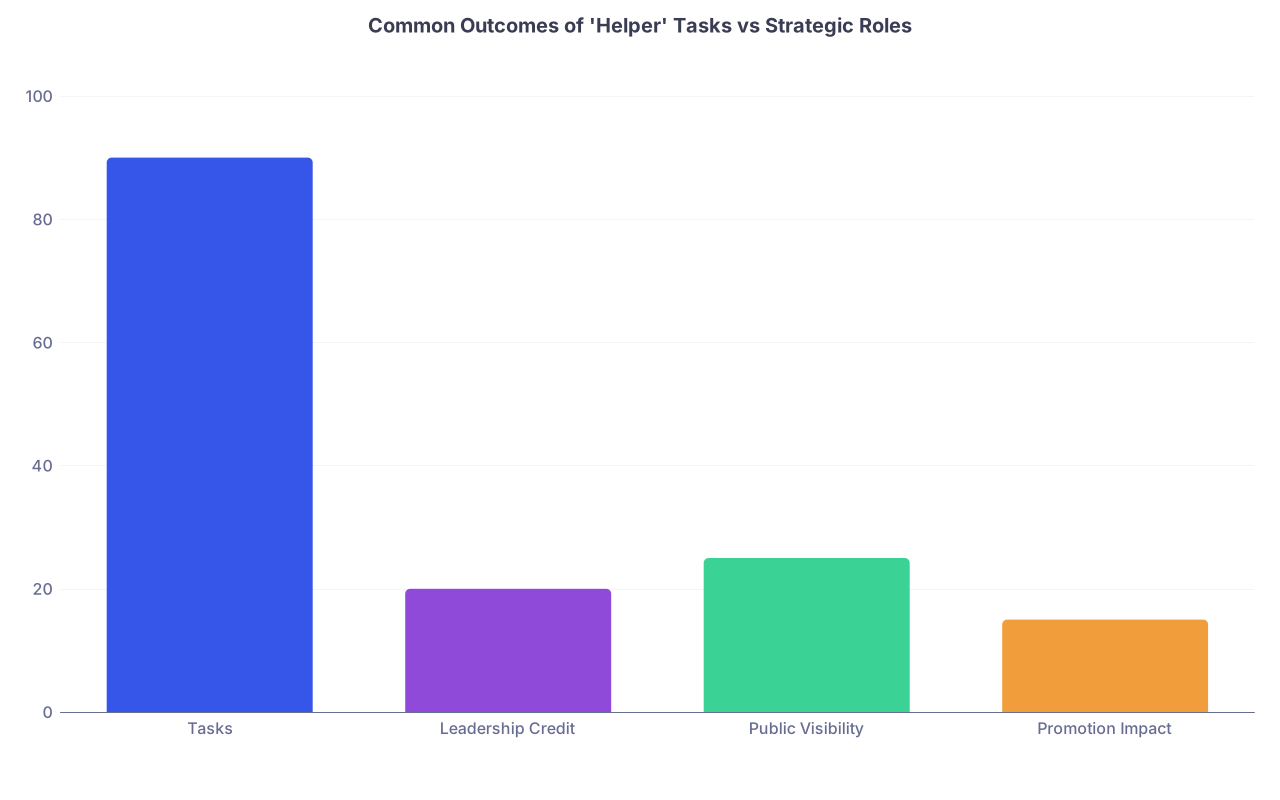
| Category | Value |
|---|---|
| Tasks | 90 |
| Leadership Credit | 20 |
| Public Visibility | 25 |
| Promotion Impact | 15 |
How to spot the trap early
Listen for these phrases:
- “You’d be perfect for this — it just needs someone organized.”
- “We just need someone to help execute the vision.”
- “We already have a chair; we’re looking for strong support.”
- “You’re so good with people; can you handle the logistics?”
Translation: They want your labor, not your leadership.
Ask yourself three blunt questions before saying yes:
- Will my name be visible (on the program, paper, website, or org chart)?
- Will this role be counted for promotion or leadership trajectory?
- Is there a clear end date or is this an open-ended sinkhole?
If you can’t answer “yes” to at least two, this is probably a helper trap.
A safer default response
Use a pause-plus-conditions approach:
- “I might be open to that. Before I commit, can you clarify:
- What the formal role and title would be?
- Where my name will appear?
- How this is usually credited for promotion or leadership?”
Watch their reaction. If they:
- Get vague
- Seem annoyed
- Say, “Oh, it’s not that formal”
That’s your sign. This is free labor disguised as an “opportunity.”
Practice saying:
“I can’t take on ongoing support roles right now, but I’m happy to consider clearly defined leadership or authorship opportunities.”
You’ll feel rude the first few times. You’re not. You’re protecting your career.
3. The Mentoring Sinkhole: Being Everyone’s Coach but No One’s Colleague
Another common trap: becoming the un-official therapist and career coach for your department.
You know this one:
- Trainees show up in your office in tears.
- Junior colleagues text you with “Can I run something by you?”
- You spend call nights debriefing someone else’s conflict rather than sleeping.
You become “the person to go to” when someone feels lost, hurt, or stuck. That’s honorable. But it can be weaponized against your time and advancement if you don’t draw lines.
The mistake: Treating every emotional crisis as your responsibility.
The result:
- Your writing time evaporates.
- Your clinic notes pile up.
- Your own projects sit untouched while you pour energy into everyone else.
Meanwhile, the colleague who’s not known as “so supportive” is finishing their R01 application, giving talks, and getting tapped for leadership — often on the backs of the thriving environment you help create.
Set boundaries before resentment sets in
You don’t have to become cold to avoid this. You do have to become precise.
Try:
- “I can give you 15 minutes right now; for more than that, we should schedule.”
- “This is important. I can talk for 20 minutes today, or we can put something on my calendar next week so I can give it proper attention.”
- “I want to support you, but I also need to protect my research/clinic time. Let’s keep this to X minutes and then we’ll schedule follow-up if needed.”
And crucially: refer out.
- “This is bigger than one conversation. Have you connected with GME/Faculty Affairs/counseling?”
- “I’m not the right person to advise on legal/contract issues, but I can point you to people who are.”
If someone repeatedly drains your time and doesn’t respect boundaries, that’s not networking. That’s exploitation.
4. The Invisible Labor Trap: Committees, Task Forces, and “Representation”
Women physicians — especially women of color — are over-recruited for any initiative that needs “representation”:
- Diversity committees
- Wellness task forces
- Women in medicine panels
- “We need a female perspective” projects
On paper, this looks like influence. In reality, a lot of it is unpaid consulting bundled with political cover for the institution.
Here’s how I’ve seen this go:
- A department launches a wellness or DEI initiative.
- A woman physician is asked to “co-lead” or “represent” clinicians.
- She attends dozens of meetings, writes documents, and manages angry emails.
- The male VP gets the official title, raise, and leadership line.
- She gets a plaque at Grand Rounds and a “thank you for your service” slide.
| Role Type | Risk Level | Clear Title? | Promotion Impact? |
|---|---|---|---|
| “Working group member” | High | No | Low/None |
| “Co-chair” without pay | High | Vague | Weak |
| Task force volunteer | High | No | Minimal |
| Named committee chair | Lower | Yes | Strong |
| Paid program director | Lower | Yes | Strong |
How to filter these requests
Before agreeing to any “representational” role, ask:
- Who owns the budget and decision-making power?
- Who is getting the official title?
- Is this protected time or “do it on top of everything else”?
- How has this type of role been treated in past promotion decisions?
If you get hand-wavy answers like “we’re still figuring that out” but they need you now — don’t step in until they figure it out.
You can respond with:
- “I’d like to be considered for a formal leadership role with defined time and title when those are set.”
- “I support this work, but I can’t take on open-ended committee roles that are not clearly recognized in promotion pathways.”
You’re not abandoning the cause. You’re refusing to be the unpaid backbone of it.
5. The “Good Soldier” Trap: Doing the Work, Not Owning the Work
One of the most dangerous traps: doing high-value work while someone else’s name is at the top.
You:
- Draft the grant sections.
- Build the curriculum.
- Run the study visits.
- Organize the conference session.
They:
- Give the keynote.
- Are listed as PI.
- Get invited as “the expert.”
The system loves this split: women as implementers, men as “visionaries.” You can’t single-handedly fix the system, but you can stop participating blindly in your own erasure.
Two questions before you say yes
Where will my name appear?
- On the paper: First, second, middle, last?
- On the grant: Co-I, key personnel, nothing?
- On the event: Co-organizer, moderator, speaker, or not at all?
What is the path from this task to a title?
- Can this eventually become Program Director, Section Chief, Chair of X?
If both answers are fuzzy, you are likely being slotted as a “good soldier,” not a future leader.
How to push for real ownership
Use calm, direct language:
- “Given the level of work you’ve described, I’d want to be listed as co-investigator/co-director/co-chair. Is that aligned with how you’re structuring this?”
- “If I take the lead on building this curriculum, I’d like to be the one presenting it at [major meeting] and listed as first author on any resulting publications.”
If they resist and say things like:
- “Let’s just get it done first and figure that out later.”
- “I was thinking of you more as the implementer.”
- “Titles get messy — can we not worry about that right now?”
That is the red flag. This person is comfortable with you doing the work and them getting the visible credit.
Back away.
6. The Endless Availability Trap: Mistaking Accessibility for Influence
Being “always reachable” is not a leadership trait. It’s a boundary problem.
Women physicians are often praised for being:
- So responsive
- So flexible
- So willing to pitch in
This quietly sets up an expectation: if there’s a gap, you will fill it.
Networking-wise, this looks like:
- Staying late at receptions to help clean up or “finish conversations.”
- Being the person who replies first on group emails to “keep things moving.”
- Letting people stack “quick questions” onto every hallway encounter.
Meanwhile the more senior (often male) physician:
- Leaves early with the keynote speaker.
- Takes only high-yield meetings.
- Ignores half the email threads.
Guess who’s perceived as “busy and important” and who’s “so dependable”?
Re-calibrate your availability
You are allowed to:
- Let non-urgent emails sit.
- Decline random “pick your brain” coffee meetings.
- Leave events on time, not after you’ve helped stack chairs and debrief everyone’s feelings.
When networking:
- Set a time limit before you walk in. “I’m staying 45 minutes, and I want to connect with X and Y.”
- After that, leave. No apologies. No explanation.
And stop auto-volunteering for logistics:
- When someone says, “We need someone to take notes,” let the silence sit.
- When they say, “Can someone coordinate schedules?” don’t reflexively raise your hand.
You’re not being selfish. You’re forcing the system to see that your highest value is not secretarial.
7. The “Nice Girl” Trap: Avoiding Asking for What You Actually Want
A lot of women physicians do heroic networking… that never turns into explicit asks.
They:
- Maintain relationships
- Send congratulatory emails
- Attend talks
- Share other people’s work
But they never say:
- “Can you sponsor me for X role?”
- “Will you introduce me to Y?”
- “I’d like to be considered for Z. What would it take?”
Networking without asks is just socializing with extra steps.
Here’s what I’ve heard from senior leaders behind closed doors:
- “She’s fantastic, but I honestly have no idea what she wants.”
- “He’s been clear he wants leadership; she’s never said that to me.”
- “If she’d asked, I could have put her name forward.”
You may think your ambitions are obvious. They aren’t.
Make one specific ask per month
That’s it. One.
Examples:
- “You’re on the planning committee — would you consider me for a speaking role next year?”
- “If something opens up on a national guideline panel in X, will you keep me in mind?”
- “In the next 1–2 years I’d like to become associate program director. What steps do you recommend, and can I circle back to you as I work on them?”
If that feels too bold, remember: men you know are doing this already, usually with less preparation and more confidence.
8. How to Network Strategically Without Becoming the Department Villain
Let me be blunt: When women stop over-helping, people notice. Not always positively.
You may hear:
- “She’s changed.”
- “She’s not as available as she used to be.”
- “She’s getting a bit… ambitious.”
That’s the tax for stepping out of the helper-only box. You have to decide if you’re willing to pay it.
There are ways to soften the blow without backtracking into martyrdom.
A simple 3-part filter for every request
Run every ask through this quick screen:
- Value – Does this directly build my CV, visibility, or skills toward my stated goals?
- Visibility – Will decision-makers see this work and associate it with me?
- Volume – Do I have capacity without sacrificing my own priority projects?
If you don’t get at least 2 out of 3, your default answer is no.
Your actual words might be:
- “I’m at capacity with current leadership and scholarly commitments, so I can’t take this on and do it well.”
- “That’s not aligned with my current priorities, but if a speaking/leadership/authorship role opens up in X, I’d definitely be interested.”
- “I’m focusing my extra time on projects that directly support my promotion/leadership trajectory.”
Then stop talking. Don’t over-explain. Over-explaining invites negotiation.

| Step | Description |
|---|---|
| Step 1 | New request |
| Step 2 | Say no |
| Step 3 | Defer or renegotiate |
| Step 4 | Consider yes with clear terms |
| Step 5 | Builds CV or skills? |
| Step 6 | Visible to decision makers? |
| Step 7 | Have capacity now? |
FAQs
1. How do I say no to “helper” roles without hurting relationships?
Use a structure that validates the work, states your limit, and signals what you would consider:
- “This is important work, and I’m glad it’s happening. Right now I’m maxed out on committee/support roles, but I’d be interested in future opportunities that come with a clear leadership title or authorship.”
You’re not rejecting the person; you’re declining the structure.
2. What if I actually like helping and mentoring? Isn’t that valuable?
It is valuable. The mistake is letting it become unbounded, uncredited, and unstrategic. Set limits (office hours, scheduled times, defined roles) and make sure some of your “helping” is tied to visible, promotable positions: formal mentorship programs, named roles, funded initiatives.
3. My department expects women to do all the wellness/DEI work. How do I push back?
You can say:
- “I support this direction, but I’m concerned about the load falling disproportionately on women faculty. Before I accept, I’d like to know how this work is recognized in promotion and whether there’s protected time or compensation.”
If they can’t answer, you’ve just surfaced a structural problem — and protected yourself from quietly shouldering it alone.
4. How do I move from “helper” to leader if I’m already stuck in that box?
Start by renegotiating one current role:
- Ask for a formal title, documented responsibilities, and visibility (on the website, in communications).
- Identify one low-value helper task you can exit in the next 3–6 months.
- Use the reclaimed time for one visible project: a talk, a paper, a grant, a course.
You don’t have to blow up everything. Shift one thing at a time toward ownership and visibility.
5. Won’t people think I’m selfish or difficult if I stop over-helping?
Some might. Especially people who benefitted from your unpaid labor. But the people who understand boundaries and respect strategic thinking? Those are the ones you want as sponsors and peers. You’re not here to be universally liked. You’re here to build a sustainable, ethical career — which requires saying no.
You do not owe medicine your endless, invisible labor.
You owe yourself three things:
- Clarity about what you want.
- Boundaries that protect time for it.
- The courage to stop being only the helper and start being the person whose name is on the door.