
What actually goes wrong after you get the leadership title you worked so hard for—and why do so many brilliant women physicians quietly hate their first year in leadership?
You’re not struggling because you are not “a natural leader.” You’re struggling because the system rewards women for one set of behaviors as clinicians… and then punishes those same behaviors the moment they step into leadership.
Let’s walk through the landmines. And how not to step on them.
1. Treating the Leadership Role Like “Extra Clinical Work”
The first big mistake: treating your new leadership job as a side gig instead of a fundamentally different job.
I’ve watched new women medical directors and associate program directors do this over and over:
- Keep a full clinical load (“I don’t want to upset the schedule”)
- Answer leadership emails after the kids are asleep
- Do all the “admin” work on nights and weekends
- Tell themselves: “Once things stabilize, it’ll get better”
It does not “get better.” It gets worse. Because you’ve trained everyone—administration and colleagues—to expect you’ll do two jobs for the price (and time) of one.
Why this is dangerous
- Burnout sneaks up fast because leadership work is emotionally heavy: conflict, complaints, metrics, politics.
- You are more likely to make poor decisions when you’re constantly rushed and reactive.
- You unintentionally signal that leadership work is less valuable than clinical work.
If you treat your leadership role like an add-on, everyone else will too.
How to avoid this
Renegotiate your schedule early, not after you’re drowning.
In your first 60 days, you should have a clear breakdown: X% clinical, Y% leadership—with protected time actually blocked on your calendar.Block “decision time” like OR time.
Protected blocks for:- Performance reviews
- Strategic planning
- Difficult conversations
Do not let these get eaten by “just one more patient.”
Stop apologizing for leadership time.
Do not say, “Sorry, I’m not in clinic that day—I have admin stuff.”
Say: “That’s one of my leadership days. I’m working on program priorities then.”
You cannot lead effectively if you’re functioning like a full-time clinician plus unpaid administrator.
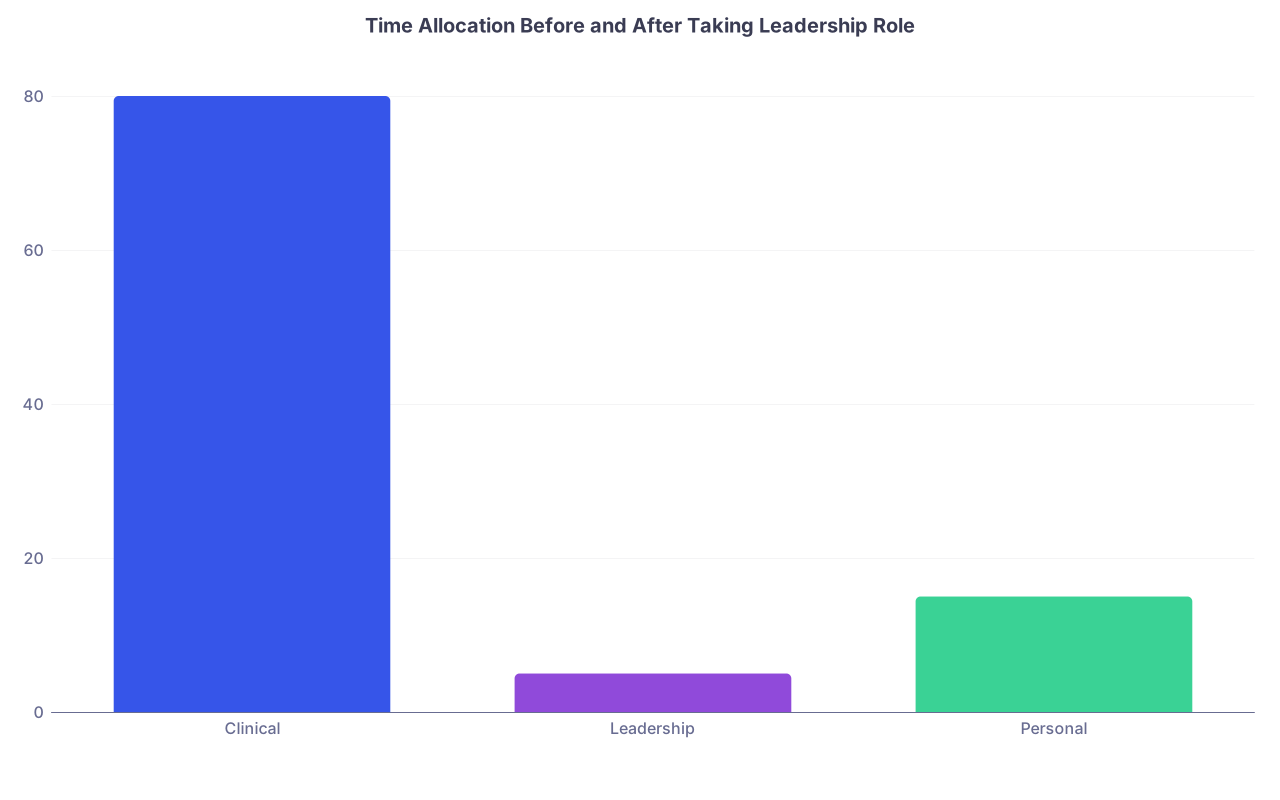
| Category | Value |
|---|---|
| Clinical | 80 |
| Leadership | 5 |
| Personal | 15 |
(This is what I see too often: leadership tacked on to an already full life.)
2. Over-Accommodating to “Be Liked” (and Losing Authority)
Here’s the quiet trap: you’ve been rewarded your whole career for being agreeable, helpful, and “easy to work with.” That is exactly what gets you run over in a leadership role.
I’ve watched new women section chiefs:
- Say yes to every schedule request
- Let meetings run 20 minutes over “because people had a lot to say”
- Avoid enforcing consequences when someone misses deadlines
- Back down the moment someone says, “Well Dr. X never made us do that”
This does not make you beloved. It makes you ignorable.
What over-accommodating looks like in real life
- You rewrite the call schedule three times to keep everyone happy.
- You “temporarily” take back responsibilities from a struggling resident or colleague instead of coaching them.
- You soften every email until it’s so vague no one knows what’s actually required.
You end up tired, resentful, and weirdly blamed for everything anyway.
How to avoid this
Decide what is non-negotiable.
Before conflicts arise, be clear in your own head about:- Patient safety and quality standards
- Professionalism expectations
- Reporting lines and authority
You don’t “compromise” on those to keep the peace.
Use clear language, not apologetic hedging.
Stop writing:
“I was just wondering if maybe we could try…”
Replace with:
“Starting July 1, we will…”
“Going forward, all residents are expected to…”Accept that leadership is not a popularity contest.
If everyone likes you all the time, you are probably not doing the job.
Someone will be unhappy when you enforce standards. That’s normal, not a sign you’re failing.
3. Being Vague About Authority and Boundaries
You know what women leaders say a lot in their first months?
- “I don’t want to step on anyone’s toes.”
- “I’m not sure if that’s my place.”
- “I don’t want to seem like I’m throwing my weight around.”
This hesitation creates a power vacuum. And someone else always rushes to fill it—usually the loudest or most entitled person in the room.
Common boundary mistakes
- You let an older male colleague introduce you as: “She’s kind of helping out with some admin stuff now.”
- You accept being left off emails about decisions that are squarely in your lane.
- You let staff bypass you and go straight to the male former chief for decisions “out of habit.”
All of that becomes the new norm if you do not correct it.
How to avoid this
State your role out loud. Often.
At your first team meeting, do not just say, “I’m excited to be in this role.”
Say:- “As section chief, I’m responsible for X, Y, Z.”
- “Decisions about A and B will now go through me.” Then repeat that consistently.
Correct mis-labeling in real time.
If someone introduces you incorrectly:- “Actually, I’m the new Medical Director for the unit.”
Say it calmly, without shrinking or over-explaining.
- “Actually, I’m the new Medical Director for the unit.”
Set communication boundaries early.
Examples:- “For schedule changes, please email the group inbox—not my personal phone.”
- “I don’t make decisions about patient-specific issues by text. Put it in the chart and page me.”
If you don’t define your scope and boundaries, other people will define them for you. You probably won’t like their version.

| Step | Description |
|---|---|
| Step 1 | Start New Role |
| Step 2 | Define responsibilities |
| Step 3 | Announce scope to team |
| Step 4 | Correct in real time |
| Step 5 | Maintain current practice |
| Step 6 | Authority reinforced |
| Step 7 | Boundary violated |
4. Doing the Emotional Labor for Everyone
Here’s a specific trap that hits women extremely hard: becoming the emotional shock absorber of the entire department.
You can probably recognize this:
- You mediate every conflict.
- You’re the one people cry to about burnout, unfair scheduling, “toxic culture.”
- You remember everyone’s birthday, check in when someone’s parent is sick, smooth over harsh emails.
Some caring and empathy is good leadership. But when you start functioning as the department therapist and emotional janitor, you burn out fast and your actual leadership work suffers.
The hidden costs
- You absorb everyone’s stress but have nowhere to put your own.
- People start bringing you problems with zero intention of changing anything. They just want to vent.
- Your time disappears into endless one-on-ones that feel supportive but achieve nothing concrete.
I’ve seen new women program directors who spend 6–8 hours per week just on resident emotional triage. Then they’re blamed for not making “program improvements.”
How to avoid this
Differentiate support from rescue.
Support sounds like:- “That sounds hard. Let’s talk about what’s in your control.”
Rescue sounds like: - “I’ll talk to them for you.”
Stay in the first camp.
- “That sounds hard. Let’s talk about what’s in your control.”
Put structure around one-on-ones.
Ask:- “What’s the main issue you want to leave this meeting with progress on?”
End with: - “What are you going to do next?”
Not: “Here are 12 things I’ll go fix for you.”
- “What’s the main issue you want to leave this meeting with progress on?”
Protect your own capacity.
It’s not cruel to say:- “I hear this is really tough. I want to make sure you have deeper support than I can provide—here’s our wellness resource/mentoring program/HR partner.”
Do not become the department sponge for everyone’s emotions. You’ll wring yourself dry for people who may not even notice.
5. Avoiding Hard Conversations (Especially With Problem Colleagues)
You know that chronically late attending. The toxic fellow. The resident everyone fears being on call with. Almost every new leader tries, at first, to “work around” them.
Mistake.
What I see women leaders do:
- Encourage everyone else to “give them grace” while secretly rearranging schedules.
- Document nothing because it feels “too harsh.”
- Hope that with enough kindness and subtle hints the person will “get it.”
They don’t get it. And then, when things finally blow up, it looks like you ignored the problem for months. Because you did.
Why women especially fall into this
You’ve been punished your entire career for being “too direct” or “not a team player” when you named problems. So now, with actual authority, you flinch at using it.
How to avoid this
Separate discomfort from inappropriateness.
Feeling uncomfortable having a performance conversation does not mean the conversation is unfair. It means you are human and new to it.Use simple, behavior-focused language.
Not:- “People feel like maybe you’re not as engaged.”
But: - “In the last month you were late for 5 of 8 clinics by more than 20 minutes.”
- “People feel like maybe you’re not as engaged.”
Document early and consistently.
You are not “building a legal case.” You’re:- Making patterns visible
- Protecting yourself ethically
- Giving the person clear feedback and a fair chance to improve
Avoiding hard conversations does not protect your team. It protects the problem person at everyone else’s expense.
| Problem Behavior | Weak Response Example | Stronger Response Example |
|---|---|---|
| Chronic lateness | "Try to be on time, okay?" | "You were late 5 of 8 shifts. This must change." |
| Disrespectful comments | "Let’s all be nice, please." | "That comment was unprofessional. Don’t repeat it." |
| Missed documentation | "Charts are important, you know." | "3 charts incomplete. By Friday they must be done." |
| Ignoring policies | "We prefer if you follow the process." | "Our policy is X. Deviating is not acceptable." |
6. Saying Yes to Everything “Because It’s Good for Women”
New women leaders get buried under “good for the women” work:
- Speak on this diversity panel
- Mentor these three students “who really need a woman role model”
- Join this “women in leadership” committee
- Write the gender-equity policy
- Be the representative on the harassment task force
Let me be blunt: some of this is important; a lot of it is institutional outsourcing of emotional and equity labor to the people most harmed by the problems.
The mistake
You say yes to everything because:
- “If I don’t do it, who will?”
- “This is important.”
- “I want to support younger women.”
The result? Your actual job—where your power, authority, and evaluation live—gets less of you. And the system coasts along, thrilled you’re patching its moral holes for free.
How to avoid this
Tie every yes to your role and goals.
Ask:- “Does this align with my job description or my top 2–3 leadership priorities this year?”
If no, your default answer should be no or “not now.”
- “Does this align with my job description or my top 2–3 leadership priorities this year?”
Negotiate trade-offs explicitly.
Response options:- “I can lead the task force, but then I’ll need to step back from X committee.”
- “If this is a priority for the department, we need protected time in my schedule for it.”
Support without owning everything.
Examples:- “I can attend one session and suggest another speaker for the rest.”
- “I’m happy to advise the group, but I cannot chair it.”
If you try to personally fix institutional gender inequities while also doing your full job, the institution wins and you lose.
7. Under-Communicating Upward (and Getting Blindsided)
One more common misstep: assuming your good work will speak for itself, and that senior leadership will “obviously” see what you’re doing.
They won’t.
Women leaders, especially, get tagged as “not strategic” or “too operational” because they quietly do the hard work but do not proactively show:
- What’s working
- What’s not
- What support they need
- How their work ties to institutional goals
Then suddenly they’re told: “We’re restructuring your program” or “We’re not renewing that funding,” and it feels like it came out of nowhere.
How to avoid this
Schedule regular brief, structured updates.
Monthly or quarterly touchpoints with your boss:- Top 3 wins
- Top 3 risks/problems
- Specific asks (resources, decisions)
Use numbers and outcomes, not just effort.
Don’t say:- “We’ve been working so hard on the schedule.”
Say: - “We reduced last-minute schedule changes by 40% this quarter.”
- “We’ve been working so hard on the schedule.”
Flag problems early—before they explode.
Yes, this feels like exposing imperfection. Do it anyway:- “We have a professionalism issue with Dr. X. I’m addressing it with HR and will keep you posted.”
That’s vastly better than your CMO hearing about it first from a patient complaint.
- “We have a professionalism issue with Dr. X. I’m addressing it with HR and will keep you posted.”
Silence gets interpreted as “everything’s fine.” Until it very much isn’t, and everyone looks at you.
8. Ignoring Your Own Ethics Red Flags “For the Team”
Last category—this one is ugly but real.
Women in new leadership roles often override their own ethical discomfort because they:
- Don’t want to rock the boat in their first year
- Feel pressure to “be a team player” with senior leadership
- Worry about being labeled “difficult” or “not aligned”
Examples I’ve seen:
- Being asked to quietly reassign a trainee who complained about harassment—without addressing the harasser.
- Being pressured to fudge documentation of supervision coverage to match billing expectations.
- Being encouraged to “downplay” staffing shortages in public messaging.
You tell yourself: “Just this once.” “I’ll fix it later when I have more power.” Then it becomes the new norm.
How to avoid this
Write down your personal non-negotiables.
Before you’re in the hot seat, get clear:- What you will not lie about
- What you will not conceal
- What you will not ask others to do
Use “I” statements when you push back.
Not:- “Some might feel this isn’t right.”
But: - “I’m not comfortable representing that as accurate.”
- “I cannot, in good conscience, sign off on that.”
- “Some might feel this isn’t right.”
Get allies and documentation.
Loop in:- Compliance
- Legal
- HR
- Ethics committee
Say what was asked, what you said, and get it in writing.
If leadership costs you your ability to look your residents—and yourself—in the eye, that’s not leadership. That’s complicity.
FAQ (Exactly 3 Questions)
1. How do I push back on unrealistic expectations without being labeled “not committed”?
Anchor your pushback to outcomes, not your feelings.
Example: “With my current 80% clinical load and 20% leadership time, I cannot add responsibility X without something else coming off my plate. If this new initiative is a priority, let’s talk about reducing my clinics or reallocating duties so I can do it well.”
2. What if my team resists my authority because I’m younger or a woman—or both?
Name the behavior, not the bias, in the moment. “We’re not going to revisit whether this policy exists. It does. We can talk about how to implement it well.” Then consistently follow up with actions that match your words. Do not start over-explaining or over-apologizing to win them over; respect comes from clarity and consistency, not from endless accommodation.
3. How do I know when a leadership role is actually toxic and not just challenging?
Three red flags:
- You’re asked to do things that violate your ethical line and get punished when you question it.
- You have responsibility without real authority or support, and every request for resources is dismissed.
- Feedback is personal and vague (“not a good fit,” “not leadership material”) instead of concrete and coachable.
If all three are present and consistent, you’re not “failing at leadership”—you’re in a bad system.
Key Takeaways
- Do not treat leadership as “extra” work on top of full-time clinical duties; claim real time, scope, and authority or you’ll burn out fast.
- Stop over-accommodating and avoiding conflict just to be liked; clear boundaries, hard conversations, and ethical lines are part of the job.
- Protect your energy and integrity: say no strategically, refuse to be the department’s emotional sponge, and do not override your ethical discomfort “for the team.”