
The biggest threat to your earning power is not sexism. It’s signing a bad first contract because you did not negotiate.
I’m not letting hospitals off the hook—bias is real. But I’ve watched smart, competent women physicians quietly lock in $30,000–$80,000 less per year than male colleagues because of avoidable mistakes in that first job offer. Once it’s on paper and you’ve signed? You’ll spend years trying to claw back what you gave away in 48 hours.
Let’s walk through 12 negotiation mistakes women physicians make on their first contracts—and how not to be one of them.
1. Treating the Offer as a Favor, Not a Business Transaction
Do not act like they’re “doing you a favor” by giving you a job.
You are revenue. You bill. You generate downstream consults, procedures, admissions. You aren’t a charity case.
Common signs you’re making this mistake:
- You feel grateful instead of strategic.
- You say “I’m just happy to have an offer” out loud.
- You apologize before asking questions about salary or terms.
I’ve heard practice managers say in debrief: “She seemed so thankful, I’m pretty sure she’ll sign as is.” They notice. And they use it.
How to avoid it:
- Reframe mentally: “This is a business conversation between two parties with value.”
- Never apologize for asking numbers. “Can we walk through the full compensation structure?” is standard, not rude.
- Banish “I know I shouldn’t be asking…” and “Sorry, one more thing…” from your vocabulary in these talks.
If you start from gratitude instead of value, you’ve already lost ground.
2. Accepting the First Number Without Benchmarking
Walking into contract talks without market data is like walking into a lateral C-spine surgery blind. You might get lucky. You might also slice something vital.
Too many women physicians just assume the number is “probably fair.” It often is not.
You need benchmarks:
- MGMA data for your specialty and region.
- Conversations with co-residents/fellows about their offers.
- National society salary reports and compensation surveys.
| Source | What You Get |
|---|---|
| MGMA | RVU & salary by region |
| Specialty Org | National medians |
| Colleagues | Real-world offers |
| Recruiters | Range by practice type |
If you don't know the range, you can't recognize a lowball. I’ve seen women in outpatient IM happily take $210k when peers at similar systems were starting at $250–270k plus bonuses.
How to avoid this:
- Before any negotiation, write down: national median, regional median, and your personal target.
- If they ask for your “expected range,” don’t undersell. Give a range that includes a strong number at the top: “For this market and workload, I’d expect total compensation in the $260–300k range.”
- If they throw the first number and it’s below benchmark, say: “Based on current MGMA data and what I’m seeing from peers, this feels below market. How flexible is this?”
You’re not being aggressive. You’re being informed.
3. Over-Focusing on Base Salary and Ignoring the Whole Package
Another classic trap: obsessing over the base salary and ignoring everything else that actually determines how much you make and how much you suffer.
I’ve seen contracts with:
- “Great” base salary but brutal RVU thresholds.
- Mediocre salary but generous loan repayment, signing bonus, and realistic RVU targets.
- Salary that looked fine until you notice call is unpaid and every weekend is “expected.”
You must evaluate the whole deal, not just the shiny number on page one.
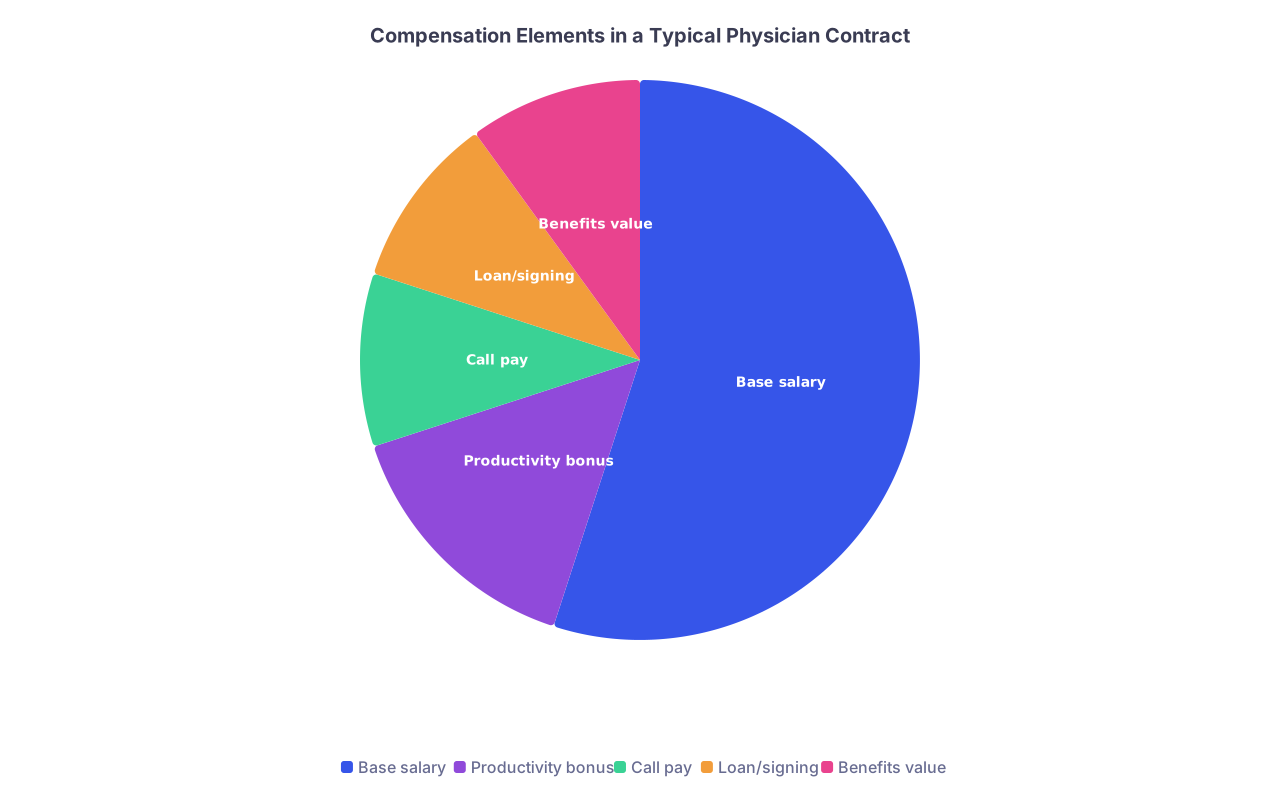
| Category | Value |
|---|---|
| Base salary | 55 |
| Productivity bonus | 15 |
| Call pay | 10 |
| Loan/signing | 10 |
| Benefits value | 10 |
Watch for these mistakes:
- Ignoring how long the “starting guarantee” lasts before you’re fully RVU-based.
- Not asking what the average RVUs are for partners and whether anyone actually hits the top tier.
- Forgetting that paid parental leave (or lack of it) is money.
Questions you must ask:
- “What did your last three hires in this specialty earn in their first and second years, total comp?”
- “What RVU range do your current physicians average, and what’s realistic in this practice?”
- “How is call compensated? Is it included in salary or paid separately?”
Sometimes the “lower” base is actually smarter long term if other levers are strong. Sometimes that “big” number is a trap with unattainable metrics and permanent burnout baked in.
4. Believing You’ll “Prove Yourself First, Negotiate Later”
This one hits women hard.
“I’ll accept this for now, then once I show them how hard I work, we’ll revisit.” No, you won’t. Not the way you imagine.
Once you accept a weak deal:
- Your baseline is set.
- Your leverage drops—especially if you’ve moved cities, bought a house, put kids in school.
- They’ll say: “We can look at a small cost-of-living increase” or “We’ll review in 2–3 years.”
I’ve watched women who doubled clinic volume over two years get offered a 3% raise and a pat on the head. The time to negotiate is when they still fear losing you.
To avoid this:
- Negotiate like there is no guaranteed “second chance.”
- Put future review in writing: “Compensation will be reviewed at 12 months with potential adjustment to X percentile based on performance metrics Y and Z.”
- If they say “We don’t renegotiate after year one,” believe them. Negotiate harder now or walk.
Hope is not a strategy. “I’ll show them and then it’ll all work out” is a lie the system benefits from.
5. Not Using Silence and Direct Language
Women physicians often undermine themselves with how they talk in negotiations. Not content—tone.
Common verbal mistakes:
- Nervous laughter after asking for more.
- Filling silence with justifications: “I mean, only if that’s okay, I know budgets are tight…”
- Turning a clear ask into a question: “Maybe something closer to 260, if that’s even possible?”
Let me be clear: administrators negotiate all day. They’re comfortable with silence. They bank on you not being comfortable.
A better pattern:
You: “Given my training and the current market, I’m targeting a starting base of $260,000 with a signing bonus of $20,000.”
Them: Silence.
You: Also silence.
That pause feels like an eternity. Live through it. Do not rescue them from it by backpedaling.
Practice direct language:
- “I’m looking for…”
- “I’d like to see…”
- “For me to accept, I’d need…”
Drop the qualifiers:
- “Just”
- “Maybe”
- “If that’s not too much”
- “If that’s okay”
Ask cleanly. Then stop talking.
6. Failing to Negotiate Non-Salary Terms That Affect Your Life
This one bites later, especially for women who want any semblance of flexibility, caregiving capacity, or sanity.
Do not ignore:
- Clinic schedule specifics (start/end times, late clinics, admin time).
- Call expectations and weekend coverage.
- Part-time or FTE reduction options down the line.
- Parental leave duration and whether it’s paid, unpaid, or cobbled together from PTO.
- Out clauses and noncompete restrictions.
You are not “difficult” for caring about these. You are smart.
I’ve seen young women sign:
- Rigid 5-day clinic schedules that made childcare a nightmare.
- Noncompetes so broad they basically couldn’t practice in an entire metro area for two years.
- Call structures that killed them while their male colleagues subtly dodged.
Ask now:
- “What flexibility exists for adjusted clinic hours after the first year?”
- “What is the exact noncompete radius and duration? Can that be narrowed?”
- “Is parental leave paid? From what bucket? How much is guaranteed?”
If they act offended you care about parental leave or flexibility, that’s not a place that will treat you better once they own your time.
7. Underestimating the Power of Call, RVU Targets, and “Other Duties”
One of the sneakiest mistakes: judging offers side by side without loading the call, RVUs, and “extras” into the equation.
Two “$250k” offers are not equal.
Offer A:
- Q4 call, in-house.
- Weekend rounding every other weekend.
- RVU target that only the top 10% of their docs hit.
- “Administrative duties as assigned” with no time.
Offer B:
- Q6 home call.
- One weekend every two months.
- Reasonable RVU expectations matched to actual patient volume.
- Protected admin half-day weekly.
Those are different lives.
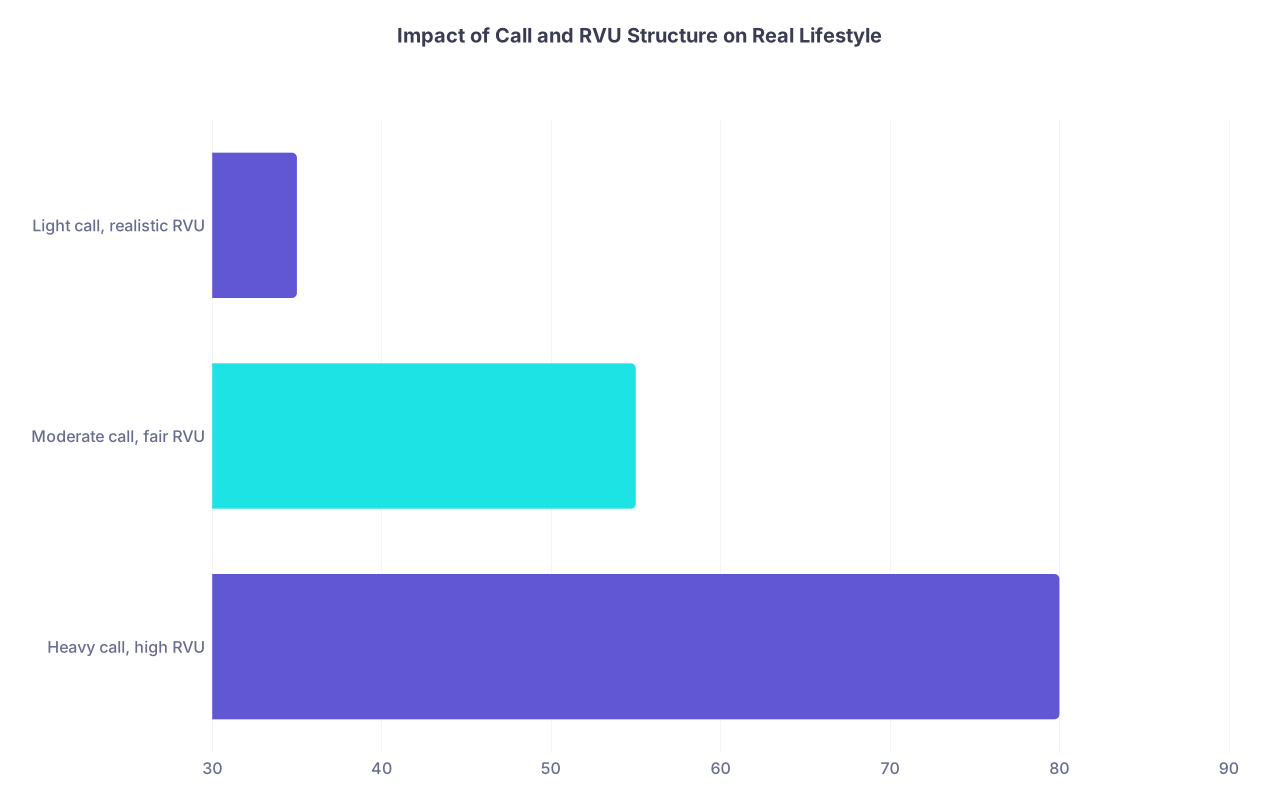
| Category | Value |
|---|---|
| Heavy call, high RVU | 80 |
| Moderate call, fair RVU | 55 |
| Light call, realistic RVU | 35 |
(The numbers don’t have to be perfect; the point is: hours balloon when call and RVUs are aggressive.)
You must:
- Ask how many nights/weekends each doc actually works.
- Ask how many physicians have met or exceeded RVU targets in the last 2 years.
- Get clarity on what “other duties” actually mean and whether there’s compensation or time.
Women physicians often end up saddled with more committee work, “wellness” projects, diversity initiatives—unpaid. If you’re likely to be tapped for that (and you are), make sure it’s either protected time or compensated.
8. Not Getting Everything in Writing (Verbal Promises Are Worth Nothing)
“I know the contract says 4 days clinic, but we’ll probably keep you at 3 days for a while.”
“We almost never enforce the noncompete.”
“You can totally shift to 0.8 FTE after your first year.”
If it’s not in the contract, it does not exist.
I’ve sat with physicians crying in year two: “But they told me…” Yes. They did. Doesn’t matter. HR and legal care about the document you signed.
Do not make these mistakes:
- Trusting “we’re very flexible” without language specifying how and when.
- Accepting vague statements like “we’ll revisit compensation later” without a schedule and structure.
- Believing “we don’t enforce that” about noncompetes or clawback provisions.
You counter with:
- “Let’s add a clause reflecting that flexibility to 0.8 FTE after 12 months based on mutual agreement.”
- “Let’s narrow the noncompete to X miles from the primary practice site.”
- “Let’s specify that call frequency will not exceed X per month without additional compensation.”
If they refuse to put it on paper, assume they either can’t or won’t honor it.
9. Negotiating Alone and Without Expert Review
You went through med school and residency. You did not go through contract law.
Trying to interpret every clause solo is a mistake. And women especially tend to feel like asking for help is “bothering people” or “making a fuss.” It’s not. It’s smart risk management.
You should have:
- A physician contract review attorney (ideally someone who does this all the time in your state).
- A trusted mentor or senior colleague in your specialty to sanity-check intangible factors.
- At least one co-resident/fellow you swap numbers with, honestly.
Yes, you’ll pay a lawyer $500–$1500. That’s nothing compared to accepting a bad RVU or noncompete structure that costs you tens of thousands every year—or traps you in a toxic place.
Red flags I’ve seen attorneys catch:
- Automatic renewal clauses that lock you in unless you opt out by a narrow window.
- Bonus structures that almost no one could realistically achieve.
- Noncompetes that cover any site “owned or operated by” the parent system—including half the state.
If you’re tempted to say “I don’t want to look difficult by bringing in a lawyer,” stop. Administrators expect it. Male physicians do it all the time.
You’re not a problem. You’re a professional.
10. Letting Guilt and People-Pleasing Drive Your Decisions
This one’s ugly but real.
Here are phrases I’ve heard from women physicians:
- “They’ve been so nice; I don’t want to seem ungrateful.”
- “They really need someone; they’ve been short-staffed.”
- “The recruiter worked so hard on this; I feel bad pushing back.”
Let me be blunt: their staffing crisis is not your moral obligation to fix at your own expense.
Your job in negotiation is not to protect their feelings. It’s to protect your future.
What guilt-based mistakes look like:
- Accepting less because “rural area” or “underserved” without verifying what’s actually fair there.
- Agreeing to earlier start dates, less orientation, or more call “to help out.”
- Backing off reasonable requests because they “seem stressed.”
A better internal script:
- “I can care about the patients and still insist on fair compensation.”
- “If I burn out in two years, I’m not helping anyone.”
- “Responsible systems budget for fair pay. I’m not the problem.”
You are allowed to want a good life. You’re allowed to insist on it.
11. Ignoring Gendered Expectations and Office Politics
You are not negotiating in a vacuum. You’re negotiating in a system where:
- Women are expected to be “nice” and “team players.”
- Assertive women are more likely to be labeled “difficult.”
- Men who negotiate hard are “savvy.”
So yes, the game is rigged. But pretending it’s not is another mistake.
What to do instead:
- Use firm but collaborative language: “Here’s what would make this a sustainable long-term position for me.”
- Tie asks to mutual benefit: “If my call burden is X instead of Y, I can protect clinic continuity and avoid burnout.”
- Avoid endless justifying, but you can anchor your requests in facts: benchmarks, your training, specific needs of the clinic.
Also, pay attention to who is across the table:
- If it’s HR or a recruiter: they usually have limited range but more than zero flexibility; they may say “standard” by reflex. Ask what’s actually adjustable.
- If it’s the department chair: this person’s attitude matters for your life at work, not just your salary. If they’re dismissive of your questions now, it won’t improve later.
And yes, compare with male peers. If you find out 6 months later that a male colleague with identical training got $20k more and less call, do not just swallow it as “my fault for not asking.” It’s okay to be angry. Use that anger now, before you sign, for the next negotiation.
12. Forgetting That “No” Is a Real Option
The most dangerous mistake: acting like you have to say yes.
You almost never do.
Here’s the leverage reality:
- At the offer stage, they’ve already invested time, paperwork, often months of recruitment.
- Backfilling your position is expensive and slow.
- They expect some back-and-forth.
Yet I’ve watched women talk themselves into bad contracts because:
- “What if I don’t get another offer?”
- “I don’t want to move again.”
- “I’m tired of this process; I’ll just take it.”
Sometimes the most powerful negotiation move is walking away from a place that shows you—upfront—that they will underpay, overwork, and undervalue you.
You should be ready, mentally and practically, to say:
- “Thank you for the offer. I’ve decided to pursue other opportunities that are a better fit for my long-term goals.”
And mean it.
Get a realistic sense of how many interviews and offers are normal for your specialty. Many physicians get multiple offers if they’re willing to consider different regions or practice types. Don’t chain your future to the first group that prints your name on a sample badge.

Putting It All Together: A Safer Way to Approach Your First Contract
If you want a simple structure that keeps you from walking into these traps, use this three-phase approach.
Phase 1: Information and Benchmarking
Before you even touch negotiation:
- Collect data: MGMA, specialty surveys, real numbers from peers.
- Decide your “walk-away” points for salary, call, location, and noncompete.
- Identify a contract attorney and mentor you’ll loop in as soon as you have a draft.
Do not skip this because you’re “busy finishing residency.” This is exactly the moment to slow down.
Phase 2: Clarify, Then Negotiate
When you get an offer:
- Ask detailed questions before reacting emotionally.
- Map out all components: base, bonus, call, loan repayment, benefits, leave, schedule.
- Write down your specific asks: salary number, bonus changes, noncompete narrowing, call limits, FTE flexibility.
Then have the conversation:
- Use clear, direct language.
- Avoid over-explaining or apologizing.
- Expect some pushback and silence—and don’t panic.
- Aim for written modifications, not verbal “assurances.”
Phase 3: Review and Decide—Without Guilt
Once they send a revised contract:
- Have the attorney review it. Yes, really.
- Compare it to your original standards and benchmarks.
- Pay attention to how they respond to your reasonable asks; that’s a preview of your future there.
Then decide: accept, counter once more, or walk.
Your goal is not perfection. It’s avoiding the structural mistakes that lock you into underpayment, overwork, and zero leverage for years.

The Non-Negotiables to Remember
If you remember nothing else, remember this:
- Do not sign a first contract you haven’t benchmarked, negotiated, and had reviewed.
- Do not rely on verbal promises, guilt, or future “prove yourself” raises.
- Do not forget that your first contract sets the floor for your entire career—make sure it’s not a trapdoor.