
The fastest way to undercut yourself in an interview as a woman in medicine is to reinforce the very gender stereotypes working against you.
You are not just answering questions. You are teaching the room how to think about women physicians—about leadership, boundaries, competence, and worth. If your answers accidentally echo sexist expectations, you help those expectations survive. That is the mistake you cannot afford.
This is not about “being perfect.” It is about not handing your power away with your own words.
The Subtle Trap: When “Nice” Answers Become Harmful
Most women do not walk into interviews wanting to sound small or submissive. That happens because of training. Years of:
- Being praised for being “helpful” and “flexible”
- Being called “sweet” when a male counterpart is called “brilliant”
- Watching women punished for being “too assertive” while men are rewarded for “strong leadership”
So in interviews, I hear the same dangerous patterns:
- Over-apologizing
- Minimizing accomplishments
- Overemphasizing “team player” to the point of self-erasure
- Accepting unequal expectations as normal
These responses feel polite. They sound cooperative. They read as “safe.”
They are not safe. They quietly confirm:
- Women are here to smooth things over
- Women will sacrifice personal life without complaint
- Women will take the emotional labor and not call it out
- Women’s leadership = nurturing, not authority
You need to learn what these answers sound like, why they are a problem, and what to say instead.
Mistake #1: Framing Yourself as the Default Caretaker
This one is everywhere. Particularly in “work-life balance” and “strengths/weaknesses” questions.
Red-flag answers
Examples that reinforce gender stereotypes:
- “I am usually the one making sure everyone is okay and supported emotionally.”
- “I tend to take on the ‘mom’ role on the team.”
- “My main strength is that I am very nurturing and always put others first.”
- “I am very accommodating; I am happy to adjust my schedule to whatever the team needs.”
What interviewers actually hear (even if they do not admit it):
“This woman will absorb extra emotional labor, pick up slack, and not push back.”
That is how you end up being the resident everyone dumps their tasks on, the faculty “good citizen” doing endless service work, the person who is always “so helpful” but never promoted.
Better framing that does not erase you
You can absolutely talk about empathy and support without casting yourself as the unpaid caregiver.
Stronger versions:
Instead of “I’m like the mom of the group”
Try: “I am very attentive to team dynamics, and I proactively check in when I see someone struggling, while also maintaining clear boundaries so responsibilities stay appropriately shared.”Instead of “I always put others first”
Try: “I am highly attuned to patient and team needs, and I balance that with an awareness of my own limits so I can sustain high-quality care over time.”Instead of “I’ll adjust to whatever schedule the team needs”
Try: “I value flexibility and I am willing to accommodate the team when possible, but I also believe transparent scheduling and fairness are essential for safety and burnout prevention.”
Notice the difference: you are caring, but not self-sacrificing by default.
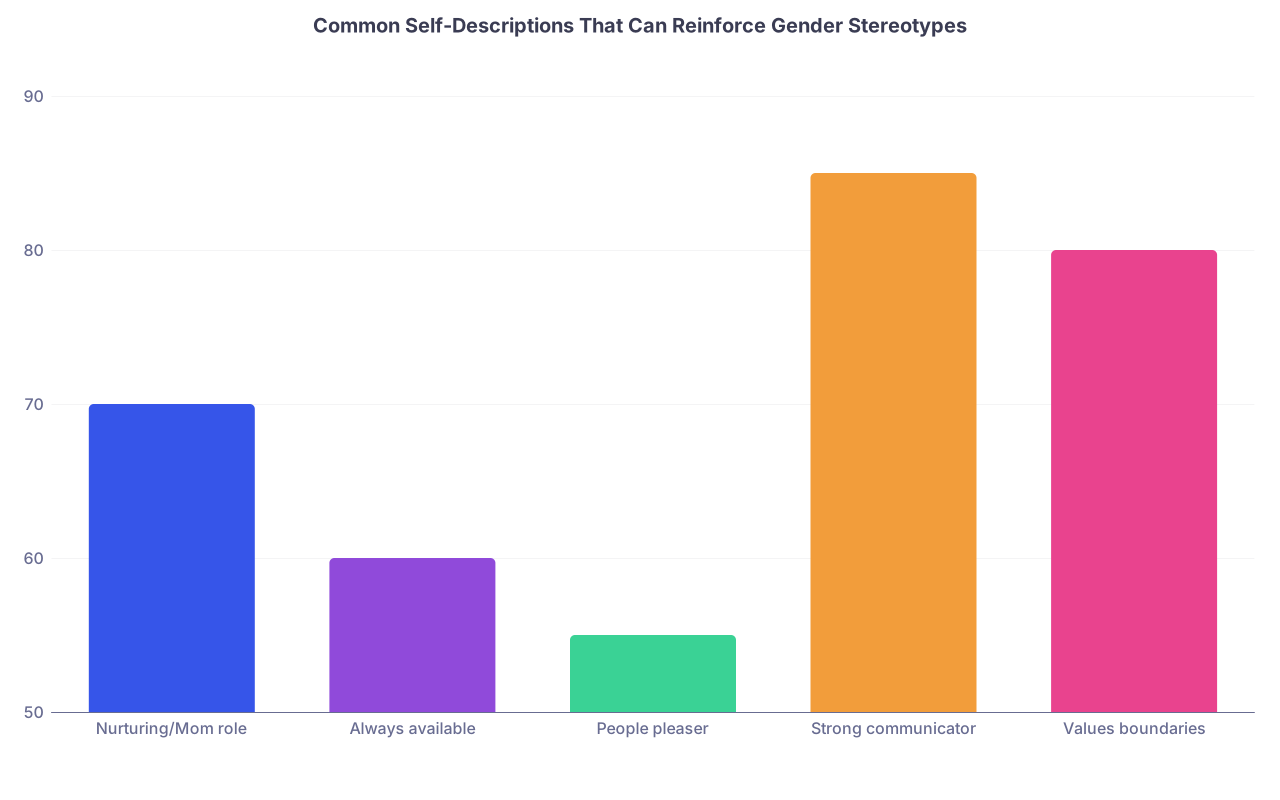
| Category | Value |
|---|---|
| Nurturing/Mom role | 70 |
| Always available | 60 |
| People pleaser | 55 |
| Strong communicator | 85 |
| Values boundaries | 80 |
The first three are what I hear far too often from women. The last two are what actually support long-term respect and leadership.
Mistake #2: Apologizing for Ambition
Nothing keeps women boxed in like apologizing for wanting power, influence, or a life outside work.
Problematic patterns
Pay attention to language like:
- “I know it might sound ambitious, but…”
- “I do want a family, so I know I might not be able to do as much as others.”
- “I do not need to be the leader; I am happy just supporting the team.”
- “I am not sure I want a big career; I just want to help patients.”
On paper that sounds humble. In reality it signals:
- Reduced expectations for your advancement
- Permission for others to sideline you “because family”
- An invitation for them to see you as secondary, not central
Men with children are framed as “providers” and “stable.” Women with children are framed as “less available” and “a risk.” Your answers must not reinforce that double standard.
How to state ambition without backlash
You can be direct without playing into the “aggressive woman” stereotype.
Strong examples:
- “I see myself in an academic leadership role where I can both care for patients and shape institutional culture.”
- “I expect to build a life that includes both family and a demanding career. That will mean being very intentional with my time, but I am committed to both.”
- “I am interested in leadership, not for the title, but because decisions at that level have a huge impact on equity, patient care, and trainee wellbeing.”
You are not asking for permission to be ambitious. You are stating a plan.
Mistake #3: Taking Ownership of Systemic Problems
Women are routinely blamed for burnout, harassment, and overwork in ways men are not. In interviews, this shows up when you internalize systemic problems as personal failings.
Watch out for these responses
To questions like “Tell me about a time you were overwhelmed” or “How do you handle conflict?” you might hear yourself say:
- “I struggle with saying no when people need help.”
- “I had an attending who yelled a lot; I just tried to work harder and not take it personally.”
- “When there is a disruptive colleague, I usually just try to quietly smooth things over.”
- “I tend to internalize a lot and wonder what I did wrong.”
These answers suggest:
- You will tolerate mistreatment.
- You will self-blame instead of raising concerns.
- You will absorb conflict rather than appropriately escalate it.
That reinforces the stereotype that women will manage the emotional mess without making “problems” for the institution.
Reframe without sounding combative
Your goal is to show you can recognize unhealthy dynamics and respond professionally, not silently accept them.
Better versions:
- “I used to struggle with saying no, especially in hierarchical settings. Over time I have learned to distinguish between genuine patient- or safety-driven needs and avoidable extra tasks, and I now set clearer limits while still being a reliable teammate.”
- “When I worked with a chronically harsh attending, I sought mentorship, documented patterns, and learned how to respond calmly in the moment while also protecting my psychological safety. I am more willing now to use official channels when behavior crosses lines.”
- “In team conflict, I start by clarifying facts and expectations. I am comfortable facilitating a conversation, but I also recognize when an issue requires leadership or institutional support.”
You are not the sponge for everyone else’s dysfunction.
Mistake #4: Reinforcing “Soft Skills for Women, Hard Skills for Men”
Another very common pattern: women oversell “soft skills” and downplay technical competence; men do the opposite. Interviewers pick up on this, even subconsciously.
Risky answer patterns
On “strengths” or “what sets you apart” questions:
- “I am not the smartest or the most technically skilled, but I care deeply and my patients feel very supported.”
- “I might not be the best in the OR, but I work really hard.”
- “I am not a natural leader, but I am very kind and approachable.”
These phrases are poison.
You just told them:
- You are less capable technically.
- You accept lower perceived competence in exchange for being “nice.”
- You see leadership as incompatible with kindness.
You have helpfully reinforced the exact stereotype that keeps women out of procedurally heavy or leadership-heavy roles.
Integrate both: competence and relational skills
You can absolutely lean into communication and empathy—but never at the cost of sounding less capable.
Better strategies:
- Pair a hard skill and a relational skill in the same answer.
- Use concrete examples, not disclaimers (“I’m not the best…”).
For example:
- “I am very systematic in my clinical reasoning and I pair that with strong communication so patients and colleagues understand my thought process.”
- “I am meticulous with procedures—prep, checklist, and debrief—and I find that my calm, clear communication keeps the team aligned, especially in high-stress moments.”
- “Colleagues often seek me out for complex cases because I bring both strong analytical skills and the ability to coordinate input across disciplines.”
Nothing apologetic there. Empathy plus competence is not an either/or.

Mistake #5: Accepting Gendered Assumptions in Questions
Sometimes the problem is not your instinct, it is the question itself. Interviewers, even well-meaning ones, will occasionally ask things they would never ask a male candidate.
Common gendered questions (sometimes subtle):
- “How do you think you will manage this demanding specialty if you want children?”
- “Do you think your personality fits this very intense environment?”
- “This is a very male-dominated specialty—how do you feel about that?”
- “Our schedule can be tough on family life; is that a concern for you?”
If you answer these as if they are neutral, you validate the bias behind them.
How not to answer
Do not say:
- “I know it will be hard with kids, but I will figure it out.”
- “I am pretty easygoing, so I do not mind adapting to whatever the culture is.”
- “I think I can handle the men; I get along better with guys anyway.”
- “I do not expect any special accommodations.”
These responses suggest:
- You accept that the burden of adaptation is yours alone.
- You think wanting a family is a liability.
- You are willing to tolerate a potentially toxic environment without question.
How to answer while signaling you see the bias
You do not need to be confrontational. But you can answer in a way that:
- Re-centers the real issue (culture, equity, institutional responsibility)
- Puts you on equal footing with male candidates
Examples:
Question: “How will you manage this demanding specialty if you want children?”
Answer:
“I approach this the same way my male colleagues do. I plan to build a full career in this field and, if I have a family, that will mean choosing supportive workplaces, using existing policies, and working within teams that value sustainability. The specialty is demanding for everyone, and I am prepared for that.”
Question: “This is a very male-dominated specialty—how do you feel about that?”
Answer:
“I am comfortable in diverse teams, but I am also attentive to culture. I thrive in environments where respect, accountability, and equity are explicit values, regardless of gender mix. I am interested in being part of continuing to improve that culture.”
Question: “Our schedule can be tough on family life; is that a concern for you?”
Answer:
“I understand the schedule is intense; that is true for all residents. I am realistic about that and I also pay close attention to burnout and wellness. I look for programs that take those concerns seriously for everyone, not just for parents.”
You answer the question, but you refuse the underlying stereotype.
Mistake #6: Selling Yourself as “Low Maintenance”
Women are often rewarded for being “no trouble.” In interviews, that shows up as trying to prove you will never be a burden, never need help, never ask for resources.
Dangerous signals:
- “I am very low maintenance and do not need a lot of support.”
- “I am fine taking whatever schedule is left over.”
- “I am not picky; I will work with anyone and do anything.”
- “I do not need mentorship; I am very independent.”
This is how programs hear it:
- She will tolerate unfairness.
- She will not push for better conditions.
- She will not compete for resources with male colleagues.
That is how inequity survives.
Shift from “low maintenance” to “professionally accountable”
You want to show resilience and independence without telling them they can neglect you.
Some alternatives:
- “I am very resourceful and will always try to solve problems independently first, but I also use mentorship and institutional resources when a situation calls for them.”
- “I am flexible with scheduling within reason, and I expect transparent processes so that workload is distributed fairly.”
- “I value clear expectations more than hand-holding. If those are in place, I am comfortable taking responsibility and seeking help when needed.”
You are not asking to be coddled. You are asking to be treated like a professional.

| Step | Description |
|---|---|
| Step 1 | Hear question |
| Step 2 | Answer directly |
| Step 3 | Pause and reframe |
| Step 4 | Address topic for all genders |
| Step 5 | State expectations of culture |
| Step 6 | Give concise confident example |
| Step 7 | Biased or neutral |
Mistake #7: Underselling Boundaries and Ethical Spine
Medical ethics and personal development are not abstract. They show up in your willingness to set limits. Gender stereotypes tell women to yield, avoid conflict, and “keep the peace” at all costs.
So when asked about:
- A time you saw something unsafe
- Handling an attending who cut corners
- Responding to inappropriate behavior
Women disproportionately give answers like:
- “I did not want to cause trouble, so I just made sure it did not happen again when I was around.”
- “I tried to manage it quietly so we did not have to escalate.”
- “I just worked harder to prevent the issue instead of confronting them.”
Ethically, that is weak. It also quietly confirms that women will swallow discomfort instead of challenging power.
What strong ethical responses sound like
You do not need to brag about being a whistleblower. But you must show you will act.
Better examples:
- “I started with a direct, respectful conversation. When the behavior continued and patient safety was at risk, I escalated through the appropriate channels.”
- “I documented specific incidents and sought advice from a trusted senior colleague to ensure I understood policy and could respond proportionally.”
- “I recognize the tension between hierarchy and advocacy, and I err on the side of safety, even when it is uncomfortable.”
This is personal development and medical ethics in real life. You are signaling you have a spine.

Quick Comparison: Weak vs Strong Responses
| Situation | Weak, Stereotype-Reinforcing | Strong, Stereotype-Resistant |
|---|---|---|
| Work-life | “I know it will be hard with kids, but I will figure it out.” | “I plan a full career and will use the same systems and policies available to all physicians.” |
| Strengths | “I am not the best technically, but I care a lot.” | “I am thorough clinically and pair that with strong communication and empathy.” |
| Conflict | “I just try to keep the peace and not escalate.” | “I address issues directly and use formal channels when safety or professionalism is at stake.” |
| Flexibility | “I will take whatever schedule is left.” | “I am flexible within a fair, transparent scheduling system.” |
| Team role | “I am the mom of the group.” | “I monitor team dynamics and support colleagues without taking on others’ responsibilities.” |
FAQ (Exactly 3 Questions)
1. What if I already gave some of these “bad” answers in past interviews?
You are not doomed. Use that discomfort as data. Reflect on which phrases you used that minimized your competence, erased your boundaries, or framed you as the default caretaker. Rewrite those answers now. Practice them out loud. By the next interview cycle, those new scripts will feel natural rather than forced.
2. How do I avoid sounding “angry” or “defensive” when I push back on gendered assumptions?
Stay calm and concise. You are not calling anyone sexist on the spot; you are simply reframing. Use phrases like “I approach this the same way as any colleague would” or “I look for cultures that value equity for everyone.” Your tone matters more than your exact words—measured, matter-of-fact, not apologetic. You are describing reality, not asking for forgiveness.
3. Should I call out blatantly inappropriate questions during the interview?
Sometimes. If a question is wildly out of line, you can say, “I am not comfortable answering that, but I can speak to my commitment to this field and my ability to meet its demands.” In most cases, though, the smarter move is to answer in a way that neutralizes the bias and then document it. You can decide later whether that place deserves you—or whether this was an early warning sign to take seriously.
Key points to remember:
- Do not volunteer yourself as the default caretaker, the low-maintenance worker, or the apologetic aspirant.
- Pair empathy with competence, flexibility with boundaries, and ambition with clear ethical standards.
- Your answers either reinforce or challenge gender stereotypes. Choose language that makes it harder—never easier—for people to underestimate you.