
The way hospitals handle complaints about women doctors is not neutral. It is political, performative, and quietly punishing in ways most trainees never see.
Let me walk you through what actually happens once a patient complains about a woman physician—what gets said in offices with the doors closed, what’s written in your “file” that you never see, and why the same complaint plays out completely differently if it’s about a male colleague.
Step 1: How the Complaint Really Lands
Most women think: “If a patient complains, the hospital will look at the facts.” That’s not what happens first.
Here’s the usual path.
A complaint comes in through one of three routes: a Press Ganey comment, a phone call to patient relations, or a direct email/phone call to the department chair or clinic manager.
Inside the institution, these are not treated equally.
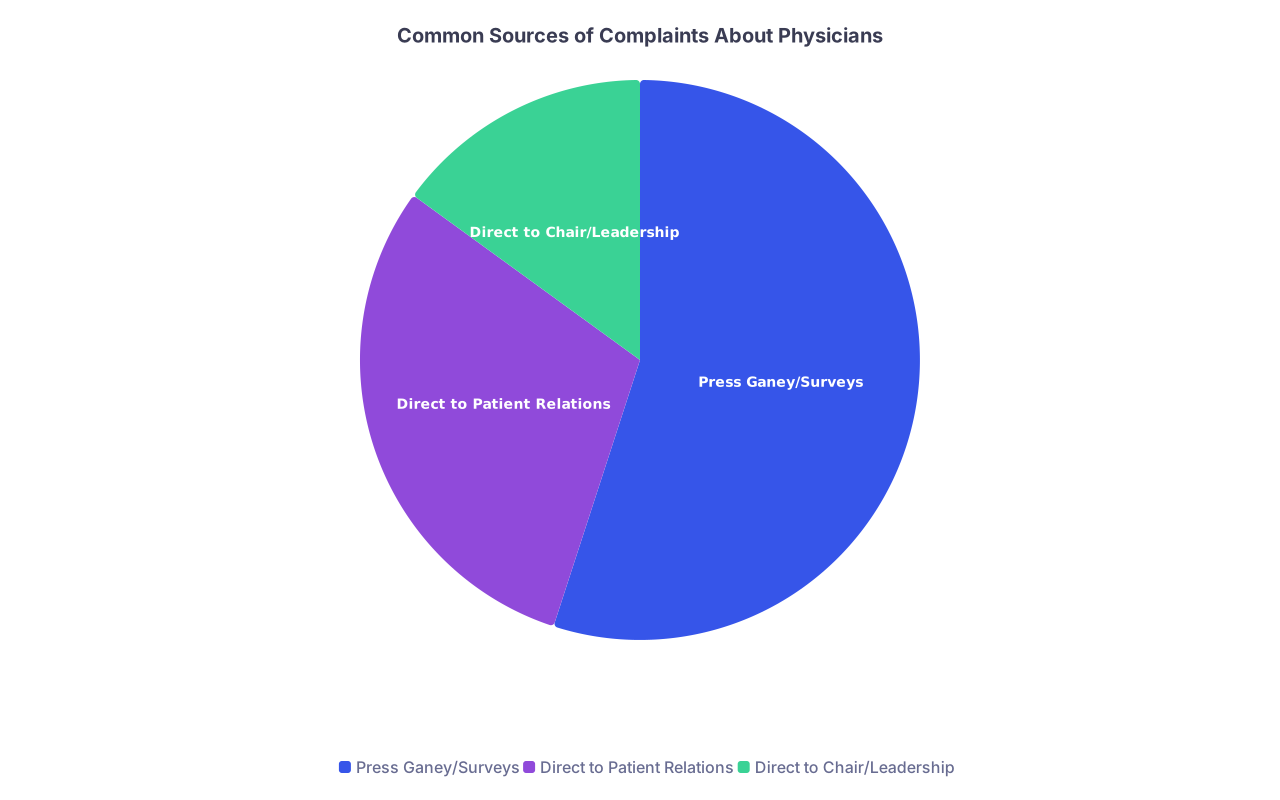
| Category | Value |
|---|---|
| Press Ganey/Surveys | 55 |
| Direct to Patient Relations | 30 |
| Direct to Chair/Leadership | 15 |
Press Ganey and survey comments get batch-processed. Someone from “patient experience” exports the data, skims for red flags, and then forwards the worst ones to service chiefs. These are often de-identified, which means context is stripped and gender bias is easier to hide behind phrases like “bedside manner” and “seemed rushed.”
The direct-to-patient-relations complaint gets tagged as higher priority. These are logged in more detail, traced back to specific encounters, and added to an internal tracking system. Think ticketing software, but for your professional reputation.
The direct-to-chair email? That’s the nuclear route. Especially when it comes from a donor, politically connected patient, or someone with a title in their email signature. Those get read the same day, sometimes within the hour.
Now comes the real split:
For men, the first unspoken filter is: “Does this line up with what we know about him?”
For women, the first unspoken filter is: “Is this confirming what we’ve been worried might be an issue?”
I’ve watched it play out three different ways, in three different departments:
- Male surgeon, known to be brusque, gets a complaint: “That’s just how he is. We’ll smooth it over.”
- Female internist, entirely ordinary interaction, patient unhappy she “didn’t listen”: “Hmm. Have you heard this from others? Is she…difficult?”
- Younger woman EM doc, refuses inappropriate narcotics: “We might need to coach her on communication style.”
Same behavior. Completely different narrative assigned on arrival.
Step 2: The “Review” That Isn’t Neutral
Once the complaint is logged, it enters the review pipeline. On paper this is a “standard process.” In practice, it’s wildly elastic.

| Step | Description |
|---|---|
| Step 1 | Patient Complaint Filed |
| Step 2 | Patient Relations Review |
| Step 3 | Sent to Service Chief |
| Step 4 | Risk Management Involved |
| Step 5 | Informal Coaching Email |
| Step 6 | Meeting with Division Chief |
| Step 7 | Chart and Note Review |
| Step 8 | Formal Letter to File |
| Step 9 | Monitoring and Future Scrutiny |
| Step 10 | Severity Flagged |
Here’s what “review” usually means:
Someone pulls your clinic note or ED note. Not to understand the clinical decision-making, but to see if there’s a sentence that backs the patient’s narrative or, at minimum, gives them a way to explain you.
They look for phrases like “patient requests opioids, I declined,” or “difficult historian,” or “counseled regarding lifestyle factors.” Any of those can be spun into “communication problem.”
Nobody is doing a deep dive on your outcomes data. No one is checking whether this is the patient who’s been dismissed from three clinics, or who has 15 prior complaints about “rude” female nurses but is “fine” with male providers.
Behind closed doors, the discussion often sounds like this:
- “She’s clinically solid, but I keep hearing she’s perceived as harsh.”
- “Her notes are fine, but this is the third patient who used the word ‘cold.’”
- “We know female physicians get dinged more for tone, but still, we have to address it.”
That last sentence is the tell. They know gender bias exists. They’ll mention it. Then they’ll proceed as if it doesn’t change what they do next.
Step 3: The First Conversation – “Just Coaching”
If the complaint is not obviously litigious (bad outcome, mention of “lawyer,” identity politics in a way that triggers risk management), the first step is “coaching.”
You’ll either get:
- An email from the clinic manager or medical director: “Can we find 15 minutes to chat about a patient interaction?”
- Or a calendar invite from your division chief with a bland subject: “Check-in.”
You walk in, they smile, maybe they start with, “You’re doing great work, but I did want to run something by you.”
Then they read you the complaint. Sometimes verbatim. Sometimes paraphrased to “soften” it, which is worse, because the coded gender bias gets turned into official language.
The script is usually some version of:
- “The patient felt you were dismissive.”
- “They perceived that you were rushed.”
- “They felt unheard and disrespected.”
- “They interpreted your refusal as not caring about their pain.”
Notice the pronouns. Felt, perceived, interpreted. That’s intentional. It lets leadership avoid saying outright that you did something wrong, but still ends with you being the one expected to “adjust.”
If you’re a woman, there’s often a gentle suggestion about “tone,” “body language,” or “emotional intelligence.” I have almost never heard those used with men for a one-off complaint. With men, early complaints get chalked up to “style mismatch” or “difficult patient.” With women, they become an early warning sign.
You might say, “Actually, this patient demanded Xanax and oxycodone, and I explained why that wasn’t appropriate.”
What you’ll get back is: “I believe you. And I agree with your decision. But we still have to be mindful of how it lands.”
This is where women start bleeding energy. You did the right thing medically, and you’re still the one who has to change.
Step 4: The File You Don’t See
Here’s the part nobody tells you: almost every formal complaint leaves a paper trail that outlives the incident.
There are usually two “files”:
- The official HR or credentialing file (you know this exists).
- The unofficial leadership memory bank, sometimes literally a spreadsheet, sometimes just shared gossip with a header.
Some hospitals have an internal log: physician name, date, complaint category, resolution. It can look deceptively simple:
| Physician | Gender | Complaint Type | Action Taken | Flagged for Review |
|---|---|---|---|---|
| Dr. A | F | Rude | Coaching | Yes |
| Dr. B | M | Rushed | None | No |
| Dr. C | F | Pain Meds | Coaching | Yes |
| Dr. D | M | Poor Explainer | No |
Nobody tells you you’re on this list.
Here’s the real kicker: those “Flags for Review” get pulled for things you care about.
- Reappointment / privileging decisions
- Promotion packets
- Leadership role discussions (“Should we make her clinic director?”)
- Informal conversations: “Any concerns about her?”
I’ve sat in meetings where someone says, “She’s had a couple of patient complaints,” as if that’s a character trait. No mention that two were about her refusing controlled substances and one was a patient angry she was pregnant and “abandoning” them on maternity leave.
By the time you hear about “concerns around patient satisfaction,” the narrative has already hardened.
Step 5: When Risk Management Smells Blood
If the complaint mentions “unsafe,” “negligent,” “discriminatory,” “lawyer,” or any version of “I’ll report you,” risk management gets a copy.
Their job is not to protect you. Their job is to protect the institution.
That shift changes everything.
Now, your clinical decisions, your documentation, and your demeanor get scrutinized for liability exposure. Not fairness. Not nuance. Exposure.
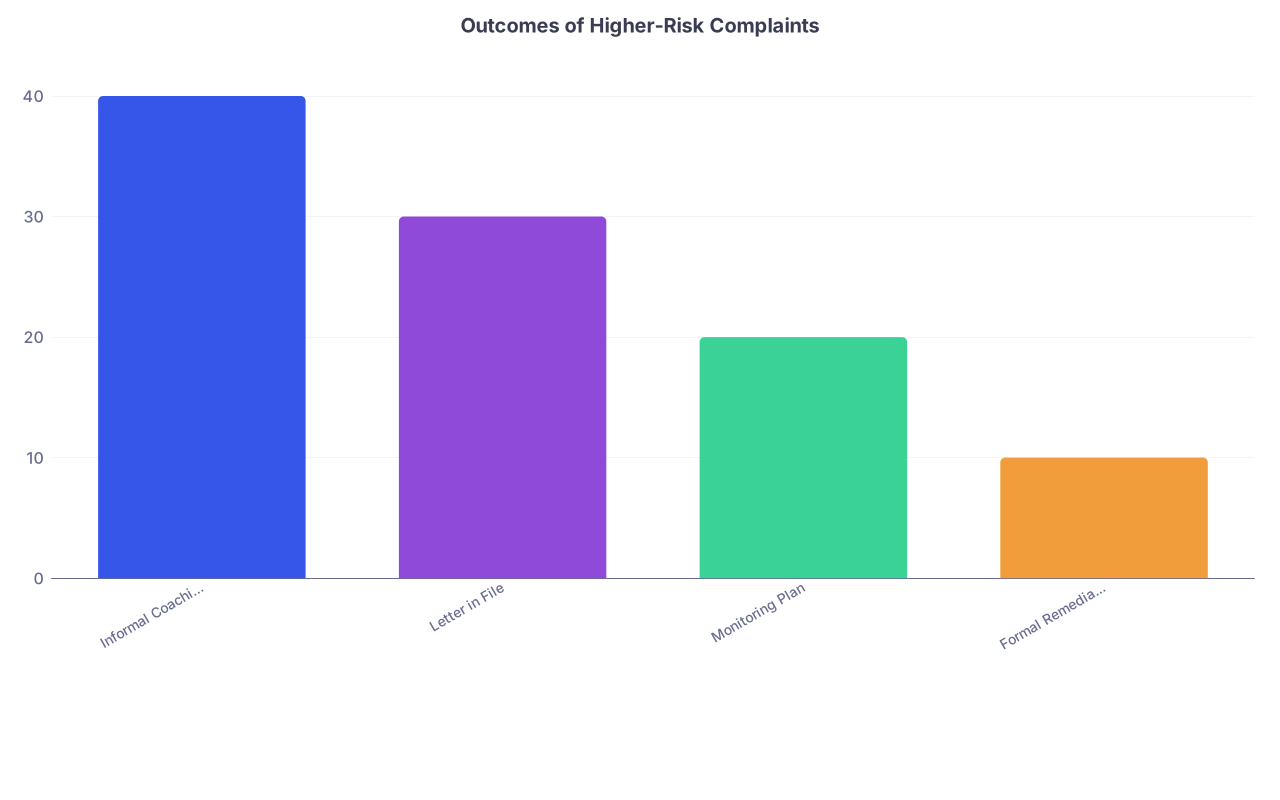
| Category | Value |
|---|---|
| Informal Coaching Only | 40 |
| Letter in File | 30 |
| Monitoring Plan | 20 |
| Formal Remediation | 10 |
For a woman physician, especially one who is not yet fully entrenched (junior faculty, early-career attending, hospital-employed rather than a big-referral generator), the thresholds are lower.
I’ve seen:
- A male surgeon with multiple explosive complaints get a single “anger management” referral and stay on staff, untouched.
- A female hospitalist with two complaints about “rude” behavior toward a family during a capacity assessment get pushed into a “professionalism remediation plan” that followed her to the next job.
Risk management will sometimes coach leadership on what to say to you. It sounds benevolent: “Let’s frame this as an opportunity for growth.” What it actually is: documentation that the hospital “acted” so they can point to a paper trail if something bigger happens.
That’s why you’ll get an email summary: “As we discussed today, we talked about strategies to improve communication…” That email isn’t for you. It’s for them.
Step 6: The Long Tail – How This Haunts Women’s Careers
One complaint rarely ends a career. But it changes how you’re watched.
This is what women don’t realize until much later: the complaint resets the default assumption about you from “competent until proven otherwise” to “potential problem, monitor for confirmation.”
Here’s how that actually shows up over the next 6–24 months:
- Your Press Ganey scores get read with a red pen. One negative comment is “data.” For your male colleague, the exact same score is “noise.”
- Any conflict with staff suddenly comes with, “She’s had patient complaints before, right?” You’re no longer just in a disagreement; you’re fitting a pattern.
- Promotion letters get the faint praise line: “With continued development in communication skills, she’ll be an excellent leader.” Code for: “We’ve heard something.”
I’ve heard program directors discuss a woman resident like this: “She’s technically excellent, but there’ve been some concerns about her interactions with patients.” What were those “concerns”? One elderly man angry she wouldn’t prescribe alprazolam, and one family who wanted “a male doctor instead.”
No one in that room said, “These complaints are biased garbage.” They just got folded into her story.
Step 7: The Gender Double Standard in “Professionalism”
Let me be uncomfortably explicit.
For men:
- Abrupt = efficient
- Direct = confident
- Unsmiling = serious
- Sets limits = strong
For women:
- Abrupt = rude
- Direct = abrasive
- Unsmiling = cold
- Sets limits = uncaring
Same behaviors. Different adjectives. Those adjectives are what get captured in complaints.
When the complaint comes from a female patient or family member, leadership relaxes slightly. They’re more likely to consider interpersonal mismatch. When it comes from an older male, especially one whose status the hospital values (donor, board member, big boss’s golfing buddy), women physicians get thrown under the bus faster.
I saw a donor write directly to the CEO about a young woman cardiologist: “She was disrespectful, talked down to me, and should learn to smile when speaking to older gentlemen.” The CEO forwarded it to the chair with: “Please address.” The cardiologist didn’t get fired. But she did get pulled from that clinic’s VIP schedule. A male colleague with a similar complaint from a donor later? He got a private laugh from the chair: “You know how Mr. X is.”
That’s the insider truth: “professionalism” is elastic. And it stretches more for some people than others.
What You Can Actually Do About It
You can’t fix systemic bias alone. But you’re not powerless.
Document like your future self will need it
When you have a difficult encounter—especially about controlled substances, boundary setting, or not doing what the patient demands—chart the context in clear, neutral language.
Not, “patient is drug seeking.”
Instead: “Patient requested early refill of oxycodone; explained policy and risk; offered non-opioid alternatives; patient expressed frustration and raised voice; visit ended with safety intact and follow up arranged.”
That note may be the only thing standing between “unsafe and dismissive” and “appropriately set boundaries” when leadership reads a complaint six weeks later.
Control the narrative with your chief
When they call you in, don’t just apologize and nod. Calmly give a concise, factual version of events. Then say the line most women are too scared to say:
“I’m aware that women physicians get more complaints for the same behaviors as male colleagues. I want to be sure we’re interpreting this with that in mind.”
You’re not accusing them directly. You’re reminding them that if they pretend this is gender-neutral, they’re lying to themselves.
Also ask, explicitly: “Will this be going into any formal file?” Make them say it out loud. Sometimes they’ll soften the resolution precisely because they don’t want to answer that.
Don’t let “coaching” become a one-way mirror
If someone offers “communication coaching” after a single biased complaint, counter with data:
- Your overall patient satisfaction scores, if they’re fine or above average
- Positive comments on evaluations
- Any leadership roles involving communication (teaching, talks, feedback)
Then say: “I’m always open to getting better. But I want to make sure we’re not pathologizing normal boundary setting just because I’m not meeting a gendered expectation of ‘nice.’”
I’ve seen that line freeze a well-meaning but clueless director into at least reconsidering the “plan.”
Build your own file
Keep a folder—yes, literally—of:
- Thank you emails from patients
- Positive comments from staff and peers
- Good evals, strong 360 feedback
- Any leadership role, talk, or award related to patient care or teaching
When someone later tries to paint a story of “ongoing concerns,” you’ll have a counter-narrative ready. Not theoretical. Concrete.
The Ethical Rot Underneath
There’s a deeper ethical problem here that almost no one in leadership will admit out loud.
Hospitals will say they care about equity and bias. But when an angry patient demands your scalp, they cave quietly. Especially if you’re a woman, a racial minority, or otherwise perceived as “replaceable.”
Because it’s easier to nudge you to be “nicer” than to tell the patient the truth: “Our doctor acted appropriately. You may not like it, but we stand by her.”
The few times I’ve seen that happen—leadership backing a woman physician against a biased complaint—the effect is dramatic. The physician doesn’t just feel supported; the whole department gets a message about what’s tolerated and what’s not.
But most of the time? Leadership takes the path of least resistance: blame the woman subtly, smooth the patient, call it “coaching,” and move on.
You’re not crazy if you feel that. It’s real.
FAQs
1. Should I ever apologize directly to a patient after a complaint?
Apologize for their experience, not for appropriate medical decisions. Something like, “I’m sorry you felt upset after our visit; that was not my intention,” is fine. Never apologize for refusing unsafe prescriptions or for following guidelines. That apology will get quoted as an admission of wrongdoing later if things escalate.
2. Can a single complaint really harm my career long-term?
One complaint rarely kills a career, but it can set a story about you in motion. Especially early on. If it’s followed by a second or third—no matter how biased—they start to call it a “pattern.” Your job is to (a) document context, (b) correct the narrative with your chief, and (c) accumulate positive data that counters the “problem doctor” label.
3. What if I know a complaint is clearly gender-biased or sexist?
Say that. Calmly and on the record. “This patient explicitly commented on my gender and appearance; I’m concerned this complaint is rooted in sexism more than my care.” Ask that this be documented in whatever response goes into the system. That forces leadership to either acknowledge or consciously ignore bias rather than pretend it doesn’t exist.
4. How do I protect myself as a trainee (student or resident)?
First, never handle a clearly escalating patient alone—loop in your attending early and document that involvement. Second, debrief difficult encounters quickly (same day) with your senior and ask them to note in their evaluation if the patient was unreasonable or inappropriate. That way, if a complaint comes later, there’s contemporaneous documentation from someone above you. And third, pay attention to how your program talks about complaints—if women are regularly described as “difficult” or “abrasive” while men are “strong personalities,” that’s a red flag about how your future complaints will be handled.
Key points, stripped of the fluff:
- Complaints about women physicians are filtered through bias at every stage—intake, review, and “coaching.”
- The institution’s real priority is risk management, not your fairness or growth.
- You can’t remove the bias, but you can document intelligently, confront the narrative early, and build your own protective record so one patient’s anger doesn’t define your career.