
You’re on call, it’s 9:30 p.m., and you’ve just had yet another interaction with an attending that left you thinking, “I need a mentor who actually gets me.” You keep hearing “find good mentorship” like it’s as easy as picking a latte. And now people are telling you: “You should really find a woman mentor,” while others swear their best mentors were older male surgeons who went to bat for them.
So you’re stuck on the obvious question:
Is it better, as a woman MD, to choose a female mentor or a male mentor?
Let me be blunt: the wrong question is “Which gender is better?” The right question is, “What do I need from mentorship right now—and who is actually delivering that, consistently?” Gender influences that. But it doesn’t decide it.
Here’s how to think about it like an adult, not like a brochure.
The Short Answer: Neither Gender Wins by Default
If you want the bottom line up front:
- A good mentor who shows up for you is better than an ideal-gender mentor who doesn’t.
- You’ll usually benefit most from a mix: at least one woman mentor and at least one man, each doing different jobs for your career.
- For gendered issues (pregnancy, harassment, subtle bias, leadership as a woman), having at least one woman mentor is almost non‑negotiable.
- For sponsorship into certain old‑boys’ spaces, a male mentor in power can open doors you simply can’t kick down alone.
So instead of “female vs male,” you should be asking: “What kind of mentorship do I need—and who (regardless of gender) has both the will and the power to provide it?”
What Mentors Actually Do (And Why Gender Matters Sometimes)
Mentorship isn’t one thing. It’s at least four:
- Advisor – helps with decisions (specialty choice, job offers, research direction)
- Coach – helps you level up skills (teaching, leadership, clinical reasoning)
- Sponsor – uses their reputation to get you invites, titles, and opportunities
- Protector/Ally – steps in when you’re being mistreated or sidelined
Different people are good at different roles. Sometimes gender lines up with that. Sometimes it doesn’t.
Where female mentors often shine
Not because women are magically better people, but because they’ve lived your reality.
I’ve seen female residents say things to each other like:
- “He called you ‘sweetheart’? Yeah, that’s not okay. Here’s how I’d respond.”
- “If you want kids in fellowship, here’s what my call schedule was like while pregnant.”
- “They’re giving you all the ‘nurturing’ committee work? That’s the pink ghetto. Say no.”
Female mentors are often better (not always, but often) for:
- Navigating sexism and bias
- Family planning and parenting in training
- Negotiating without being labeled “difficult”
- Handling being the only woman in the room
Where male mentors can be powerful
Especially senior men who “get it” and aren’t fragile about gender conversations.
Male mentors can be uniquely useful when:
- The department is still male‑dominated and men hold most leadership roles
- You need access to networks that are informally male‑centered (golf groups, text threads, “guys’ trips” thinly disguised as conferences)
- You want someone in the majority group to say out loud: “Her ideas are solid, why aren’t we listening?”
A male sponsor in a high‑status role can:
- Put your name forward for talks, committees, research
- Shut down dismissive behavior toward you in meetings
- Normalize your presence in male‑heavy spaces
So yes, gender matters. But it matters differently depending on the problem you’re trying to solve.
Pros and Cons: Female vs Male Mentors for Women MDs
Here’s the trade‑off in more concrete terms.
| Aspect | Female Mentor | Male Mentor |
|---|---|---|
| Lived experience as woman MD | High | Low/Indirect |
| Insight on sexism/microaggress. | High | Variable |
| Access to male-dominated spaces | Limited (system-dependent) | Often higher |
| Role modeling work-life choices | Very high relevance | Less matched, but can model boundaries |
| Risk of overburden (“mom role”) | Higher | Lower |
| Perceived power (senior roles) | Variable, improving but still uneven | Often higher in some departments |
What this table doesn’t show: plenty of women mentors are burned out from “being the woman role model for everyone,” and plenty of men are quietly doing phenomenal mentorship work. You can’t predict quality from gender alone.
Where a Female Mentor Is Especially Valuable
There are situations where not having at least one woman you can talk to is a real handicap.
1. When you’re facing gendered crap
Stuff like:
- A senior surgeon consistently calling you “young lady” in front of patients
- Being mistaken for a nurse repeatedly, even after introductions
- Performance feedback that’s 80% about “tone” or “likeability,” not competence
A woman who’s lived this can give you:
- Language that works (“I prefer Dr. X when we’re with patients.”)
- A read on when to confront vs when to document and escalate
- Reality checks: “No, you’re not too sensitive. That’s out of line.”
2. When you’re planning pregnancy or parenting in training
Sure, a supportive dad in your department can empathize. But he didn’t go through:
- Deciding when to tell the program she’s pregnant
- Worrying how pregnancy would affect surgical cases, research, recommendations
- Pumping between OR cases in a supply closet
A woman who actually did this in your field can give you specifics:
- Which rotations are more pregnancy‑friendly
- How to negotiate call, leave, and coverage without getting punished
- How it impacted her evaluations and promotion
3. When you need to see someone “like you” in a role you want
Vision matters. If you’ve never seen a woman chief of surgery, it’s harder (not impossible, but harder) to picture yourself there. A woman mentor can:
- Show you what’s actually required for that role
- Tell you what she’d do differently if she had to climb again
- Warn you about traps specifically aimed at “nice, competent women” (overwork, zero recognition)
Where a Male Mentor Can Be Strategically Smart
Now flip it.
There are times when a male mentor, especially a senior one, is not just “fine” but extremely useful.
1. When the power is still mostly held by men
Let’s not pretend every institution is enlightened. In some departments:
- The chair, division heads, and key decision‑makers are almost all men.
- The informal leadership networks are men scheduling things on group texts and hallway chats.
In those places, a male sponsor can:
- Translate your goals into language the old guard respects
- Argue for your promotion/raise in rooms you’re not in
- Normalize your presence on committees and projects where there’s “never been a woman before”
2. When you need bias confronted by someone in the majority group
Sad but true: the same message lands differently depending on who says it.
“I think we’re interrupting her a lot” from a woman can get shrugged off. The same sentence, calmly said by a senior man in the meeting? People stop talking.
Strong male mentors can:
- Call out bias without being dismissed as “overreacting”
- Model respectful behavior to junior men
- Back you publicly when you push for fair treatment
3. When you want exposure to high‑impact networks
The FOMO is real:
- The post‑meeting beers where grant collaborations get sketched out
- The invitation‑only working groups at big conferences
- The “he’s one of my guys” introduction that unlocks a job interview
A plugged‑in male mentor who actually sees you as “one of his people,” not a token, can open doors you literally wouldn’t know exist.
The Real Play: Build a Mentorship “Board,” Not a Soulmate
Trying to find one perfect mentor is like trying to find one app that does email, banking, dating, and photo editing. Stupid goal.
You want a team, something like:
At least one woman mentor Ideally in or near your specialty, 3–15 years ahead of you. Someone you can talk to about:
- Gender bias
- Family/career logistics
- Leadership as a woman
At least one male mentor/sponsor Ideally with real institutional power. Someone who:
- Is respected in the department
- Has a reputation for fairness
- Actually answers emails and follows through
At least one near‑peer 1–3 years ahead of you (senior resident, junior attending). This can be any gender. They:
- Know the unspoken rules
- Can say, “Don’t rotate with X if you can avoid it, here’s why”
- Are close enough to remember how scary this phase feels
Here’s what that mix does: it removes the pressure on any one person to be everything. Your male mentor doesn’t have to fully get pregnancy issues. Your female mentor doesn’t have to be the political powerhouse in the department. They each play their lane.
How to Choose Mentors: 6 Filters That Matter More Than Gender
When you’re picking, look for these first. Then use gender as a tie‑breaker, not the main filter.
- Responsiveness – Do they reply? Show up on time? Follow through?
- Track record – Have they successfully mentored other people? Ask around.
- Values alignment – Do they treat staff well? Talk about patients with respect?
- Willingness to sponsor – Do they volunteer your name in rooms? Or just “give advice”?
- Boundaries and safety – Especially with male mentors: do you feel physically and emotionally safe? No weird comments, no 10 p.m. “social” invites.
- Honesty – Do they give you real feedback, not just empty praise?
If someone scores high on these and happens to be male? Don’t reject them because Twitter said “all women need women mentors.” Take the help. Then go find at least one woman too.
A Simple Decision Flow: Who Should You Ask First?

| Step | Description |
|---|---|
| Step 1 | Define your main need |
| Step 2 | Prioritize female mentor |
| Step 3 | Prioritize high power mentor even if male |
| Step 4 | Choose by fit and responsiveness |
| Step 5 | Also add at least one sponsor of any gender |
| Step 6 | Is it gendered? bias, pregnancy, role modeling |
| Step 7 | Is access/power the main issue |
Use this as a mental shortcut. But don’t overcomplicate it. If someone is clearly good and willing to invest in you, start there.
Common Pitfalls to Avoid
You can screw this up in a few predictable ways.
1. Expecting a woman mentor to fix everything
She’s not your therapist, your union rep, and your career coach all in one. Don’t:
- Dump every unfiltered vent with no ask
- Expect her to fight all your battles
- Assume her time is unlimited because “supporting women is important”
Go in with specific questions, clear goals, and respect for her bandwidth.
2. Ignoring red flags from male mentors because they’re powerful
Powerful man who “jokes” about residents’ looks, texts you late at night, or bad‑mouths other women behind their backs? Hard pass. I don’t care how many R01s he has.
You want sponsors who:
- Respect boundaries
- Speak well of others
- Don’t use “mentorship” as cover for boundary crossings
3. Sticking with a bad mentor out of guilt
If someone:
- Regularly cancels last minute
- Never does what they say they’ll do
- Makes you feel smaller or more confused after every meeting
You don’t owe them your loyalty just because they said “I’ll be your mentor.” You can quietly downgrade them in your mental org chart and invest elsewhere.
Visual: Mentorship Sources Women Physicians Use
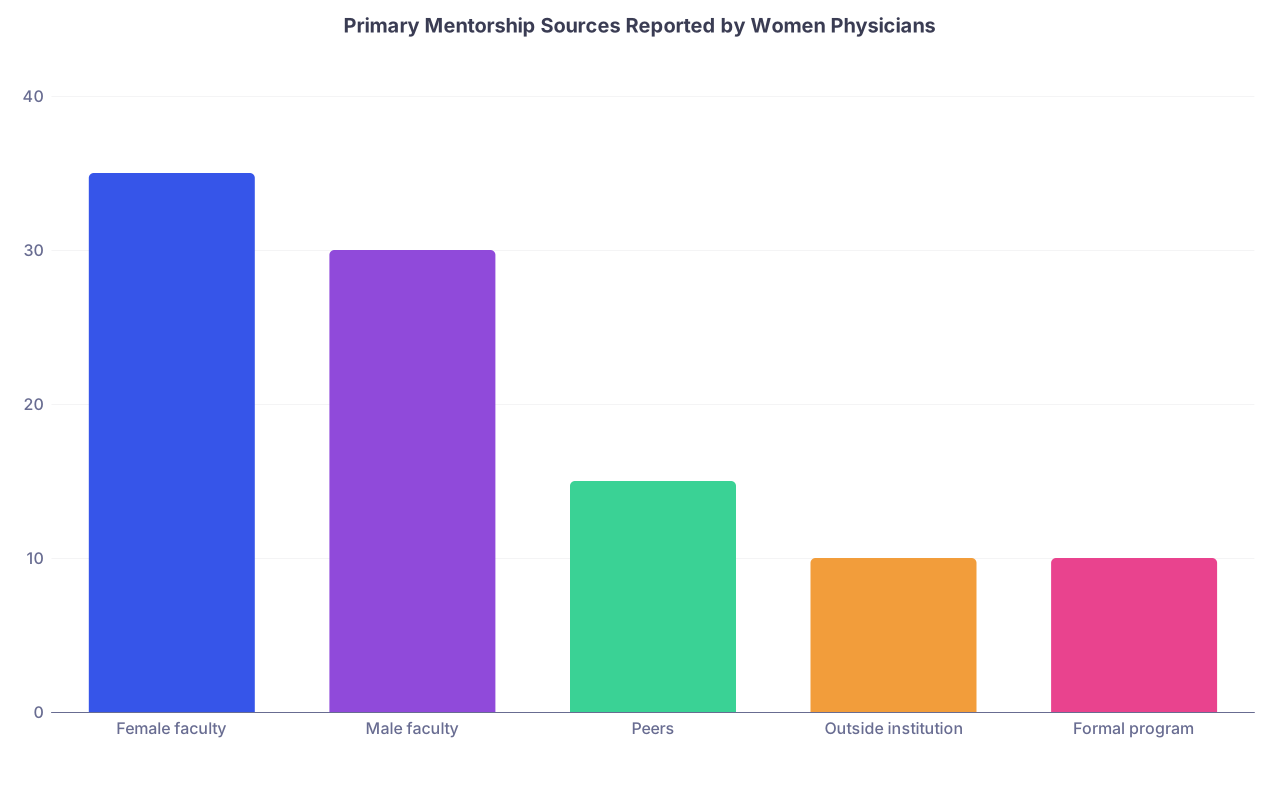
| Category | Value |
|---|---|
| Female faculty | 35 |
| Male faculty | 30 |
| Peers | 15 |
| Outside institution | 10 |
| Formal program | 10 |
This is roughly what I see in real departments: a split between female and male mentors, with peers and external mentors filling the gaps. The pattern that works best? Not relying on only one category.
Practical Steps: What To Do This Month
If you want action items, here:
Write down one main thing you want from mentorship right now
Example: “I want to position myself for an academic cardiology fellowship.”Identify three possible mentors:
- One woman in or near that field
- One senior person with real power (any gender)
- One near‑peer 1–3 years ahead
Send short, targeted emails:
- “Could I get 20–30 minutes to ask your advice about X?”
- Not “Will you be my mentor?” on day one.
After two or three meetings, ask yourself:
- Did they show up?
- Did I leave clearer, more energized, more focused?
- Did they suggest next steps or offers of help?
Upgrade the ones who pass that test to “real mentors” and keep meeting every 3–6 months.
You’re not waiting for the perfect mentor. You’re actively building a small network.
FAQ: Women MDs and Choosing Mentors
1. If I can only find one mentor right now, should I prioritize a woman or a man?
If gendered issues are front and center for you (harassment, pregnancy, being sidelined), prioritize a woman. If your main barrier is access to opportunities in a male‑dominated department and a powerful man is offering real sponsorship, take that. Either way, don’t stop at one—build toward a mix.
2. What if the only senior people in my specialty are men?
Then your move is: take the best male mentor you can get, and supplement with women outside your immediate specialty or even outside your institution. Virtual mentorship, women’s physician groups, and national specialty societies often have women leaders you can connect with.
3. Is it risky to meet one‑on‑one with male mentors?
It can be, depending on the person and context. Protect yourself with basic structure: meet in public/professional spaces, during normal work hours, keep communication professional, and trust your gut. If you’re uneasy, you’re not obligated to deepen that relationship, no matter how prestigious he is.
4. How do I ask someone to be my mentor without making it weird?
Don’t lead with “Will you be my mentor?” Start with: “Can I get your advice about X?” After a couple of good meetings, you can say: “I’ve really valued your perspective—would you be open to meeting a couple of times a year as I work through Y?” Make it low‑pressure and specific.
5. My woman mentor is overwhelmed and not very available. What should I do?
Assume she’s over‑tapped (which is common). You can: tighten your asks (“Can we meet once a semester?”), come with clear agendas, and at the same time, recruit additional mentors so you’re not relying solely on her. It’s okay to diversify; it’s not a betrayal.
6. What if my best mentor is a man who doesn’t really “get” gender bias—should I still keep him?
If he’s honest, supportive, follows through, and uses his power to help you, yes—keep him. Just don’t use him as your only sounding board for gender‑specific issues. Pair him with at least one woman mentor who can give you the missing perspective. Different mentors, different roles.
Key takeaways:
You don’t need to choose “female or male” like it’s one correct answer. You need a small, intentional mix of mentors who (1) actually show up, (2) have the power or experience you need, and (3) include at least one woman who understands the realities of being a woman in medicine. Build a board, not a soulmate.