
You’re sitting in the workroom, charting at 9:30 pm. A male colleague, same year out of residency, same service, casually mentions his “RVU bonus was actually decent this year, like 40K.” Your brain does the math. Your bonus wasn’t even close.
Now the doubt hits: am I being underpaid, or is this just apples and oranges?
Here’s the direct answer: there is a systematic pay gap in medicine between women and men, and yes, you might be underpaid. But you don’t want vibes. You want evidence. You want to know how to actually tell—using data, questions, and strategy rather than gossip and guessing.
Let’s walk through how to do that.
Step 1: Get Clear on What “Being Paid Less” Actually Means
You can’t compare salaries until you define the comparison.
In medicine, compensation isn’t just “salary.” It’s a bundle:
- Base salary
- Productivity bonuses (RVU-based, collections-based, etc.)
- Stipends (call, leadership roles, medical directorships)
- Benefits (retirement match, CME, relocation, student loan help)
- Non-clinical time (admin, teaching, research) that doesn’t show up as dollars but affects earning capacity
So when you’re asking, “Am I being paid less than my male colleagues?” what you really want to know is:
“Controlling for role, workload, and experience, is my total compensation and opportunity meaningfully lower than comparable men?”
That means you must compare:
- Same specialty
- Same practice setting (academic vs private vs employed)
- Similar years in practice
- Similar FTE (0.8 vs 1.0 vs 1.2)
- Similar clinical/administrative mix
If you skip this, everyone will hand-wave away differences as “productivity,” “seniority,” or “he just negotiated harder.” You need cleaner comparisons than that.
Step 2: Get Benchmark Data Outside Your Institution
Before you touch local comparisons, get your baseline from national data. It’s safer, less political, and gives you leverage.
Places to start:
MGMA (Medical Group Management Association)
Gold standard for compensation benchmarks. Most large systems use it. You usually need access via your institution or department chair. Look for:- Median total compensation by specialty and region
- Percentiles (25th, 50th, 75th, 90th)
- Compensation per RVU
AAMC Faculty Salary Reports (for academic medicine)
If you’re faculty, your dean’s office or chair has this. Look for:- Salary by rank (assistant, associate, full)
- Salary by specialty/department
- Regional data
Specialty societies
Many publish compensation surveys: ACEP, ACOG, ACP, ASCO, etc. Some are members-only, but ask your division chief or look in member portals.Public databases & job postings
Less precise but still helpful:- Medscape Physician Compensation Report
- Doximity compensation data
- State employee salary databases (for public universities/hospitals)
Your goal: identify a reasonable range for someone like you in your specialty, region, and practice type.
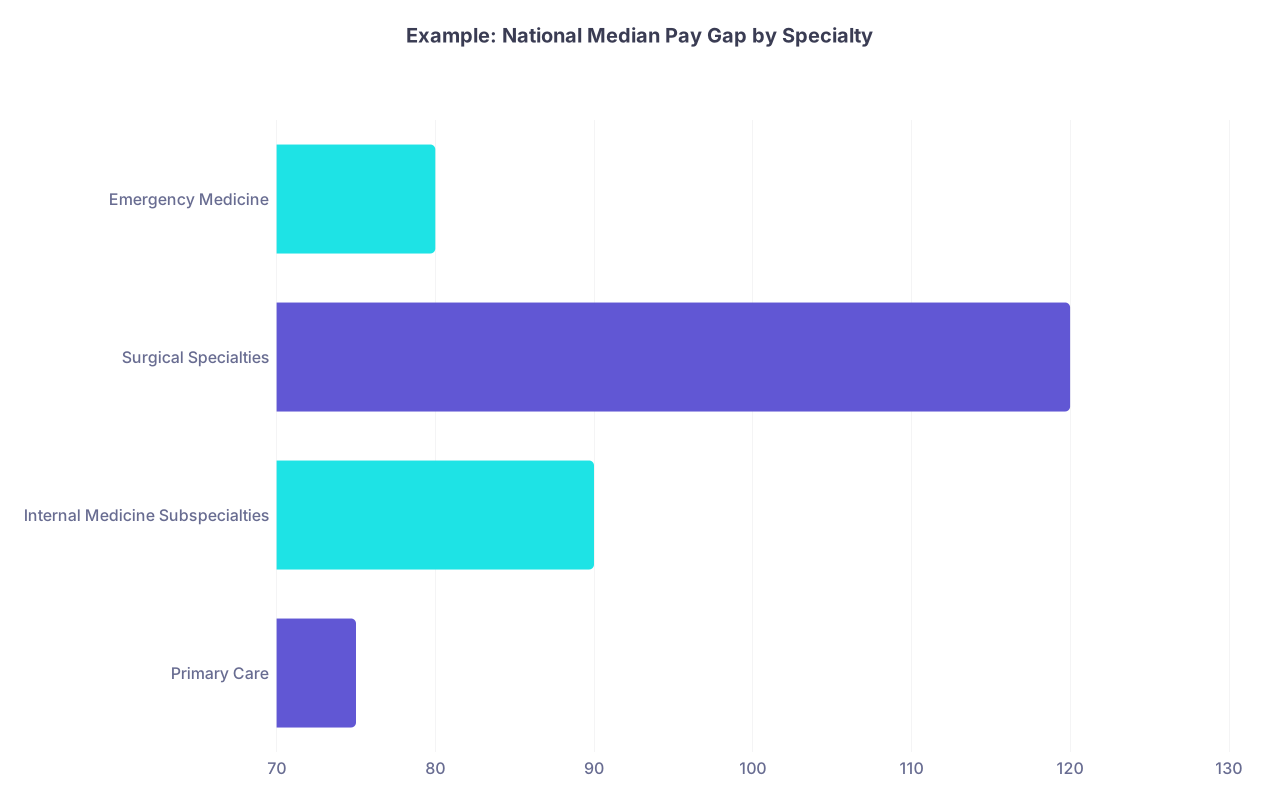
| Category | Value |
|---|---|
| Primary Care | 75 |
| Internal Medicine Subspecialties | 90 |
| Surgical Specialties | 120 |
| Emergency Medicine | 80 |
(Think of these as hypothetical gaps in thousands between men and women—because the real numbers look painfully similar.)
If your total compensation is:
- Below the 25th percentile for your profile → yellow flag
- Far below and your performance is decent → red flag
But you still haven’t answered the core question: “Compared to men like me, here?” That’s next.
Step 3: Understand Your Own Compensation Formula (Cold)
Most physicians don’t truly understand how their pay is calculated. That’s a mistake.
Pull:
- Your employment contract
- Any bonus/RVU policy document
- Recent productivity reports (RVUs, wRVU rate, collections, panel size, etc.)
- Last 2–3 years of W-2s or pay summaries
Then answer these questions, in writing:
- What is my base salary?
- Am I wRVU-based, collections-based, salary-only, or hybrid?
- If RVU-based:
- What is my wRVU rate (dollars per wRVU)?
- What is my RVU target for “at plan”?
- How is my bonus calculated? Thresholds? Tiers?
- Do I get:
- Call pay?
- Extra pay for extra shifts?
- Stipends for leadership/teaching?
- How many FTE am I officially? (Plenty of women are “0.8 on paper, 1.0 in reality.”)
If you can’t describe your compensation model to a co-resident in two minutes, you’re operating blind—and that’s exactly how systems let inequities hide.
Step 4: Start Building Internal Comparison Data (Without Being Reckless)
Now the part that feels awkward: figuring out what your male colleagues actually make.
You’ve got several tools—some subtle, some blunt.
1. Direct conversations with trusted peers
This is hands down the most powerful.
Use this framing:
“I’m trying to understand whether my compensation is fair. Would you be comfortable ballpark-sharing your base and RVU rate so I can see if I’m in range? I’m happy to share mine too.”
Key people:
- Same specialty, similar years in practice
- Men and women (you need both)
- People you trust not to run to leadership in a panic
I’ve seen this happen in a group text where three women compared numbers…and realized all three were tens of thousands below the lowest-paid man with similar experience. That’s the kind of pattern you’re looking for.
2. Look at structural tells
You may not get exact salaries, but you can see:
- Who gets the high-paying procedures
- Who gets block time in the OR or cath lab
- Who gets clinic templates loaded with new patients vs follow-ups
- Who’s doing unpaid admin vs paid director roles
If men get more revenue-generating opportunities and women get more “good citizen” work, that’s compensation—just hidden.
3. Use formal channels where possible
Some institutions now perform equity reviews or have pay transparency efforts. Use them.
Ask HR or your chair:
“Do we perform regular gender-based pay equity analyses in our department? If so, have there been findings or adjustments in my specialty?”
If they dodge or say “we don’t track that,” that’s revealing by itself.
Step 5: Make Apples-to-Apples Comparisons
Once you’ve got some data, compare like a surgeon—not sloppily.
You’re looking for women-vs-men differences after controlling for:
- Years in practice
- FTE status
- Specialty and subspecialty
- Leadership roles
- Call burden
- RVU or workload
A practical approach:
Pick 2–3 male colleagues similar to you.
Compare:
- Base salary
- Incentive structure (RVU rate, thresholds)
- Actual annual bonus
- Call/shift pay
Then sanity-check against productivity:
- Are you generating similar or more RVUs but earning less total?
- Are you at or above target but still at a lower tier or base?
| Item | You (F) | Male Colleague A |
|---|---|---|
| Years in practice | 4 | 4 |
| FTE | 1.0 | 1.0 |
| Base salary | 245k | 280k |
| wRVU/year | 6,000 | 5,800 |
| wRVU rate ($/wRVU) | 45 | 52 |
| Annual bonus | 20k | 40k |
In this (very common) kind of scenario, yes—you’re being paid less than a comparable male colleague, and the data is blunt about it.
Step 6: Watch for the “Structural” Pay-Gap Traps
Sometimes the gap isn’t in the rate, it’s in the setup.
Common patterns I see for women physicians:
- Lower starting offers out of training (“you’re coming back to the area, so we assumed you’d want to be here”)
- Longer delays before promotion to associate/full professor → locked in lower salary bands
- Under-credited prior experience (fellowship, prior positions)
- More non-RVU work (teaching, mentoring, committees) with zero compensation
- Worse clinical schedules: fewer late clinics means fewer new patients, fewer procedures
- “Part-time” labels that don’t reflect reality
Example: You’re 0.9 FTE on paper but regularly covering like a full FTE, so your “lower salary” gets excused as part-time.
These are all pay-gap mechanisms, just less obvious than “Bob makes 40K more.”
Step 7: How to Raise the Issue Without Nuking Relationships
Once you’ve got evidence, you don’t sit on it forever. But you also don’t storm into your chair’s office accusing everyone of sexism. You present it like a quality issue: clear, data-driven, and solvable.
Prep a short, tight summary:
- Your current compensation details
- Your productivity and contributions
- External benchmarks (MGMA/AAMC)
- Internal comparisons (carefully anonymized if needed)
Then ask for a meeting with whoever actually controls your pay: division chief, department chair, or practice CEO.
Your script can sound like this:
“I’ve spent some time understanding my compensation and comparing it to both national benchmarks and local colleagues at similar levels. Based on MGMA data and what I know about my productivity and responsibilities, I appear to be significantly below market and below some male peers with similar profiles.
I want to approach this constructively: I’m asking for a review of my compensation structure and for a plan to bring me to a fair, market-consistent level.”
Avoid three traps:
- Don’t center it only on “I found out X makes more.” Use them as context, not your main argument.
- Don’t minimize it as “maybe I’m overreacting.” You did the homework. Own that.
- Don’t leave without a timeline: “When can we revisit this?” “What specific steps will happen next?”

| Step | Description |
|---|---|
| Step 1 | Gather Data |
| Step 2 | Analyze Benchmarks |
| Step 3 | Identify Gaps |
| Step 4 | Prepare Summary |
| Step 5 | Meet With Leader |
| Step 6 | Negotiate Adjustments |
| Step 7 | Escalate or Plan Exit |
| Step 8 | Response |
If leadership is defensive or dismissive (“We don’t compare pay between physicians”), that’s not a neutral answer. That’s an answer.
Step 8: Decide How Far You’re Willing to Push
You have options, but they’re not all equally pleasant.
Reasonable escalation steps:
Internal equity review
Ask specifically: “Can HR perform a gender pay equity review for our department?” Some systems are legally obligated to care when you phrase it that way.Use institutional resources
- Office of Faculty Affairs (academics)
- Office of Diversity, Equity, and Inclusion
- Ombuds or confidential advisors
Document everything
Dates of discussions, emails, summaries of meetings. If things get ugly, this matters.External legal advice
If the disparities are large, clearly gender-based, and leadership ignores you, a consult with an employment attorney who knows healthcare is not overkill. Don’t threaten lawsuits in meetings. Just quietly get informed.Plan your exit
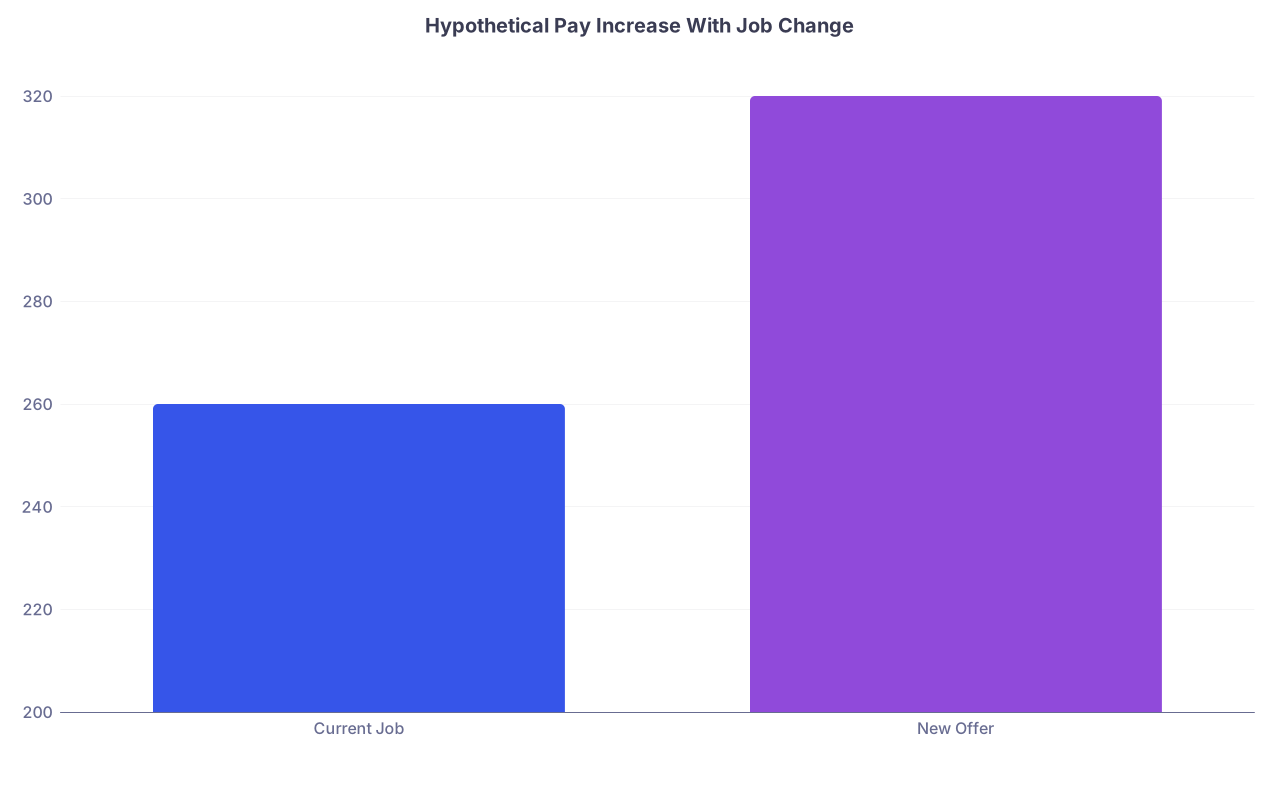
Sometimes the clearest validation you’re underpaid is how quickly another employer offers you 50–100K more. I’ve seen that happen over and over.
| Category | Value |
|---|---|
| Current Job | 260 |
| New Offer | 320 |
Step 9: Protect Yourself Long-Term: Negotiate Like It Matters (Because It Does)
Even if you’re stuck in a bad structure now, you can stop future damage.
Key moves:
- Always know the market range before signing or renewing.
- Don’t accept “this is the standard contract” as final. In medicine, that’s usually a lie of laziness.
- Aggressively clarify:
- RVU targets
- RVU rates
- Minimum base guarantees
- Time to promotion or compensation review
- Put everything in writing. Verbal promises vanish.
And don’t fall for the soft-guilt plays: “We’re all a family here,” “We’re mission-driven,” “We just want people who are here for the right reasons.” Mission doesn’t pay your loans or retirement. Men rarely get shamed for asking for market pay. You shouldn’t either.
FAQs
1. Is there really a gender pay gap in medicine, or is it just productivity?
There’s a real gap. Even after adjusting for specialty, hours worked, experience, and productivity, women physicians still earn less on average. Some of that is productivity-linked (because women get fewer high-RVU opportunities), but multiple large studies show an unexplained residual gap. So no, it’s not just “you’re slower” or “you work less.”
2. What if my male colleagues won’t share their salaries?
Then you:
- Use national benchmarks more heavily
- Ask about RVU rates, call pay, and structures instead of exact totals
- Look for any colleagues—male or female—who are willing to be transparent (often younger docs are more open)
- Consider approaching it as a group: “Can we talk about how our comp is structured across the board to see if it’s consistent?”
You don’t need perfect data to see a problem. You just need enough.
3. How big does the pay gap need to be before I take it seriously?
If you’re 5–10K off from a colleague with slightly different responsibilities, that’s noise. If you’re 30–100K below comparable men year after year, that’s not noise—that’s your kids’ college fund and your retirement. As a rule of thumb, if you’re consistently below 80–85% of what comparable male colleagues make, I’d call that a serious issue.
4. Can I get in trouble for asking about pay equity?
You can get political blowback in a dysfunctional environment, yes. But in many jurisdictions, employers cannot legally prohibit employees from discussing wages. You can reduce risk by being professional, data-driven, and framing it as equity and market alignment, not an attack. If retaliation happens (sudden schedule changes, exclusion, threats), that’s exactly the kind of thing employment lawyers and regulators care about.
5. What if I find a gap but my institution offers only a tiny “adjustment”?
Then they’ve told you who they are. You can either accept a small bump as a bridge while you quietly search for a better offer, or you can push harder with more data and possibly legal backup. But don’t let them gaslight you that a token 5K increase fixes a 60K gap. It doesn’t. Do the math and decide if sticking around is worth the compounded loss.
Today’s next step is simple: pull your last contract and your most recent productivity or compensation statement. Sit down for 15 minutes and write out, in plain language, exactly how you’re paid and what your RVU rate or base is. Until you can explain your own compensation clearly, you can’t tell if it’s fair.