
You just walked out of a patient room. Or the OR. Or the team room.
Someone made a comment that landed exactly wrong: “Are you the nurse or the doctor?” said with a smirk. “We’ll let the pretty one present.” “Calm down, you’re being emotional.” Or the attending consistently calls you “sweetie” and all the male students “doctor.”
Your heart rate’s up, your charting is derailed, and one question is looping in your head:
Do I let this go, or do I escalate it?
You’re not confused about whether it was sexist. You’re trying to decide: Is it “worth” the fallout, the time, the political cost?
Let’s walk through a clear, practical way to make that decision, grounded in medicine, not theory.
Step 1: Name What Actually Happened
Start by taking 60 seconds (literally) to get specific. Vague experiences are hard to act on.
Write down or mentally list:
- Who did what or said what?
- Where? (patient room, OR, team room, in front of whom)
- How often has this type of thing happened with this person?
- How did it affect you in the moment? (froze, cried after, couldn’t speak up in front of patient, etc.)
You are not building a legal brief. You’re getting clarity.
Some examples:
- “Attending, on rounds with 2 residents and 3 students: ‘The guys can go see the interesting case; ladies stay here and finish notes.’ Everyone laughed awkwardly. I felt humiliated and sidelined.”
- “Patient’s husband to me (female intern): ‘We want the real doctor, not the little girl.’ Attending said nothing. I finished the exam but felt undermined.”
Two reasons this detail work matters:
- It helps you distinguish between “annoying but minor” and “pattern or significant harm.”
- If you do escalate, you already have a contemporaneous record.
Step 2: Shift the Question You’re Asking
The question, “Is this worth escalating?” sounds neutral. It isn’t.
What you’re usually actually asking is:
- “Is this worth risking my evals, my relationships, my reputation as ‘easy to work with’?”
- “Will I be seen as overreacting?”
- “Will this follow me?”
So I want you to reframe the decision into three more useful questions:
- What is the impact on me, my learning, or patient care?
- What is the pattern — one-off or recurring?
- What is my goal if I escalate?
If you cannot answer #3 (“What outcome do I actually want?”), you’re not ready to escalate yet. You’d just be lobbing a grenade and hoping something good happens.
Step 3: Use a Simple Triage Framework
Think of this like triaging a consult, not philosophizing about gender equity.
Here’s a straightforward, non-theoretical way to sort incidents.
| Level | Description | Typical Response |
|---|---|---|
| Green | Annoying, isolated, low impact | Consider letting go or brief boundary-setting |
| Yellow | Repeated, undermining, affects learning or authority | Document, seek advice, possibly local escalation |
| Red | Severe, abusive, retaliatory, or tied to patient harm | Document in detail, formal report or institutional escalation |
Green: Irritating but low long-term impact
Examples:
- Single off-color “joke” from someone who immediately looks embarrassed.
- Older patient calls you “nurse” repeatedly but accepts correction.
- Colleague interrupts you once, then backs off when you say, “Let me finish my thought.”
Question to ask:
Did this really change anything about my safety, learning, evaluations, or patient care?
If honest answer is no, and there’s no pattern with this person, it may be reasonable to:
- Note it mentally as data.
- Make a brief boundary-setting comment next time.
- Then move on.
That is not “letting sexism win.” That’s conserving energy for bigger fights.
Yellow: Pattern or clear undermining
Examples:
- Same attending repeatedly calling female trainees by first name and males “doctor.”
- Being consistently left out of procedures with gendered excuses (“the guys can handle the heavy lifting”).
- Evaluations implying you are “abrasive” or “difficult” only after you set a boundary with a sexist colleague.
Questions to ask:
- Is this interfering with my education or my ability to function as a physician?
- Is this a pattern, not a one-off?
- Are others impacted too (multiple women, nurses, etc.)?
Yellow usually is worth some escalation — but “escalation” here can be very local and strategic, not nuclear.
Red: Serious, abusive, or tied to safety
Examples:
- Explicit harassment, sexual comments, “quid pro quo” behavior.
- Retaliation after raising a concern.
- Sexist dynamic that directly undermines patient care (e.g., attending refusing to listen to female resident’s concern about a crashing patient, but immediately responding when a male colleague repeats it).
Questions to ask:
- Do I feel unsafe or targeted?
- Would I tell a mentee, “You must report this if it happens to you”?
- Does this meet Title IX / HR policy definitions of harassment or discrimination?
Red-level incidents are not about “is it worth it.” They are about “how do I escalate in the safest, most supported way.”
Step 4: Run a Quick Risk–Benefit Analysis (Realistically)
This is where most people get stuck, so let’s be blunt.
You’re weighing:
Potential benefits of escalation:
- Behavior stops (for you and others).
- Documentation exists if pattern continues.
- Leadership actually gets data they need to act.
- You feel less complicit and less resentful.
Potential costs:
- Time and emotional energy.
- Being labeled “difficult” in the short term.
- Subtle retaliation (fewer opportunities, cooler tone on rounds).
- “He’s a great surgeon, are you sure?” gaslighting.
Now, instead of catastrophizing, rate the risk and benefit for this situation on a 1–5 scale in your head.
Then ask:
- Benefit score ≥ 4 and risk ≤ 3? Lean toward escalating.
- Benefit score ≤ 2 and risk ≥ 4? Probably not worth a formal path; consider informal options.
- Both high? (Benefit 4–5, risk 4–5) → Yellow/red. That’s when strategy and allies really matter.
Step 5: Choose Your Level of Escalation
Escalation is not binary. You have a ladder. You can step off at any rung.
Here’s what that ladder can look like:

| Step | Description |
|---|---|
| Step 1 | Incident occurs |
| Step 2 | Do nothing or self boundary |
| Step 3 | Informal conversation or mentor consult |
| Step 4 | Formal report if needed |
| Step 5 | Escalate to chief resident or clerkship director |
| Step 6 | Level Green Yellow or Red |
Option 1: Internal-only (no escalation)
You:
- Journal the incident (date, names, exact phrases).
- Talk it through with a trusted friend or mentor for emotional processing.
- Decide: “I’m not taking further action right now.”
This is valid. Especially for true “green” incidents. Not every microaggression requires you to become a one-person DEI task force.
Option 2: Direct, in-the-moment boundary (micro-escalation)
You address it with the person, calmly, with one sentence.
Examples:
- To a colleague: “I prefer ‘doctor’ like everyone else on the team.”
- To an attending: “When you call the men ‘doctor’ and me ‘sweetie,’ it makes it harder for me to be taken seriously by patients.”
- To a patient: “I’m the physician taking care of you today. The nurse will be in shortly.”
Does this always fix it? Of course not. But it:
- Gives the person a chance to correct.
- Shows bystanders what you consider acceptable.
- Creates a clear line if you later escalate: “I addressed it directly on [date], and it continued.”
Option 3: Quiet consult with a mentor or peer
Before you go to leadership, talk to someone who:
- Knows your institution’s culture.
- Is not in your direct evaluation chain.
- Has shown they care about equity more than PR.
Ask very specific questions:
- “Has this person had complaints before?”
- “What actually happens if I report to HR here?”
- “How have other residents handled similar situations?”
This is where you calibrate your risk–benefit estimate with reality.

Option 4: Local escalation (within the program)
Targets:
- Chief resident
- Clerkship director
- Program director
- Site director
Approach:
- Use concrete language: dates, quotes, impact on your learning and on patients.
- State your ask: “I want this documented,” or “I want him to stop doing X,” or “I want to be off this rotation if possible.”
Avoid:
- Vague emotional summaries like “He’s just really sexist.”
Lead with facts, then add impact.
Option 5: Institutional escalation (HR, Title IX, ombudsperson)
This is for red-level incidents or yellow-pattern behavior that hasn’t stopped with local efforts.
You’ll need:
- Names, dates, and specifics.
- Any witnesses.
- Any prior attempts to resolve.
Real talk: Institutions will often move slowly and prioritize liability. Do not expect catharsis. But formal documentation:
- Protects you and others long-term.
- Creates a record if the behavior escalates.
- Forces the institution to own the problem, not just you.
Step 6: Consider the “Silent Cost” of Doing Nothing
People overestimate the cost of rocking the boat and underestimate the cost of endlessly absorbing it.
Costs of never escalating:
- Internalized self-blame: “Maybe I am oversensitive.”
- Burnout and cynicism.
- Avoiding certain rotations, attendings, or teams (which absolutely affects your career).
- Reinforcing to bystanders that this is “normal here.”
So when you think, “Is it worth it?” include this in the equation:
If I do nothing, what does this train me to tolerate in my career?
I’ve watched too many brilliant women stay silent for years, then wake up as attendings who can no longer tell where their boundaries are. You don’t need to fight every battle, but you do need to fight some.
Step 7: Pick One Concrete Goal for This Incident
Decision fatigue comes from fuzzy goals.
For this incident, choose just one primary goal:
- I want this specific behavior to stop.
- I want to protect my evaluations and get through the month with as little damage as possible.
- I want it documented in the system, even if nothing dramatic happens now.
- I want to model to junior trainees that this is not okay here.
- I want to protect patient care from gendered sabotage.
Then ask:
What is the smallest step toward that goal that I’m willing to take this week?
That’s your answer to “Is it worth escalating?” at a practical level.
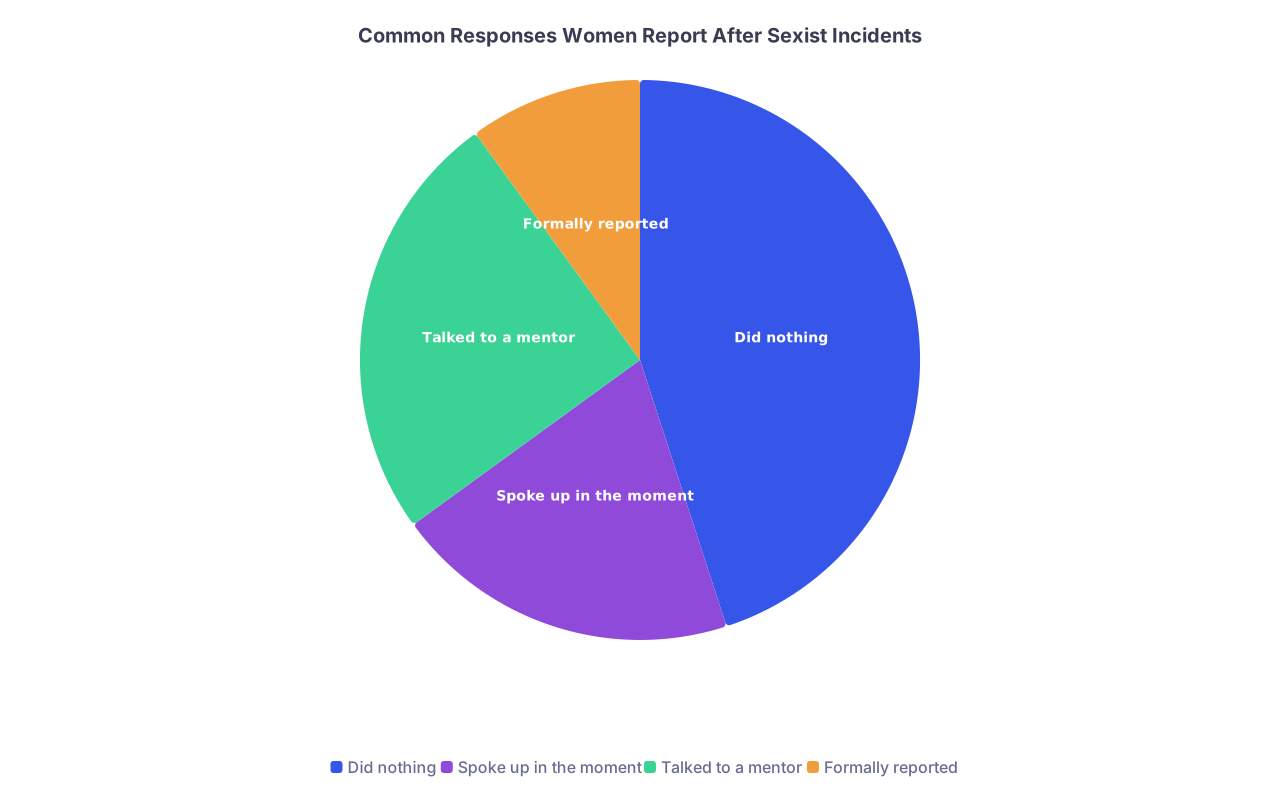
| Category | Value |
|---|---|
| Did nothing | 45 |
| Spoke up in the moment | 20 |
| Talked to a mentor | 25 |
| Formally reported | 10 |
Step 8: Protect Yourself While You Decide
A few tactical moves you can make immediately, even if you’re undecided:
Start a private log
Date, time, who, what was said, witnesses, your response, impact. Keep it off work email.Screenshot or save anything written
Texts, emails, notes in the EMR that show differential treatment.Identify at least one ally on the team
Sometimes a quiet, “Did you hear that too?” after rounds both validates your experience and builds witness support if you escalate later.Use “we” language strategically
When talking to leadership: “Several of us have noticed…” That does not mean you have to produce names, but it reminds them you’re likely not an outlier.

Quick Decision Tool You Can Use Tonight
Here’s a 5-question lightning round. Answer yes/no:
- Has this happened 2+ times with the same person or on the same rotation?
- Did it clearly undermine your authority, learning, or patient care?
- Would you be upset if this happened to a junior you care about?
- Do you have at least 1 person you could safely talk to about it?
- Are you still thinking about it 24+ hours later?
If you answered yes to 3 or more: it’s probably worth at least some escalation (even if that’s just talking to a mentor or documenting).
If yes to 1 and 2 and 3: I’d strongly lean toward yellow/red-level response, not silence.
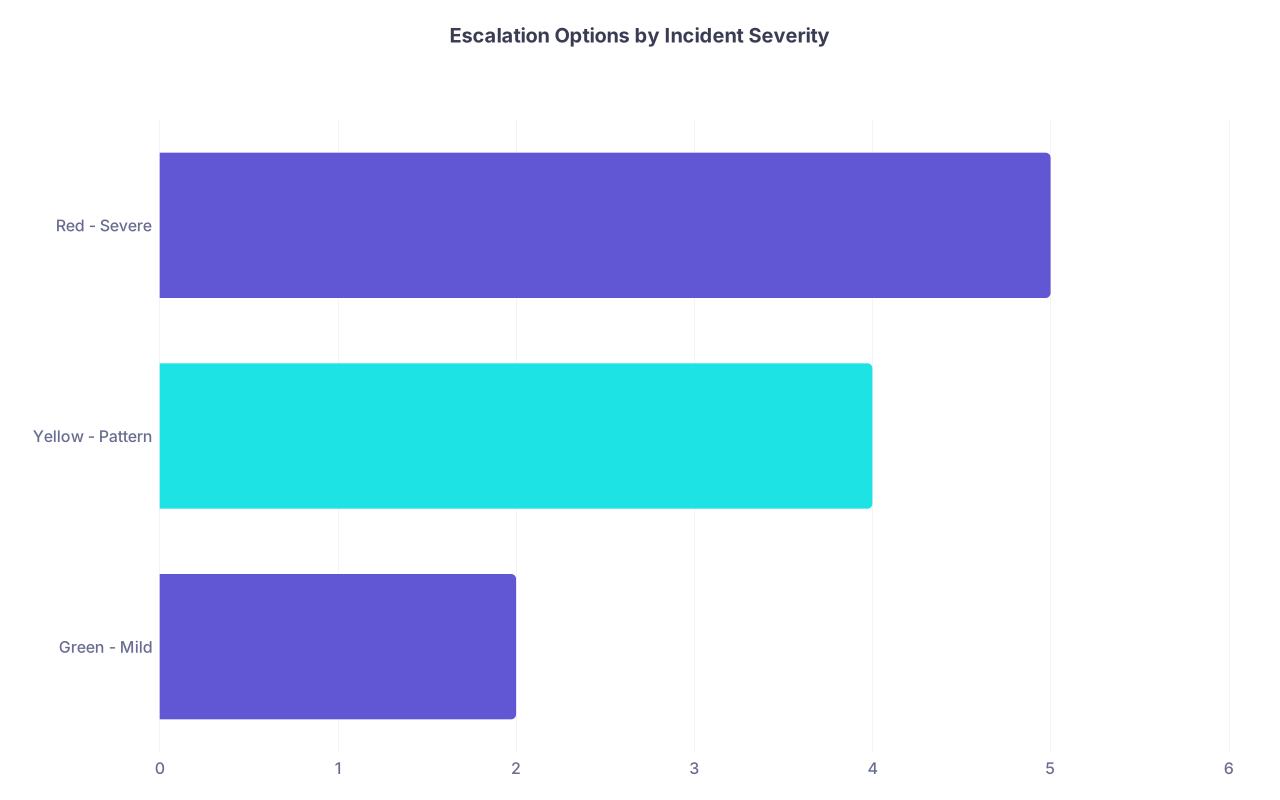
| Category | Value |
|---|---|
| Green - Mild | 2 |
| Yellow - Pattern | 4 |
| Red - Severe | 5 |
(Scale here is how likely I am, as someone who has watched this play out, to recommend formal action.)
FAQs
1. What if I’m not 100% sure it was sexist and not just someone being a jerk?
You do not need 100% certainty to respond. Ask: “Would this have happened the same way if I were a man?” If the honest answer is probably not, you’re dealing with gendered behavior. You can still calibrate your response based on severity. For borderline cases, a light in-the-moment boundary (“I’m not comfortable with that comment”) can both test the waters and give you more data about their intent.
2. Am I obligated to escalate for the sake of other women?
No. You are not HR. You are not the institution’s conscience. You’re a human in a power-imbalanced system trying to survive and grow. Yes, there’s a moral pull to protect those coming after you. But martyrdom is not a requirement for being a good woman in medicine. You can prioritize your safety on some rotations and choose to escalate on others when you have more support or capital.
3. How do I handle sexist patients without hurting my evals?
Two tracks: Clinical and evaluative. Clinically, maintain professionalism: “I’m the physician taking care of you; our team is here to provide the best care.” If they refuse care specifically because you’re a woman, loop in your attending and follow institutional policies. Evaluatively, document the interaction briefly in the chart if appropriate and tell your senior/attending: “The husband refused to speak to me because he wanted a male doctor.” You want witnesses and context in case your “patient satisfaction” image takes a hit.
4. What if the sexist person is writing my letters or holding my career in their hands?
Then your strategy must be colder and longer-term. Often that means:
- Documenting quietly now.
- Seeking other strong letter writers so you’re not dependent on them.
- Talking to a mentor outside their sphere of influence.
- Sometimes waiting until you’re off their rotation to report patterns, especially if there’s no immediate safety issue.
You are allowed to play the long game. That’s not cowardice; it’s survival in a hierarchical system.
5. How do I deal with the emotional fallout when I choose not to escalate?
Name it directly: “I am choosing not to escalate right now for these reasons.” That’s different from “I’m too weak to do anything.” Then give that anger somewhere to go: journal, therapy, peer debriefs, future advocacy work. What burns people out is the story that they’re complicit or crazy, not the single incident. Reframe: “I’m making a strategic choice for myself today. I’m not signing a lifelong contract to stay silent.”
6. I escalated before and nothing happened. Why bother again?
Because patterns in institutions change slowly, and each report adds weight. But you’re right: it’s demoralizing when nothing seems to happen. If that’s your experience, adjust your goal. Maybe you’re no longer escalating with the fantasy of a dramatic firing. Maybe your new goal is: “I want this in writing in case there’s a lawsuit later,” or “I want leadership unable to claim ignorance.” And you might shift your efforts toward finding or building a better environment for yourself, rather than fixing a rotten one alone.
Action step for today:
Think back to one sexist incident in the last 3 months that’s still bothering you. Write down exactly what happened, who was there, and how it affected you. Then decide one thing: Will you keep it as documentation only, set a boundary next time, or talk to one specific person about it this week? Pick your move and put it on your calendar.