
It’s 9:30 pm after a brutal call. You’re standing in a half-empty workroom, staring at your screen, replaying the day. The attending who “joked” about you being too pretty to be a surgeon. The patient who asked, again, when the “real doctor” would be in. The male co-resident who interrupted you in front of the whole team, then repeated your plan like it was his idea.
You’re asking yourself the right question:
Is this just a tough day in medicine… or is this a toxic environment for women?
Here’s the answer you’re looking for.
1. Core Red Flags: When Your Gut Starts Yelling “This Is Not Normal”
Let’s call things what they are. Not every uncomfortable moment means the place is toxic. But certain patterns are giant red flashing signs.
Red Flag #1: Disrespect Disguised as “Jokes”
If you keep hearing:
- “We need more eye candy on rounds.”
- “You’re too emotional for this specialty.”
- “You’ll change your mind about fellowship once you have kids.”
That’s not “dark humor.” That’s gender bias.
Key signals:
- Comments about your looks, clothes, or body that wouldn’t be said to a male colleague.
- “Teasing” that always punches down: about pregnancy, fertility, age, or relationship status.
- Leadership hand-waving your concerns with, “Oh, that’s just how he is.”
If people minimize clearly sexist comments instead of shutting them down, that’s a toxic norm.
Red Flag #2: Different Rules for Women vs. Men
Watch how expectations shift depending on who you are.
Examples I’ve seen over and over:
- Women get labeled “abrasive” or “aggressive” for the same communication that gets men praised as “strong leaders.”
- A male resident who’s late is “overworked.” A female resident who’s late is “disorganized.”
- Women are expected to take on extra “helper” roles: planning parties, mentoring every student, being the “team mom,” smoothing over conflicts.
If feedback you get is about your “personality” instead of your performance, while men get specific, actionable feedback—that’s a bias pattern, not a you problem.
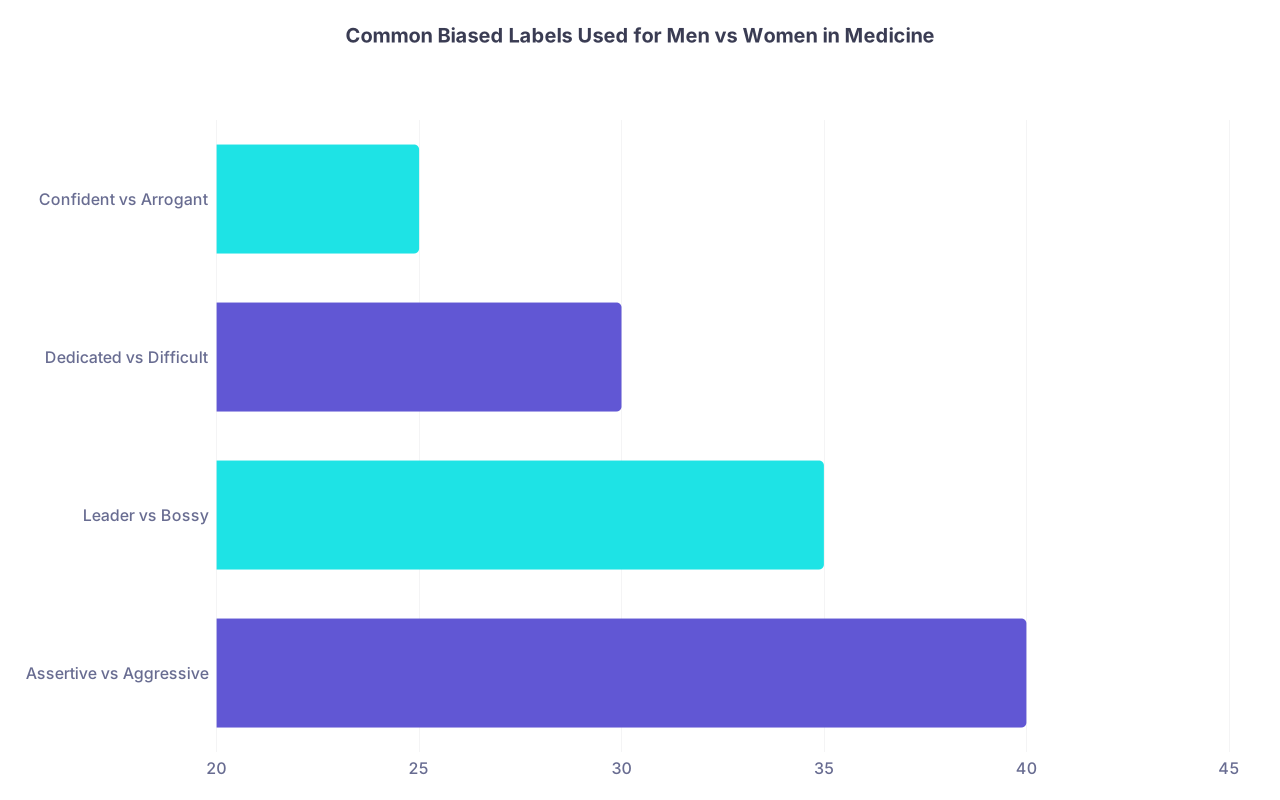
| Category | Value |
|---|---|
| Assertive vs Aggressive | 40 |
| Leader vs Bossy | 35 |
| Dedicated vs Difficult | 30 |
| Confident vs Arrogant | 25 |
2. Structural Red Flags: It’s Not Just People, It’s the System
You don’t just evaluate individuals. You evaluate the culture and the structure they create.
Red Flag #3: No Women in Real Power
Look at who actually makes decisions:
- Department chair
- Program director
- Promotions and awards committees
- Scheduling or call assignment leads
If women are everywhere in the brochure but absent in leadership, the message is clear: You’re welcome to work here, but not to lead here.
Extra bad signs:
- One senior woman is paraded around constantly (“We have Dr. X, she’s proof we’re supportive”) but she’s overworked, burned out, or checked out.
- Women in leadership have no real authority—every decision still goes through a man.
| Area | Healthy Sign | Red Flag Sign |
|---|---|---|
| Department Leadership | Mixed-gender leadership | All or almost all male |
| Program Leadership | Women as PD/APDs with authority | Women only in coordinator roles |
| Committees | Diverse mix of voices | Same 3-4 older men on every committee |
| Public Recognition | Both men and women showcased | Token woman highlighted repeatedly |
Red Flag #4: The “Mom Track” Is Real and Punitive
Watch what happens to women who:
- Get pregnant
- Take FMLA
- Request pumping time
- Work part-time or ask for flexible scheduling
Toxic environments do things like:
- Punish or “forget” about promotion for anyone who takes parental leave.
- Make snide comments about “commitment” if you have kids.
- Schedule important meetings or conferences at times that obviously conflict with childcare (very early mornings, late evenings) and then never offer alternatives.
- Treat breastfeeding as an inconvenience instead of a legal right.
Non-toxic environments do the opposite: they plan, they accommodate, and they don’t make you beg.

| Step | Description |
|---|---|
| Step 1 | Announces Pregnancy |
| Step 2 | Discuss Leave and Coverage |
| Step 3 | Comments About Commitment |
| Step 4 | Return With Normal Trajectory |
| Step 5 | Delayed Promotion |
| Step 6 | Considers Leaving Program |
| Step 7 | Supportive Response |
3. Day-to-Day Culture Red Flags: The Stuff You Feel on Rounds
A lot of people overlook these because “no one screamed at me.” That’s a low bar.
Red Flag #5: Your Voice Is Systematically Ignored
Patterns to watch:
- You present a plan, no response; male colleague repeats it, suddenly it’s “a great idea.”
- You’re frequently interrupted; men are allowed to finish.
- In multi-disciplinary rounds, nurses and women residents are talked over or talked around.
This wears you down. It also directly harms your learning and career growth.
Practical check:
- Over a week, tally in your notes: how many times you’re interrupted vs allowed to finish vs ignored. Patterns are revealing.
Red Flag #6: Your Safety Is Treated as Optional
This one’s non-negotiable.
Red flags:
- You report a patient or staff member’s harassment or stalking behavior; people minimize it or don’t change your assignment.
- You’re sent alone at night to unsafe areas of the hospital or parking structures despite previous incidents.
- No clear mechanism to report sexual harassment that feels confidential and real.
- People tell you not to “rock the boat” if you bring up a boundary issue with a powerful attending.
If your physical or psychological safety is seen as “your problem” to manage, that’s a toxic environment.

4. Feedback, Evaluations, and “Professionalism” Used as Weapons
You can tell a lot about a culture by how it evaluates people.
Red Flag #7: Gendered Feedback in Evaluations
Look at direct quotes (you should be doing this):
- Women: “Can be abrasive,” “needs to be more likable,” “comes across as intense,” “should smile more.”
- Men: “Strong advocate,” “assertive,” “takes charge,” “shows leadership potential.”
If your professionalism comments are about tone while his are about content and competence, that’s bias.
Watch for:
- One-off low evaluations after you set a boundary, declined a date, or refused to laugh at a sexist joke.
- Attendings who always seem to “misinterpret” women’s boundaries as “not a team player.”
Serious red flag: your program knows this happens (you’re not the first to say it) and still assigns you repeatedly to those same evaluators.
Red Flag #8: Professionalism as a One-Way Street
You see:
- Staff yelling at nurses = “stress.”
- Men cursing, slamming charts, storming out of rooms = “just passionate.”
- A woman raises her voice once after months of mistreatment = instant professionalism committee meeting.
If “professionalism” is enforced mainly against women, nurses, and trainees—and rarely against powerful men—that’s not professionalism. That’s control.
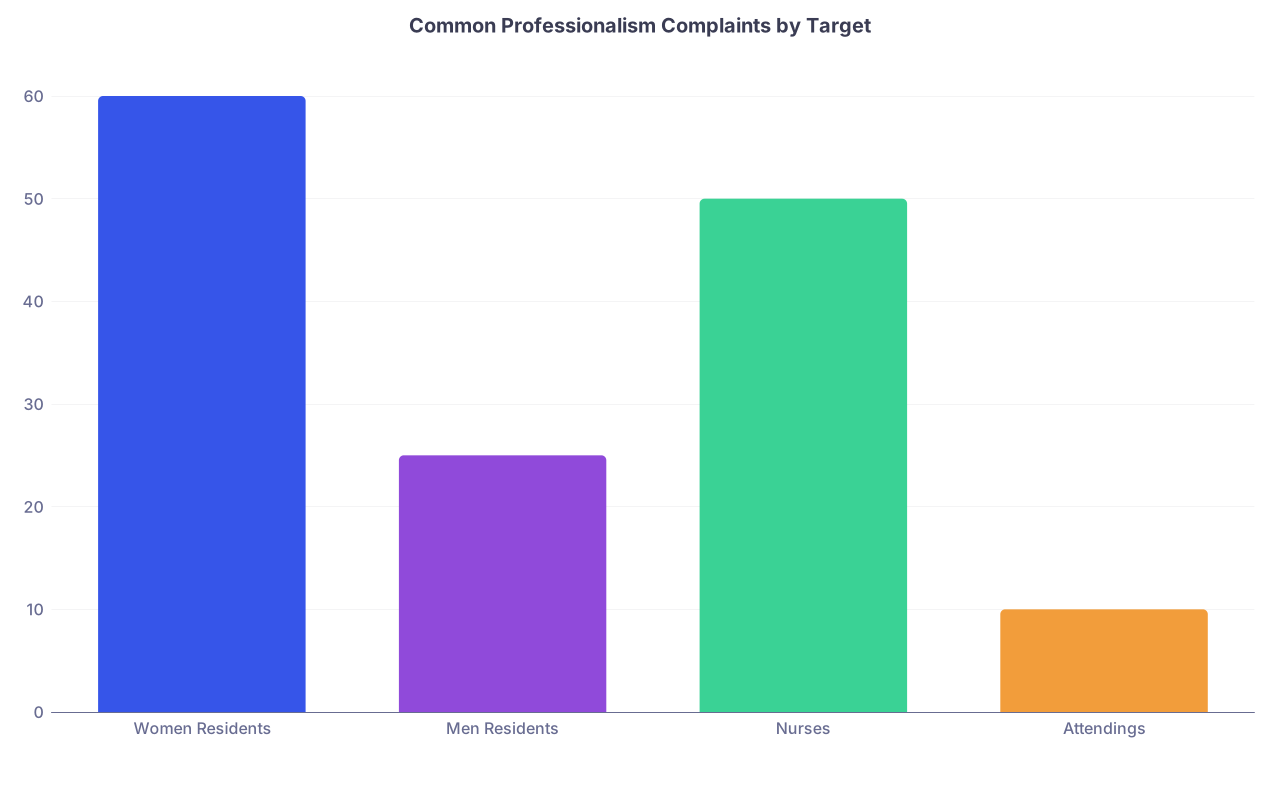
| Category | Value |
|---|---|
| Women Residents | 60 |
| Men Residents | 25 |
| Nurses | 50 |
| Attendings | 10 |
5. Reporting and Response: How the System Reacts When You Speak Up
The single strongest predictor of a toxic environment isn’t that bad things happen. It’s that nothing changes when they’re reported.
Red Flag #9: “We Take This Very Seriously” – Then Nothing Happens
Watch the sequence after a complaint:
- You report discrimination or harassment.
- They say all the right legal words.
- Time passes.
- The harasser stays in power, you get quietly removed from teams/rotations, or nothing visibly changes.
Specific ugly patterns:
- You’re warned informally that “this might follow you” if you escalate.
- You’re advised to “think about your career” before filing something formal.
- Multiple women give you a knowing look and say, “Yeah, we all went through that with him.”
If there’s a well-known “creepy attending” or “problem surgeon” and leadership’s response is essentially institutional shoulder-shrugging, that’s a fully toxic culture.
Red Flag #10: People Who Try to Fix Things Get Punished
Watch what happens to:
- The resident who raises issues about gender equity.
- The nurse who files a grievance about a physician’s behavior.
- The junior faculty member who calls out pay inequity.
If they’re suddenly:
- Labeled “difficult” or “not a team player”
- Passed over for opportunities
- Left off projects or committees without explanation
You’re not just in a bad environment. You’re in a retaliatory one.

6. How to Reality-Check: Is It Me or Is It Toxic?
You’ll eventually ask, “Maybe I’m just too sensitive? Maybe I’m the problem?” Classic gaslighting effect. Let’s cut through that.
Quick Reality Check Framework
Ask yourself:
- Is this a single person or a pervasive pattern?
- Do other women (and often nurses) independently describe the same issues?
- When concerns are raised, do things improve or just get buried?
- Are the women ahead of you thriving… or just surviving?
If three or more of these are pointing in the wrong direction, you’re not imagining it.
Talk to:
- Women 2–3 years ahead of you in training. Ask bluntly: “Would you send your daughter or sister here?”
- Nursing leadership. They see everything and usually know which services are toxic.

| Step | Description |
|---|---|
| Step 1 | Noticing Problems |
| Step 2 | Address Directly if Safe |
| Step 3 | Talk to Trusted Women |
| Step 4 | Monitor and Document |
| Step 5 | Assess Safety and Options |
| Step 6 | Engage Allies and Report |
| Step 7 | Plan Exit Strategy |
| Step 8 | Pattern or One Off? |
| Step 9 | Others Confirm? |
| Step 10 | Able to Change? |
7. What You Can Actually Do (Short, Realistic List)
You can’t fix a system overnight, and you shouldn’t destroy yourself trying. But you do have options.
- Document everything. Dates, times, exact quotes, witnesses. Not in your work email.
- Find at least one ally in power (female or male) who’s shown they “get it” and doesn’t just offer platitudes.
- Decide your goal:
- Survive your remaining time with minimal damage?
- Try to improve culture locally?
- Get out as soon as logistically possible?
- Protect your mental health. Therapy, peer support groups, women-in-medicine communities. You are not weak for needing support; you’re sane.
- Remember: leaving a toxic environment is not failure. Staying and slowly eroding is a worse outcome.
FAQ: Red Flags for Women in Medicine
1. How do I tell the difference between a tough program and a toxic one?
Tough programs push you clinically but still respect you. Toxic ones routinely disrespect or endanger you and dismiss concerns when raised. In a tough but healthy place, feedback is specific, fair, and focused on your growth. In a toxic one, it’s personal, inconsistent, and often gendered. Also: in a tough program, residents complain about hours; in a toxic one, they warn you in private about people.
2. What if the environment is mildly sexist but the training is excellent—should I stay?
This becomes a cost–benefit question. Mild, isolated bias with leadership trying to improve is one thing. Chronic sexism that chips away at your confidence—even with good training—can leave long-term scars and push you out of the field early. I’d stay if (a) people in power are actively working to change, and (b) you have mentors who shield and support you. I’d seriously consider leaving if you’re constantly questioning your worth or safety.
3. How early can I spot toxicity when interviewing for jobs or residency?
Earlier than you think, if you stop ignoring small signs. On interview day: who speaks in conferences? Are women residents allowed to disagree in front of attendings? Ask, “What happens when there’s a conflict between a trainee and an attending?” Listen very carefully. If everyone gives polished answers but women residents pull you aside to say “We’ll tell you more later,” that’s data. Also look at call rooms, pumping spaces, and shift schedules—those reflect real priorities.
4. Is it worth reporting harassment if the person is powerful and well-liked?
Legally, yes. Psychologically and professionally, it’s complicated. If you choose to report, document obsessively and find an advocate—GME office, ombudsperson, or trusted senior faculty. You should assume some personal cost and decide if you’re willing to bear it in this environment. Sometimes the best path is: secure a safer position elsewhere, then report on your way out. Not because you “owe” them, but to protect the people coming after you if you have the bandwidth.
5. How can male colleagues tell if they’re in a toxic environment for women?
Simple: ask and then actually listen. Pay attention to who speaks in rounds, whose ideas get credited, who gets stuck with emotional labor. Look for patterns in maternity leave, leadership positions, and “problematic” labels. If multiple women tell you certain attendings or services are unsafe or demoralizing, believe them—especially if you’ve never personally seen it. Your job isn’t to “save” anyone; it’s to stop being a passive beneficiary of a rigged system.
6. What if I can’t leave right now—how do I protect myself while staying?
Then your goal is damage control. Build a small circle of people who see you clearly and can give you reality checks. Limit unnecessary exposure to the worst offenders (swap shifts when possible, minimize one-on-one encounters). Keep records of evaluations and any questionable incidents. Focus on skills and experiences that will make you competitive for your next step out. And remind yourself daily: their behavior is an indictment of them, not you.
Key takeaways:
First, repeated disrespect, double standards, and unsafe responses to harassment are not “part of medicine”—they’re red flags of a toxic environment for women.
Second, patterns matter more than isolated events. Look at who gets power, who gets punished, and what happens when women speak up. Then decide, deliberately, whether to push for change, protect yourself while you finish, or get out and find a place that deserves you.